BHIPP Bulletin

Volume 12, Issue 4

October 2026

How Pediatric Primary Care Providers Can Use Motivational Interviewing Strategies to Facilitate Patient Behavior Change

This month's BHIPP Bulletin is a contribution from

Grace McIlmoyle, MPH, MS, Research Project Manager for Maryland BHIPP.

This month, BHIPP is sharing resources related to motivational interviewing in the pediatric primary care office. Motivational interviewing is a "patient-centered, evidence-based technique, used to explore ambivalence and empower individuals towards behavior change."1 Motivational interviewing (MI) was initially developed to help promote behavior change in adults with alcohol use problem but has since been used to address a range of health behaviors, including other substance use, weight management, and vaccine hesitancy.1 Research suggests that MI is a promising approach for reducing adolescent social media use2, and has potential in engaging parents in the pediatric primary care office to address issues, such as family violence or severe corporal punishment.3


Motivational interviewing uses the OARS technique1:

  • Open-ended questions: to encourage patients to provide a narrative of their experiences
  • Affirmations: to recognize the patients' strengths, build confidence, and reinforce positive behaviors
  • Reflections: to rephrase or paraphrase responses and reflect feelings back to the patient
  • Summaries: to bring together the key points and next steps

These principles emphasize empathy, rolling with resistance, reinforcing self-efficacy, and promoting cognitive discrepancy and self-reflection.1 These strategies place the patient in an active role during the question-answer process and allows them to explore their own ambivalence about changing their behaviors. MI can be used by providers to guide patients during difficult conversation topics and emphasizes collaboration, evocation, autonomy, and compassion.4


The American Academy of Pediatrics has several resources about motivational interviewing, including an overview video and a case example in communication strategies:


Additional online resources on motivational interviewing:


Published literature on motivational interviewing:


The BHIPP training library also has links to a prior webinar on Motivational Interviewing: An Introduction to Strategies to Help Facilitate Behavior Change, including the full video recording and links to resources.

As always, if you have questions about the behavioral health needs of your patients, we encourage you to call the BHIPP consultation line at 

855-MD-BHIPP (632-4477), open 9am-5pm Monday-Friday, for resource/referral networking or consultation support.


We will keep you informed about all our services and training events through our website (www.mdbhipp.org) and monthly e-newsletters. Additionally, BHIPP is on LinkedIn, Facebook, and Instagram. We invite you to follow us there to stay up-to-date on upcoming training events, pediatric mental health research, and resources for providers, families and children.

BHIPP Announcements

Don't miss the next session of BHIPP ECHO for Pediatric Primary Care Providers Series in November!

A new BHIPP ECHO for Pediatric Primary Care Providers series returns on November 5th! This series is great for providers who want to improve their knowledge of child mental health and develop skills.

Join our next session of the BHIPP ECHO PMHNP Series!

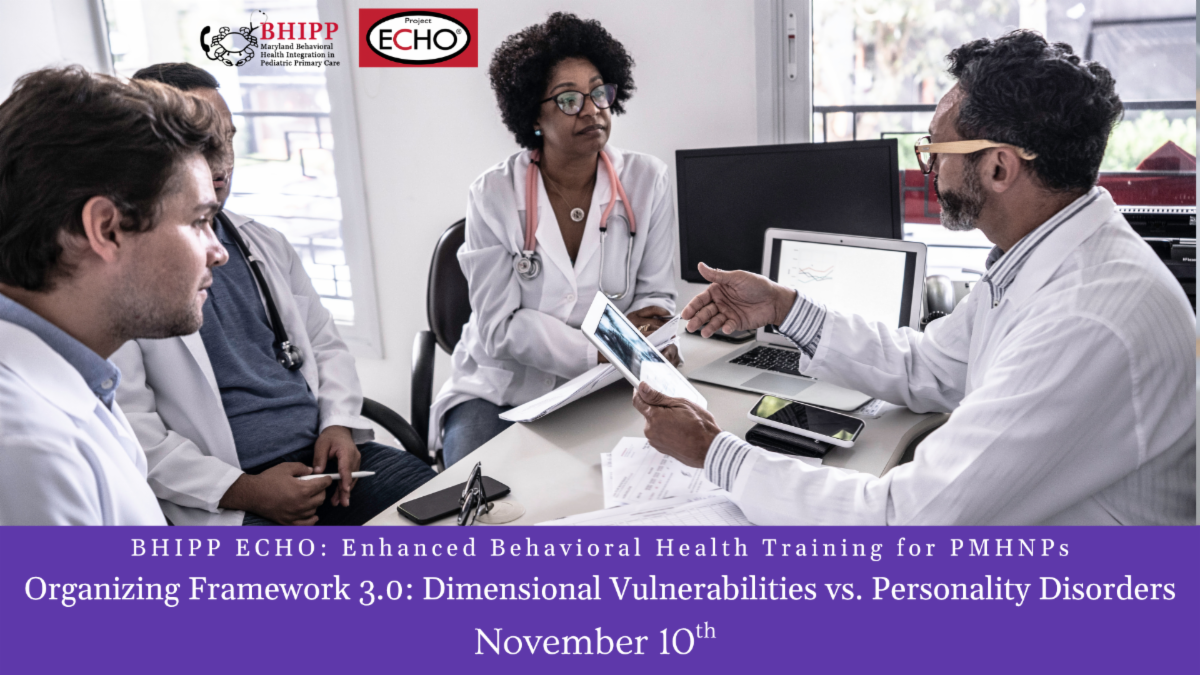
A new BHIPP ECHO Enhanced Behavioral Health Training for PMHNPs series continues on November 10! This series is designed for Maryland Psychiatric-Mental Health Nurse Practitioners (PMHNPs) who want to deepen their knowledge of child and adolescent mental health.

Register for the next BHIPP Webinar!

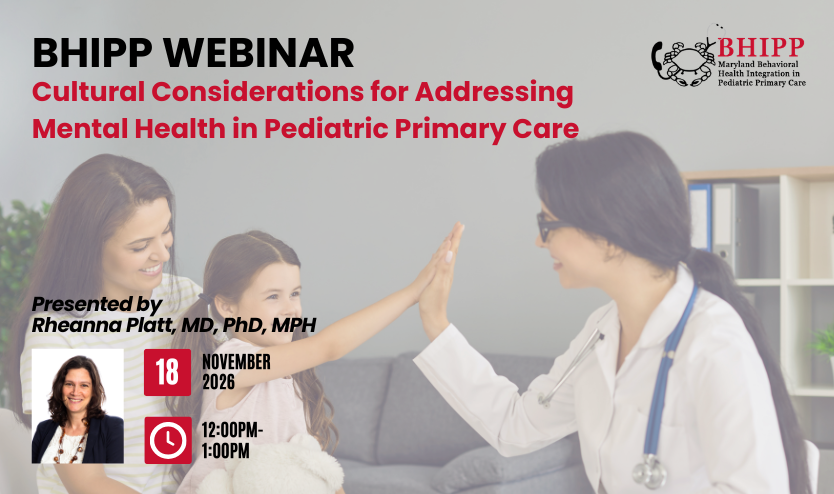
Register for the next BHIPP Webinar on November 18 at 12:00pm! BHIPP Webinars are a series of interactive, web-based learning sessions that are a virtual space for pediatric primary care, emergency medicine, and behavioral health providers to connect, learn and share about strategies, practices and resources to promote mental health and resilience among children and families as well as providers. Free CME and CEU credit is available for participation!

 
Facebook  Linkedin  Instagram  Youtube

BHIPP is supported by funding from the Maryland Department of Health, Behavioral Health Administration and operates as a collaboration between the University of Maryland School of Medicine, the Johns Hopkins University School of Medicine, and Salisbury University.


BHIPP and this newsletter are also supported by the Health Resources and Services Administration (HRSA) of the U.S. Department of Health and Human Services (HHS) as part of an award totaling $1,379,327 with approximately 20% financed by non-governmental sources. The contents of this newsletter are those of the author(s) and do not necessarily represent the official views of, nor an endorsement, by HRSA, HHS or the U.S. Government. For more information, visit www.hrsa.gov.


Copyright © 2021 Maryland Behavioral Health Integration in Pediatric Primary Care (BHIPP), All rights reserved.