Image of letter tiles spelling out Hello March. Text reads- BRHD Bi-Weekly Newsletter. March 7 2023.

Clocks “Spring Forward” One Hour this Weekend! 

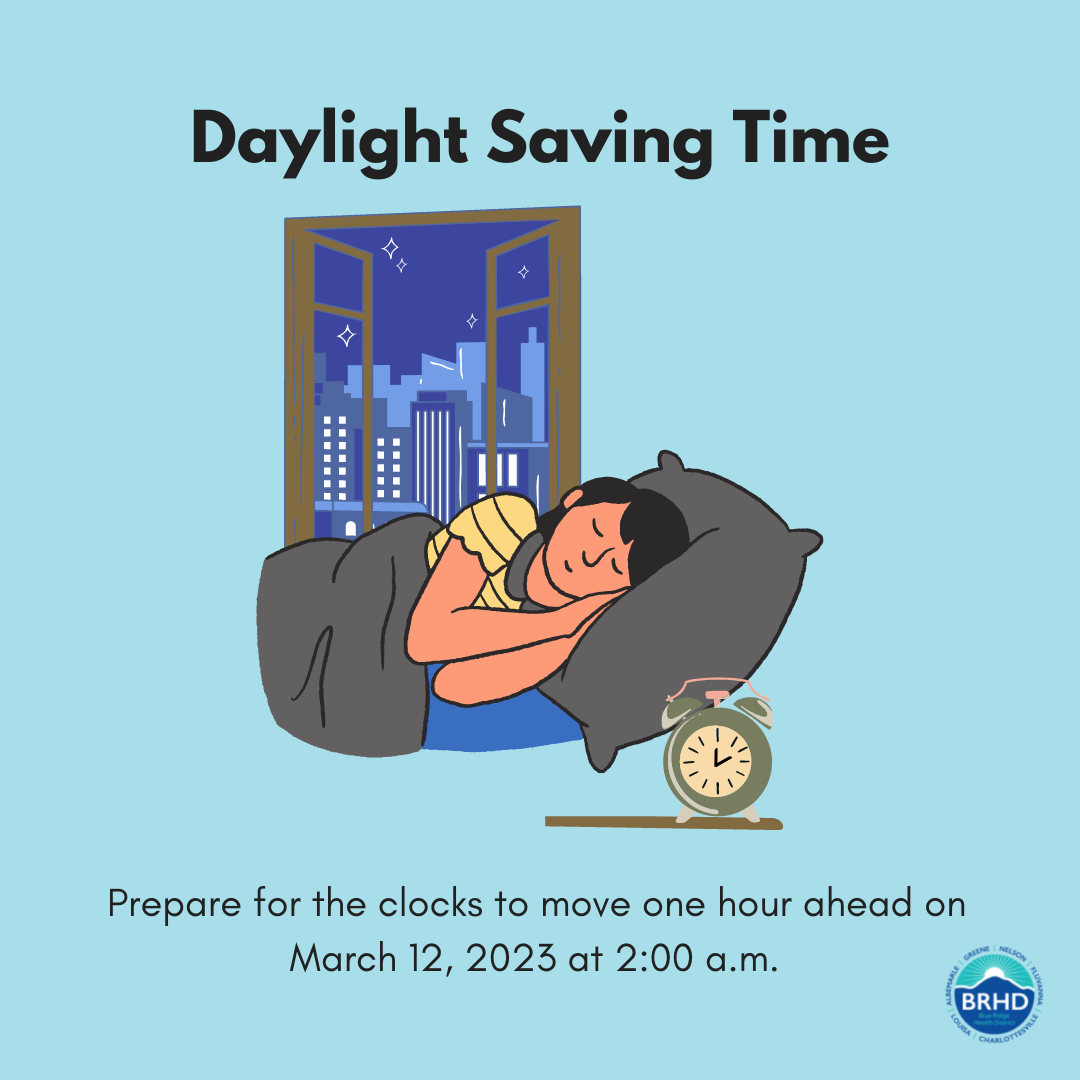
Light blue background behind an illustration of a person asleep in bed. A green alarm clock sits on the bedside table while the open window shows a nighttime city landscape. Text in the image reads: “Daylight saving time. Prepare for the clocks to move one hour ahead on March 12, 2023 at 2:00 a.m.”

Did you know that Daylight Saving Time can affect your circadian rhythm and sleep quality? Losing an hour as we “spring forward” this weekend may explain why you may feel more tired in the coming days. Daylight Saving Time begins this year on Sunday, March 12 at 2:00 AM. Digital clocks on devices like phones and computers will automatically change to be an hour ahead at 2:00 AM on Sunday. Be sure to change any analog or alarm clocks yourself on Saturday night before you go to bed.


Daylight Saving Time shifts waking hours by one hour every year to create a brighter nighttime and darker morning. This change can cause you to stay awake longer if you go to sleep when the sun sets. Additionally, the body’s circadian rhythm – the human 24-hour sleep-wake cycle – is better aligned with standard time, not Daylight Saving. Over time, this one-hour shift can accumulate into chronic sleep loss.


The good news is that there are steps you can take to make this transition easier and to create a healthy sleeping routine:  

  • Get at least eight hours of sleep each night. 
  • Try to go to bed 15 or 20 minutes earlier each night before the time change. This will give your body a chance to adjust. 
  • Maintain your normal bedtime after the time shift has occurred.  
  • Make your bedroom a dark environment so that light later in the day does not affect your sleep.


For more tips on handling Daylight Saving Time, read this Centers for Disease Control and Prevention (CDC) blog.

Community Health Worker (CHW) Office Hours

We are thrilled to announce that BRHD Community Health Workers (CHWs) are now hosting weekly office hours! During these walk-in office hours, CHWs will be able to connect/refer community members with services and resources (like housing or food), provide education on different health topics, translation services, and a range of other types of support and assistance. Anyone is welcome, no appointment necessary! Click on the hyperlinks below to view their schedules for March - May in each locality or visit the BRHD CHW webpage. 

Albemarle County

  • Yancey Community Health Center 


City of Charlottesville

  • Friendship Court Community Center 
  • Charlottesville/Albemarle Health Department 


Fluvanna County 

  • Fluvanna County Public Library 
  • Fluvanna County Health Department 

Greene County

  • Greene County Public Library
  • Greene County Health Department 


Louisa County 

  • Betty J. Queen Center 
  • Louisa County Health Department 


Nelson County

  • Rockfish Valley Community Center 
  • Nelson County Health Department

Are You Caught Up on Regular Immunizations?

Purple background behind a smiling black man in an orange shirt. White text reads- Routine vaccines aren't just for kids.

With the recent report of a meningococcal outbreak in Eastern Virginia and a measles outbreak in Kentucky near the VA state border, now is the time to make sure you’re up-to-date on your regular immunizations. Not sure what vaccines you need? Check out the CDC’s Immunization Schedule webpage or contact your primary healthcare provider to make sure you’re on track and fully vaccinated.

Read VDH's Press Release on the Meningococcal Outbreak
Read CDC's Health Advisory on the Measles Exposure

Louisa County Movie Night & Recovery Fair 

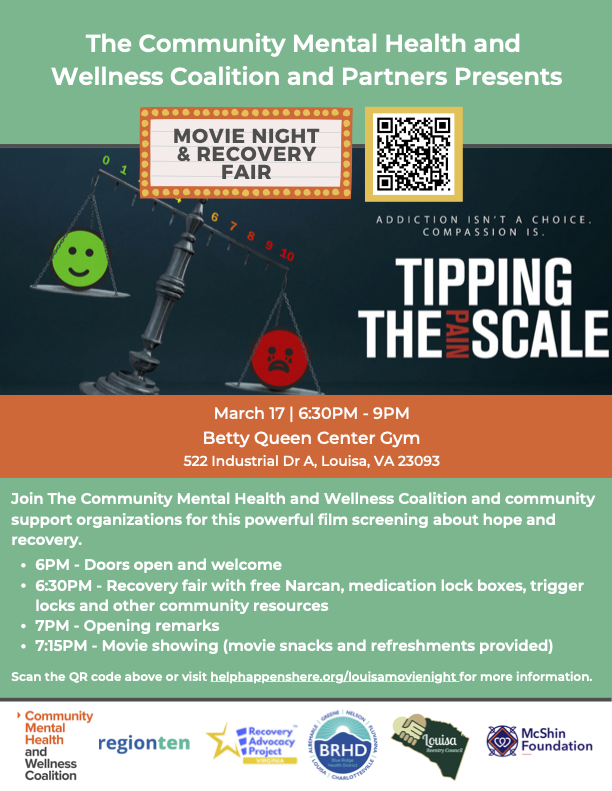
The Community Mental Health and Wellness Coalition and Partners Present Movie Night & Recovery Fair. Tipping the Pain Scale. Scan the QR code near the top of the flyer to learn more.

Calling all Louisa County community members! The Community Mental Health and Wellness Coalition and local community partners are hosting a recovery fair and film screening on Friday, March 17 inside the Betty J. Queen Center Gym. Doors open at 6 PM and the fair will begin at 6:30 PM. Resources include free Narcan, safe sex supplies, Hep C and HIV testing, and more! Also included is the Louisa County premiere of Tipping the Pain Scale, beginning at 7:15 PM. This feature documentary about the substance use recovery movement highlights the stories of five individuals who are making a difference in their communities. To learn more, go to www.helphappenshere.org/louisamovienight.

Colorectal Cancer Awareness Month

Colorectal cancer, or CRC, is the second deadliest cancer in the United States. Every March, National Colorectal Cancer Awareness Month spotlights this disease and inspires more people to get checked starting at age 45. To help prevent colorectal cancer or catch it early, when it’s most treatable, we recommend the following tips: 


Know the risk factors and practice prevention 

  • Exercise regularly, maintain a healthy weight, don't smoke, drink alcohol in moderation, and eat a diet rich in fruits, vegetables, whole-grain fiber, and calcium. 
  • Family history of colorectal cancer, certain inherited genetic syndromes, chronic inflammatory bowel diseases, and type 2 diabetes are also risk factors. 


Watch for symptoms and take action 

  • Symptoms to look for include a change in bowel habits, rectal bleeding, abdominal discomfort, weakness and/or fatigue, and unexplained weight loss. 
  • If you experience these symptoms, speak with a healthcare provider immediately. 


Get screened 

  • Screening can prevent colorectal cancer through the detection and removal of precancerous growths called polyps. Screening can also detect cancer at an early stage, when treatment is usually more successful. 
  • People at average risk should start screening at age 45, and those at higher risk may need to get checked earlier. 


The Colorectal Cancer Alliance (CCA) also provides a free screening recommendation based on your individual risk factors at quiz.getscreened.org. For more information about colorectal cancer, visit ccalliance.org.

Ombre blue background behind thick blue and white text that reads- Colorectal cancer awareness month. Recognized by the Colorectal Cancer Alliance.
JOIN THE BRHD MAILING LIST ⟶
Facebook  Twitter