We Advocate Participation |
|
In the Friday Morning Bronzecomm Newsletter:
.....Redistricting Plan Does More Harm Than Good For Black Voters
.....EPA Details Why Climate Change Will Hit Minorities the Hardest
.....FREE Blues at the Quarry this Weekend
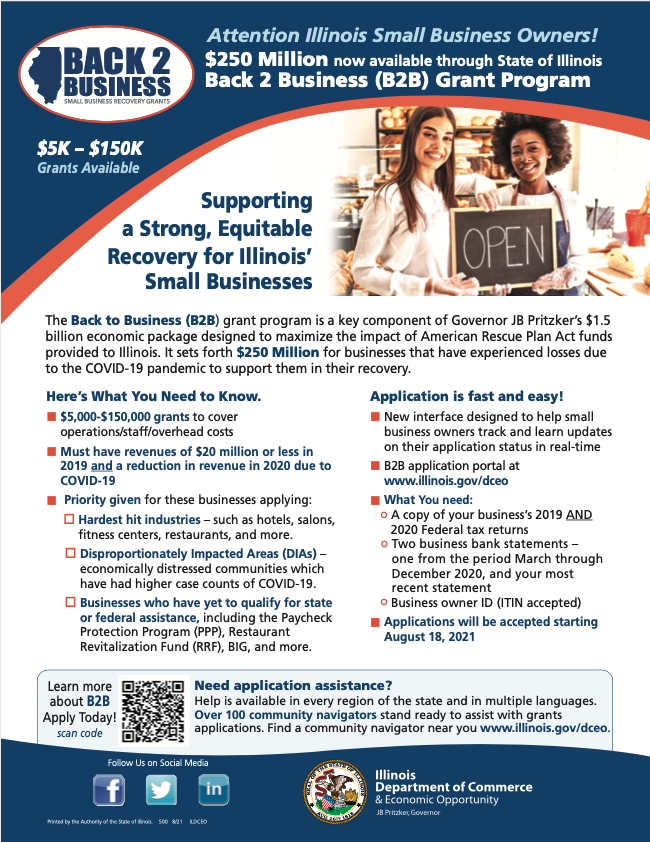
.....Back 2 Business Grant Program
.....Colors of the Musical Tones of Duke Ellington
.....Is Credit Racist?
...and more, much, much more.
Meanwhile, share today's Bronzecomm Newsletter with anyone you think can use the information.
Thanks again,
Raynard Hall, Publisher
Bronzecomm News and Information Services
|
|
Access Community Health Network |
http://www.blackstarproject.org |
Call for an appointment today
312 663-1890
|
COMMUNICATIONS PROBLEM SOLVERS |
Promote your business
or organization:
|
|
1. From: Valerie F. Leonard <valeriefleonard@msn.com>
.....Subject: Redistricting Plan Does More Harm Than Good For Black Voters
Illinois Redistricting Plan Does More Harm
Than Good for Black Voters
Members of Illinois African Americans for Equitable Redistricting (IAAFR) have reviewed the Legislature’s final redistricting plan and they are not happy. “From what we can see, Black voters in the state of Illinois are worse off under the revised plan than we were under the plan enacted in June”, said Valerie F. Leonard, the group’s convener. “In fact, every redistricting plan the Legislature has come up with after 2011 has done progressively more harm to Black voters”.
In 2011, the redistricting plan was drawn with 16 majority Black Representative districts, and 8 majority Black Senate districts. This past spring UCCRO developed a redistricting proposal with 18 representative districts with 50% or more Black population. They also drew 9 Black Senate districts.
A recent review of the data that supports the maps enacted in June revealed that the Legislature drew 12 Black Representative districts and 6 Black Senate districts. The amended plan reduced the number of Black Representative districts from 12 to 8, and the number of Black Senate districts from 6 to 4. Black people made up 14% of Illinois population in 2011 and 14% of the state's population in 2021. The latest redistricting plan drew fewer than 7% of the new districts as majority Black.
We know the Legislature can figure out a way to balance their political agenda with optimizing Black voting rights”, Leonard said. Speaker Madigan did this in 2011, and the data show that it is possible to do it again. For some reason, they decided not to go that route this time around.”
IAAFR shared their concerns in a letter to the Court overseeing the lawsuit brought by MALDEF and the Republican leaders.
Letter to the District Court August 27, 2021
Letter to the District Court September 1, 2021
Valerie F. Leonard
Founder, Nonprofit Utopia
Phone: 773-571-3886
|
|
2. From: raynard
.....Subject: EPA just detailed all the ways climate change will hit U.S. racial minorities
.....................the hardest. It’s a long list.
EPA just detailed all the ways climate change will hit U.S. racial minorities the hardest. It’s a long list.
If the planet warms 2 degrees Celsius, new report warns, Black people are 40 percent more likely than other groups to live in places where extreme temperatures will cause more deaths.
by Darryl Fears and Dino Grandoni
|
|
Racial minorities in the United States will bear a disproportionate burden of the negative health and environmental impacts from a warming planet, the Environmental Protection Agency said Thursday, including more deaths from extreme heat and property loss from flooding in the wake of sea-level rise.
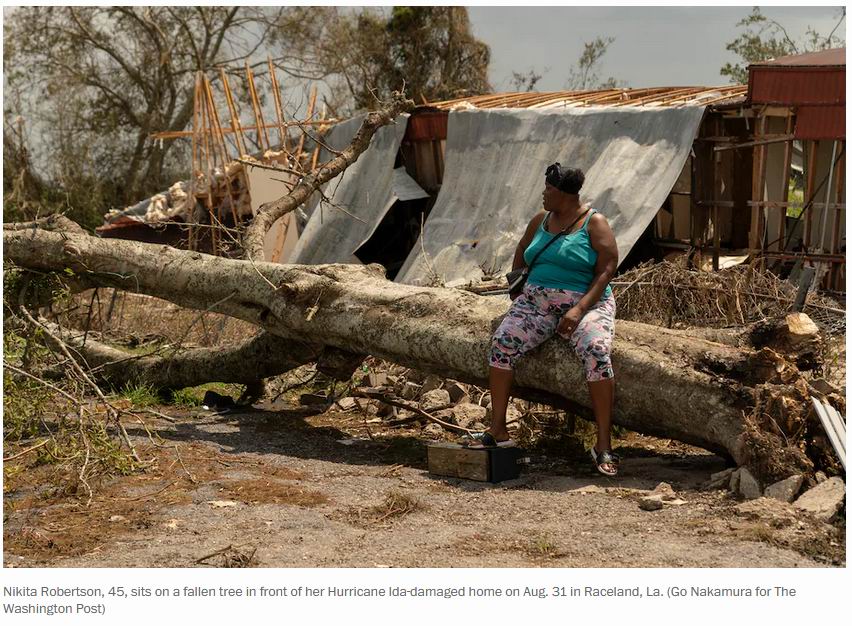
The new analysis, which comes four days after Hurricane Ida destroyed homes of low-income and Black residents in Louisiana and Mississippi, examined the effects of the global temperature rising 2 degrees Celsius (3.6 degrees Fahrenheit) compared with preindustrial levels. It found that American Indians and Alaska Natives are 48 percent more likely than other groups to live in areas that will be inundated by flooding from sea-level rise under that scenario, Latinos are 43 percent more likely to live in communities that will lose work hours because of intense heat, and Black people will suffer significantly higher mortality rates.
Joe Goffman, acting head of the EPA’s Office of Air and Radiation, said the comprehensive review was a “first of its kind.”
It amounts to a federal acknowledgment of the broad and disproportionate effect that global warming is having on some of America’s most socially vulnerable groups. Just this week, the Department of Health and Human Services established the Office of Climate Change and Health Equity, the first federal program aimed at specifically examining how the burning of fossil fuels and other greenhouse gas emissions affect human health.
The impact of Hurricane Ida, whose remnants Wednesday wreaked havoc in New Jersey and New York City, is still being calculated. But Goffman said many Black and low-income residents in Louisiana and Mississippi are faced with the challenge of mustering the resources to replace living rooms drowned in floodwaters and rooftops ripped apart by powerful winds.
“But one of the underlying lessons of this report is that so many communities that are heavily Black and African American find themselves in the way of some of the worst impacts of climate change,” he said, “as was the case with Katrina and, we may find, turns out to be the case with Ida.”
|
|
3. From: The Black Star Project, USA <gloria@blackstarproject.org>
.....Subject: September 1, 2021 - 25 Days Till 25th Anniversary Celebration
.......................of The Founding of The Black Star Project
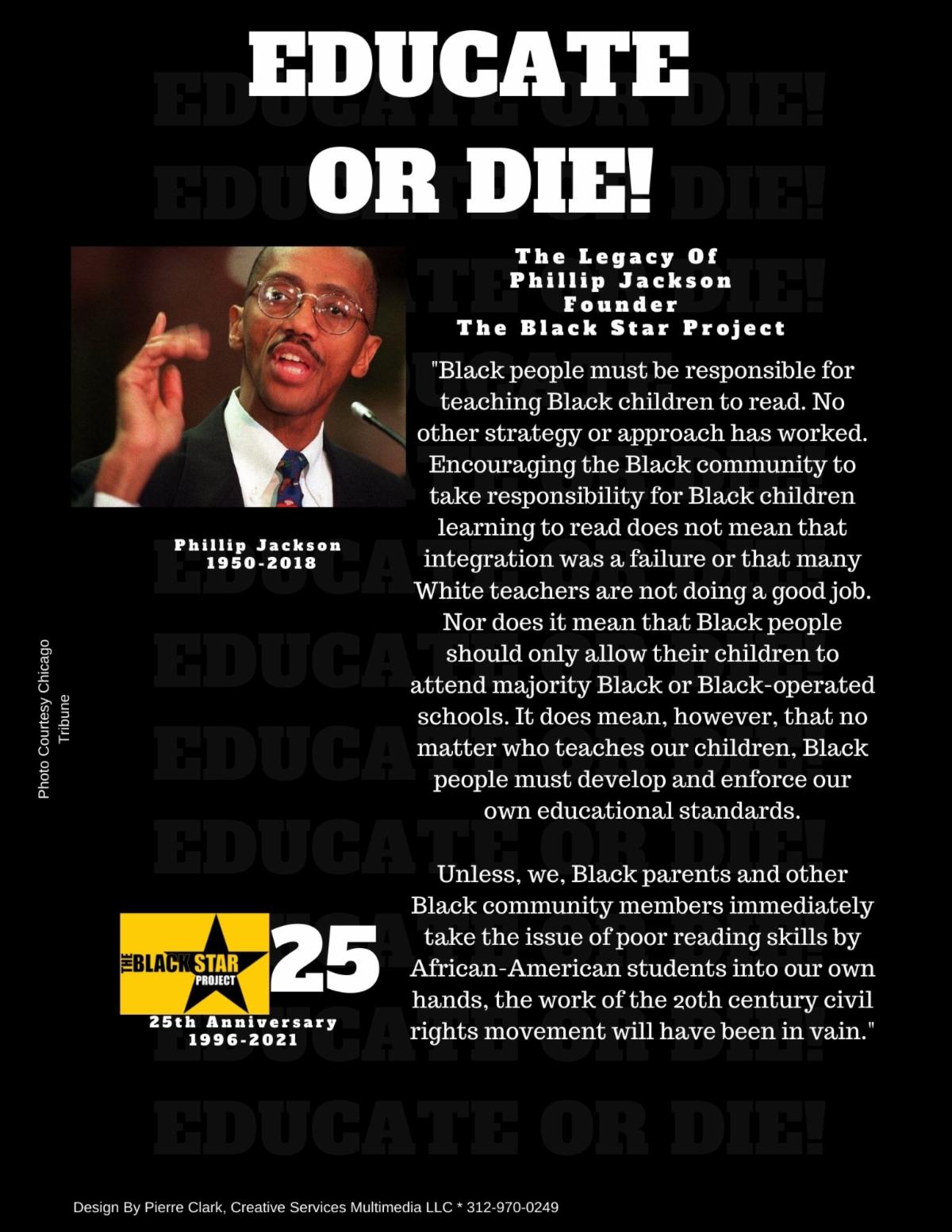
"Educate Or Die" - Poster Celebrates The Legacy Of Founder Phillip Jackson
|
|
September 1, 2021 begins the 25-day countdown to the celebratory event of the street renaming of 35th Street and King Drive as "Phillip Jackson Parkway" in honor of the late founder of The Black Star Project, Phillip Jackson and the 25th anniversary of the founding of The Black Star Project. As we count down to September 25 we will be focusing on the people, programs, philosophies and activities which together encompass Black Star's 25-year history. We'll reminisce about why the organization and its founder and staff have become so important to so many people in Chicago and around the country.
This poster focuses on Phillip Jackson's statement, "Educate Or Die" and Phillip Jackson's explanation of why education and reading are so critical to the success potential of Black people in this country and globally.
Follow us in the newsletter and our other online (Facebook, Instagram, etc.) resources during September 2021 for knowledge, insight, perspective and our own expressions for the present and the future of The Black Star Project as an organization and a legacy. And we look forward to seeing you on Saturday, September 25, 2021 at 2:00 p.m. at Black Star's Bronzeville headquarters, 3509 South Dr. King Jr. Drive.
Donate to our 25 Days of Giving Campaign:
|
|
4. From: raynard
.....Subject: FREE Blues at the Quarry for Labor Day
FREE Blues Labor Day Weekend, September 5th & 6th at The Quarry
presented by The Chicago Department of Cultural Affairs
featuring Freddie Dixon's Chicago Blues Allstars and Michael Damani...
FREE Food... Door Open at 5p
#ChicagoInTune
|
|
5. From: Sponsored: Gallery 400 at UIC reopens Sept. 2 with “Young, Gifted and Black” exhibition
.....Subject: Gallery 400 at UIC reopens Sept. 2 with “Young, Gifted and Black” exhibition
|
|
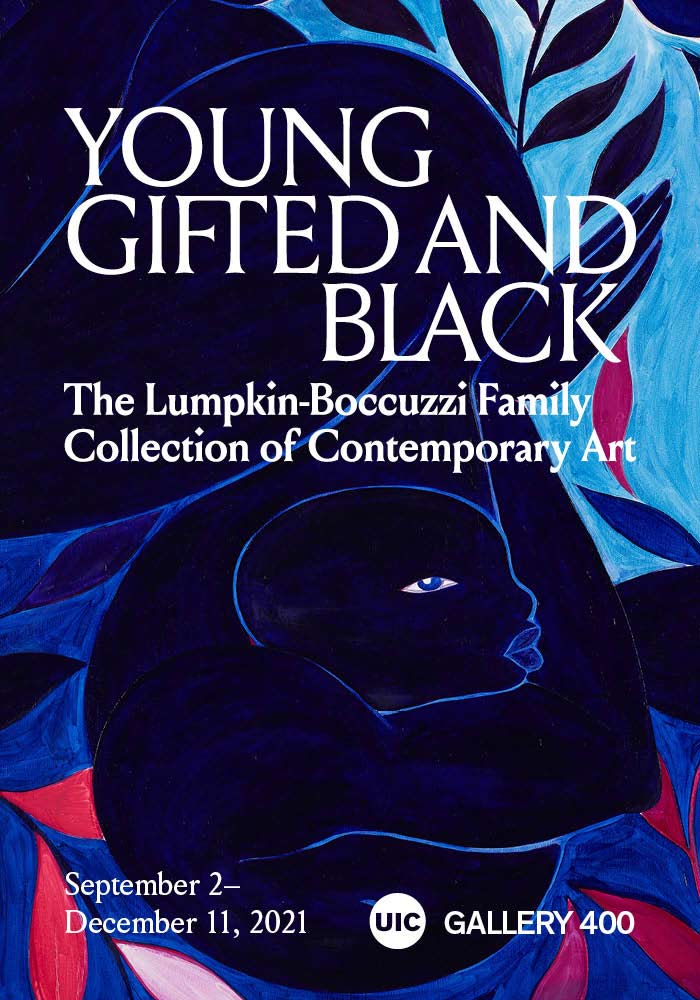
Gallery 400 at the University of Illinois Chicago reopens this fall with Young, Gifted and Black: The Lumpkin-Boccuzzi Family Collection of Contemporary Art, a nationally traveling exhibition of works by Black artists. Including the work of 50 artists in two successive generations of Black artists, Young, Gifted and Black is a timely exhibition of the lines of lineage and association in contemporary Black artists’ explorations of social relations, sexuality, gender, identity, abstraction and much more.
The exhibition includes works in a variety of media from artists Derrick Adams, Caitlin Cherry, Bethany Collins, Deana Lawson, Kerry James Marshall, Jennifer Packer, Paul Mpagi Sepuya, Mickalene Thomas, Chiffon Thomas, Lynette Yiadom-Boakye, and 40 others. Drawn from the highly regarded private collection of Bernard I. Lumpkin and Carmine D. Boccuzzi, the exhibition is co-curated by writer and curator Antwaun Sargent and artist Matt Wycoff.
The exhibition, and its accompanying catalog Young, Gifted and Black: A New Generation of Artists capture what it means—in the words of Lorraine Hansberry and Nina Simone—to be young, gifted and Black in contemporary art. At a moment when the country is wrestling anew with race and racism and debates about equality and inclusion in the art world have taken on greater urgency, Young, Gifted and Black assesses how
|
|
CPS Transcription provides quality transcription services
with prompt turnaround at affordable prices.
For more information about our services and rates,
or call 708-596-9371.
|
|
6. From: Martha Heitman <martha.heitman@achn.net>
.......... Subject: Be Prepared for the School Year
|
|
7. From: service@6ward.com
.....Subject: Back 2 Business Grant Program
|
|
8. From: Constance Howard <constance_a_howard@comcast.net>
.....Subject: Register for Amazon Career Day and find your dream job
|
|
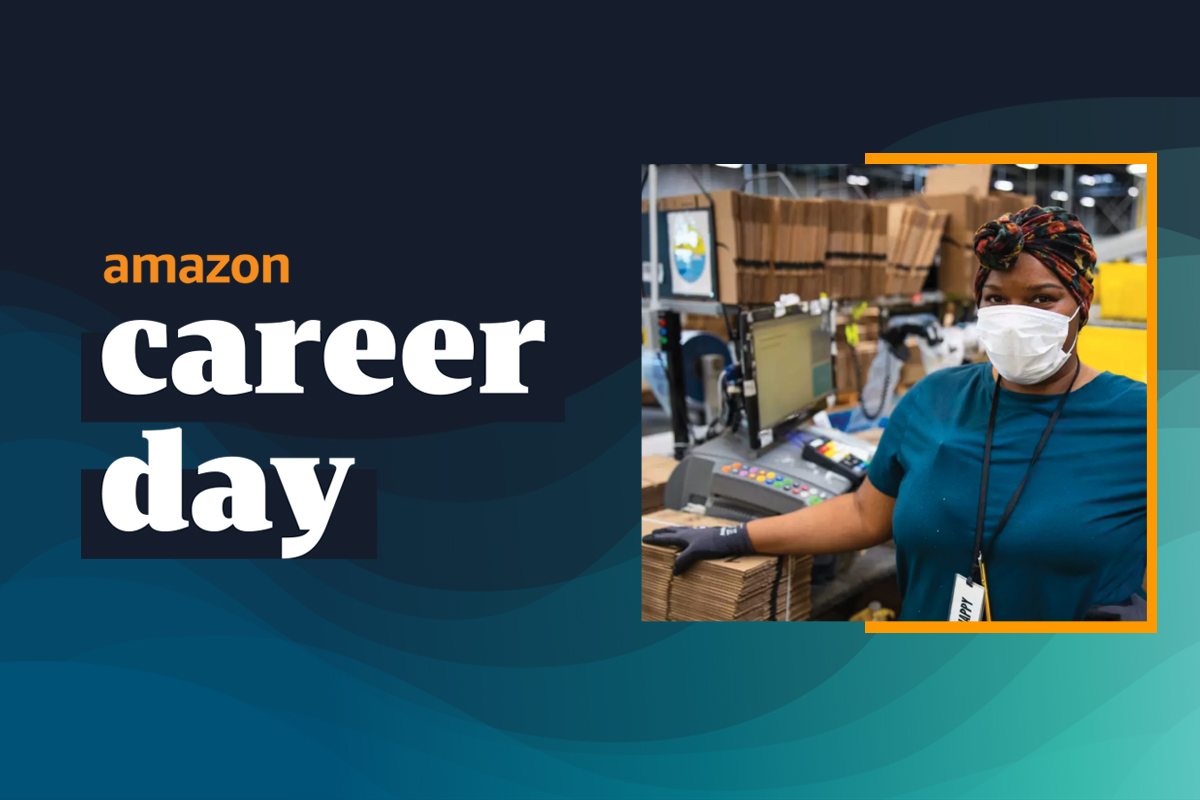
Want to advance your career? Register for Amazon Career Day.
Amazon is hiring for more than 40,000 corporate and tech roles in over 220 locations across the U.S. To give job seekers a chance to learn more about these roles and the tens of thousands of hourly positions available across Amazon’s Operations network, the company is hosting Career Day on September 15. Anyone can register for free here.
Career Day will offer more than 20,000 individual career coaching sessions with Amazon recruiters, plus opportunities to learn about how to transition to higher-paying jobs for employees already at Amazon. World-leading experts will provide candid job advice on how to start, build, or transition careers.
Amazon hired more than 450,000 people in the U.S. since the beginning of the pandemic in 2020 and is the largest job creator in the U.S. LinkedIn recently named Amazon the No. 1 company where Americans want to work and develop their careers.
|
|
9. From: raynard
.....Subject: Musical tones in Ellington's dukedom come in beige, tan, brown, and black
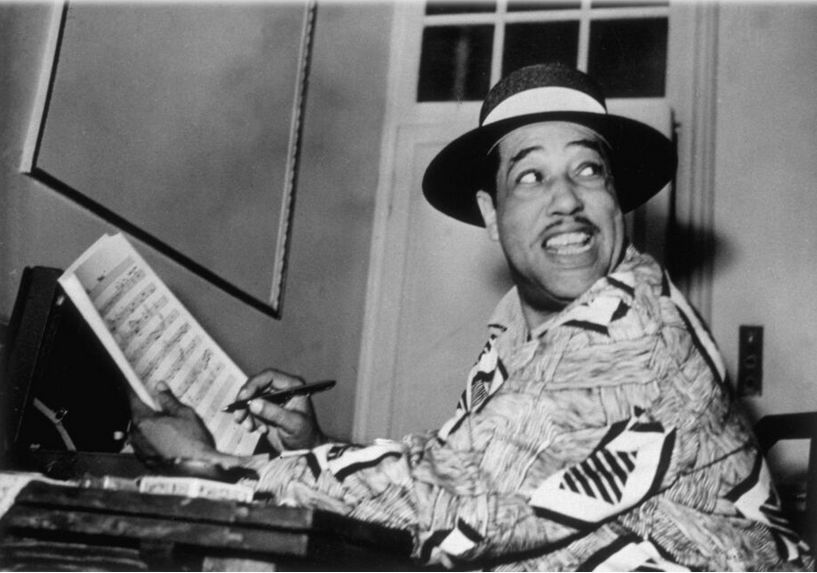
Musical tones in Ellington's dukedom come in beige, tan, brown, and black
by Denise Oliver Velez
|
|
In the color palette that Black musicians paint with, it should come as no surprise that the tones and shades used often reflect and project our skin tones and the words used to describe them. In other cases the very names used by groups or individual entertainers played upon how we were viewed and marketed to the world outside of the Black community.
We are a pastiche of hues, from ecru, beige, and tan to honey deepening into redbone. We are coffee and chocolate, darkening into rich deeper tones that are often described as “black”; however, they contain hints of eggplant and blue. In essence we are a symphonic blend of musical complexions and complexities; for today’s Black Music Sunday, I’ll explore them through the work of the late great Duke Ellington, namely his 1943 Black, Brown and Beige symphony, and 1927’s “Black and Tan Fantasy.”
|
|
10. From: raynard
......Subject: Inside a New Effort to Change What Schools Teach About Native American History
Inside a New Effort to Change What Schools Teach About Native American History
A new curriculum from the American Indian Museum brings greater depth and understanding to the long-misinterpreted history of indigenous culture
|
|
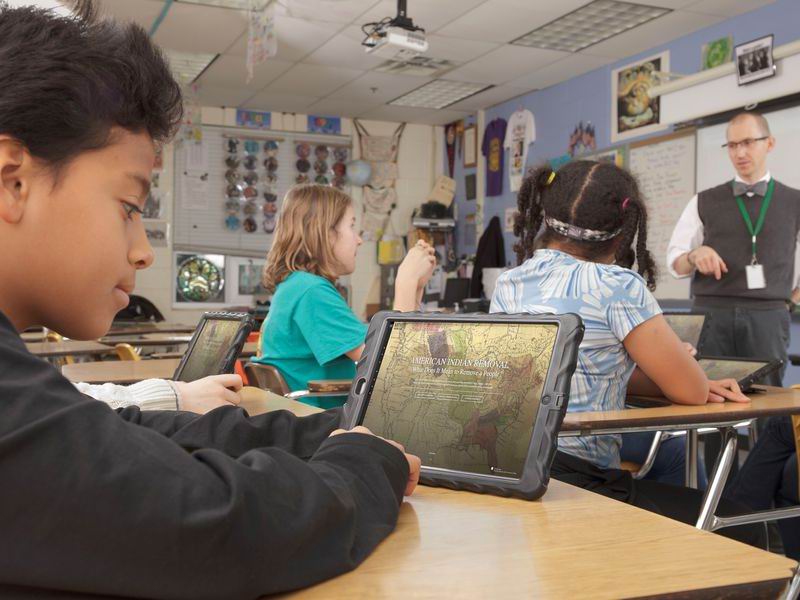
This school year, three new Smithsonian lesson plans on the Inka Empire, Native American treaties and the history of 19th-century Cherokee removal became available to K-12 educators. (Alex Jamison, NMAI) |
|
Students who learn anything about Native Americans are often only offered the barest minimum: re-enacting the first Thanksgiving, building a California Spanish mission out of sugar cubes or memorizing a flashcard about the Trail of Tears just ahead of the AP U.S. History Test.
Most students across the United States don’t get comprehensive, thoughtful or even accurate education in Native American history and culture. A 2015 study by researchers at Pennsylvania State University found that 87 percent of content taught about Native Americans includes only pre-1900 context. And 27 states did not name an individual Native American in their history standards. “When one looks at the larger picture painted by the quantitative data,” the study’s authors write, “it is easy to argue that the narrative of U.S. history is painfully one sided in its telling of the American narrative, especially with regard to Indigenous Peoples’ experiences.”
The Smithsonian’s National Museum of the American Indian is setting out to correct this with Native Knowledge 360 Degrees (NK360°). The museum’s national education initiative, first launched in February 2018, builds on more than a decade of work at the museum. The multi-part initiative aims to improve how Native American history and culture is taught in schools across the country by introducing and elevating indigenous perspectives and voices. Just in time for the start of the 2019-2020 school year, the initiative released three new lesson plans, offering a deeper look at the innovations of the Inka Empire, investigating why some treaties between Native American tribes and the U.S. government failed, and providing an in-depth exploration into the context and history of the Cherokee removal in the 1830s.
At the core of NK360° is the “Essential Understandings,” a ten-part framework to help educators think about how they teach Native history. Some of the understandings directly challenge narratives that are already perpetuated in schools through textbooks and standards, such as the idea of American Indians as a monolithic group: “There is no single American Indian culture or language. American Indians are both individuals and members of a tribal group,” the curriculum asserts. Another myth the curriculum addresses is the idea that American Indians are a people of the past: “Today, Native identity is shaped by many complex social, political, historical, and cultural factors.” And it highlights the work done by Native people to foster their cultural identities: “In the late 20th and early 21st centuries, many American Indian communities have sought to revitalize and reclaim their languages and cultures.”
These essential understandings underpin the initiative’s online lesson plans released cost-free, for teachers to use in their classrooms. Edwin Schupman, manager of NK360° and a citizen of the Muscogee (Creek) Nation, says that the initiative is trying to “meet teachers where they are [and address] what their needs are.”
|
|
11. From: raynard
......Subject: Is Credit Racist?
Is Credit Racist?
A recent investigation into the mortgage loan industry exposed the well-known systemic inequality embedded in America's credit reporting system.
By Michael Harriot
|
|
This article begins with an almost humblebrag.
In April 2020, just as America’s COVID death toll was beginning to rise, I received a random call from a politician. I immediately recognized the voice as someone who sporadically called me to basically say: “This thing is happening to Black people, no one is paying attention and The Root should be covering it.”
Most of our conversations went this way: I would say something brilliant that I had thought about for a long time. Then she would explain exactly why I was wrong and she was right. And she was always right. Not only did she know a lot about a lot of things, but there was also almost nothing she didn’t know...
Almost.
This particular time, she wanted to talk about how the pandemic would disproportionately affect Black people. But instead of focusing on health issues, she wanted to talk about how the pandemic would affect voting rights and economic inequality. “This issue of homeownership and housing security is highlighted in a profound way during this pandemic,” she explained, before going into a long explanation about Black homeownership and wealth inequality.
Finally! Now, this was something I knew about. “The problem is with the banks,” I added, reeling off data about how the financial industry is rife with systemic inequality.
“But that’s not where the problem is,” she interjected.
“But those aren’t the biggest reasons for the gap in Black homeownership,” she interjected.
“So tell me what it is,” I replied, eager to hear her answer, yet reluctant to be wrong again. Unlike the other times, she did not offer an extended explanation. Even though her response only consisted of two words, she succinctly encapsulated the entirety of all the studies, research and data on the issue:
“Nobody knows.”
Dammit, Kamala Harris was right again.
Is credit racist?
Unlike what people on both the left and the right believe, racism doesn’t require animus or intent. Words have meaning and—in this context—racism is defined as “the systemic oppression of a racial group to the social, economic, and political advantage of another.”
By any measure, America’s credit reporting companies fit the definition. This is not even in dispute. The U.S Department of Justice has filed claims against JPMorgan Chase & Co., Bank of America, Wells Fargo, Citigroup and U.S. Bank – the five largest banks in the United States, have all paid millions to settle claims of racial discrimination. And if any human being on the planet disagrees, they should be prepared to answer one simple question:
How do you know?
|
|
BRONZECOMM PARTNERS:
Support the businesses and organizations that support Bronzecomm.
Click the links below to connect to our Partners:
Sincerely,
Raynard Villa Hall, Publisher
BRONZECOMM News and Information Services
|
|
|
|
|
|
|