April 27, 2022

basis blowout.jpg

Basis Blowout

What is Going on???

CEMA members have been expressing concern over recent high prices, due to both rising NYMEX prices and rack differentials. CEMA hopes to shed some light on this situation with the following advisory. Thanks to Elaine Levin of Powerhouse and Rich Larkin of Hedge Solutions for contributing to this report. 

THE HEATING OIL MARKET TODAY

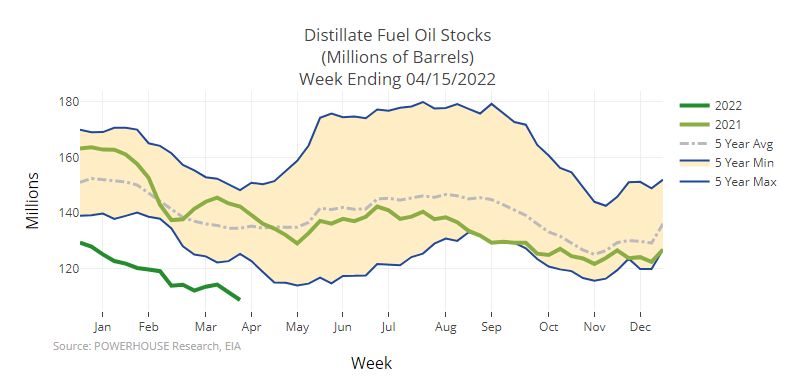
Pricing for both crude oil and heating oil has been shaken in recent months by external events. Previously, administration policy hostile to petroleum and new exploration and drilling has resulted in higher prices over the past year. In addition, for the distillate market, increased demand from a rebounding economy following the worst of the COVID pandemic has further put pressure on prices and reduced supply. As the following chart from Elaine Levin, president of Powerhouse, shows, distillate inventories are now at a multi-year low.

powerhouse research EIA.png

The dark green line in the lower left of the graph shows distillate fuel stocks substantially lower than last year or even the five-year averages.


Exacerbating this trend in petroleum prices has been this year’s Ukraine War. U.S. sanctions on Russian oil and gas, plus increased demand for distillate fuel from Europe, have pushed prices, and differentials, higher as it becomes harder for refiners to source fuel for physical delivery in New York and New Haven harbors. According to Elaine Levin, normally, when New York Harbor gets tight, we attract cargoes from Europe. With natural gas prices so high and the prospect of cutting off Russian energy looming large, Europe is not exporting diesel. They too are low on distillate inventory themselves and are paying a premium for supply. Also, supplies from the U.S. Gulf Coast can find higher buyers overseas, which means our market must compete for supplies through higher prices and differentials.


To this point, this week the Energy Information Administration (EIA) released their petroleum inventory reports, and OPIS writes:  "Total distillate inventory, particularly on the East Coast, may be emerging as a concern. The agency estimated domestic distillate supplies fell by about 1.45 million barrels last week to 107.3 million barrels, threatening the sub-100-million-bbl level for the first time in about 20 years."


Tom Kloza of OPIS tweeted on April 26: “New York Harbor diesel just topped $4.66/gallon which works out to $195.72/bbl.  It’s piggybacking on a 40+ cents increase in May ULSD which still has 3.2 days of trading before expiration. To quote Crazy Eddie, these prices are insane.”


BACKWARDATION

In addition, futures backwardation has increased supplier reluctance to buy and store fuel today, further pushing up differentials. As Rich Larkin, president of Hedge Solutions, writes: “Backwardation is the relationship in the futures’ market between the forward months. This makes it difficult for the wholesalers to bring product into the terminals since they can’t lock in a positive hedge. It elevates their risk. Why is this a problem? Your suppliers at the local terminals will become reluctant to bring in those barges and cargoes if they know that the hedge is negative or, simply put, the price they pay today is basically cheaper tomorrow.” Higher differentials can result from wholesalers trying to discourage purchases until the market settles.


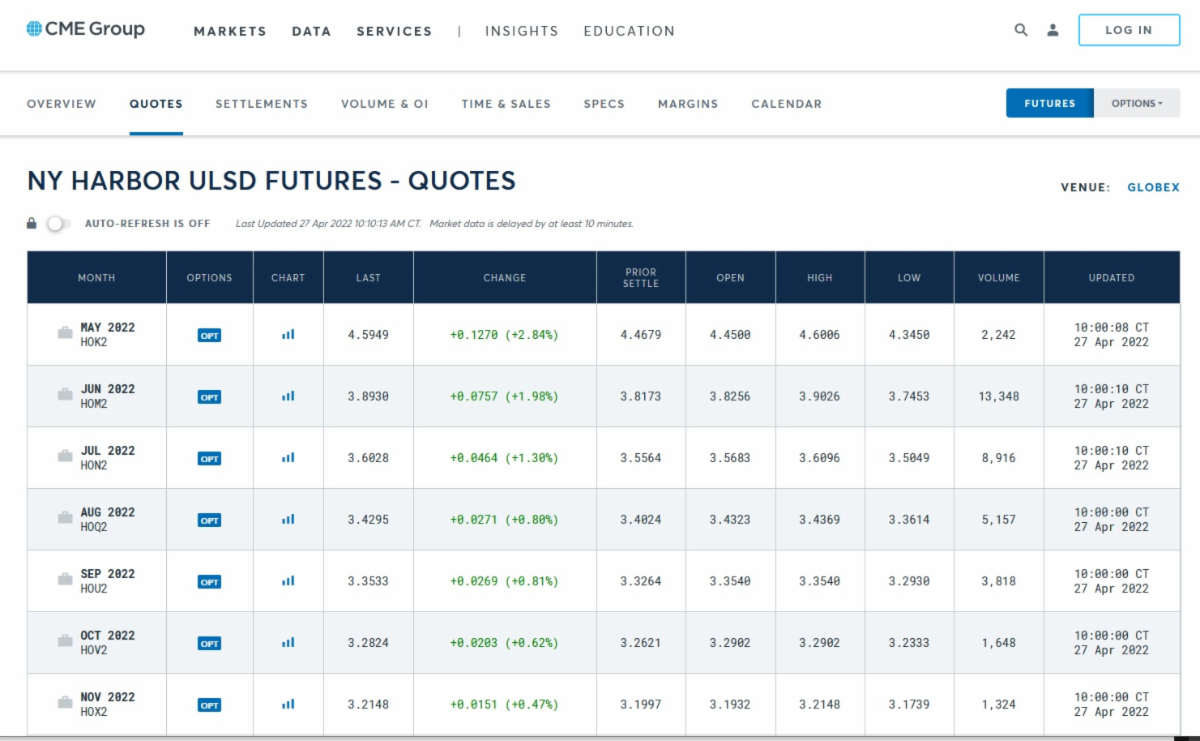
The following shows the heating oil futures contract in NY Harbor from the CME Group.


CMA NY Harbor ULSD Futures.png

Future forward months are substantially lower as of 10 AM, April 27. For example, the May 2022 contract is $4.5949 while the June 2022 price is $3.8930, a 70 cent decrease in price. The reason is that buyers are willing to pay a premium to own barrels right now, widening the spread to future months. 


Will prices decline in New Haven harbor once the May contract expires? Not immediately, according to Elaine Levin, as it will time to replace older higher cost fuel in storage tanks.


And we have in fact been seeing a basis “blowout” in distillate markets everywhere. Specifically, the differential in New Haven has been over 30 cents/gallon [$4.09/gallon closing heating oil NYMEX price on April 25; $4.40 rack average price the next morning in New Haven Harbor for a 31 cents differential].


Again, the differential in the spot market or at the rack is based on physical factors, such as availability of physical supply and transportation costs, low distillate inventories, replacement cost of supply, and market backwardation. Even if the NYMEX FUTURES paper market is declining as shown above, differentials may not, if it’s still costly to move supply into New Haven harbor from Europe or elsewhere.


There is some good news out there, according to Rich Larkin. Normally this time of year, refineries will “turn” production at its facilities to produce higher yields of gasoline in anticipation of the summer driving season. However, it is significantly more profitable to produce distillates versus gasoline well into the spring season. A recent survey shows widespread intentions by refineries to defer their turnarounds to produce mostly gasoline, opting instead to continue producing higher volumes of distillates. This will help cut into the current deficit in inventories.


Also, there are opportunities when looking at the forward futures curve. Next winter’s strip prices look like a bargain compared to the current retail price. This is helping the price protection programs.


Finally, there are some practical issues regarding deliveries still to be made this week. If you're in the state's energy assistance program, then your approved price is falling behind your rack price. CEMA is aware of this and is working with the state to get additional mid-day price corrections, and to see if they will allow for deliveries that were approved this week to be delivered next week, assuming rack prices will decline. 


What the situation at the rack next week is still somewhat up in the air depending on your wholesale supplier's situation, and you should be in contact with them to resolve any supply issue you may have. 


Regarding automatic delivery agreements with customers where you determine when and how much to deliver, consider delaying such deliveries this week until the price situation next week becomes clearer, or if the customer is about to run out, work with them so that they agree on how much you can deliver, even at today's high prices, to hold them over for at least another week.

Basis Basics

OPIS Fuel Price Chain.jpg

source: OPIS


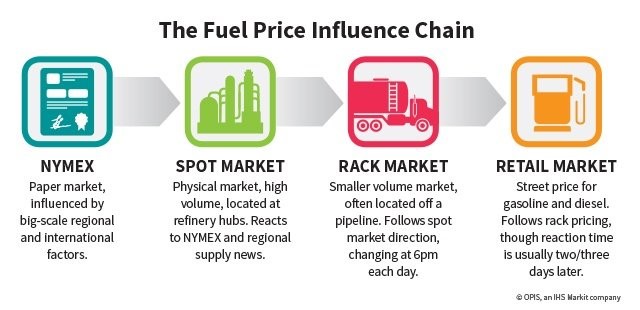
NYMEX: This is the first step in our fuel pricing structure – a mostly electronic platform exchange, where “paper” contracts of fuel are bought and sold for a period in the future. Hardly any physical barrels ever change hands. The paper market is also heavily used as a way to hedge physical fuel purchases. The NYMEX oil prices are very sensitive to global events, OPEC decisions, the US Dollar, supply inventories, and more.


Spot Market: Spot purchases refer to commodities physically traded either on a pipeline or via barge or cargo. You negotiate for the fuel “on the spot” at the refinery gate or at one of the seven major refining hubs. Spot transactions are large – pipeline deals are a minimum of 5,000 barrels (210,000 gallons) up to 50,000 barrels (2.1 million gallons).


Basis: Spot transactions for refined products are not done on a “flat price” basis (i.e. $2.00/gallon). They are done as a relationship to a related commodity on the NYMEX. That relationship is called a “differential” to the “cost basis,” which, in this case, is the NYMEX.


NYMEX + Differential = Actual Spot Price


Note the differential can be either plus or minus, i.e. add to or subtract from the NYMEX price. Though we’re used to seeing a positive differential, it can be negative, such as when there is oversupply and refiners need to move product.


NYMEX prices move up and down due to domestic and global influences. NYMEX price moves, in turn, influence the spot market. Basis differentials react to news as well. Gulf Coast spot differentials can “blow out” if there is, say, a hurricane. A cold winter in New England can send the basis up. The differential to the NYMEX strengthens or weakens spot prices which rise or fall independently of the NYMEX move. Remember, NYMEX prices result from paper trading and have little relation to physical supply in a local market.


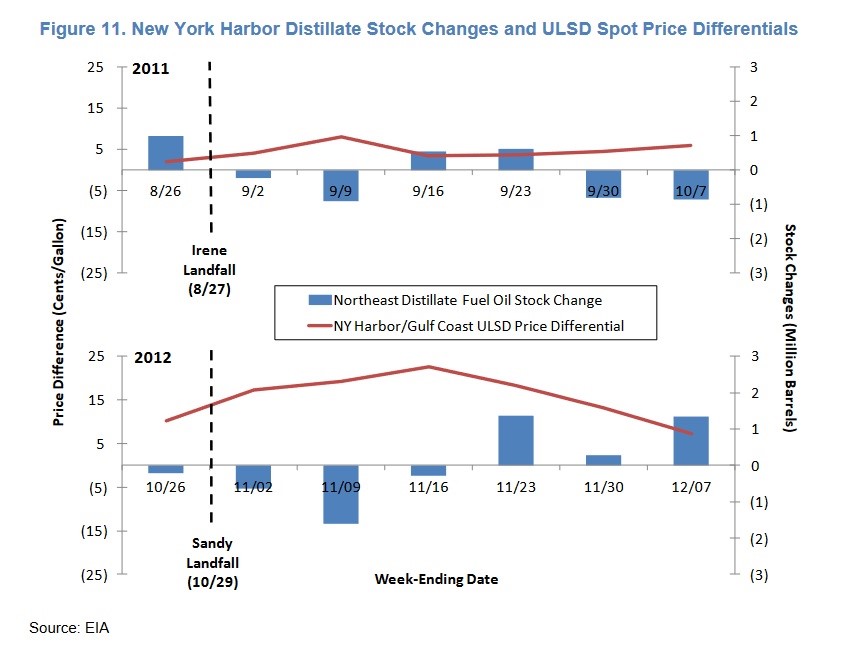
As an example of an event causing a change to basis in a local market, when Hurricane Sandy struck the Northeast in 2012, knocking out power stations and causing extensive damage, distillate basis in New York Harbor more than doubled from 10 cents/gallon to 23 cents as the lower half of the graph below shows. Gasoline basis (not shown) was even harder hit, increasing from 18 cents to 46 cents.

2012 diffs.jpg

THE RACK

Finally, the Rack is where refiners physically move their fuel to distribution points where wholesalers, jobbers and end users buy it. Refiners can add or subtract to the spot differential depending on local conditions and their need to buy replacement barrels so they can fulfill their supply contracts. A refiner’s calculated spot replacement cost changes every day based on the movement of the NYMEX and the corresponding movement in the spot market. They track that fluctuating cost throughout the day – every day. Refiners increase or decrease their daily rack costs based on the average daily change in their spot replacement cost. That’s why rack prices move up and down!

View as Webpage

CEMA email advisories sponsored by:

Federated New Logo 2015.jpg