|
Please share this edition of Wildlife Highlights with other outdoor enthusiasts
and help our subscription list grow!
| |
Bear Activity Increases in Early Spring; Help Keep Bears Wild | |
|
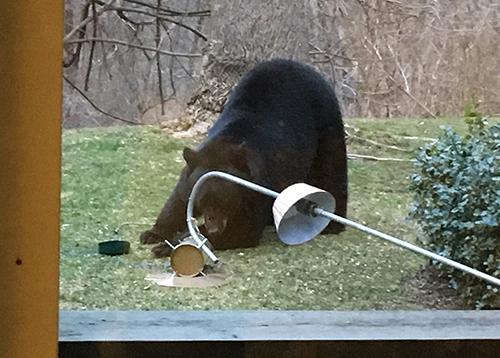
Early spring is the time of year in which black bear activity increases, following the winter denning season. It is critical to ensure that bears do not have access to human-related food sources such as bird seed. The Wildlife Division advises residents to take down, clean, and put away bird feeders from late March through November. Some residents may need to stop even earlier or all together if bears are active nearby. It is important to also clean up spilled seed from the ground and store any unused bird seed and suet in a location not accessible to bears, such as a closed garage. Do not store bird seed in screened porches or sheds where bears will be able to rip screens or break through windows to access the seed.
While human-bear conflicts continue to rise and have become more severe, simple steps, such as reducing attractants around your home, can help to greatly reduce the likelihood of encounters and potential conflicts with bears. Black bears can be encountered in every town in Connecticut. The photo shown here was taken earlier this month in Groton.
DEEP Reminds Residents to Be Bear Aware . . .
BearWise Checklist . . .
| |
Winner of the 2023 Migratory Bird Conservation Stamp Contest | |
|
The DEEP Wildlife Division and the Connecticut Waterfowl Association (CWA) are pleased to announce the winner of the 2023 Migratory Bird Conservation Stamp Art Competition! Congratulations are extended to Sulan Zhang from Tolland whose painting of a long-tailed duck will be the featured artwork for the 2024 Connecticut Migratory Bird Conservation Stamp and will also represent Connecticut in the Federal Junior Stamp Contest (taking place next month)!
Over 120 entries were submitted from public school, private school, as well as home-schooled students in grades K-12, from all across the Connecticut. The participants in every age group put forth a great amount of time and effort to produce some amazing artwork and conservation messages. Select the link below to view more of the entries from this year's contest!
View winning artwork from the 2023 CT Junior Duck Stamp Art Contest . . .
More on the CT Migratory Bird Conservation Stamp . . .
| |
The Federal Endangered Species Act Celebrates 50 Years | |
|
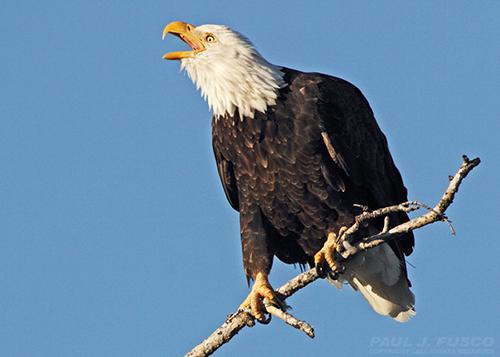
From the iconic bald eagle to the small, charismatic bog turtle, the federal Endangered Species Act (ESA) has prevented the loss or harm of endangered and threatened species across America since it was first enacted in 1973.
Now in its 50th year, the ESA stands testament to the power of partnerships and the conservation successes achieved through collaboration. Today, hundreds of species, many of which call Connecticut home, are stable or improving thanks to conservation actions undertaken by federal agencies, state and local governments, conservation organizations, and private citizens. Throughout the year, we will highlight some of the many species that have directly benefitted from this landmark federal law.
More on the ESA . . .
| |
Have You Seen a Mallard Nest? | |
|
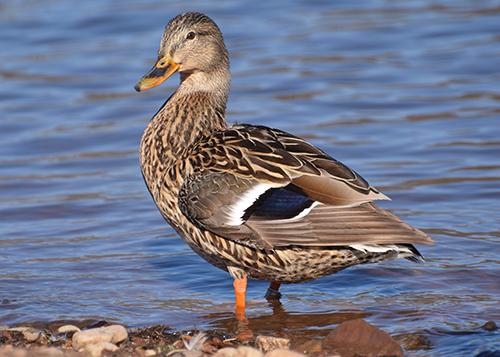
The Wildlife Division is taking part in a large-scale project to assess nesting success, nest habitat selection, brood movement, and habitat selection in mallard ducks. Mallards are seemingly very adaptable, much more so than our native puddle duck, the iconic black duck. Our landscape has changed in the past 30 years with more development and wetland loss. At the same time, the suite of medium-sized mammals - potential predators of mallards or their nests, eggs, or chicks - has increased. This study allows the Wildlife Division to assess how mallards have adapted to these changes and how their productivity has been affected.
Wildlife Division biologists are requesting assistance in finding nests. If you have mallards nesting on your property or find an active nest, please contact the Division's Migratory Bird Program at min.huang@ct.gov.
More on reporting mallard nests . . .
| |
The Importance of Snags for Wildlife | |
|
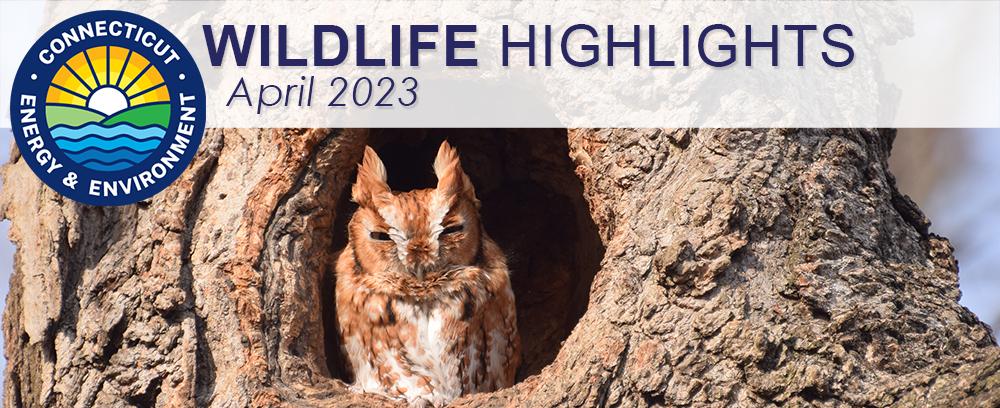
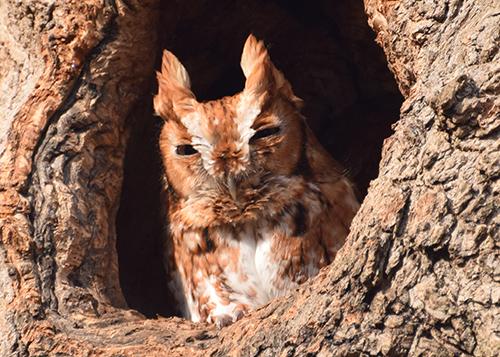
The incredibly well-camouflaged eastern screech owl is a year-round Connecticut resident that occurs in a red or gray morph (red morph pictured here). Like many other species of birds, this small owl nests in tree cavities and is also receptive to using nest boxes.
Tree cavities are a vital source of food and shelter for a host of species and are most likely to be found as part of a dead or dying tree, commonly referred to as a snag by wildlife biologists. While a snag may be considered “unsightly” to some homeowners, it is important to understand their significance when it comes to wildlife. And, as you can see, this screech owl could not agree more!
More on snags . . .
More on nest structures for wildlife . . .
| |
Biologists Travel Underground to Monitor Connecticut's Bats | |
|
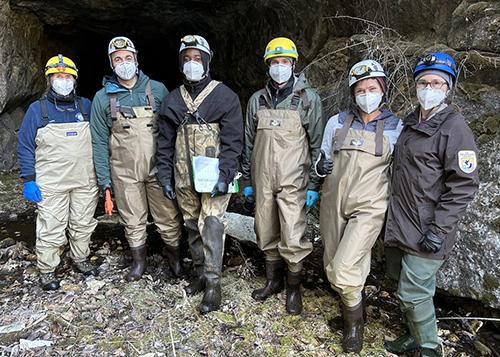
Last month, DEEP Wildlife Division Biologists conducted bat hibernacula surveys at select mines and underground spaces across the state. These surveys provide critical information on Connecticut’s cave bat populations, especially since all but one (big brown bat) of the six species of cave bats are on Connecticut's List of Endangered, Threatened and Special Concern Species.
Come winter, big browns and the other cave bats, like tri-colored, northern long-eared, eastern small-footed, little brown, and Indiana bats, migrate regionally to these cavernous spaces where they hibernate through the coldest months of the year.
Following standardized protocol, biologists scan through the many rocky twists and turns to not only identify the species of bats present but also check for signs of white-nose syndrome, a deadly disease caused by a fungus that has killed millions of bats since it was documented in New York in the winter of 2006-2007.
These surveys are conducted every other year, and the data collected also benefit regional partners when it comes to conserving bats across the Northeast.
More on Connecticut's bats . . .
| |
Spring Turkey Hunting Season Opens April 27 | |
|
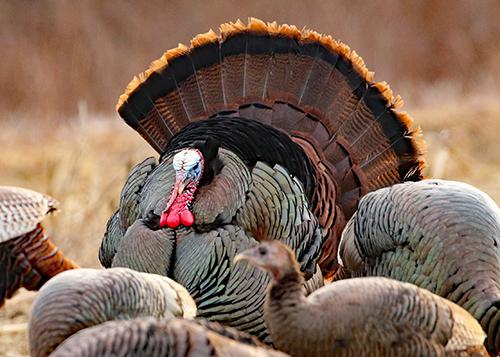
The 2023 regular Spring Turkey Hunting Season runs from Wednesday, April 26 through Saturday, May 27 (excluding Sundays). Turkey hunting requires a great deal of skill and advance planning to be safe and successful. To guarantee a memorable spring turkey hunting experience, hunters must follow all safety recommendations and hunting regulations. Other outdoor enthusiasts are encouraged to recreate responsibly, as more people are using public lands where hunting may be occurring.
Junior Hunter Training Days: Each year, Connecticut designates specific days when experienced adult hunters are encouraged to take a youth hunting, helping them learn safe and effective hunting practices, develop observational skills, and gain confidence and a comfort level needed to further their hunting skills. The 2023 Spring Turkey Junior Hunter Training Days take place Saturday, April 15 through Saturday, April 22, 2023 (excluding Sunday). Photo courtesy of Matt Balnis.
More on spring turkey hunting season . . .
| |
Species Spotlight: Blue-spotted Salamander | |
|
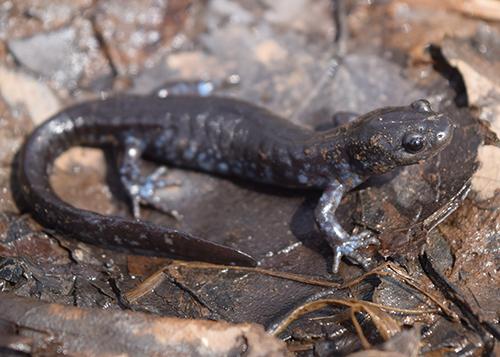
While many Connecticut residents are familiar with the charismatic spotted salamander, the much smaller blue-spotted salamander, another member of the “mole” salamander family (Ambystomatidae), is no less charismatic but not commonly encountered!
This state-listed species occurs in two forms; a genetically pure form and a hybridized form. The pure, naturally diploid blue-spotted salamander is an endangered species in Connecticut that occurs in isolated areas where individuals do not have the opportunity to mate with the Jefferson salamander.
Blue-spotted salamanders spend most of the year underground, usually beneath leaf litter where they feed on insects, slugs, worms, and other small invertebrates.
More on the blue-spotted salamander . . .
| |
|
Stay Connected!
Follow us on Social Media
| |
|
-- Quick Links --
Your Feedback Is Important to Us!
Send your comments or suggestions to deep.ctwildlife@ct.gov
|  | |
The Connecticut Department of Energy and Environmental Protection is an Affirmative Action/Equal Opportunity Employer that is committed to complying with the requirements of the Americans with Disabilities Act. If you are seeking a communication aid or service, have limited proficiency in English, wish to file an ADA or Title VI discrimination complaint, or require some other accommodation, including equipment to facilitate virtual participation, please contact the DEEP Office of Diversity and Equity at 860-418-5910 or by email at deep.accommodations@ct.gov. Any person needing an accommodation for hearing impairment may call the State of Connecticut relay number - 711. In order to facilitate efforts to provide an accommodation, please request all accommodations as soon as possible following notice of any agency hearing, meeting, program or event.
This program receives Federal financial assistance from the U.S. Fish and Wildlife Service.
Under Title VI of the 1964 Civil Rights Act, Section 504 of the Rehabilitation Act of 1973, Title II of the Americans with Disabilities Act of 1990, the Age Discrimination Act of 1975, and Title IX of the Education Amendments of 1972, the U.S. Department of the Interior prohibits discrimination on the basis of race, color, national origin, age, sex, or disability. If you believe that you have been discriminated against in any program, activity, or facility, or if you need more information, please write to:
Office of Diversity, Inclusion and Civil Rights
U.S. Department of the Interior 1849 C Street, NW
Washington, D.C. 20240
| | | | |