|
When the Fire Island to Montauk Point project - FIMP - was first authorized by Congress in 1960, Dwight D. Eisenhower was president, and the U.S. had not yet sent a human being into space. FIMP was conceived as a long-range plan to protect Fire Island and other vulnerable shoreline communities through beach restoration, dune construction, and routine renourishment, so we would not have to fight emergency battles every time storms washed our beaches away.
For decades, that promise stalled while storms kept coming and our shoreline kept shrinking. I am writing to tell you that we are finally close to turning that promise into a reality.
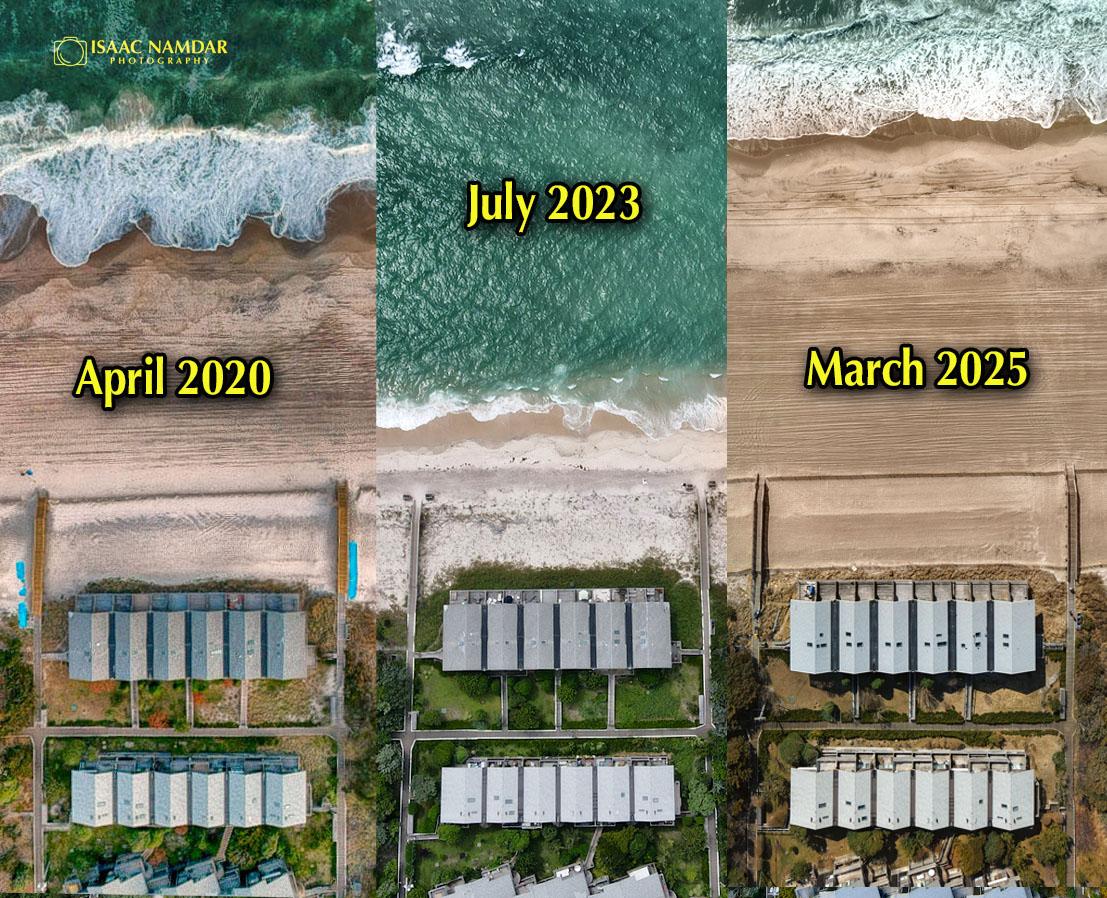
Our journey began in crisis, as you well remember. Christmas Storm Elliott in 2022, followed by two more historic storms, created an existential threat to the Pines and other east end communities on the island. Entire stretches of beach disappeared, and some areas were one serious storm away from catastrophic damage. For the first time, it became thinkable that we might lose the place we love.
We did not accept that. We launched a campaign to save the beach and secure its future.
FIPPOA organized a community-wide effort and forged a partnership with Seaview to save our beaches. Together, we mounted an intensive lobbying and public relations campaign to build a coalition of elected officials and allies willing to come to our aid.
Thanks to Governor Kathy Hochul, we secured $3 million in state aid to build a temporary line of trap bags in the most vulnerable areas. That emergency measure bought us time and likely saved multiple homes.
We pushed for a full rebuild. The U.S. Army Corps of Engineers had told us "no" more than once, but through relentless advocacy, a unified community effort, and the critical assistance of Senator Chuck Schumer, we persuaded the Corps to undertake an emergency restoration of the east end of Fire Island. Completed last year, that roughly $52 million project resulted in a vast new beach and renewed protection.
But a single rebuild can still leave you reliving the same nightmare over time. Our final goal was to secure routine renourishment for the next 25 to 30 years, fulfilling the promise of FIMP, so our beaches could be regularly maintained.
Efforts to implement the FIMP plan had taken many twists and turns over the decades, but they took on new urgency after Hurricane Sandy and subsequent storms. Following the $52 million beach restoration, FIPPOA and Seaview partnered with the Fire Island Association to persuade five Long Island towns and Suffolk County to sign onto required cost-sharing agreements.
Governor Hochul, who had become a champion of the Pines in the course of our campaign for the emergency beach replenishment, got the state legislature to approve an extraordinary $1.7 billion in funding for FIMP. FIPPOA and our two partners then embarked on a year-long effort to persuade mayors and supervisors across the south shore to sign their cost-sharing agreements.
Our efforts reached an historic milestone last week: Six local governments - Babylon, Brookhaven, East Hampton, Islip, Suffolk County, and Southampton - have signed the agreements FIMP needs to proceed.
We are now close to the finish line. Remaining approvals are needed from the state Department of Environmental Conservation, the state attorney general, the U.S. Army Corps of Engineers, and the state comptroller. These final steps are far more straightforward than securing six municipal agreements and state financing, but we are not taking anything for granted.
When these approvals are complete, Fire Island - and the entire south shore of Suffolk County - will finally have what FIMP promised a half-century ago: a system for restoring beaches before a crisis becomes a catastrophe.
The cost of each new project will be shared: Fifty percent by the federal government, 35 percent by the state, and 15 percent by localities such as the Pines - substantially less than the 100 percent we had been shouldering for decades prior to the emergency project.
While the state has already committed its 35 percent, thanks to Hochul, we will need to push for the federal contribution each time; our efforts over the past four years will not be our last.
In just a few years, we have gone from staring down the possible loss of our beach to securing a $52 million emergency restoration, and then helping to unlock a once-in-a-generation coastal protection program. That has only been possible because so many members of the Pines community wrote, called, donated, and showed up when it counted.
I am deeply grateful for your support and look forward to writing again, with hope for the last time in this long saga, when the final signatures are in place and this achievement is fully realized.
Best wishes,
Henry
|