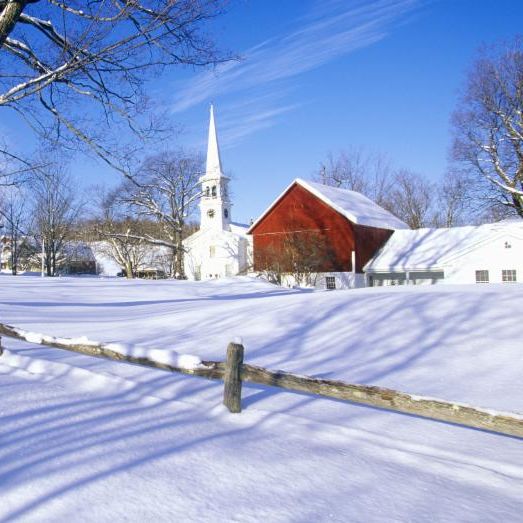
| | Last year at this time, after an unusually warm spell from Christmas through Epiphany, we in Wisconsin, along with much of the rest of the country, found ourselves in mid-January digging ourselves out from a snowstorm that left over a foot of bright, drifting, all-blanketing snow. After trying to keep up with the snow through three passes over our driveway and sidewalk with hand-powered shovels, we bundled up to greet what suddenly felt like a new neighborhood, and a new world. Rather than her usual stroller, bike, or scooter, our young Reverie sat plush on a sheepskin-lined sled as we walked down the middle of the road. The snow was not only everywhere underfoot, but it also rose head-high in the drifts and snowplow piles, and the snow vaulted above us, too, clinging like white paint or shaving cream on the windward side of all the trees, from the base of their trunks to the tip of their branches, rendering the shapes of the branches more noticeable and more fantastical than ever. On some trees like the maples and ash, the snow seemed to defy gravity, reaching up from the tree to the sky. On others, the snow made its weight known, pulling the branches down, as with the Norway spruce that now looked like folded-up umbrellas and the birches that bent and arced completely over, forming tunnels.
As our walk through the winter wonderland continued, it became clear that the snow not only transformed the landscape, but also transformed human behavior and interaction. Neighbors were quicker than usual to greet one another and join in a feeling of mutual marveling, or, if a bit sore from all the shoveling, mutual complaint. They were quicker to offer help, too, as when at the end of the block a vehicle got stuck in the snow. After my spouse and I couldn’t budge it with our shoulders pushing from the back, two pickup trucks suddenly arrived with shovels and chains to offer help. Steeped in children’s’ books like The Little Blue Truck series, Reverie quickly understood and cheered on this particular social occasion of neighbors helping neighbors. “They’re lending a helping hand,” she said. Like the rain that Jesus taught falls equally upon all (Matthew 5:45), snow, too, can be a great social equalizer and an invitation from the elements to remember and embrace our essential togetherness and interdependence.
Given the power of snow to transform the world and our way of being in it, I’ve been trying to reflect on some of the spiritual dimensions and wisdom of snow. Of the couple-dozen references to snow in the Bible, there are only a few that seem to refer to actual (not metaphorical) snow. Fittingly for a scripture written in a Mediterranean climate, where there are primarily two seasons—one hot and dry, the other moderately cool and wet with rain—the Bible has very little to say about the power and beauty of a good blizzard.
What, then, are we to make of a world suddenly transformed by a foot of new snow—changed in color, changed in brightness and luminescence, changed in smell, in sound, in temperature and feel? Snow that changes us? Languages and cultures indigenous to snowy climates have much to say about this, of course. Although not quite the clichéd “100 words for snow,” the Yupik and Inuit languages do have between 40 and 70 different words for describing different qualities of snow, including “tliyel,” snow that has been marked by wolves.
- hiryla—snow in beards
- kriplyana—snow that looks blue in the early morning
- intla—snow that has drifted indoors
- sotla—snow sparkling with sunlight
- tlun—snow sparkling with moonlight
- astrila—snow sparkling with starlight
- clim—snow sparkling with flashlight or headlight
- tlapi—summer snow
Linguists count at least 25 words for snow in Swedish, including one that reminds me that we in Wisconsin still have more to come from the snowy season: “Aprilsno,” snow in April. Icelandic has about 50 words, including “mjoll,” fresh snow. The Sami have about 180 words, including “skava,” a thin layer of frozen snow. The most verbose snow vocabulary seems to belong to the Scots language, with 421 words for snow, including such delights as “feefle” (swirling snow), “flindrikin” (brief snow), and “spitters” (small flakes of wind-driven snow).
- snaw-pouther—fine, driving snow
- skelf—large snowflake snow
- sneesl—to begin to rain or snow
The sudden change to the world and to our way of being in it strikes me as one of the main spiritual teachings and effects of snow. Whereas rain doesn’t dramatically change the color of the world—and can often be absorbed into the earth quickly or evaporate with a bit of sun—snow, if it sticks at all, quickly changes things. With snow there is a sense that something new and real and transformative is happening.
Ralph Waldo Emerson captured this feeling well in a dramatic moment in his famous, and at the time controversial, Harvard Divinity School Address of 1838. The speech in general is a critique of the Church for being out of touch with Nature—the official title was “Acquaint Thyself First Hand with Deity.” In a passage that I think would resonate today with those in the spiritual-but-not-religious camp, Emerson describes a moment of sitting in a church pew, listening to a preacher whom Emerson found so dull and so out-of-touch with nature that he says he was tempted never to go to church again. Emerson found his gaze drawn out the window, as the early New England churches tended to have not stained-glass but clear windowpanes. “A snowstorm was falling around us,” he wrote. “The snowstorm was real; the preacher merely spectral; and the eye felt the sad contrast in looking at him, and then out of the window behind him, into the beautiful meteor of snow.”
As I look out through my own clear windows into a winter world recently visited by a beautiful meteor of snow, I try to stay close to the feeling that the world around me has been changed, and that I, too, as a part of the winter world am a part of the change. I now try to see snow as a powerful way of encountering the world in a new way. I see snow, for example, as a way of seeing the world, like a new lens, as the snow makes the outline of my neighbors’ homes more visible and apparent, as it makes the contours of the landscape, the gentle hills, easier to comprehend, as it, like a diffuse ground-level lighting system, adds luminescence and brightens the world, by day and by night. I now hear snow as a way of hearing the world, which can be soft and stealthy like an owl in flight, or can crunch and squeak underfoot. Snow makes the world sound softer but at the same time clearer. Snow is stillness and peace and snow is squall and confusion. Snow is a new and a present moment thing, and snow is memory, holding images from the past in an almost proto-photographic way, capturing and keeping impressions and prints—footprints, tracks, wingprints, windprints, icicle-drip prints, snow-falling-on-snow prints.
Snow is ethereal at first, almost immaterial, but over time, left to settle rather than melt, snow solidifies and materializes, and like a mini-glacier it coheres and becomes one thing—a blanket, we call it, using a warm word to describe a cold thing. And that, perhaps, is another spiritual power of snow—through that which is cold, snow evokes within us a feeling and a necessity for warmth, for coziness, for neighborliness, for love—and hence the often cold-weather associations with cultural practices of gift giving, holidays, hospitality, generosity, visiting and checking in with family and loved ones—and of course, the pure joy, especially when you’re young at heart like Reverie, of making snow angels, and snowpeople, and getting your first pair of skis and learning to scoot right down the middle of the road because there’s lots of snow and not many cars out, and making a pretend birthday cake out of snow and using icicles as the candles, and best of all, eating fresh snow by the mitten and frozen-hand-full.
In Job 38: 22, God asks Job whether he has found “the treasures of the snow,” inviting us to wonder if we, too, have discovered and found and appreciated the beauty and power and mystery of a newly snow-covered world. In our climate-changed and changing world, while we still have winter, while we still have this frozen water-stuff with us, may we never tire of marveling at it, and being inspired and changed and graced by it. And so for the gift and the hope and the prayer of a good snowy winter—thanks be to God.
Daniel Cooperrider is the author of “Speak With the Earth and it Will Teach You” and convening pastor of Flicker Wild Church.
Note: This celebration of winter is based on phenological notes from Madison, Wisconsin, January 2024.
Questions for Reflection
- What is your spiritual relationship to winter and to snow?
- What might snow, as a phenomenon of God’s creation, have to teach us about its Maker?
- Author and travel blogger Anamika Mishra writes: “Winter is not a season, it’s a celebration.” What spiritual practices or winter activities help you experience, honor and align with winter as a celebration?
|