|
Who was the worst Health Secretary, in my sixty odd years?
There’ve been some numpties but probably Andrew Lansley. He had a plan that swung a wrecking ball through the NHS.
Licensed by a bewildered David Cameron.
More recently? Wes Streeting. He had no plan but still swung a wrecking ball through the system.
He’s so dangerous I’d have locked him up. Why Burnham has put him in-charge of the nation’s defence is beyond me.
However… the worst is yet to come.
Yvette Cooper will end up tagged, ’the worst’, because...
... she’s likely to be in place at the next election (by all accounts in the spring) and be the one who’ll be identified as not delivering on Labour’s simple promise…
...to sort out waiting lists.
History won’t be kind. The public will certainly not be kind. The situation is not of Cooper’s making but she’ll be punished, standing in the rubble of the latest re-disorganisation.
Cooper, the rest of the ministerial team and the top echelons of the NHS will have wasted the best part of three years acquiescing in the demolition of the NHS and...
... will spend the rest of Labour’s term, trying to put it back together again.
There’s no time to focus on the one thing that maters... WAITING!
It’s not easy… there’s a puzzle.
The NHS is doing more. More appointments, tests, operations. Staff are working harder, hospitals are running hot.
NHS performance is up, by 0.6 percentage points in a month, and by approximately four points compared with September 2025, and...
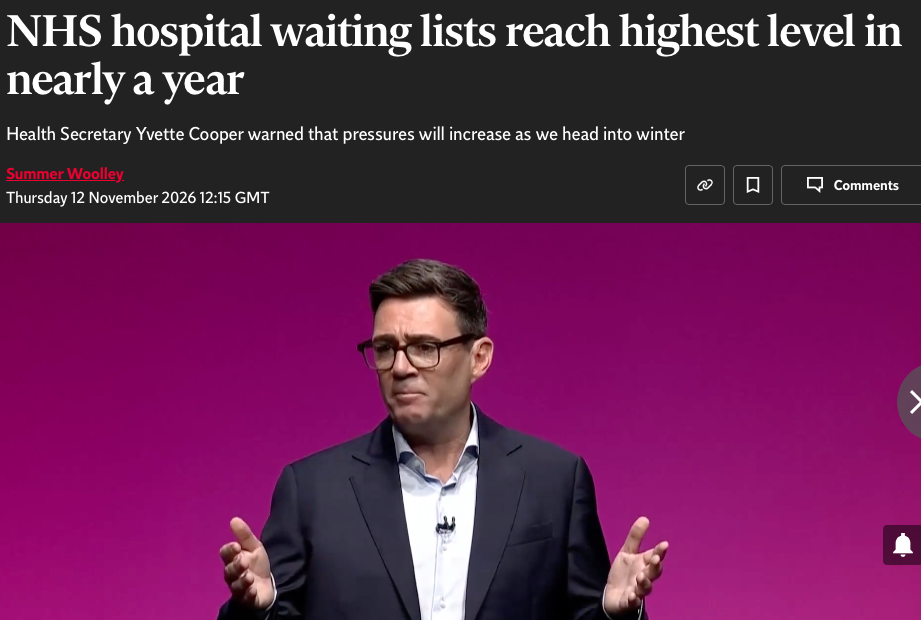
... ministers are telling us the waiting list is coming down.
Except… it isn't.
The latest figures show that since the beginning of the financial year, the waiting list has grown by around 270,000.
It's now 7.38 million.
That's a lot of people waiting to get back to 92% of patients waiting no longer than 18 weeks for treatment.
Where are we?
65.8%… ouch... that's 26.2 percentage points to find, with less than two and a half years left.
There’s been progress. When Labour took office, performance was around 59%, but… progress is not the same as being on course.
The Institute for Government's latest Performance Tracker suggests that, on present trends, the NHS will reach only 79% by March 2029.
The Health Foundation say;
‘… [sic]..on recent trends, by July 2029 the waiting time within which 92% of patients are treated could still be almost 35 weeks.’
Welcome to the arithmetic of queues.
Every month, patients join the waiting list.
Every month, patients leave it.
Some have treatment. Others, removed because they no longer need it, have gone elsewhere or for other legitimate reasons.
If more join than leave, the list grows. It doesn't matter how many press releases are issued, how many initiatives are launched or how many politicians visit operating theatres.
The arithmetic always wins.
Labour's pledge isn't specifically to halve the numbers on the waiting list...
... it's to get 92% of patients
treated within 18 weeks...
Meaning, in theory, performance can improve while the list grows.
In practice, an expanding backlog makes sustained improvement harder, particularly when demand keeps arriving and capacity is stretched.
Some modelling estimates suggest the NHS waiting list will need to fall from 7.4 million to around 3.5 million to meet Labour’s 92% within 18 weeks pledge by March 2029. Effectively halving the backlog.
The NHS is capable of short bursts of improvement but not the sustained recovery to deliver the promise.
There are three questions Cooper has to answer;
First, where is the capacity coming from?
Not in a strategy document. In actual operating theatres, diagnostic departments, outpatient clinics, the workforce needed to run them and social care support?
Second, how much of the improvement comes from treating patients…
… and how much from validating and administratively clearing waiting lists? Both have a place. They’re not the same thing.
Third, who is managing the whole patient journey?
Edwards Deming warned against optimising the parts at the expense of the whole
A faster scan is no use if the patient waits months for an outpatient appointment.
An extra clinic achieves little if the bottleneck simply moves to surgery.
It's the old management problem; improve one part of the system and the queue reappears somewhere else.
Meanwhile, Cooper is re-dismantling the NHS. ICBs are losing staff. Responsibilities are being redistributed and managers are spending time worrying about their own futures.
When the the party's over and the music stops, Cooper will be standing in the rubble of a part-demolished system, holding the waiting list, and…
… the voters will know exactly how long they’ve been on it.
|