|
Can't see the images? Click "Show Content" or "Trust Sender"
at the top of your email.
| Behavior Support Newsletter | |
This newsletter is intended for educators and other interested parties who have a role in providing student services. Any information contained is to provide updates to the field on student services matters.
This newsletter should not be forwarded.
| |
Welcome to the 2026-2027 school year! We hope you all had a restful summer and are excited to be back. At the Utah State Board of Education (USBE), we have been working hard all summer, developing professional learning opportunities, technical assistance documents and resources to support Utah students and educators. Our focus this year will be on Tier 1 behavior support and prevention. A strong system of Tier 1 supports sets the foundation for effective learning. It allows educators to intervene early to prevent behaviors from getting worse.
Benefits include:
- Improved clarity with roles and responsibilities, discipline procedures referral processes and available supports
- Improved teaming and shared responsibility, resulting in decreased burnout
- Data-based decision making
- Improved student and staff morale
- Improved academic performance
- Improved attendance
- Fewer behaviors
Effective Tier 1 practices include:
- An established leadership team that meets regularly to analyze student data
- Established school-wide social/behavioral standards that have been developed by staff
- Clear roles and responsibilities
- A plan for teaching and reteaching established social/behavioral standards
- Established systems for data collection and review
- A fully developed discipline matrix with a continuum of identified supports and consequences for student behavior
- Identified classroom-based supports that are implemented by all staff (for example, classroom agreements, short transition times or student greetings)
While Tier 1 supports should ideally be implemented as part of a comprehensive, school-wide multi-tiered system of support (MTSS), supports can also be implemented within each classroom. USBE has several resources available to support educators in implementing Tier 1 supports:
In addition, USBE is hosting several professional development opportunities in the next year, including a two-day summit with John Hannigan focused on Tier 1 and Tier 2 systems (See the “Mark Your Calendar” section of this newsletter for registration information), communities of practice, and two full-day trainings on Tier 1 supports.
As the new school year begins, we encourage you all to look at your current systems and practices and pick one or two areas to focus on in your setting. Taking the time to establish strong Tier 1 supports now will help improve student behavior and will make your year run much smoother. We are here to support you in your efforts and encourage you to reach out if you have any questions.
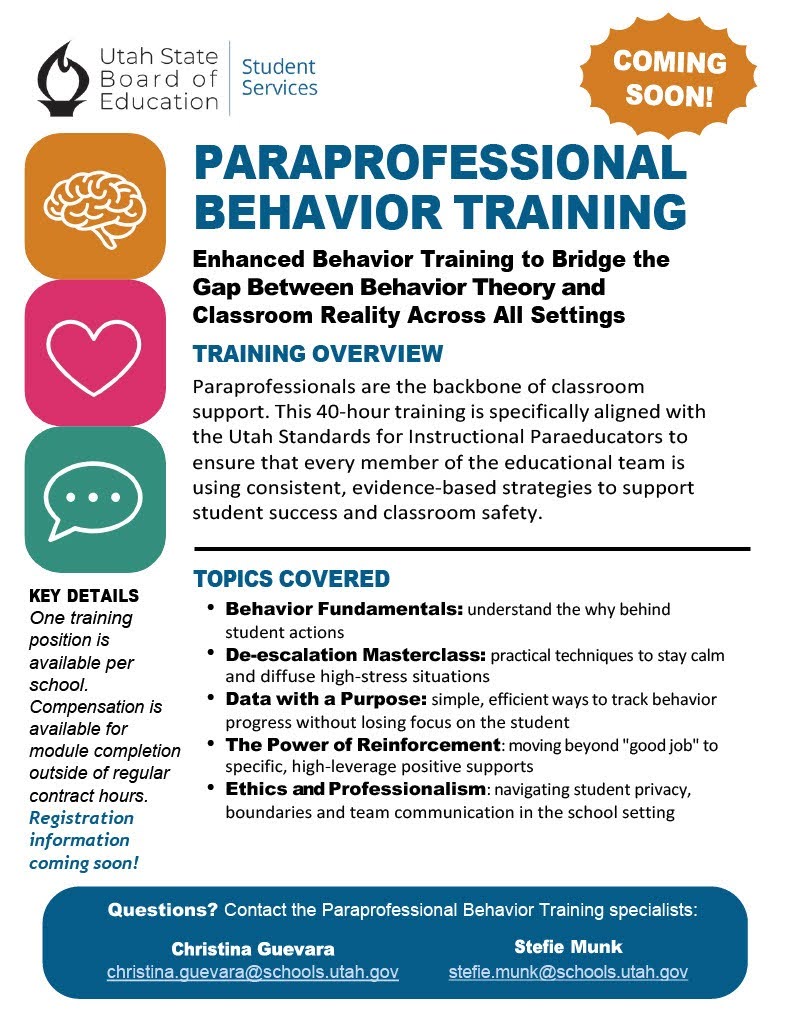
| Paraprofessional Behavior Support Training - Enrollment Details Coming Soon! | |
USBE has been awarded funds from Intermountain Health Care (IHC) to develop a 40-hour course to train paraprofessionals across the state on behavior support. The grant allows one paraprofessional from each school in Utah to take the course and receive compensation for the time they spend outside of contract hours completing the course.
The course modules are as follows:
- Roles and responsibilities of paraprofessionals, with a focus on behavior
- Behavior basics and the learning environment, including brain development, functions of behavior and tiered supports
- Data collection - the why, when, how and where
- Behavior plans and supports with a focus on Tier 3 interventions and implementation
- Crisis management, the stages of the Crisis Cycle and adult responses for student support
For questions, please contact Christina Guevara (christina.guevara@schools.utah.gov) and Stefie Munk (stefie.munk@schools.utah.gov), Paraprofessional Behavior Training Specialists.
| |
A functional behavior assessment (FBA) is defined as a systematic process used to understand the function and purpose of a student’s specific, interfering behavior and factors that contribute to the behavior’s occurrence and nonoccurrence for the purpose of developing effective positive behavioral interventions, supports and other strategies to mitigate or eliminate the interfering behavior (USBE Special Education Rules I.E.21). It is often used to develop a behavior intervention plan (BIP), although it can be used to inform other behavior supports. In which of the following circumstances would an FBA be required?
- As part of a special education eligibility evaluation for emotional-behavioral disability (EBD)
- When emergency safety interventions (ESIs) are included in an Individualized Education Program (IEP) as a planned intervention
- If a student’s conduct is determined to be a manifestation of their disability
- All of the above
Correct answer: D
Part of the evaluation requirements for EBD includes an FBA that evaluates the observable behaviors leading to the referral for the educational evaluation (USBE Special Education Rules II.J.5.c). In addition, before ESIs can be included in an IEP as a planned intervention, an FBA must be conducted (USBE Special Education Rules III.I.1.b(5)) and other requirements must be met. Finally, if a student’s conduct is determined to be a manifestation of the student’s disability, the IEP team must conduct a FBA unless the local education agency (LEA) had conducted an FBA before the behavior that resulted in the change of placement occurred.
An FBA is advised in other circumstances, including when a student’s behavior interferes with their access to a free appropriate public education (FAPE) or when needed to inform service provision. The FBA should produce four main results:
- Baseline data on the behavior’s occurrence
- Data gathered from direct observation (and, if applicable, indirect assessment) that includes an operational definition of the behavior, descriptions of the antecedent events that reliably precede the behavior and descriptions of consequent events that reliably follow the behavior
- Description of the possible function(s) of the problem behavior
- A hypothesis statement summarizing the behavior’s antecedents, operational definition, reinforcing consequences and the function(s) maintaining the behavior.
For more information about FBAs, refer to chapter six of the LRBI Technical Assistance Manual.
| |
2026-2027 Foundational Behavior Support Model Training
WHAT: USBE has received requests to open a new Foundational Behavior Support Model Training course in Canvas for the 2026-2027 school year. This will allow those LEA employees who completed the course last year to enroll in the course again.
The new course has the same content as last year’s course and will allow LEAs to re-enroll employees or use this model training to train new employees.
WHO: Per Board Rule R277-608, all school employees who supervise students or who may be asked to assist in managing a student's behavior shall receive foundational behavior support training.
WHEN: The Foundational Behavior Support Model Training must be completed within two months or 30 days* of employment and bi-annually thereafter.
*The 30 day requirement applies if the staff being trained will be working directly with a student with disabilities.
WHERE: LEA employees can enroll in the 2026-2027 Foundational Behavior Support Model Training course in Canvas.
ACTION: Please reach out to Ashley Lower (ashley.lower@schools.utah.gov) or Krisanne Lewis (krisanne.lewis@schools.utah.gov) with any questions.
| |
Updated ESI Implementation and Reporting Requirements
The requirements related to ESIs have changed due to updates made during the 2026 Utah Legislative Session. These changes are detailed in Utah Code Section 53G-8-301 (effective July 1, 2026). Please review this section of code to ensure adjustments are made to your ESI policies and practices.
In response to the changes in code, Board Rule R277-608 will also be updated. The rule passed through the Law and Licensing Committee in August and will go before the full Board in September. Look for those changes in the upcoming months.
One of the changes designates that each “LEA that operates or plans to construct a seclusion room shall report to the state board by December 31, 2026” certain information as required in code. USBE will be collecting this information through a Qualtrics survey. This survey will be released following approval of Board Rule R277-608 by the full Board.
Additionally, Utah eTranscript and Record Exchange (UTREx) has been updated to include all the ESI data that is required to be collected and reported. The new data fields were released in July, and can be found in the UTREx Specifications manual. USBE will continue to monitor the required ESI data throughout the 2026-2027 school year.
Review the 2026-2027 ESI Data Monitoring video for more information on the process for the upcoming school year. Additionally, all superintendents, charter directors, special education directors and Student Services Directors should have received an email with all the information needed to report the ESI data for this monitoring process.
| |
New USBE Learning Portal
We are excited to share the development of the USBE Learning Portal for all requests for professional learning, training, and technical assistance.
You may have previously used the Training Request Portal (TRP), varied forms or direct email to request agency learning assistance. The Learning Portal is now the one-stop portal for all requests across the agency, streamlining the process to ensure you receive timely support.
We have developed multiple resources to assist you in engaging with this new process. We suggest starting with the Learning Portal Overview for a quick three-minute explanation of the entire system.
Additional resources include:
This single, agency-wide system will help streamline requests and help serve you better. Please ask any questions that may come up as this new process is implemented.
| |
Behavior Support Team Resource Hub
Our behavior team is here to support you with training and resources related to behavior support. We encourage you to visit our Behavior Support resource page that is housed in Canvas. Please note that this self-enrollment only allows the user to access the resources; user information will not be shared or used for any other purpose. Questions and requests to add additional resources should be addressed to Krisanne Lewis (krisanne.lewis@schools.utah.gov).
| |
We are excited to highlight schools that are successfully implementing effective behavioral interventions, and we would love to feature your school in our statewide Behavior Support Newsletter.
If you are interested in being featured, we would love to hear more about:
- The behavioral interventions your school is implementing.
- How these strategies are positively impacting students and staff.
- Any success stories or key takeaways that might inspire other schools.
Your insights and experiences could help other educators across the state enhance their own behavior support practices. Submit your spotlight nominations here. We look forward to hearing from you!
| |
The Student Services team would like to build more usable resources for you. We will be creating a series of professional learning resources in the near future and would like to know which topics would be the most helpful.
Please take a minute to complete this short survey and help us identify priority topics. Doing so will take less than 5 minutes and will help us create tailored training resources that will help you expand your professional knowledge and better support your students.
| See the full agenda or visit the Board Meeting webpage (Meeting Summary tab) for information about USBE’s monthly board meetings. | Upcoming Trainings and Workshops | |
Behavior Support and Prevention Summit
WHAT: USBE’s Behavior Support and Prevention teams are excited to host a two-day Behavior Solutions Customized Workshop. This training, based on the work of Dr. John Hannigan and colleagues, will provide a framework for establishing and implementing proactive, tiered behavior supports. This approach is designed to bridge the gap between academic and social behavior instruction through a systematic structure. This workshop will move learning beyond theoretical concepts to build effective interventions that reduce classroom disruption. Participants will leave with a customized framework for their school. This is a free workshop and will be provided at no costs for participants. Relicensure credit will be offered to attendees.
WHO: This training is designed for educators at all levels. School teams (teachers, administrators, related service providers, etc.) are encouraged to attend together in order to facilitate framework development.
WHEN:
- Thursday, September 24, 2026 | 8:00 a.m. - 3:30 p.m.
- Friday, September 25, 2026 | 8:00 a.m. - 3:30 p.m.
WHERE:
- Utah Valley Convention Center |220 W Center St., Provo, UT 84601
ACTION: Registration is open until August 28, 2026 via the Behavior Support and Prevention survey.
INFORMATION: For more information, contact Krisanne Lewis (krisanne.lewis@schools.utah.gov) or Tanya Albornoz (tanya.albornoz@schools.utah.gov).
There is no cost for registration, however any and all travel costs are the responsibility of the traveler.
| |
Youth Mental Health First Aid (YMHFA) Trainings
WHAT: The USBE will be hosting multiple YMHFA trainings throughout the 2026-2027 school year. 7.5 relicensure points are available to those who attend and complete the training, including two hours of pre-work to be completed before the live training session. While school-based mental health professionals may possess advanced clinical training beyond this course, YMHFA offers an essential foundation in mental health support for non-clinicians. This evidence-based training equips educators with practical tools to effectively identify warning signs regarding students' mental health needs which can help students and families to access appropriate resources. This training can improve educator quality and effectiveness, and satisfy statutory requirements for strengthening prevention initiatives, improving school safety and mental health literacy (Utah Code Sections 53G-8-802, 53F-2-525, and Board Rule R277-622).
WHO: School personnel supporting students from ages 12-18
WHEN:
- September 17, 2026 | 8:00 a.m. - 3:00 p.m
- October 29, 2026 | 8:00 a.m. - 3:00 p.m
- January 15, 2026 | 8:00 a.m. - 3:00 p.m
- Friday, February 12, 2027 | 8:00 a.m. - 3:00 p.m
- March 18, 2027 | 8:00 a.m. - 3:00 p.m
- Thursday, April 15, 2027 | 8:00 a.m. - 3:00 p.m
WHERE: Virtually via Zoom
ACTION: Register via Altitude
INFORMATION: YMHFA is a curriculum that focuses on how to help an adolescent (age 12-18) who is experiencing a mental health or substance use challenge or is in crisis. YMHFA is primarily designed for adults who regularly interact with young people. The course introduces common mental health challenges for youth, reviews typical adolescent development and teaches a five-step action plan for how to help young people in both crisis and non-crisis situations. To learn more, download the Mental Health First Aid for Youth one-pager.
|
Lunch and Learn Webinar Series for School Year 2026-2027
WHAT: Join the Prevention and Student Services teams at USBE for a monthly Lunch and Learn webinar series focused on helping educators create the conditions that support student success. Topics include protective factors, prevention science, behavior support and other evidence-informed practices that foster safe, supportive, and engaging learning environments. For detailed descriptions, please visit the USBE Prevention Professional Learning webpage.
WHO: School administrators, prevention staff, behavior specialists, school counselors, social workers, teachers, school mentors and staff who work directly with students.
WHEN: Sessions are held from 12:00 p.m. to 1:00 p.m. on the third Thursday of each month, except in August and October, when webinars occur on the last Thursday of the month.
WHERE: Webinars will be held virtually.
ACTION: You only need to register once for the entire webinar series. Please register via the Prevention and Student Services Webinar Series SY 26-27 Zoom link. Please feel free to share the flyer and registration link with anyone who may be interested.
INFORMATION: For more information, please contact us at prevention@schools.utah.gov or reach out to Tanya Albornoz (tanya.albornoz@schools.utah.gov) or
Krisanne Lewis (krisanne.lewis@schools.utah.gov).
|
Manifestation Determination Review (MDR) Training Registration
WHAT: USBE is offering professional learning related to MDR requirements and related issues.
WHO: This opportunity is available to Utah charter school administrators or their designated staff.
WHEN: Friday, September 11, 2026 |12:00 p.m. - 2:00 p.m.
WHERE: Participants may attend in person or online. Participants joining virtually will be sent a link prior to the event. In-person attendance is encouraged.
The address is as follows:
USBE South Boardroom
250 E 500 S
Salt Lake City, UT 84111
ACTION: Register via the registration survey. Registration closes August 28, 2026.
INFORMATION: For questions, please reach out to Krisanne Lewis (krisanne.lewis@schools.utah.gov).
|
PREPaRE Workshop I, Comprehensive School Safety Planning: Prevention Through Recovery
WHAT: PREPaRE Workshop 1 is the curriculum chosen by the State Security Chief. This one-day workshop provides essential strategies for integrated school safety and crisis response. The course covers the development of Incident Command System (ICS) safety teams and crisis plans to improve a school's overall readiness and crisis response capabilities.
WHO: Any school personnel who need to understand how the comprehensive school crisis team is organized and functions.
WHEN: October 20, 2026 | 8:00 a.m. - 4:00 p.m.
WHERE: USU Brigham City | 989 S Main Street, Brigham City, UT 84302
ACTION: Register via Altitude
Note: Registration will close at 5:00 p.m. on October 9, 2026.
| | | | |