|
The Episcopal Diocese
of Northern California
Beloved Community
Resource Newsletter
Published by
The Commission for
Intercultural Ministries
| | | Episcopal Church Becoming Beloved Community | | |
Newsletter Highlights:
- Indigenous Peoples' Day - Episcopal Diocese of Northern California
- Dean Matthew Shares Indigenous Peoples Day Worship Highlights for this Sunday
- Advocacy
- Peace Building in Eastern Congo Connected to our Advocacy and Creation Care Ministries
- Embracing Accessibility in Sacred Ground
- Faith and Freedom Across the Waters: Reflections on the Black Atlantic (1500-1800) - Excerpts from a PBS Documentary Compiled by the Very Rev. Bob Scott
- More Diocesan Churches Implementing Energy Efficiency Projects to Reduce Their Carbon Footprints and Save Money on Their Utility Bills
- A New Green Place
- Oasis
| | |
Facebook I Episcopal Diocese of Northern California I Posted October 13, 2025
Indigenous Peoples’ Day is a federal holiday that commemorates the rich history, culture, and achievements of Indigenous American communities. We would like to take this moment to acknowledge and honor the history of the beautiful land upon which our churches currently sit.
There are 44 federally recognized Native American tribes in our Diocese, each with a unique story. The Episcopal Diocese of Northern California seeks to embrace this wonderful diversity and continually build collaborative relationships with indigenous communities.
Did you know The Episcopal Church offers a guide to land acknowledgements for groups who are interested in adopting the practice? Check out The Office of Indigenous Ministries on The Episcopal Church website for more resources and information.
| |
Dean Matthew Shares Indigenous Peoples Day Worship Highlights for this Sunday
News from Trinity Cathedral I Posted October 9, 2025
| | Dean Matthew with his dog, River | | |
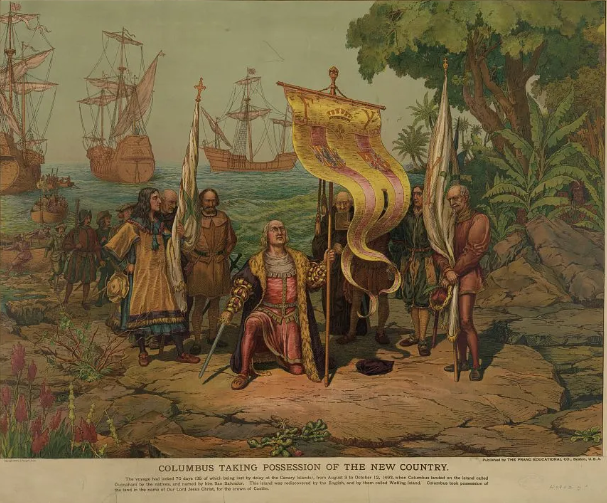
Columbus Day Celebrates an Ongoing Christian Nationalism Threat to American Democracy
White Too Long Newsletter I Robert P. Jones I Posted October 13, 2025
| Columbus taking possession of the new country, 1893 print. Library of Congress. | Amid rapid demographic changes—today only 42% of Americans identify as white and Christian—and cultural reckoning with the legacy of racism in our nation’s history, replacing Columbus Day with Indigenous Peoples’ Day would represent a meaningful step forward. Columbus Day inevitably celebrates both the colonizer and the religious worldview that authorized the violence unleashed in his wake. But Indigenous Peoples’ Day points Americans forward toward our higher principles. | | |
Grant applications open to screen "SUGARCANE" and deepen truth-telling around Native American boarding schools
Episcopal News Service I Episcopal Divinity School I Posted October 14, 2025
Episcopal Divinity School has launched a small grants program to support faith communities in hosting screenings of the documentary film, SUGARCANE. Directed by Julian Brave NoiseCat and Emily Kassie, the film follows a groundbreaking investigation exposing a shocking cover-up of cultural genocide perpetrated by the church and government and illuminates the enduring love, beauty and courage of an Indigenous community. [The deadline to apply for the grant is October 31st.]
This initiative is part of a larger effort to encourage truth-telling and reconciliation within The Episcopal Church and beyond. The film offers an opportunity for congregations to engage with the painful history of Native American boarding schools, including our own denomination’s role in this legacy.
| |
Webinar invitation:
'Embracing Accessibility in Sacred Ground'
Oct. 28, 1-2:30 p.m. ET [10-11:30 p.m. PT]
Join this webinar to hear from members of the Sacred Ground community who have personal experience with hearing and vision accessibility issues to consider what facilitators and organizers can do to improve accessibility and what resources are available.
The webinar includes Q&A time and an open invitation for people with accessibility needs to share feedback at any time.
Sacred Ground is The Episcopal Church’s 11-part film- and readings-based dialogue series on race and faith. It began in 2019 and launched its program year this month.
| | |
Dear Friends,
In a time when so many are asking what can we do, we respond, "Tell the story, and remind people of God's Dream". It can feel small but it is a powerful and faithful act of resistance.
If you didn't catch our last email, Jen and Will's work, formerly known as Tell Me the Truth About Racism has a new name, Sowing Seeds in the Sand. This rebranding reflects the vast power our method has to open up rich conversation through our faith for all ages (including our new nature stories). Check out our new website if you've missed it.
Our antiracism work continues just as before. In fact, in addition to our storyteller trainings which over 100 of you have experienced (next training in January), we now offer a facilitator training which takes advantage of prerecorded story videos. The next facilitator training begins next week Oct 23 11-2pm Central, and wraps up the following Thursday Oct 30 at the same time. Can you join us for that as a way to start dismantling racism in your community?
Blessings to you however you continue the work.
Will and Jen
| |
Have Mercy Initiative
"The Gospel is political. But it is political in a particular way. Jesus announced a reign that had no military, maintained unclear borders, called for mercy and compassion as fundamental ways of living, and turned conventional values upside down. Following the lead of VTS graduate Bishop Mariann Edgar Budde, 'Have Mercy' is a series of essays from the faculty of Virginia Theological Seminary and The General Theological Seminary that explore the power of the Gospel for this political moment. These essays aim to be a resource to Christian leaders and the faith communities they serve...The essays were published weekly during the summer of 2025."
| |
Bishop Mariann Budde and Poet-Theologian Pádraig Ó Tuama brought themes of sanctuary and courage to 2025 Hobart Lecture
Episcopal News Service I Episcopal Diocese of New York I Posted October 17, 2025
| |
“Sanctuary: Space of Belonging and Thriving"
YouTube I Theology at Saint Thomas Church I Posted October 16, 2025
| The conversation drew a packed audience in person at Saint Thomas Church Fifth Avenue and many more via livestream, engaging themes of sanctuary, courage, borders, and belonging in faith, culture, and public life. | | |
Bishop Mariann Budde on How to be Brave in the Face of Fear
Marianne Budde Substack I Reflections on Courage, Faith, and the Work of Love cross-posted an episode from The Contrarian I Posted October 17, 2025
| |
We tend to fixate on moments when we see people doing something really extraordinarily brave, but to see the whole backstory of their lives and their humanity, and the progression, that allows us to find ourselves on that same path, and when our moments come, and they do come, we have more to work with when it’s our turn to step up and be brave.
The pair also discuss Bishop Budde’s new book We Can Be Brave, which addresses teens and young adults and examines the important life lessons we learn when faced with difficult choices. As the Bishop explains, it’s much easier to teach through the medium of narrative rather than didactic lecture. However, the lessons in We Can Be Brave are relevant to all readers.
| |
'Our Commitment to Love and Serve All Migrants is Unwavering'
The Living Church I Neva Rae Fox I Posted October 1, 2025
| | |
In January, an executive order from the Trump administration called for closing the refugee resettlement program. On May 12, Presiding Bishop Sean Rowe announced the ministry would not resettle white Afrikaners despite a government order, and that it was pulling out of partnership with the federal government as of September 30, the end of the government’s fiscal year.
While this action was sparked “as a result of everything that happened in the Trump administration,” Shipman said that, for the Episcopal Church, “the Afrikaners were the final straw.”
“Funding from the U.S. government completely funded our resettlement effort,” she said. “You cannot do refugee resettlement without being a federal contractor. The decision to terminate that contract meant that we lost all those funds.”
Nonetheless, Shipman said work has not stopped. “The most important thing for people to know is our commitment to supporting migrants has not changed just because we no longer are a federal contractor in the United States refugee resettlement.”
Photo: The Rev. Sarah Shipman, Episcopal Migration Ministries director I EMM
| |
Update on the Sensitive Locations Lawsuit
House of Deputies Newsletter I Posted September 2025
| | |
Sacred spaces should never be places of fear. Yet today, our sanctuaries are less safe because of a harmful policy change.
For more than thirty years, the federal government’s “sensitive locations” policy protected churches, schools, and hospitals from immigration enforcement, recognizing these as sacred and essential community spaces. That protection was abruptly rescinded in January. Since then, many congregations, including Episcopal churches, have experienced real harm: sharp declines in worship attendance and ministry participation, increased fear among members, immigrant and nonimmigrant alike, and costly security measures that conflict with our call to hospitality.
Earlier this year, The Episcopal Church joined a broad interfaith coalition in filing suit to challenge this rescission. This week, our case has moved forward on appeal with the filing of the opening brief in Mennonite Church USA v. Department of Homeland Security. The brief makes clear why restoring protections for houses of worship is essential to religious freedom, public safety, and the integrity of our ministries.
| | |
She came to her ICE check-in backed by an Episcopal Bishop and 500 supporters
Religion News Service
Aleja Hertzler-McCain
Posted September 16, 2025
Across the country, many faith groups have had longtime practices of accompanying immigrants to ICE check-ins. As the Trump administration’s mass deportation campaign has ramped up and immigrants increasingly fear detention at the routine appointments, many such groups have doubled down on that strategy, believing they can at the very least provide spiritual support and, in some cases, influence decisions to allow immigrants a stay of removal.
| | |
Portland Episcopalian injured during peaceful protest at ICE facility
Episcopal News Service
Melodie Woerman I Posted October 8, 2025
Laura Eckman, a member of Trinity Episcopal Cathedral in Portland, Oregon, suffered minor injuries when standing in protest outside the Immigration and Customs Enforcement building in South Portland on Oct. 4. She was there with her husband, Richard Eckman, a veteran of the Vietnam War. Both are 84.
The two were part of a peaceful crowd that had walked from a park in the Eckmans’ neighborhood to the nearby ICE facility to stand in protest, according to a text message sent by Eckman to her sister, Marjorie Sanders, who posted that message on Facebook.
| | |
Share Your Episcopal Church Journey
TryTank Experimental I The Rev. Lorenzo Lebrija I Posted September 29, 2025
| |
Have you found a home in the Episcopal Church as a Hispanic/Latino person? We’d love to hear your story.
We are conducting a series of one-on-one conversations with Hispanic/Latino individuals who have joined the Episcopal Church.
- Each conversation lasts about 30–45 minutes and focuses on how people experience faith, belonging, and community life within the Church.
- The goal is to listen deeply, learn what feels most welcoming and life-giving, and discover how our language and expressions of faith can reflect the diverse people God has called together.
| | |
ADVOCACY
For questions or information, contact Bob Wohlsen,
Advocacy Team Chair, bob.wohlsen@gmail.com,
Dear Advocates,
The Episcopal Church’s work in the world is being challenged as never before by the policies of our federal government. It’s paramount that we, as citizens and followers of Jesus, speak up loudly and let our voices of Faith be heard. Engage with the advocacy work of the church and advocacy organizations in your community. We all have our part to play and must play it in these dire times. Attending the weekly OGR Legislative Update, writing to your legislators, participating in town halls of your legislators, are just a few of the ways you can be involved.
Read this week's notes - most of the values we hold and the legislation and policies our church supports are threatened and many have been eliminated or disappeared already.
Please be safe and peace be with you.
Bob
| | Peace Building in Eastern Congo Connected to our Advocacy and Creation Care Ministries | | YouTube I Episcopal Church of St. Martin, Davis I Posted October 4, 2025 | | |
Carbon Neutral 2030 project, advocating for peace tied to peace building in Eastern Congo and conflict resolution in our diocese--you are probably wondering how this can be.
The Energy Efficiency Assessments for our 39 churches that are engaged with the diocese’s Carbon Neutral 2030 project were performed by Colby May, energy efficiency expert. His firm, Energy for Purpose, donates a significant portion of the fees they are paid to a peace building organization in Eastern Congo, Energy for Mission.
Colby also taught us about the link between our consumption of resources here in the US and the armed conflict in Congo. Being good stewards of our resources is a key strategy in our creation care work.
Peace Building and Human Rights is a major focus of our church's advocacy work led by the Episcopal Office of Government Relations.
The lessons learned and practices developed by Energy for Mission can teach us how to be peace builders and resolve conflicts here in our churches, communities, and nation.
To further explore this connection, Bob Wohlsen, Carbon Neutral 2030 project coordinator and chair of the EDNC Advocacy team, hosted a conversion with Marcel Serubungo and Colby May. Bob invites you to watch the video to learn more.
| |
"A Promise Kept": California Establishes
First-in-the-Nation Reparations Agency
The Sacramento Observer I CBM Newswire I Antonio Ray Harvey I Posted October 13, 2025
| | |
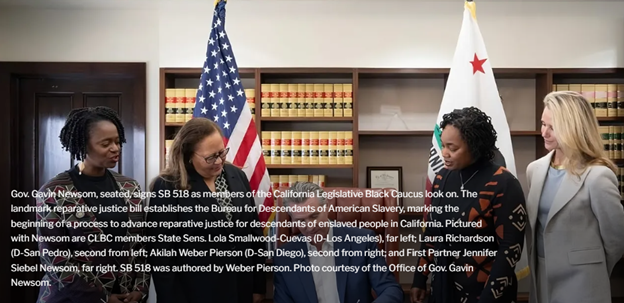
Gov. Gavin Newsom has signed Senate Bill (SB) 518, landmark legislation creating California’s Bureau for Descendants of American Slavery — the first state agency in the nation dedicated to implementing reparations for Black Americans.
“A few days ago, I, with a few other members of the California Legislative Black Caucus (CLBC), met with Gov. Newsom as he signed my bill SB 518 – the Bureau for Descendants of American Slavery,” said Sen. Akilah Weber Pierson (D-San Diego), chair of the CLBC and author of the bill. “California has taken a monumental and historic step toward justice, becoming the first state in the nation to create a permanent agency dedicated to reparative justice for Black Americans.”
| | |
Faith and Freedom Across the Waters:
Reflections on The Black Atlantic (1500–1800)
Excerpts from a PBS documentary compiled by
the Very Rev. Bob Scott
| |
The African Americans Many Rivers to Cross Episode 1: The Black Atlantic (1500-1800)
YouTube I Discriminology I 2016
| | This is the third in my series of articles on racial history and stories. It begins as a powerful journey through the roots of African American history. Hosted by historian Henry Louis Gates Jr., the episode uncovers how the earliest Africans came to the Americas—some free, others enslaved—and how their lives became bound to the economic, political, and spiritual tides of three continents: Africa, Europe, and the Americas. | | Black and White families in the South discover their shared roots | YouTube I CNN I Posted September 16, 2025 | Two families in South Carolina with almost the same last name find each other after generations of separation. The Black Simrils and the White Simrills came from the same plantation more than 200 years ago, and while their shared history is painful, their reunion generations later is full of joy. Watch the full documentary The Simril(l)s: A Family in Black and White on "The Whole Story" with Anderson Cooper. | | |
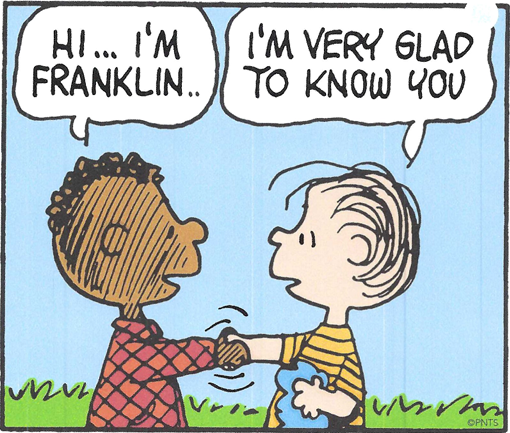
Franklin Armstrong's First Appearance on Peanuts
Facebook I Jon S. Randall Peace Page
Posted July 28, 2018
| On July 31, 1968, a young, black man was reading the newspaper when he saw something that he had never seen before. With tears in his eyes, he started running and screaming throughout the house, calling for his mom. He would show his mom, and, she would gasp, seeing something she thought she would never see in her lifetime. Throughout the nation, there were similar reactions. | |
Why are Citizens Behind Barbed Wire?
Remembering California's Forgotten Internment Camp
| | YouTube I ABC10 I Posted May 30, 2025 | | Arboga Memorial Honors Japanese Americans Interned in California during WWII. | |
More Diocesan Churches Implementing Energy Efficiency Projects to Reduce Their Carbon Footprints and Save Money on Their Utility Bills
Diocesan Churches continue to improve their energy efficiency and save money on their utility costs. Here are recent updates from several churches as they take steps to be Carbon Neutral by 2030.
| | |
INVITATION: EDNC Creation Care Network on Mighty Networks
SPONSOR: Diocesen Commission on the Environment
HOST: Perry Gray-Reneberg (perryggr@gmail.com), Christ Episcopal Church, Eureka, CA
INVITED: Episcopal Diocese of Northern California parishioners and clergy called to care for creation and work for environmental healing.
ACCESS LINK: https://norcal-episcopal-carbon-losers.mn.co/
Our Commission on the Environment (COE) has subscribed to Mighty Networks at the community level with the intention of providing a secure, free online space where we can nurture our diocesan call to care for creation. We invite all in the diocese to join us online and discuss how we, as people of faith, can love our neighbor and honor our Creator in response to global warming, rising seas, degraded habitats, and pollution. We’ll help each other reduce our carbon emissions, conserve (and even generate) energy, minimize our waste, and help our neighbors and selves better live as created ones in communion with all God called “good.”
| |
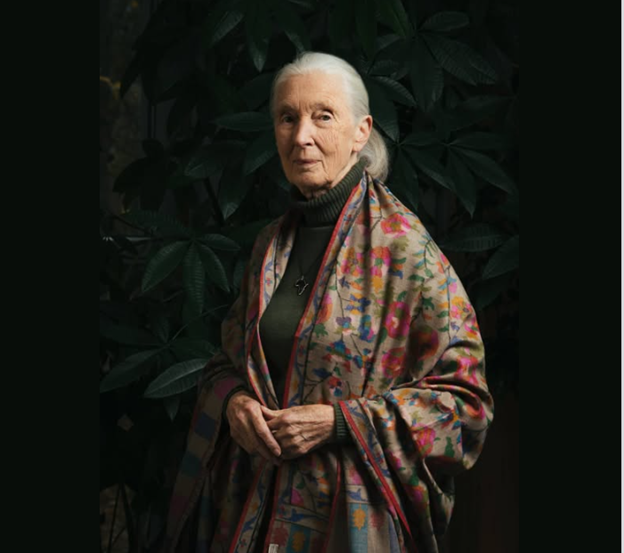
Jane Goodall Saw Nature as a Spiritual Sanctuary
For Goodall, the sacred was not confined to ritual spaces;
it was alive in the luminous weave of life itself.
Religion News Service I Opinion I Joshua M. Greene I Posted October 13, 2025
| | Photo Credit: Marko Zlousic | | |
In a hall filled with robes and rituals, Jane Goodall was the only one without an institutional affiliation. Yet she was the one who spoke most like a spiritual guide. Others invoked Scripture; she invoked the natural world and described sunlight through rain forest leaves as stained glass, and the gaze shared with a chimpanzee as a holy encounter.
That was the summer of 2000, at the United Nations’ World Peace Summit of Religious and Spiritual Leaders. More than 1,500 dignitaries had gathered in New York: priests, bishops, rabbis, imams, shamans, yogis and even chiefs from the remote Queros people of Peru who had never before left their mountain village. My task was to interview delegates. Out of dozens of conversations, none was more memorable than my 90 minutes with Jane Goodall, the primatologist and anthropologist who died Oct. 1 at age 91.
| | |
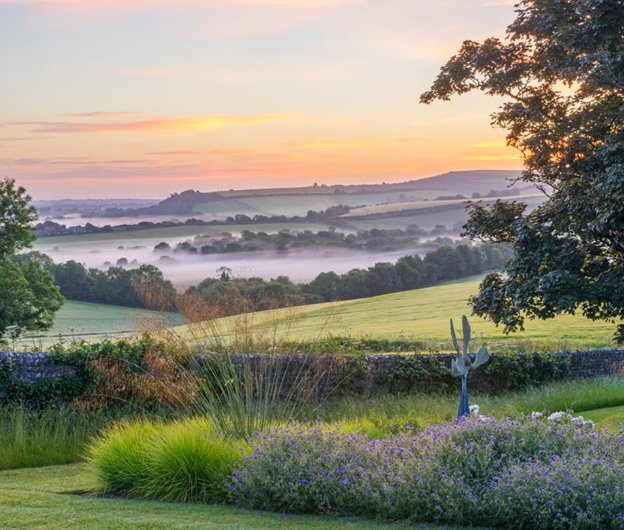
How Planting a 'Sanctuary Garden' Can Improve Your Wellbeing, According to Landscape Designers
Veranda I Rebecca Norris I Posted August 5, 2025
| Marianne Majerus on Pinterest | |
Sanctuary gardens, also called wellness gardens, might be gaining traction on social media, but TOPOPHYLA
landscape architect Eric Arneson says they’re anything but a trend. “Sanctuary gardens aren’t passing fads; they reflect qualities that all good gardens have always had to offer.” Such qualities include flowers, birds, butterflies, bees—a whole habitat, big or small, to ignite the senses. “In today’s fast-paced, high-stress world, people are simply starting to recognize and long for these connections, ones that are deeply rooted in our biology—sanctuary gardens aren’t new trends; they’re just more necessary than ever,” Arneson adds.
| | |
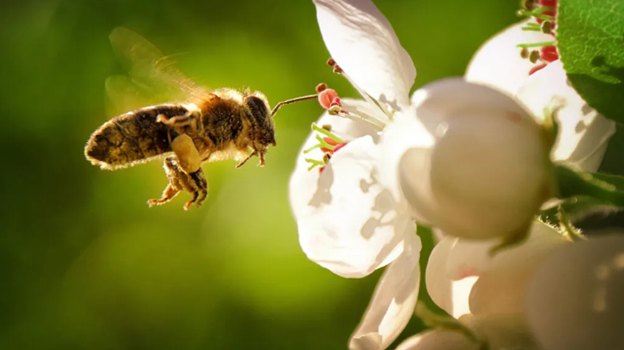
The Spiritual Importance of Honeybees
Guideposts I Kaylin Kaupish
| Credit: Getty Images/iStockphoto | |
Honeybees are an integral part of our natural world. They pollinate the majority of our crops and trees, giving us the food we eat and the air we breathe. But bees also hold a spiritual significance for humanity. They are present in religious life, from the Bible to monasteries. What is it about these tiny insects that connects them to the divine?
Bees in the Bible
Bees are mentioned multiple times in the Bible. Bees in a swarm are often viewed as a prophetic occurrence. In the story of Samson, bees appear in the carcass of a lion he kills, symbolizing a victorious triumph over evil. In the Book of Judges, Deborah was a prophetess who spoke the words of God. Deborah’s Jewish name, Devorah, translates to “bee.”
| |
As followers of Jesus, we are called to follow the way of love that Jesus teaches us, and to love our neighbors as ourselves.
We understand that the laws enacted at the federal and state levels impact the systems that operate within our communities. They either contribute to building just systems and the Beloved Community, or they diminish justice and equity within societal systems. As people of faith, we have an opportunity to advocate for laws that are just and help to build the Beloved Community.
The Action Alerts provided below are supported by the General Convention and/or the Executive Committee. Please review these Action Alerts and consider submitting a letter to elected officials encouraging them to support legislation that builds justice and the Beloved Community.
| | | |
The Episcopal Diocese of Northern California
The Commission for Intercultural Ministries
| | If the content of our newsletters is no longer relevant to you, please unsubscribe below. | | | | |