|
Benchmarks' Child Welfare Webinar Recording & Friday Update
|
| | Child Welfare Webinar January 14, 2021 |
Benchmarks Members,
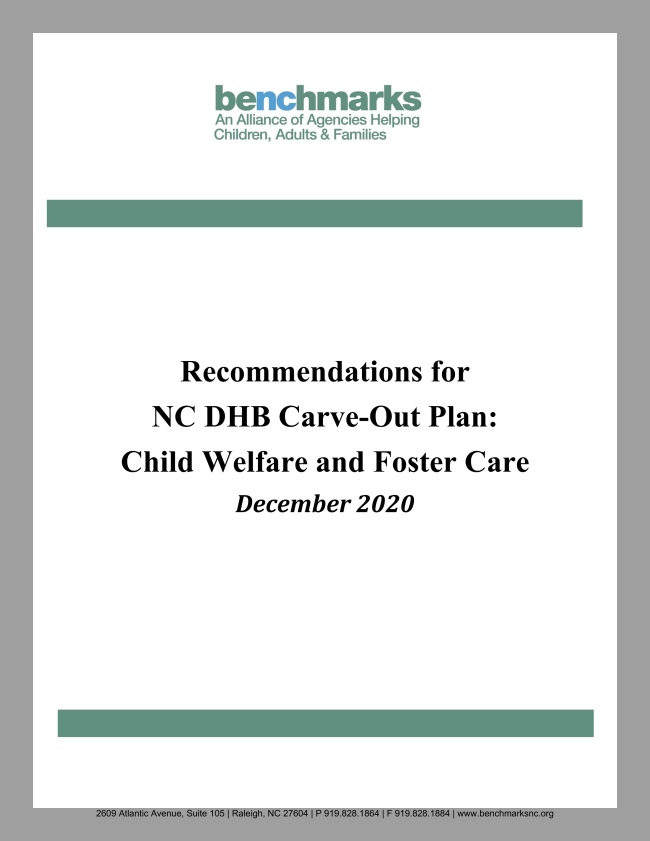
For many years, the members of our association have been discussing ways to improve the foster care system. Benchmarks also implemented a pilot, "Partnering for Excellence", that has been testing (in multiple counties) how to improve the partnership between LME/MCOs and county DSS agencies in an effort to improve outcomes for children in care. Currently, NC DHHS is working on developing a plan to implement a foster care, managed care carve-out that will be set up concurrently with the Tailored Plans. This carve-out offers an amazing opportunity to implement changes to the NC foster care system that could incorporate the recommendation that Benchmarks members have discussed and lessons learned from our Partnering for Excellence (PFE) sites.
In an effort to package the member recommendations we have been hearing, the lessons from PFE and some feedback from county DSS agencies and LME/MCOs, Benchmarks quickly put together a working group to formulate a child welfare carve-out white paper. The group, which consisted of county DSS, LME/MCO and provider reps, met to craft the framework of the white paper. I don't think any of you will be surprised by what you see included in the paper as it captured key points we have been discussing for years including:
- upstream services to support families before removal of the child is necessary
- treat whole families - children enter care because of issues the parents are facing
- acquire clinical assessments early on
- address the family's social determinants of needs to help keep them stabilized
- don't make children "fail up" to receive the level of service they need
- services the child needs should be provided wherever they are placed: foster, kinship, residential, etc
- more and better supports need to be in place to increase kinship care
- provide case management services for foster care
The paper was completed in Decembers and was submitted to DHHS leadership. Our hope is that this document will serve as a catalyst for future conversations with Benchmarks and its members in designing the carve-out model.
Friday Update
NC Cases: 650,926
Cases Hospitalized: 3,909
NC Deaths: 7,825
Positive Tests: 7-day average was 13.5%
COVID Warnings
Laura Leslie, WRAL NEWS, 1/08/21
As North Carolina marked a second straight day with more than 10,000 new coronavirus infections, Dr. Mandy Cohen, state secretary of Health and Human Services, said the anticipated holiday surge is upon us. "This is the most worried that I have been for our state," Cohen said. Given the level of viral spread across the state, Cohen said, "You may have COVID right now and not know it."
She pointed to the exponential nature of coronavirus spread and the believed even greater transmissible nature of a new variant of the virus spreading around the world. "It is possible that variant is here," Cohen said. "It is likely. We are operating as if it is already here."
The state's nurses association is concerned enough to ask Gov. Roy Cooper and Cohen to do more. "We anticipated this given the holidays and Christmas, but I don't think any of us thought that it would be as bad as it has turned out to be," said Dr. Dennis Taylor, president of the North Carolina Nurses Association. "We're seeing ICU capacities at 100 percent, and we're seeing hospital capacities at 90, 95 percent," he said. "Hospital capacity, ICU capacity are both being stretched to the absolute limits."
Statewide, 3,960 people are being treated in hospitals for COVID-19, putting a strain on available beds, especially in intensive care units. "All of our beds are full," said Dr. Charles Harr, WakeMed's chief medical officer. "We have some patients who we are maintaining in what we call surge spaces, but all patients are getting hospital beds. Our main challenge is keeping all the staff available to care for patients."
Health Care Workers and Adults 65 and Older Are Next to Receive Vaccine
RALEIGH - The North Carolina Department of Health and Human Services announced today that vaccine providers that are ready to expand may vaccinate all health care workers and anyone 65 year and older.
"Doctors, hospitals and local health departments are working hard to get people vaccinated. There may be a wait, but when it's your spot, take your shot to stay healthy and help us get back to being with family and friends," said NCDHHS Secretary Mandy K. Cohen, M.D.
Because vaccine supplies are currently limited, states must make vaccine available in phases. To save lives and slow the spread of COVID-19, independent state and federal public health advisory committees recommend first protecting health care workers, people who are at the highest risk of being hospitalized or dying, and those at high risk of exposure to COVID-19.
North Carolina moves through vaccination phases by aligning to federal priorities while giving local health departments and hospitals the flexibility to move to the next priority group as they complete the previous one and have vaccines available. With today's announcement, vaccine providers who are ready may vaccinate adults 65 years and older and health care workers, which will be followed by frontline essential workers, then adults with high risk of exposure and increased risk of serious illness, then everyone. It is the responsibility of all vaccine providers to ensure equitable access to vaccines. This will mean taking intentional actions to reach and engage historically marginalized communities.
"We know that people are doing all that they can to learn about the vaccines so they can make the best decision for themselves and their families. It can be hard to know what is true and what can be trusted. We are here to provide you with honest, factual information," said Secretary Cohen.
As part of the ongoing effort to educate North Carolinians about the safety, benefits and importance of receiving COVID-19 vaccinations, NCDHHS launched You have a spot. Take your shot. to provide all North Carolinians with information about COVID-19 vaccine development, testing, safety, side-effects and reactions.
A searchable list of health departments and hospitals administering the vaccination is available on the state's COVID-19 vaccination website, yourspotyourshot.nc.gov. There is a wait time in many areas. Counties are in various stages as they deal with new COVID-19 cases and vaccinations. To support communities, NCDHHS is partnering with health systems, local health departments and community health centers across the state to host large community vaccine events for people currently eligible to be vaccinated.
COVID-19 vaccinations are free of charge, regardless of whether or not people have insurance. However, most doctors cannot provide COVID-19 vaccines in their office at this time. Individuals who are currently eligible and would like to receive the vaccine must make an appointment with their local health department or hospital.
In collaboration with local and statewide media outlets, pooled video footage and photos from recent vaccination clinics, PSAs produced by NCDHHS and other resources are available for publication and broadcast use, and can be downloaded from bit.ly/3rTOcS2.
For more information, visit yourspotyourshot.nc.gov.
Vaccine Rollout
NC WATCHDOG REPORTING NETWORK
In the four weeks since a Charlotte doctor became the first in the state to receive a shot of COVID-19 vaccine, federal officials have shipped nearly 1 million doses of the drugs to North Carolina hospitals, long-term care facilities and public health officials. Yet most other states managed to roll out the vaccine more quickly than North Carolina, which has so far administered about one-third of its allotment. That speed may matter, as federal officials have said future distributions may be based on how quickly states are putting shots into arms. But exactly why North Carolina lags behind is complicated.
A survey of dozens of county health departments across the state by the N.C. Watchdog Reporting Network shows a range of problems that have hampered their ability to vaccinate people in the first phase of the rollout - namely front-line health workers and the elderly.
Problems include:
- The public health workforce in many counties is stretched thin.
- Social distancing guidelines and facility size limit how many patients health care workers can see at a time.
- A new vaccine management system launched by the state has made record-keeping more complex.
- Inability to plan because the state and county health departments learn how many doses they're getting week to week.
- Health directors also noted slowdowns over the holidays and some hesitancy to take the vaccine among those in the Phase 1 groups.
As the N.C. Department of Health and Human Services ramped up its vaccine distribution, Secretary Dr. Mandy Cohen put an emphasis on equity. She wanted to make sure at least some doses got to all 100 counties in the state. But not all health departments have the same capacity to carry out the final step. As a result, some counties told DHHS they would be OK taking smaller shipments, while other counties will see their allotments increase. Cohen acknowledged the emphasis on geographic equity contributed to the delay. Now, the state will push for speed. "There is a tension between speed and equity," Cohen said. "And we were trying to find that right middle ground."
State health officials announced this week they were setting up 10 "high-throughput" sites around the state which will receive a combined allocation of 45,000 doses. Cohen said these sites plus higher efficiency from county health departments will eat through the backlog of doses. But as more doses of the vaccines roll in, local health officials say they're continuing to work through problems on the ground as they execute the largest mass vaccination program in U.S. history.
Health departments across the state say one of the biggest factors complicating the rollout of the vaccine is the supply. But it's not just about the limited number of doses. Federal officials announce the supply allocated to each state weekly, normally by Tuesday. State officials then divvy up that number across counties and alert local health departments, which expect to receive their shipments early the following week. That week-to-week notice, several county health directors said, makes it difficult to plan. You can't easily tell people to sign up for vaccination appointments next week if you don't know how many shots you'll have.
Census estimates put the total number of people 75 and older in North Carolina at upward of 650,000, a count that includes those living in long-term care facilities. Many counties are also still in the process of vaccinating the more than 140,000 front-line health care workers as part of the first phase of the rollout. Despite the problems, almost every county health director acknowledged that they receive ample support and communication from state health workers at DHHS, and that the agency was working to improve the system. Cohen said the state plans to roll out improvements to the system every other week.
Rental Assistance
Travis Fain, WRAL NEWS
State officials don't have a timetable yet to open a new rental assistance program to bolster a similar initiative that proved so popular that it closed after three weeks worth of applications soaked up the available funding. When it does open, this program should be larger than the first one, which saw massive demand, though it's taken officials months to distribute less than a third of the funding.
The latest federal Coronavirus bill, which the president signed into law on Dec. 27, includes an estimated $700 million for rental assistance in North Carolina. Some of that money will flow through larger city and county governments around the state, but the state's Office of Recovery and Resiliency will run a statewide version, helping people struggling through the pandemic pay their rent. Officials said they're working hard to iron out the details, and that they received guidance they needed from the federal government Wednesday.
The new program will have different rules, because the federal bill creating it is more restrictive. This new $700 million is money the federal government dedicated specifically for this type of assistance program. The previous funding had fewer strings attached to it, and the state stood up its own program. People who qualified for grants under the original program may also qualify under the new one, if they need continued assistance. They may have to submit new paperwork, due to the new federal requirements. New applicants will also be eligible once the program opens.
Child Abuse
Karen Chávez, ASHEVILLE CITIZEN-TIMES
Reports of sexual assaults against children in Asheville and Buncombe County rose sharply in 2020, and some experts attribute the increase to the effects of the COVID-19 pandemic, as well as the new state mandatory reporting law. Buncombe County Sheriff's Office had 35 sexual assault reports involving minors in 2019, which jumped to 65 reports through mid-December of 2020, an 86% increase, said spokesman Aaron Sarver. The Asheville Police Department had a 55% increase, with 29 cases of sexual assaults on a juvenile - someone younger than 18 - in 2019 and 45 through mid-December, said spokeswoman Christina Hallingse.
The new law, "An Act to Protect Children From Sexual Abuse and to Strengthen and Modernize Sexual Assault Laws," went into effect on Dec. 1, 2019. "The new law is resulting in more reports, and we are thankful to have it in place," said Sheriff's Detective Sgt. Bryon Crisp.
Some experts fear, however, that the law has gone largely unnoticed, since it started gaining momentum just as COVID hit, and was mostly focused on the removal of consent aspect of sexual assault. "School personnel are our number one reporters, and if not for COVID and school being out for parts of this year, the numbers would likely have been higher," Crisp said.
The new law updates North Carolina's mandatory reporting law to say all adults are responsible for reporting instances of physical and sexual abuse to a law enforcement agency, changed the definition of "caretaker," added the crimes to include "sexual offense," extended the statute of limitations for misdemeanor crimes abuse and closes the so-called "consent loophole."
Session Plans
Dawn Baumgartner Vaughan, THE NEWS & OBSERVER and Colin Campbell, THE INSIDER
The legislature has adjourned until Jan. 27, when they'll come back to take up new legislation and, later this spring, tackle the state budget. Among the priorities are education, economic development, broadband internet and more. Senate leader Phil Berger expects several mostly non-controversial issues will be on the agenda in the first few weeks.
One will be state spending for the recent federal coronavirus relief package - lawmakers will need to determine how some of the money coming to North Carolina will be allocated. Berger said he's still awaiting further guidance from the federal government, but he anticipates "there is probably not as much leeway as far as what can be done at the state level."
Last year's COVID-19 relief measures from Congress left North Carolina with hundreds of millions of dollars to dole out. The latest package more clearly targets much of the money to specific programs. Berger said that "one of the first things we'll do" is pass legislation dealing with a rural broadband grant program. That bill is part of an agreement lawmakers reached with Cooper last month to ensure $30 million in broadband grants were issued as expected. Cooper's administration had raised concerns that the grants couldn't be paid for with federal coronavirus dollars. So the governor's office shifted some funds to solve the problem, and lawmakers will need to pass a budget adjustment to reflect that.
Courts Reopening
Virginia Bridges, THE NEWS & OBSERVER
In his first week as chief justice, Paul Newby's administration has replaced top officials in North Carolina's court system and is moving forward with reopening courts that have been closed in response to the pandemic. After being sworn in during a virtual Jan. 6 ceremony as the 30th chief justice of the North Carolina Supreme Court, Newby signaled he planned to reopen courts. "That is a constitutional requirement, " he said. "Certainly open courts available for all of citizens is not a luxury, it's a mandate." Figuring out how to keep court personnel safe and the courts open is the "great stress of our times," he said. Newby, 65, a Republican, beat Cheri Beasley, a Democrat who was appointed by Gov. Roy Cooper, in a tight race that ended after a hand count of votes. Democrats had held a 6-1 majority over the state's high court, but that majority narrowed to 4-3 after the November elections.
Newby has also asked Cooper to enhance the availability of the vaccine to courthouse personnel, but is moving forward with reopening courts regardless of the response. A preview of his order, set to go into effect Thursday, was distributed Monday. The order states Newby is allowing Beasley's Dec. 14 order to expire. Beasley's order had stopped all but essential business in all state courts for 30 days, citing the recent spike in coronavirus cases. Since Dec. 14, the seven-day average of new COVID-19 cases and the number of people hospitalized both have increased by about 45%.
Newby is extending some other COVID-related orders, including requiring face masks in courthouses and allowing virtual court hearings. The changes would allow counties to move forward with jury trials, which many postponed to 2021 due to previous court closures and the pandemic. Wake County had one criminal jury trial before the courts ceased nonessential services, and Durham County plans to start a criminal jury trial in the coming days.
Response by defense attorneys to the order was mixed. Some have been asking for courts to reopen, while others want to wait until the vaccine is available to court personnel or the number of new COVID-19 cases fall, attorneys said in interviews.
Medicaid Transformation
Colin Campbell, THE INSIDER
North Carolina's long-delayed Medicaid Transformation program is on track to meet its July 1 deadline, the Department of Health and Human Services told lawmakers on Tuesday. A legislative oversight committee got an update on the transition to a managed care system for the state's Medicaid program. "We're on target, we're on schedule and our commitment to you is that we're going to do everything possible" to launch on July 1, said Dave Richard, deputy secretary for Medicaid.
Richard added that while "we don't see any reasons that we would not be able to go live," the project still has six months to go and unforeseen issues could come up. He said DHHS will immediately notify the legislature if something happens. One challenge has been contracting with medical providers, because many of them are stretched thin due to COVID-19. Lawmakers on the committee stressed the importance of keeping the deadline. "I was going to suggest that we tattoo on our wrists: July 1," said Rep. Donny Lambeth, R-Forsyth and chair of the House Health Committee. "We'll be back in town, we can help you, we can push where we need to."
Richard's presentation included several key dates ahead of the launch. On Jan. 25, people enrolled in Medicaid will be able to access an online tool that shows available providers and health plans. Open enrollment will run from March 15 to May 14, with a 90-day "change period" following the July 1 launch where people can change their plans without cause. As of December, DHHS estimates the work required to launch Medicaid Transformation is about 78% complete.
|
Upcoming Benchmarks' Webinars
Benchmarks' Friday Membership Webinar
Date: Friday, January 22, 2021
Time: 8:30 am thru 9:30 am
Benchmarks' and i2i Partnership
The Bridge Between System of Care and Medicaid Managed Care: Looking at the Value Proposition
Date: Tuesday, January 26, 2021
Time: 1:00 pm thru 2:00 pm
|
|
| |
FREE WEBINAR
The Bridge Between System of Care and Medicaid Managed Care: Looking at the Value Proposition
Tuesday, January 26, 2021
1:00 - 2:00 p.m.
The BH/IDD Tailored Plan RFA incorporates System of Care as a part of the vision for Medicaid managed care.
This is an important and timely webinar to help you incorporate System of Care into your services under Tailored Plans. System of Care is a national set of guiding principles to address the multiple needs of children and their families. The principles of interagency collaboration, individualized strengths-based care, cultural competence, family and youth involvement, community-based services and accountability align well with the vision for integrated, whole person care in North Carolina. In fact, these principles drive our system toward value-based care by focusing on a collaborative, integrated approach to services and supports.
This webinar offers providers an exciting opportunity to hear how System of Care for children and their families can support your organization in the provision of value-based care.
|
| | Kody Kinsley
Deputy Secretary for BH and IDD NC DHHS | |
|
| | Liz Manley
Clinical Instructor for Health & Behavioral Health Policy
The Institute for Innovation and Implementation | |
|
| Saarah Waleed
Community Mental Health Section Chief NC Division of MH/IDD/SAS |
|
COVID-19 Vaccination Update
Our goal is to vaccinate as many people as quickly as possible given the limited supply of vaccines. Today, we shared that vaccine providers that are ready to expand may vaccinate all health care workers and anyone 65 years and older.
North Carolina moves through vaccination phases by aligning to federal priorities while empowering local health departments and hospitals with flexibility to move to the next priority group as they complete phases and have vaccines available. It is the responsibility of all vaccine providers to ensure equitable access to vaccines. This will mean taking intentional actions to reach and engage historically marginalized communities.
As always, we rely on you as a trusted messenger to help people make informed decisions and take action. NC DHHS has created a suite of communications materials to help you be a spot for accurate information.
You can use these resources to keep your networks and communities informed about the safety and effectiveness of the vaccines, as well as direct them to information that will help them find local vaccination sites. Available in both English and Spanish, the materials include general information about COVID-19 vaccinations and North Carolina's ongoing rollout that can help you inform people of all ages.
In addition, we now have video testimonials that we hope you will use and share!
Our website, YourSpotYourShot.nc.gov, has flyers, fact sheets, postcards in English and Spanish that we ask you to post, print and handout in places where people visit, and share in newsletters. Check the website often for new materials.
|
NCTracks Call Center Closed for Martin Luther King Jr. Holiday, New Medicaid Bulletins, and Dec. Pharmacy Newsletter Now Available
NCTracks Call Center Closed for Martin Luther King Jr. Holiday
The NCTracks Call Center will be closed Monday, January 18, in observance of the Martin Luther King, Jr. holiday. (The Pharmacy Prior Approval Unit will be open holiday hours from 7:00 a.m. to 6:00 p.m.)
In keeping with the published approved 2021 checkwrite schedule, because of the federal holiday, the checkwrite the week of the holiday will be on Wednesday, January 20. The posting and availability of funds to provider bank accounts will depend on the provider's financial institution.
Bank of America customers should see their payments in their accounts on the day that the EFT is processed, which will be Thursday (1/21/2021). Providers who bank at other financial institutions should see payments the business day following the date that the EFT is processed, which will be Friday (1/22/2021) afternoon. (Some may post sooner.)
New Medicaid Bulletins Available as of Jan. 12, 2021
The NC Division of Health Benefits (DHB) has recently published new Medicaid Bulletin articles:
Providers are encouraged to review this information. All bulletin articles, including those related to COVID-19, are available on DHB's Medicaid Bulletin webpage.
Dec. Pharmacy Newsletter Now Available
The latest Medicaid Pharmacy Newsletter, dated Dec. 2020, is now available on the N.C. Medicaid website. In addition to the Jan. 2021 checkwrite schedule, this edition of the newsletter includes the articles:
- Preferred Brands with Non-Preferred Generics on the Preferred Drug List (PDL) - Current as of Dec. 14, 2020
- 72-Hour Emergency Supply Available for Pharmacy Prior Authorization Drugs
Providers are encouraged to review this important information. The 2021 Medicaid Pharmacy Newsletters can be viewed here.
|
Upcoming Events
|
Tuesday, January 19, 2021
Using Innovative and Alternative Approaches for De-Escalating Individuals in Crisis Situations
Time: 2:00 pm thru 3:00 pm
|
Thursday, January 21, 2021
Clinical Quality Webinar Series-Diabetes
Time: 5:30 pm thru 6:30 pm
|
New: Friday, January 22, 2021
Benchmarks' Friday Membership Webinar
Time: 8:30 am thru 9:30 am
|
Friday, January 22, 2021
SESSION 2: Provider Engagement and Education (NC's Dr. Shannon Dowler will be presenting)
Time: 2:00 pm thru 3:30 pm
|
New: Tuesday, January 26, 2021
The Bridge Between System of Care and Medicaid Managed Care: Looking at the Value Proposition
Time: 1:00 pm thru 2:00 pm
|
Wednesday, January 27, 2021
Session 2
Post-Acute Care and Long Term Care Facility Pandemic Response Best Practices and Lessons Learned
Time: 2:00 pm thru 3:00 pm
|
Wednesday, January 27, 2021
NC Medicaid Transition to Managed Care
Time: 3:00 pm
|
New: Thursday, January 28, 2021
Tips for Keeping Kids Safe Online
Time: 10:00 am thru 11:30 am
|
Thursday, January 28, 2021
Time: 1:00 pm thru 2:00 pm
|
Friday, January 29, 2021
SESSION 3: Patient Engagement and Education
Time: 2:00 pm thru 3:30 pm
|
New: Tuesday, February 2, 2021
Medicaid Managed Care Organization (MCO) Learning Hub - Webinar on MCO Investments in Affordable Housing
Time: 2:00 pm thru 3:00 pm
|
Thursday, February 4, 2021
Medicaid Managed Care Fireside Chat Series: Value-Based Payment/Advanced Payment Models & Quality
Time: 5:30 pm thru 6:30 pm
|
Friday, February 5, 2021
SESSION 4: What's Next? A Roadmap for Telehealth Policy Beyond the Pandemic
Time: 2:00 pm thru 3:30 pm
|
Thursday, February 11, 2020
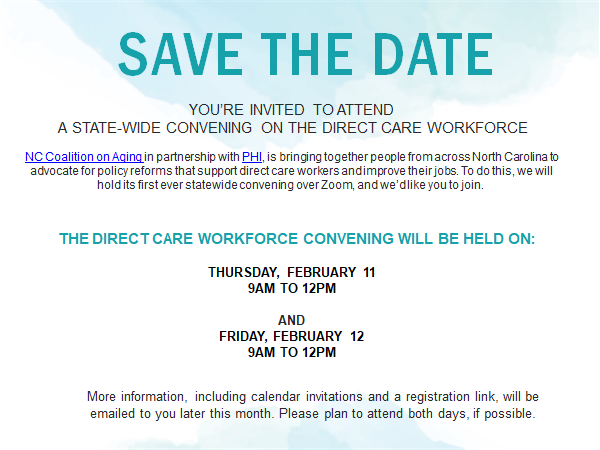
Save The Date: A State-Wide Convening on the Direct Care Workforce
Time: 9:00 am thru 12:00 pm
|
New: Thursday, February 11, 2021
Time: 10:00 am thru 12:00 pm
|
Friday, February 12, 2020
Save The Date: A State-Wide Convening on the Direct Care Workforce
Time: 9:00 am thru 12:00 pm
|
Thursday, February 18, 2021
Clinical Quality Webinar Series-TBD
Time: 5:30 pm thru 6:30 pm
|
Tuesday and Wednesday, March 2 & 3, 2020
|
Thursday, March 4, 2021
Medicaid Managed Care Fireside Chat Series: Policy Approvals, Process Changes and Appeals
Time: 5:30 pm thru 6:30 pm
|
Please click on each of the following links to view details sent out from each LME/MCO.
Benchmarks' wants to be sure to make the following list handy for our members to visit and suggests a peek at least once per week to find information that may be pertinent to your agency and contracts.
|
|
|
|
|
|