NC Cases: 690,912
Cases Hospitalized: 3,740
NC Deaths: 8,200
Positive Tests: 7-day average was 11.4%
Tailored Plan Care Management Agency Applications
HHS has been very vocal in their expectation to start the Standard Plan July 1, 2021. The Department is also moving forward with the expectation that Tailored Plans will also begin on July 1, 2022. A key area of focus in Medicaid Transformation is building robust and effective models for managing beneficiaries' comprehensive needs through local care management. Provider-based care management will promote whole-person care, foster high-functioning integrated care teams, and drive towards better health outcomes.
For providers looking to obtain certification prior to Behavioral Health and Intellectual/Developmental Disability (I/DD) Tailored Plan launch in July 2022, the certification process will take place in three rounds.
- Applications for the first round of certification will be due on March 1, 2021.
- Round two applications will be due in late Spring of 2021, and
- Round three applications will be due in the Fall of 2021.
There will be additional opportunities for certification after Behavioral Health I/DD Tailored Plan launch.
The Department recognizes that it will take time to build a delivery system to support Tailored Care Management that is fully integrated with primary care and other providers. The provider manual describes the model requirements and initiating the certification application process for AMHs and CMAs.
Vaccination Numbers
Dawn Baumgartner Vaughan, THE NEWS & OBSERVER
North Carolina has vaccinated 450,000 people against COVID-19 as the state ramps up its vaccination efforts, the state's top health official said Tuesday. The comments by Dr. Mandy Cohen, the N.C. Department of Health and Human Services secretary, came as she and North Carolina Gov. Roy Cooper toured one of the few mass vaccination sites in operation. Cohen said state officials want to use up all the doses from the federal government as quickly as possible.
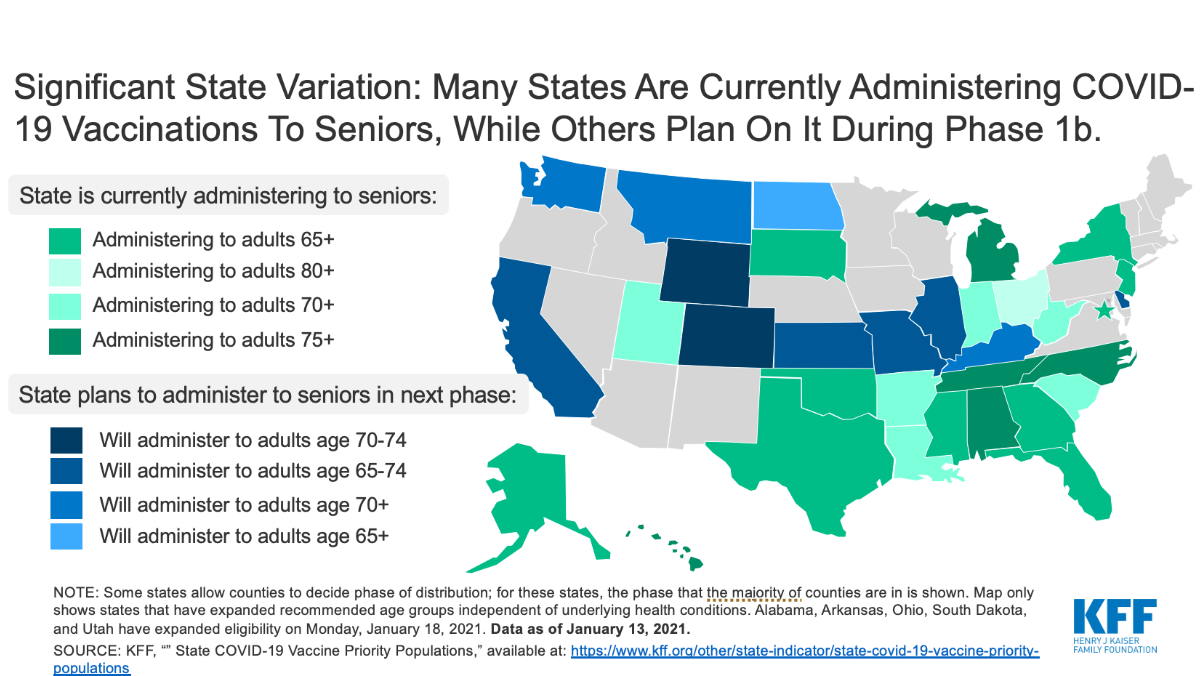
Cooper and Cohen visited UNC-Chapel Hill's Friday Center as UNC plans to vaccinate 10,000 people at that and more than a dozen other locations across the state this week. The state has lagged far behind other states in its vaccination rate. Cooper told reporters it is his administration's top priority is to get people vaccinated "as quickly and as equitably as we possibly can." Cooper said that "one of the reasons ... North Carolina was a little slower than other states, (is) because the decision was made to give every single county doses the first time. And when you do that, to be equitable, there are going to be some who do not respond as well." The governor said that since the state opened up vaccination criteria to people ages 65 and older, it has been easy to get them vaccinated in a lot of communities, but very difficult in others. "So we want to be making sure that communities of color and underserved communities and others know about this vaccine, and that they can also be part of this process," Cooper said.
Cohen said they want to have access points all across the state, but that supplies are still limited. Cooper said the state is making "significant" progress and North Carolinians will see an increase this week. Cohen said what's needed now is to support local providers and move vaccine to operations that can scale up and take on more vaccinations. She said this week they are moving doses around to those locations that can get it out fastest.
Cooper said until the state vaccinates enough people, preventive steps of wearing a mask, avoiding large groups of people and staying socially distant are still needed. North Carolina is under a statewide mask mandate and is in Phase 3 of restrictions, which limits capacity in businesses and gathering size.
Vaccine Stats
Joedy McCreary, CBS 17 NEWS
Black people in North Carolina have received the COVID-19 vaccine at a rate twice as high as some nearby states that disclose demographic information. The state Department of Health and Human Services says 10 percent of the more than 238,000 doses of vaccine administered over the past month have been given to Black people. The rate trails that group's proportion of the population but has grown over the past several weeks as the vaccine has been made available to an increasing number of people. In Virginia, the state Department of Health reported 5.1 percent of its nearly 238,000 doses have gone to Black people. That figure is just under 5 percent in Florida and 3.8 percent in Tennessee, according to the health departments in those states. Demographic breakdowns were not available for South Carolina, Georgia and West Virginia.
The share of vaccine doses going to Blacks has gone up in recent weeks, but don't expect a quick fix, said Dr. Crystal Cené of the University of North Carolina School of Medicine. "This is like cooking a home-cooked meal. This is not fast food," she said. "So I think it's a mistake for health systems to think that, 'Well, we can just kind of tell you, come on, get your vaccine,' and people will run to do it. They're not."
Vaccine hesitancy is rooted in distrust, from the Tuskegee syphilis experiments to the eugenics movement, she said. "It's difficult. It requires a lot of effort. It requires partnerships in the community," she said. The Rand Corporation, funded by the Robert Wood Johnson Foundation, surveyed more than 4,000 people and found many people don't recognize the connection between systemic racism and public health. It also found nearly 70 percent of Black people who responded say they don't trust the government. "So that's going to be an important barrier to overcome," said Brian Quinn, an associate vice president for research, evaluation and learning for the foundation.
People with disabilities desperately need the vaccine. But states disagree on when they'll get it.
For weeks, Wendy Lincicome has been asking the same question. She asks it on the phone. She asks it in emails to state officials. She cares for an epileptic blind man with cerebral palsy 24 hours a day, and when he is asleep, she types her question into Google.
"When will people with disabilities get the coronavirus vaccine?"
Tens of thousands of Americans with intellectual and developmental disabilities - who are two to three times as likely to die of covid-19 - are waiting for an answer. The Centers for Disease Control and Prevention has said health-care personnel and residents of long-term-care facilities should be first in line, in phase "1a." Disability advocates say guidance should be interpreted to include all people with disabilities who receive long-term care, whether in large institutions, smaller group homes or in settings like Lincicome's, who is paid to live with a North Carolina man who has round-the-clock needs.
But as guidance from the federal government has been translated into vaccine distribution plans made by states, those with disabilities have been downgraded to lower priority status.
D.C. as well as Maryland, Alabama and many other states are leaving people with disabilities who live in large institutions and group homes out of their Phase 1a plans, instead moving them to 1b or 1c. In Indiana and Rhode Island, group homes have been pushed to Phase 2, with the likelihood that vaccinations are months away.
Most states make no mention of disabilities in their vaccine plans, leaving people like Lincicome panicking and confused about how long they and those for whom they care will have to wait.
She is terrified that the man who relies on her, 33-year-old Sloan Meek, could end up as another case of a disabled person being allegedly discriminated against in a hospital after falling ill with covid-19. Without her help, or the help of a computer, Meek is extremely limited in what he can communicate to medical professionals.
"They don't look at Sloan and see what I see," Lincicome said. "They don't see the guy who just recorded an album or has an annual Christmas carol concert. They see a wheelchair, and somebody who is laying in their bed all day." By North Carolina guidelines, Meek may not qualify for the vaccine until Phase 2, because he doesn't live in a home with other individuals with disabilities. If Meek lived in Tennessee, according to its state plan, he'd be a part of the very first wave of vaccinations because of the level of care he receives. Though some state plans would count Lincicome - a caregiver known as a "direct support professional" - as a health-care provider to be provided for in Phase 1a, most have no public plans for caregivers in her role.
The lack of consistency is the result of a lack of guidance from the CDC. Other than acknowledging those with Down syndrome should be prioritized along with people with high-risk medical conditions, federal recommendations for vaccine rollout make no explicit mention of any other disabilities. A CDC spokesman said states could request that intermediate-care facilities, the large, often government-run institutions for the disabled, receive vaccinations through the same pharmacy partnership program as nursing homes. Decades of reform efforts have closed many of those institutions, moving people with disabilities into small group homes or other living situations integrated into their communities. But despite an estimated 70,000 people living in group homes, the CDC recommendations do not include them, leaving states to decide where in line those residents, and their caregivers, should fall.
Germán Parodi, a co-director of an organization focused on natural disaster response, hosts a daily phone call for people with disabilities and the agencies that support them. Parodi, who is quadriplegic, has listened as a vulnerable population has been made more vulnerable with each new challenge: disability care workers passed over for protective equipment, testing sites inaccessible to wheelchairs, funding cuts to in-home care programs, and now, trouble getting vaccines. "For our marginalized community, it feels like fighting against Goliath," Parodi said.
The most recent blow in that battle: Despite months of desperate pleas, Congress did not include additional funding for community-based disability services across the country. And adults with disabilities who qualify as dependents on their parents' taxes will not receive stimulus checks.
"When we are left out of relief packages like this, Congress is telling us they don't care whether we live or die," said Julia Bascom, executive director of the Autistic Self Advocacy Network.
Bascom and other advocates have been stymied even in their efforts to get the federal government simply to count the number of covid-19 outbreaks in facilities for disabled people in the same way they are counted in nursing homes.
Researchers such as Scott Landes of Syracuse University have tried to fill the void, studying what little state-level data is available to learn how covid-19 is affecting the disabled community. Landes knew before he looked at a single number that the circumstances were stacked against those with disabilities: an abundance of preexisting conditions. Communal living. Close contact with caregivers who are so low-paid they must work multiple jobs.
But the results were even worse than he expected, with data showing people with intellectual and developmental disabilities are at least two or three times as likely to die if they contract the virus and even more at risk if they receive intensive nursing care.
He hoped those numbers would be enough to push the government to track outbreaks in institutions and group homes. Lawmakers including Sen. Elizabeth Warren (D-Mass.) pushed, too. But nothing changed.
"To me, it's unconscionable. We know this is a vulnerable health population. We can show they're not doing well. I just cannot fathom why states are being allowed to not report," Landes said. If states had a greater focus on the pandemic's impact on the disabled, he said, "vaccination prioritization would be much clearer. You would have the evidence to tell you what needs to be done." Advocates calling governors and legislators trying to get clarity on vaccination rollout plans are also asking about direct-service professionals, the caregivers like Lincicome. The majority of "DSPs," as they're known in the disabled community, are women of color, and many are immigrant women.
As the Justice Department has pushed to close large institutions for disabled people, and instead encourage them to live in group homes or in their own homes within communities, these caregivers have become more and more essential. They bathe and clothe their clients, administer medication and manage feeding tubes, lift in and out of wheelchairs, and monitor oxygen levels and vital signs. But unlike health-care workers with higher levels of certifications, they are typically paid close to minimum wage.
Lincicome, 48, works 18 or more hours to earn $142 per day. Many caregivers depend on multiple jobs in multiple group homes to survive, increasing the coronavirus risk for themselves and those for whom they care. But most state plans do not say whether the caregivers are counted as health-care workers or at what stage they will be vaccinated. Donna Martin of the nonprofit ANCOR has been trying since November to decipher what each state's plan means. As of Jan. 8, she could confirm only that 15 states had some kind of plan for caregivers to be vaccinated. "There is a large sector [of the disabled community] that depends on DSPs for 24 hours a day support," Martin said. "That is as essential to them as someone who shows up in the ER and needs a nurse or doctor in that moment."
Sloan Meek, 33, is waiting to learn when he will be vaccinated. Until Lincicome and Meek get their shots, she said they'll continue to live the way they have for nine months. Because she's trying to limit the number of people to whom he's exposed, she rarely gets a break, sometimes sleeping just three hours per night. Three air purifiers she bought for their living room and bedrooms hum alongside the David Bowie Pandora station he likes to play. She does not go to the grocery store, the pharmacy or anywhere else she might have even a small chance of becoming infected. She doesn't see her own family members. They stay inside and read about hospitalization rates rising. Meek, she said, definitely understands what the pandemic is all about. She knows because sometimes when she talks about it, he begins to make a deep, loud noise that is his version of a scream.
"How much more can we retreat?" she asks the advocates and doctors from whom she has tried to get answers about vaccines. "We feel like prisoners in our own home."
Last week, she attended a webinar with the North Carolina Council on Developmental Disabilities. She prepared to ask her question once again. But before she typed, she could see there were dozens of other people on the call, all seeking the same answers.
Public Health Resources
Rachel Crumpler, THE NEWS & OBSERVER
Across the state, local public health workers are on the front lines of North Carolina's response to the COVID-19 pandemic. They play important roles like testing, contact tracing, educating their communities about safety precautions and more, on top of their regular duties like inspecting water wells and restaurants. "Public health employees are exhausted, mentally and physically," said John Morrow, a former Pitt County health director who is assisting the state's Department of Health and Human Services with its COVID-19 efforts.
In part, that's because over the past decade the number of people working in local public health and the money being spent on it at both the state and local level has declined. And while some counties say they have welcomed a boost in resources to fight the virus, they say that a long pattern of eroding resources has left them without the infrastructure they need. Spending on public health at the state level from 2010 to 2018 dropped by more than 27% when adjusted for inflation and population increase. This spending decline is even steeper than the national slide of 16% across all states.
North Carolina's state government spent about $72 per person on public health in 2018, which is less than all but 13 other states. In 2010, North Carolina spent 90% of the national average on state-level public health. By 2018, North Carolina spent only 78% of the national average per person. And while North Carolina's state government has reduced spending on public health faster than most states, it's been compounded by drops in county-level spending - a decline that has, until now, remained hidden from public view.
Based on financial analysis of 44 health departments in North Carolina, county-level spending on public health dropped 22% from 2010 to 2018 when adjusted for inflation and population increase. At least 40 health departments serving 45 counties saw a decline in inflation-adjusted public health spending per person from 2010-2018. North Carolina has a decentralized public health system, meaning the local level bears most of the responsibility in figuring out how to fund local public health.
Local public health officials say this crisis funding pattern prevents adequate infrastructure from being built, leaving health departments ill-prepared to address emergencies as they arise. Instead of consistently funding public health, funding surges as emergencies occur and dwindles soon after the threat subsides. "They throw money at us, probably more than we can handle at any given time, in a short period of time, and it dwindles," Gibbie Harris, health director of the Mecklenburg County Health Department, said.
Rep. Larry Potts, R-Davidson, introduced a bill in the state House in April 2019 that he said would have helped ease some of that pressure. But the $8 million that it would have allocated to local health departments to expand infrastructure for activities associated with the surveillance, detection, control and prevention of communicable disease was incorporated into the state budget that Gov. Roy Cooper vetoed as part of a larger political battle. "I don't think the governor found fault with the way that money was applied or allocated. He just vetoed the budget period," Potts said.
Broadband Funds
Colin Campbell, THE INSIDER
Attorney General Josh Stein said Friday that he wants the proceeds of a telemarketing lawsuit settlement to improve internet access. North Carolina received $13.42 million from Dish Network, the satellite TV company that the attorney general's office sued for years over illegal telemarketing calls. "Too many kids are learning from their parents' cars parked in public library parking lots," Stein said in a news release. "Adults are struggling to work and support their families with spotty internet access. We must do more to make sure people have access to the critical 21st century infrastructure - broadband. I urge legislative leaders to add this money to their existing efforts to address the digital divide."
Under state law, proceeds from legal settlements go into the state's general fund, where they're spent through the normal legislative budget process. Lawmakers have indicated that broadband will be a key priority this year, and they could add more funding to the "GREAT" grant program to expand broadband infrastructure into rural areas.
Broadband Solutions
Colin Campbell, THE INSIDER, 1/22/21
Drive west from the Triangle into the far reaches of Chatham County - where suburban communities give way to farmland - and the available internet speed slows to a crawl that makes working from home into a nightmare.
In neighborhoods between Siler City and Ramseur, speeds average around 5 megabits per second -- well below the 25-megabit threshold for basic broadband and a far cry from the 1,000-megabit fiber internet offered in nearby cities. According to a survey conducted by Randolph Communications, children there struggle to complete online assignments, while remote work is next to impossible.
And don't even think about watching Netflix. "We do not even try to watch movies because of buffering," Teresa Phillips wrote to the company, which recently got a state broadband grant to build fiber lines along her rural road. As part of a recent $30 million in grant awards, state government will cover half the $776,000 cost to extend broadband to about 100 homes and 16 farms.
The program, known as Growing Rural Economies with Access to Technology, or GREAT, has been the legislature's primary tool for expand broadband access into rural areas. So far it's helped private internet companies expand service to about 20,000 homes and businesses. But after a year in which the COVID-19 pandemic made the digital divide even deeper, state legislators want to do more this year to expand high-speed internet. Lawmakers from both parties and from across the state have listed it among their top priorities.
Rep. Dean Arp, R-Union and a co-sponsor of the GREAT grant legislation, says more funding for grants is likely. The latest application period saw qualified projects seeking $64 million - well above the $30 million available, so he says that means $34 million of "shovel ready" projects are simply awaiting more action from the legislature. So far, the grants have helped about 10% of the state's 200,000 unserved or underserved households and businesses, Arp said. "It's very specific about what it's trying to accomplish, and we haven't been able to accomplish all of that yet," he said.
But lawmakers are considering other approaches that could solve other pieces of the broadband puzzle. Sen. Paul Newton, R-Cabarrus, said he's working with the N.C. State Institute for Emerging Issues to create a stakeholder group to propose other policy solutions. The group also includes the governor's office, Arp, Rep. Brian Turner, D-Buncombe, Sen. Kirk deViere, R-Cumberland, Sen. Jay Chaudhuri, D-Wake, and Sen. Todd Johnson, R-Union. "I think the industry is going to be coming to me with some ideas," including a possible tax credit or incentives program. "We'll put that in the mix with alternatives and ideas that we haven't even thought of."
Towns and cities will continue to push this year for an idea that so far hasn't gained traction at the legislature: Leasing government-owned infrastructure so that private providers can use fiber lines and power poles to expand service areas. The N.C. League of Municipalities has pushed for a bill in recent sessions, but the idea continues to face opposition from major telecom companies and some Republicans.
Cities like Washington in Beaufort County want to be able to use existing infrastructure to attract new providers, which could result in higher speeds and lower rates. Washington Mayor Donald Sadler said internet service in his community isn't bad enough to qualify for the GREAT grants, but he's heard so many complaints about the city's one provider - Suddenlink Communications - that he joined with other nearby mayors in asking Attorney General Josh Stein to investigate. Sadler says people are paying up to $250 per month for internet speeds well below what the company claims to provide.
With its waterfront location near the coast, Washington could attract new residents with work-from-home jobs, Sadler said, but slow internet would be a deterrent. "we have a lot of natural resources to offer, but that could be a business person's concerns that we don't have the necessary services to provide."
Legislators, however, aren't convinced that local governments are the right solution. "There's enough of a track record of failure and risk in that area that that's not a smart thing to do," Newton said. He pointed to the example of Salisbury, which developed its own high-speed internet service but ultimately lost money and sold the network to a private company. Local governments aren't seeking now to build and operate their own services, however, and Newton said that for infrastructure leasing, "if there are guardrails to it ... I wouldn't rule out the possibility."
Derek Kelly, a government affairs director for CenturyLink, said leasing government-owned infrastructure would lead to "overbuilding where there's existing networks." "The unserved pockets of the state are not within city limits," he said. He also noted that local governments are responsible for permitting broadband construction projects, so it could mean "having to go into competition with people who are approving your permit." Kelly said some localities are taking up to three months to approve permits, which is slowing broadband expansion efforts. That's something the legislature might need to address, he added.
Scott Mooneyham, a spokesman for the N.C. League of Municipalities, dismisses the criticism of infrastructure leasing from companies like CenturyLink. "If the big telecoms are going to rule the day, I don't think people should waste their time on this anymore, and North Carolina can suffer the economic consequences," he said. "The League has spent three years making the case for more solutions and all solutions that are practical."
CenturyLink wants to see more GREAT grants instead, which it has been using to expand its service. It received grants recently for Franklin, Johnston, Harnett, Pamlico and Pitt counties. In Johnston, the grant will expand gigabit fiber to hundreds of homes in the rural Hardee Crossroads area north of Benson that currently only receive low-speed DSL service from CenutryLink. Kelly said it's been helpful that the latest grants made the state's wealthiest Tier 3 counties eligible, because internet access in Tier 3 counties like Johnston varies dramatically from inner suburbs to the more rural communities. He wants to see that eligibility continue in future grant rounds.
The state currently bases eligibility for grants on data from census tracts, but that's problematic because that misses census tracts where high-speed service isn't available in all areas. Perry says he wants to "take this initiative to the address level," because "census tract analysis is a blunt instrument." Future broadband initiatives, he said, will also need to consider new low-earth satellite internet services such as SpaceX's Starlink currently launching in Canada. He sees that as a potential solution for areas that don't have multiple providers to choose from, such as Washington. "You suddenly see a future where the competition is brought by the private sector," he said.
A Problem We Can't See: NC Child Abuse Reports, Foster Placements Drop During Pandemic
When Adrian Tucker was growing up, school was his escape from the physical and mental abuse he says he and his mother faced almost daily. He played sports. Joined the band. Activities that let teachers, coaches and counselors see him - and make sure he was OK."I was one to sign up for a lot of things," he said. "A big reason for that was it kept me away from home."
That's what worries Tucker, an instructional assistant at W.G. Pearson Elementary School in Durham, about students in virtual classes. "There are students who needed that time away from home," he said. "And there are adults, for lack of better words, who might have needed time away from their child."
Spending time with children day after day helps educators like Tucker recognize the signs of abuse and neglect. That time, he said, can also build enough trust for students to share what's happening to them. "That is one of the things I am terrified about," he said. "We have been able to break through certain veils and barriers virtually, but there is still not that connection with the student sometimes, or at least the opportunity to have that."
With much of that connection now remote, data from state and local child welfare agencies suggest the pandemic has made it harder to protect kids from abuse and neglect. Reports to Triangle counties have plunged. And statewide, hundreds of fewer kids are entering foster care, where children land when they're taken out of dangerous situations. Such declines would, in past years, have been a positive sign. But experts fear that multiple stressors - including wage and job loss, psychological challenges and health issues - are actually driving up child abuse and neglect cases hidden in the shadows of the pandemic. "The prevalence of abuse is very likely off the charts, and we are going to see the domino effect for a very long period of time to come," said Cristin DeRonja, executive director of SAFEchild, a Raleigh agency working to eliminate child abuse in Wake County. When things get back to normal, child welfare advocates say, there's likely to be a surge in need. And they're not sure the state is ready.
County social services agencies handle thousands of reports of child abuse and neglect every year. Those numbers typically drop in the summer while children are out of school - and out of sight - of teachers and counselors. But in 2020, reports in Wake, Orange and Durham counties dropped roughly 15% compared to the same period in 2019. To Paige Rosemond, director of Wake County's child welfare division, it was a sign that fewer children were showing up at child care centers, schools and doctor's offices during the COVID-19 pandemic.
Educational personnel accounted for about 25% of abuse and neglect reports the week before the pandemic closed Wake schools. In the weeks that followed, that number fell to a weekly average of 8%, according to information provided by Wake County. While overall reports returned to their pre-COVID-19 level of roughly 75 to 150 reports per week after virtual school started, Rosemond said, reports from teachers, guidance counselors and other school employees remained low. The overall increase may have reflected children resuming extracurricular activities or attending more medical appointments, or possibly more domestic violence incidents with children present, Rosemond said. "We are still posing those hypotheses," she said.
Less reporting, though, means more uncertainty. At the N.C. Department of Health and Human Services, Lisa Cauley, deputy director of Child Welfare Services, said more parents at home during the pandemic could create safer environments for kids. But she's also concerned about the alternative: without the school safety net, more kids are falling through the cracks.
Recognizing Red Marks
In February, a Guilford County elementary school official reported concerns about a student who had missed weeks of school and returned thinner and with red marks on his arms, according to court documents. The red marks came from being chained to a television stand, the court documents state. Officials also found cigarette burns on his buttocks and thighs. If the boy had returned to school a month later, the abuse likely would have continued undetected because school officials wouldn't have been at school at the time to see the warning signs, said High Point Police Officer Matt Truitt, a former high school resource officer.
It's hard to notice those physical details in virtual school, he said. "You had vigilant and observant school teachers, school administrators, counselors, social workers - all the people that see the children on a daily basis," he said. "Now, they are not being seen."
Those severe cases, however, aren't typical of the cases that social service workers, educators and others see on a daily basis. Those more often involve children coming between caregivers during domestic violence, or parents who aren't measuring out proper amounts of formula for children to thrive. In such situations social workers may be able to refer people to parenting classes and one-and-one support to address their challenges, Rosemond said.
Recognizing Trouble
For Tucker, it was his coaches and band teacher who helped him without ever broaching the topic of abuse. "Even if they didn't recognize what it was, they could see there was something that was troubling this child," he said. Tucker takes that approach when he's concerned about his students. "Let me see what is going on, but also realizing and living in the fact that I am not going to know everything," he said. "And I am not going to pry too much."
A report to child protective services, on its own, doesn't necessarily mean a child is experiencing severe trauma. Not all reports are substantiated, and others result in support services or periodic monitoring. But some cases do require removing children from potential harm. More than 10,000 kids are in North Carolina's foster system at any given time. And state data show that system, too, has taken a hit.
Fewer Kids in Care
When Brooks Rainey Pearson and her husband were licensed as foster parents in 2017, social workers warned them to keep their phones on. The need in Durham and across the state is typically so great that open spots are filled quickly. "We got a call in two hours," Rainey Pearson said. They've cared for several children since then, including an 9-year-old who's been with them for more than three years. So when their second spot opened up again this February, days before North Carolina confirmed its first case of COVID-19, she expected a similar, quick turnaround.
This time, Rainey Pearson didn't hear from social workers until August. And she wasn't the only one. "We were hearing a lot from foster families at the beginning that even when they had openings and were prepared to take in a child, they weren't getting any calls," said Rainey Pearson, who serves on the board of Fostering Families, a group that offers support and resources in the Triangle. Those openings remained because there were fewer kids to fill them, an analysis by The News & Observer shows.
From April to August, the most recent data available, more than 700 fewer children entered the foster care system in 2020 compared to the previous five-year average. That's a decline of almost 30%. And just like with the dip in reports of suspected abuse and neglect on the county level, DHHS data shows the drop statewide in 2020 is largely due to a lack of reports from teachers, guidance counselors and other school workers. Those sources normally account for around 1 in 5 reports that lead to child protective services assessments in regular school months. But compared to the previous year, the number of referrals from educational personnel dropped during the 2019-20 school year by about 30% - the largest decline for any category of reporting. "Schools are a safety net," Cauley said. "It's not just that they make a report. It's that teachers, guidance counselors, they care."
A foster parent and senior fellow at the Duke-Margolis Center for Health Policy, Aaron McKethan has reviewed the data on the decline in foster care entries after noticing the slump in demand firsthand. Those numbers, he said, have big limitations. "What we won't be able to see in the data is the extent of the harm, the nature of harm that these kids will have to overcome," McKethan said. "It's going to be a long road."
Beyond the risk of physical injuries, abuse and neglect can change children's brains - and how they develop in the world. In the short term, abuse may result in a child having trouble concentrating and performing poorly in school, said Sharon Hirsch, president and chief executive officer of Prevent Child Abuse North Carolina. In the long term, it increases the risk for delayed development, dropping out, getting pregnant at a young age and getting diseases, according to a World Health Organization report. Those strains, which can last a lifetime, also have economic consequences. The estimated U.S. economic burden of child maltreatment is $428 billion a year, according to a Global Status Report on Preventing Violence Against Children 2020. Breaking down that resistance.
The state-supervised but county-administered social services system gives each county its own reporting line. If screening questions suggest abuse, state law requires county staff to conduct an in-person visit within 24 hours - 72 in the case of neglect. Even though staff never went virtual, Cauley said the coronavirus has complicated the process. "People who may not have wanted you in the house before COVID would want you in the house less because of COVID," Cauley said. "There are some additional challenges to CPS responding, but CPS is used to breaking down that resistance." Social service workers responding to reports might prescribe or recommend next steps, which could include parenting classes or counseling. Officials could also determine there is no need for services.
A coming surge?
Experts are also worried, however, about what happens when the pandemic starts to ebb. Families are dealing with new stressors, from social isolation to uncertainty about employment, housing and food security. And the impacts of that additional stress, experts fear, have been largely hidden. Tripp Ake is director of training for the Center for Child and Family Health in Durham, which focuses on the treatment and prevention of childhood trauma. It's handling plenty of referrals for services now. But Ake said it's unclear what will happen when in-person instruction returns - and starts catching signs of months of backlogged trauma. "I feel like it's really just the tip of the iceberg in some ways as far as the level of need that we'll see later," Ake said.
Big caseloads and burnout among child welfare workers predated the events of 2020. A sudden surge in demand could make matters worse. Cauley said the potential for a surge worries her too. "This was hard work before COVID - and same thing with the counties. What sustains you is that understanding: We can't quit," Cauley said. "People need the child welfare system; foster parents rely on us. Biological parents of children rely on us. That's what keeps you going."
Ake credits the state for starting to invest in training, self-care and support for the child welfare workforce, but notes there's more to be done. "I do think if the system is properly supporting the workforce, that's a model for how we want our workers to take care of our kids," Ake said. The potential need goes beyond workers. A surge in reports would increase demand for foster families that could outstrip the pre-pandemic supply.
Foster families need background checks, 30 or more hours of training and other assessments before they can earn a license. So adding capacity takes time. "We have this issue where we're expecting to see more kids eventually come back into the system when schools reopen, mixed with an uncertain supply of foster families given the difficulty of training them," McKethan said. "It really adds up to be a perfect storm that unfortunately places the greatest risk on the most vulnerable children in our state." That's why he's urging families to step up now.
"There are fewer ways that we can think of to actually practice what it means to be a good neighbor," McKethan said. "It could just as easily be our kids who need help, and that's what's driven us to participate."
Those kids are out there.
In November, McKethan piled his two boys in the car and struck out for the North Carolina coast, one of their last chances for a family fishing trip before winter. Over their excited chatter, McKethan worried aloud about who wasn't there. The open foster care spot in his home remained vacant, as it largely had since the pandemic began. The way forward, he argues, is to get schools reopened safely. It's a process he acknowledges is likely to be "expensive and complicated and frustrating." But he sees few other options. And in the meantime, he worries children will continue to suffer unseen. "It's disheartening," McKethan said, "because you know those kids are out there. It's not like the abuse and neglect evaporated."