|
Last Call to Complete Benchmarks' CMA Survey!
Our survey will close at midnight tonight.
Included in the Medicaid Tailored Plan, scheduled to go live July 2022, integrated care management (physical and behavioral) will be delivered through Care Management Agencies (CMA).
The LME/MCOs that win contracts for the Tailored Plan will be providing some of the Care Management in the beginning but the expectation is that some private provider agencies will eventually take on the bulk of integrated care management by becoming a Care Management Agency (CMA).
The first round of applications for private providers to apply to be a CMA are due in March 2021.
Benchmarks has been reviewing the provider CMA manual and talking with agencies who are preparing to apply. There have been numerous concerns and questions raised about the potential rate and lack of detailed information provided to develop a comprehensive business model for the application process. In response to these concerns/questions, we have set up numerous meetings with DHB to discuss the issues raised by our members.
To help in this process, we would greatly appreciate if you would fill out this very short survey and share you thoughts with us.
|
Benchmarks' Friday Membership Webinar Recording and Written Update
|
| | Benchmarks' Friday Membership Webinar: February 5, 2021 |
NC Cases: 776,307
Cases Hospitalized: 2,706
NC Deaths: 9,578
Positive Tests: 7-day average was 10.26%
Vaccine Delivery
Adam Wagner, THE NEWS & OBSERVER
Over the last week, North Carolina has climbed up the Centers for Disease Control and Prevention's rankings of states with the highest rate of COVID-19 vaccine delivery. According to the CDC, 322,294 people in North Carolina have received their first dose of a COVID-19 vaccine since last Friday. That brings the total to 728,551 residents who have gotten at least one dose. The sheer number of vaccinations shot North Carolina up the rankings from 40th in first doses administered per 100,000 to 12th by Friday. "North Carolina vaccine providers have done a phenomenal job serving the people of our state," N.C. Department of Health and Human Services Secretary Mandy Cohen said in a press release touting the rankings.
With a backlog of first doses mounting and the federal government threatening to shift allocation toward states that got shots into arms more quickly, North Carolina shifted its strategy two weeks ago. Where the first month of the vaccine effort had focused on sending doses across the state, the priority now became speed. That included sending large quantities of vaccine to large-scale vaccination efforts while also urging providers to push out first doses as quickly as possible.
Vaccine Concerns
Claire Donnelly, WFAE RADIO
People with intellectual disabilities or developmental disabilities like autism have been disproportionately affected by the coronavirus pandemic. They are at higher risk of dying from COVID-19 and many have suffered because of increased social isolation. Yet they are among the last groups to get vaccinated under North Carolina's new vaccine plan.
In the state's initial 148-page vaccine plan, released in October, people with chronic conditions that make them more likely to become seriously ill with COVID-19 could be vaccinated under what was then called Phase 2. Under the simplified plan, issued in January, those people were bumped to Group 4. The state and federal governments have been vaccinating some people with intellectual and developmental disabilities but only if they live in long-term care facilities like group homes.
"North Carolina moves through vaccination phases by aligning to federal priorities," Kelly Haight Connor, a spokesperson for the state's Department of Health and Human Services, said in an email. "We are aligning with the Centers for Disease Control and Prevention Advisory Committee on Immunization Practices in terms of priority order."
Vaccine Prioritization
Colin Campbell, THE INSIDER
Rep. John Bradford, R-Mecklenburg, is asking Gov. Roy Cooper to prioritize people with Down syndrome in the state's vaccination plan. In a letter to the governor this week, Bradford said North Carolinians with Down syndrome were originally in Group 2 along with others who have health conditions that put them at higher risk, but now they're being told they're in Group 4 after the prioritization guidelines were changed.
"These individuals have a much higher risk to contract the COVID virus due to their underlying health issues," Bradford wrote. He noted that the current guidelines would put him and other elected officials in Group 3 for frontline government workers, which he thinks is inappropriate. "In good conscience I cannot and will not receive the vaccination ahead of the Ds community just because of my role in government," he said. "Candidly, my health and wellbeing is not any more important than theirs." Bradford has long been an advocate for people with Down syndrome, some of whom have served as interns in his House office.
Vaccine Disparity
Hannah Smoot, THE CHARLOTTE OBSERVER
More than two-thirds of the people vaccinated by Mecklenburg County Public Health are white, according to data released Tuesday that provided a race and ethnicity breakdown for the first time at the local level. Only 16% of people given first doses of the COVID-19 vaccines by the health department have been Black. That's a big disparity compared to the county's demographics, which show nearly 32% of people in Mecklenburg are Black, according to U.S. Census Bureau estimates.
By contrast, 69% of people given first doses by the county are white, and white people comprise 54% of the county population. And people living in the "wedge" of Charlotte - a collection of affluent neighborhoods in south Charlotte - are receiving vaccines at a higher rate than many other Charlotteans, a ZIP code map released by county Public Health Director Gibbie Harris Tuesday shows. "We do see some under-representation in our people of color," Harris told county commissioners during their board meeting Tuesday night. "It is not what we would want it to be. We know we need to continue our work in these areas."
COVID Bill
Colin Campbell, THE INSIDER
A bill allocating $2.24 billion in federal dollars toward school reopening needs, vaccine distribution and rental assistance is headed to Gov. Roy Cooper's desk after a unanimous House vote on Thursday. Senate Bill 36 is the first of several COVID-19 relief measures planned in the legislature, spending money from the latest federal stimulus bill. No amendments were made on the House floor, and Rep. Donny Lambeth, R-Forsyth, said he and other budget writers will be taking suggestions for further legislation. "We're going to do another COVID bill and we'll likely do another one after that," he said.
The bulk of the money in SB 36 is $1.6 billion for schools, which Rep. Dean Arp, R-Union, said will include funding for student mental health and catching students up from months of virtual classes. The Department of Public Instruction will oversee how the funding is distributed. In a rare floor speech, House Speaker Tim Moore said some of the funds should go toward a "robust summer program" to help students who fell behind. He said he's particularly concerned about the long-term effects on kids if they can't learn to read by third grade. "If we don't get this right ... we'll be paying for it for decades," he said.
House Democratic Leader Robert Reives, D-Chatham, called the bill a "fine show of bipartisanship" in which the House, Senate and governor's office worked together. Cooper voiced support for the funding during a news conference later Thursday. The bill also extends deadlines for spending federal COVID dollars allocated last year, as well as the deadline to apply for $335 stimulus checks for parents.
Required Reopening
Dawn Baumgartner Vaughan, THE NEWS & OBSERVER
The North Carolina Senate backed a bill Thursday that would require schools to give some in-person instruction to the state's K-12 public schools students. Senators voted 29-16. A final vote, which is usually a formality without more debate, will be next week. Then it moves to the House. The bill requires school districts to offer a full-time, in-person instruction option - known as Plan A - to special needs students. It would also require schools to offer either Plan A or Plan B, which requires 6 feet of social distancing, to all students. The bill to require schools to reopen, Senate Bill 37, does not include charter schools.
Sen. Deanna Ballard, R-Watauga, said that schools can safely reopen now - including under Plan A for special needs students - with measures in place. She said it could mean more innovative thinking about how students interact in classrooms and when they should change classes in hallways.
Republicans and Democrats in the Senate agreed that they want students to go back to in-person school as soon as possible, but disagreed on when that should be. Senate Democrats didn't like the bill allowing middle and high school students to go back under Plan A, which has minimal social distancing. Senate Democrats didn't like the bill allowing middle and high school students to go back under Plan A, which has minimal social distancing. "We agree that students definitely need to come back to school under at least Plan B. We agree on that," said Sen. Don Davis, D-Pitt. But he had "real concerns" over Plan A for middle and high school students. He also wanted to extend the start of reopening to 30 days, instead of the 15 days in the bill, to give teachers more time to be vaccinated. Teachers are in the next group of people to be vaccinated in North Carolina, but that is still weeks away.
Democrats also asked for funding in the bill. Ballard noted that the Senate approved $1.6 billion in schools reopening funding in the latest COVID-19 relief bill, which is now on Cooper's desk after it passed the House on Thursday.
Abuse Legislation
Moss Brennan, THE WATAUGA DEMOCRAT
U.S. Rep. Virginia Foxx joined a bipartisan group on the United States House of Representatives Education and Labor Committee that introduced legislation to "strengthen federal efforts to prevent and treat the harmful impacts of child abuse" on Jan. 25. The Stronger Child Abuse Prevention and Treatment Act is co-sponsored by four Republicans and four Democrats, according to the committee. "This broad-ranging proposal will serve America's children and families by bolstering efforts to prevent and treat devastating cases of child abuse and neglect across the nation," Foxx said in a statement.
Marriage Bill
Danielle Battaglia, THE NEWS & OBSERVER
North Carolina is one of two states that allows children to get married as young as 14 years old. A group of state lawmakers wants to change that this year. If passed, House Bill 41 and Senate Bill 35 would prevent anyone under the age of 18 from marrying. Sen. Vickie Sawyer, R-Iredell, partnered with the Tahirih Justice Center to find a way to change North Carolina's law and sponsored the bill in the Senate. A Tahirih Justice Center news release sent Monday stated that North Carolina is tied with Alaska for having the lowest age of marriage set by statute in the United States. That's a statistic Sawyer said in the news release pains her.
Rep. Jason Saine, R-Lincoln, who sponsored the bill in the House, said in the news release he is concerned that the state could become a regional destination for child marriages. In North Carolina, 50 counties list 4,000 minors as married, the news release states. But that number is estimated to be closer to 10,000 if all 100 counties reported. Of those married children, 93% married an adult, with 200 being married to someone 10 years or more older than the child, the justice center reports. State law requires parental consent for minors to marry, and allows marriage for 14- and 15-year-olds with court approval in cases involving pregnancy or raising a child.
Domestic Violence
Hannah Critchfield, NC HEALTH NEWS
Reports of domestic violence spiked in the last year, confirming what advocates and providers had feared and anticipated at the start of the pandemic. Sheriff's offices across the state saw higher incidents of domestic violence, according to public records requests made out to each county sheriff's office. In total, these counties reported almost 2,000 additional cases in 2020 over the 2019 tally. The virus has wreaked additional havoc on victims who seek help, North Carolina researchers and providers said, by making it more difficult to access services.
Domestic abuse, though for centuries regarded as a private, family matter or dismissed as a "lovers' quarrel," is considered a public health crisis - and it's a highly deadly one. In 2018, The Washington Post found that nearly half of the women murdered in the last decade were killed by a current or former intimate partner. The same year, about 40 percent of women who were killed in North Carolina died at the hands of a partner. However, people of all genders and sexualities can commit domestic violence.
Domestic abuse is more likely when a potential perpetrator is unemployed, experiences isolation from other people, participates in heavy alcohol or drug use, or is depressed -- all of which have increased during the last year. Last year, the 38 counties that responded to records requests from NC Health News filed 24,760 reports involving domestic violence. In contrast, those same counties had 22,776 domestic violence reports in 2019. Thirty of them filed more reports in 2020 than in the previous year. North Carolina domestic violence advocates and experts worry actual incidents of domestic violence may be much higher, as people who are isolating throughout the pandemic with abusive partners may struggle to find privacy to reach out for help.
As the pandemic continues into 2021, safe remote communication with victims remains a challenge. Providers said they follow the lead of the victim themselves. The pandemic has aided with one thing, researchers and advocates said: It's catalyzed domestic violence organizations to come up with creative ways to make rehabilitative services more accessible. "The local domestic violence agency in Orange County moved their support groups online, and they were worried that attendance would go down," said Beth Moracco, a professor who studies domestic violence at the Gillings School of Global Public Health at UNC Chapel Hill. "But what they found in fact was that attendance actually went up and they were able to reach people who may not have been able to attend in person before the pandemic."
|
Upcoming Benchmarks' Webinars
Benchmarks' Membership Child Welfare Webinar
Lisa Cauley Joins Karen McLeod
Date: Thursday, February 11, 2021
Time: 8:00 am thru 9:00 am
Benchmarks' Friday Membership Webinar Date: Friday, February 19, 2021 Time: 8:30 am thru 9:00 am Benchmarks' Friday Membership Webinar
Date: Friday, March 5, 2021
Time: 8:30 am thru 9:00 am
Benchmarks' Membership Child Welfare Webinar
Lisa Cauley Joins Karen McLeod
Date: Thursday, March 11, 2021
Time: 8:00 am thru 9:00 am
Register Here
|
Webinar featuring an Overview of North Carolina's Specialized Foster Care Plan
As part of North Carolina's Medicaid managed care implementation, the state will launch a specialty Medicaid managed care plan currently referred to as the Specialized Foster Care Plan (FC Plan). The FC Plan will operate statewide and serve children and youth currently and formerly in North Carolina's child welfare system.
The North Carolina Department of Health and Human Services (NCDHHS) is pleased to invite you to a webinar, scheduled for Feb. 11 from 3-4 p.m., that will provide an overview of the FC Plan design planning efforts to date. Specifically, the webinar will highlight how the FC Plan seeks to address the many challenges this population faces today in receiving seamless and coordinated health care. The webinar will also review the key design features related to eligibility and enrollment, benefits, care management, and quality, among other areas.
Stakeholder engagement is a critical component of these efforts. This webinar is one way that NCDHHS is seeking feedback to further inform and refine the FC Plan design and implementation planning efforts.
COVID-19 Stakeholder Updates
PRESS RELEASES since the last update include:
NEW resources since the last update include:
UPDATED guidance since the last update include:
UPDATED reports since the last update include:
Medicaid Provider Announcements
Temporary Clinical Policy Modifications: Payment for Healthy Opportunities Screening and Referral
Effective Jan. 1, 2021, NC Medicaid and NC Health Choice are temporarily covering Healthy Opportunities screenings to encourage providers to gain capacity for screening Medicaid beneficiaries for unmet health-related resource needs and referring them to appropriate community-based resources prior to the launch of Medicaid managed care.
- Reimbursement is limited to Carolina Access II providers and is a time limited opportunity through June 30, 2021.
- Coverage of this code after Medicaid Managed Care launch will be at the discretion of the health plans.
Carolina Access II providers may temporarily receive reimbursement for positive Healthy Opportunities screenings conducted using the North Carolina Department of Health and Human Services (DHHS) standard screening questions or an equivalent instrument with similar questions covering beneficiary needs related to DHHS's 4 priority domains (food, housing/utilities, transportation and interpersonal safety). For providers who have not already adopted a tool, we strongly encourage the use of the DHHS standard questions.
Advanced Medical Home Tier 3 "Glidepath" Payments
Effective April 1, 2021, as part of the transition to Medicaid Managed Care, NC Medicaid will offer a time-limited payment opportunity to practices that have attested into Advanced Medical Home (AMH) Tier 3 if they can demonstrate successful readiness for AMH Tier 3 responsibilities as set out below.
- The payments, called "AMH Tier 3 Glidepath Payments," will be $8.51 per member, per month (PMPM), paid by NC Medicaid in addition to eligible practices' existing Carolina Access II PMPM payments.
- AMH Tier 3 Glidepath Payments are intended to provide an incentive for managed care launch readiness as well as provide funding to offset some of practices' Tier 3 implementation costs.
- Payments will be available for the months of April, May and June, 2021, only.
Behavioral Health I/DD Tailored Plan Memo on Eligibility and Enrollment Updates
Behavioral Health and Intellectual and Developmental Disabilities (I/DD) Tailored Plans are specialized managed care products targeting the needs of individuals with significant behavioral health disorders, I/DD and traumatic brain injuries (TBI). These plans are scheduled to begin in July 2022 as part of NC Medicaid's transition to Medicaid Managed Care and will cover a more robust package of Behavioral Health, I/DD and TBI services compared to Standard Plans.
Prior to launch of the Behavioral Health I/DD Tailored Plans, beneficiaries meeting eligibility for the Behavioral Health I/DD Tailored Plans will continue to be covered through the current Medicaid fee-for-service/local management entity - managed care organization (LME-MCO) system, also referred to as NC Medicaid Direct. Some will have the choice to opt into a Standard Plan.
DHHS has held ongoing discussions with stakeholders to refine the Behavioral Health I/DD Tailored Plan eligibility criteria used in claims/encounter data reviews. Through these discussions and with consultation from DHHS clinical leadership, additional encounter/claims data markers were identified as being indicative of I/DD or functional impairment and have been added to the criteria used for identifying beneficiaries as eligible for Behavioral Health I/DD Tailored Plans.
For more information about eligibility changes, please see the Behavioral Health I/DD Tailored Plan Memo on Eligibility and Enrollment Updates and Appendix B - Behavioral Health I/DD Tailored Plan Criteria under "Final Policy Guidance" on the Medicaid Transformation Policy Papers webpage.
BH/IDD Tailored Plan RFA Update
Update regarding the Behavioral Health I/DD Tailored Plan RFA.
- Applications for Behavioral Health I/DD Tailored Plans were opened February 2nd at 4 p.m. ET.
- A list of RFA applicants will be posted on the North Carolina Interactive Purchasing System (IPS).
- As a reminder, the Department has invoked a silent period through the award of the Behavioral Health I/DD Tailored Plan contracts. During the silent period:
- Employees may not discuss the Behavioral Health I/DD Tailored Plans RFA with external stakeholders, including the LME/MCOs.
- Constituent or other stakeholder inquiries regarding the Behavioral Health/IDD Tailored Plan RFA can be directed to Kimberley Kilpatrick at Medicaid.Procurement@dhhs.nc.gov.
- For media inquiries, please contact the DHHS Office of Communications at (919) 855-4840 or news@dhhs.nc.gov.
- For more information, please refer to the following resources:
|
Adoption Promotion Program Fund Updates
The purpose of the Adoption Promotion Program (APP) is to enhance and expand adoption programs, to secure permanent homes for children in foster care with special needs who are harder to place, and to encourage partnerships between public and private agencies to achieve permanency for children in a timely manner. In accordance with NCGS 108A-50.2, criteria and guidelines for the awarding of funds to licensed public and private adoption agencies upon the adoption of children in foster care as described in NCGA 108A-50 are outlined below.
Click below for related documents:
|
Medicaid Provider Webinars
Advanced Medical Home Glide Path | Register
Thursday, Feb. 11 | 5:30 p.m. - 6:30 p.m.
This series is designed to support practice managers, quality improvement professionals, care coordinators, and others within your practice who are responsible for meeting the NC Medicaid AMH Tier 2 or 3 requirements.
COVID-19 Vaccine Administration | Register
Thursday, Feb. 18 | 5:30 p.m. - 6:30 p.m.
Join DHHS for the latest information on vaccine administration. More information coming soon.
SPECIAL BULLETIN COVID-19 #154 The NC Division of Health Benefits (DHB) has recently published a Medicaid Bulletin article related to COVID-19: SPECIAL BULLETIN COVID-19 #154: Monoclonal Antibodies - Billing Guidelines The U.S. Food and Drug Administration has issued an Emergency Use Authorization to permit the emergency use of the unapproved monoclonal antibodies to be administered for the treatment of mild to moderate COVID-19 in some patients. More Information Providers are encouraged to review this information. All bulletin articles, including those related to COVID-19, are available on DHB's Medicaid Bulletin webpage. New Medicaid Bulletins Available as of Feb. 1, 2021 The NC Division of Health Benefits (DHB) has recently published new Medicaid Bulletin articles: - Advanced Medical Home Tier 3 "Glidepath" Payments
- Temporary Clinical Policy Modifications: Payment for Healthy Opportunities Screening and Referral
- Behavioral Health I/DD Tailored Plan Memo on Eligibility and Enrollment Updates
- NC Medicaid Electronic Health Record Incentive Program Announcements
- Electronic Visit Verification Update: Implementation Flexibilities
Providers are encouraged to review this information. All bulletin articles, including those related to COVID-19, are available on DHB's Medicaid Bulletin webpage. No Provider Training in February There are no provider training classes scheduled for Feb. 2021. Providers are encouraged to utilize the User Guide and Fact Sheets page, the Provider Training Tool Kits page and Skillport resources for additional help. Skillport may be accessed through the NCTracks Secure Portal on the Provider User Guide and Training page.
Criteria for Supporting Documentation: Exclusion Sanction Questions
The requirements for responses to exclusion sanction questions C, D, F and J have been updated. Providers who answer "Yes" to these questions (as related to an affiliation) must provide supporting documentation that meets the following criteria (as it relates to the affiliated provider):
General identifying information about the affiliated provider or supplier, which includes:
- Legal name as reported to the Internal Revenue Service or the Social Security Administration (if the affiliated provider or supplier is an individual)
- "Doing business as" (DBA) name (if applicable)
- Tax identification number
- National Provider Identifier (NPI)
- Reason for disclosing as it relates to the provider, affiliated provider or supplier
Specific data regarding the affiliation relationship, including the following:
- Length of the relationship
- Type of relationship
- Degree of affiliation
Providers are encouraged to review these requirements carefully before submitting the supporting documentation to avoid application processing delays caused by insufficient information. If the requirements are not met, an application incomplete letter will be generated prompting the provider to submit the proper documentation.
Issues List Updated as of Feb. 3, 2021
The NCTracks Issues List, which logs known problems affecting providers and their statuses, has been updated. The most current issues list may be found on the provider portal home page under Quick Links. Providers are encouraged to check this list to see if an issue they are experiencing is already known before calling in about an issue.
Providers with Denials for Edit 02104 May Now Resubmit Claims
An issue was identified with provider claims denying with edit 02104 - PROVIDER TAXONOMY NOT ALLOWED FOR MODIFIER SUBMITTED when the CR modifier was used. Upon review by the State, the edit disposition has now been updated to allow the claims to be properly adjudicated. Affected providers should resubmit claims that were denied for this issue. This occurrence was identified on the issues list and will be updated to reflect the disposition change.
|
Advancing Population Health in Rural Places: Key Lessons and Policy Opportunities
This paper advances policy discussion of population (defined as either a patient panel based on conditions such as diabetes, all enrolled patients, or the general community) health in rural places, with a focus on the role of rural healthcare organizations.
Though the demonstration projects discussed in this report have their roots in the Medicare and Medicaid programs, there are other ways that Medicare and Medicaid are addressing population health through policy. Within Medicare, care management programs, value-based payment arrangements, supplemental benefits, and telehealth expansion all help achieve population health goals.
In Medicaid, the provision of preventive services, connection to social supports, state administrative flexibility, and telehealth do the same. Based on progress thus far, future efforts to address population health in Medicare and Medicaid programs must prioritize staff and infrastructure development, flexibility in covered benefits, and further expansion of telehealth.
|
Substance Use Disorder, COVID-19 & Resources
Opioids & Substance Use Disorder - The Pandemic and the Epidemic
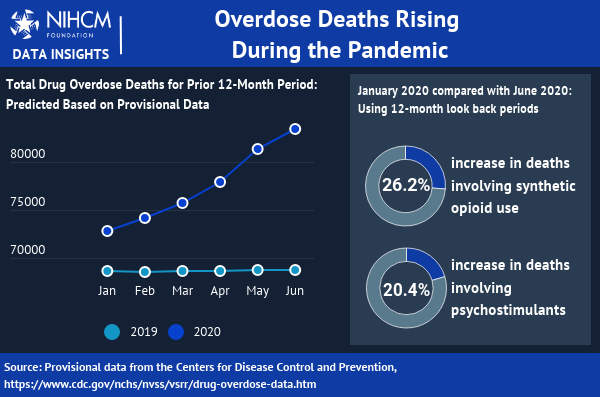
Over the past year, the opioid epidemic has continued to devastate communities and require expanded prevention efforts. Recent data from the CDC suggest that overdose deaths are accelerating during the pandemic, with synthetic opioids a primary driver of this increase. -
Waiver Requirement: A January HHS announcement that physicians will no longer have to obtain a federal waiver to prescribe the opioid use disorder treatment buprenorphine was halted by the Biden administration. The new administration noted that the guidelines were issued prematurely and cited legal and operational problems.
-
Epidemic's Cost: New data from the CDC shows that fatal opioid overdoses and opioid use disorder cost the US $1.02 trillion in 2017.
-
Civil Complaint: The Justice Department sued Walmart for filling thousands of suspicious opioid prescriptions.
-
Overdoses Increase: In San Francisco, there was an uptick in opioid overdoses and drug abuse as the pandemic strains resources and fentanyl's presence increases.
-
Addiction Treatment: A New York Times piece describes the challenges for people with addiction during this time of isolation and how addiction treatment centers are shutting down because of the pandemic.
-
Research: Learn more about the new drug combination that may help stop some people's use of methamphetamine.
|
Sustained Release Buprenorphine (SRB) in the Outpatient Setting Webinar Recording and Slide Deck
|
| |
UVM CORA Community Rounds: Use of Sustained Release Buprenorphine (SRB), John Brooklyn, MD
|
|
Upcoming Events
|
Friday, February 5, 2021
SESSION 4: What's Next? A Roadmap for Telehealth Policy Beyond the Pandemic
Time: 2:00 pm thru 3:30 pm
|
New: Tuesday, February 9, 2021
VACCINATION POLICY CONSIDERATIONS AND OTHER TRENDING EMPLOYER CHALLENGES FOR 2021
Time: 9:00 am thru 11:00 am
|
New: Tuesday, February 9, 2021
An Overview of Peer Support in the Face of
COVID-19
This is the 1st part of a 3-part series
Time: 10:00 am thru 11:00 am
|
Wednesday, February 10 AND 12, 2021
Virtual Training: 2- Day Person-Centered Thinking
Time: 9:00 am thru 4:00 pm (both days)
Cost is $50.00 per person
|
Thursday, February 11, 2021
Benchmarks' Membership Child Welfare Webinar
Lisa Cauley Joins Karen McLeod
Time: 8:00 am thru 9:00 am
|
New: Thursday, February 11, 2020
BREAKFAST BRIEFING: NONCOMPETES,
NONSOLICITS, AND NDAS ... OH MY!
Time: 9:30 am thru 11:00 am
|
Updated: Thursday, February 11, 2020
A State-Wide Convening on the Direct Care Workforce-Day 1
Time: 9:00 am thru 12:00 pm
|
Thursday, February 11, 2021
Time: 10:00 am thru 12:00 pm
|
Thursday, February 11, 2021
IER Webinar for Refugee and Asylee Service Providers Refugees' and Asylees' Right to Work
Time: 12:00 pm thru 1:00 pm
|
Thursday, February 11, 2021
What Does a Person-Centered System Look Like?
Time: 2:30 pm thru 4:00 pm
|
New: Thursday, February 11, 2021
DHHS Overview of Specialized Foster Care Plan (FC Plan)
Time: 3:00 pm thru 4:00 pm
|
New: Thursday, February 11, 2021
Advanced Medical Home Glide Path
Time: 5:30 pm thru 6:30 pm
|
Updated: Friday, February 12, 2020
A State-Wide Convening on the Direct Care Workforce-Day 2
Time: 9:00 am thru 12:00 pm
|
New: Tuesday, February 16, 2021
A Focus on Peer Support Sub-Population Services
This is the 2nd part of a 3-part series
Time: 10:00 am thru 11:00 am
|
Wednesday, February 17, 2021
IER Webinar for Refugee and Asylee Service Providers Refugees' and Asylees' Right to Work (Identical to the webinar on 2/11/21)
Time: 2:00 pm thru 3:00 pm
|
New: Thursday, February 18, 2021
Telehealth Policy Update: What Has Happened and What to Look for in 2021
Time: 2:00 pm thru 3:00 pm
|
Thursday, February 18, 2021
COVID-19 Vaccine Administration
Time: 5:30 pm thru 6:30 pm
|
Friday, February 19, 2021
Benchmarks' Friday Membership Webinar
Time: 8:30 am thru 9:30 am
|
New: Tuesday, February 23, 2021
Voices of Peer Support & Where to Get PSS Services
This is the 3rd part of a 3-part series
Time: 10:00 am thru 11:00 am
|
New: Wednesday, February 24, 2021
The Drivers Shaping The Movement To A Value-Based Contracting Business Model Key Competitors & Potential Partners
Time: 10:00 am thru 11:15 am
|
Tuesday and Wednesday, March 2 & 3, 2020
|
Thursday, March 4, 2021
Medicaid Managed Care Fireside Chat Series: Policy Approvals, Process Changes and Appeals
Time: 5:30 pm thru 6:30 pm
|
New: Friday, March 5, 2021
Benchmarks' Friday Membership Webinar
Time: 8:30 am thru 9:30 am
|
New: Thursday, March 11, 2021
Benchmarks' Membership Child Welfare Webinar
Lisa Cauley Joins Karen McLeod
Time: 8:00 am thru 9:00 am
|
New: Wednesday, March 24, 2021
Are You Ready For Value-Based Reimbursement? An Executive Guide For Assessing Readiness In A Value-Based Market
Time: 10:00 am thru 11:15 am
|
Friday, March 26, 2021
NC DHHS Supported Living Level 2 &3
STAKEHOLDERS MEETING
Time: 2:30 pm thru 4:30 pm
|
New: Wednesday, April 21, 2021
Bridging The Gap From Data To Data-Driven Performance
Time: 10:00 am thru 11:15 am
|
New: Wednesday, May 26, 2021
Developing New VBP Services That Increase Quality & Decrease Service Costs
Time: 10:00 am thru 11:15 am
|
Please click on each of the following links to view details sent out from each LME/MCO.
Benchmarks' wants to be sure to make the following list handy for our members to visit and suggests a peek at least once per week to find information that may be pertinent to your agency and contracts.
|
|
|
|
|
|