|
Upcoming Benchmarks' Webinars
Benchmarks' Friday Membership Webinar
Date: Friday, February 19, 2021
Time: 8:30 am thru 9:00 am
Benchmarks' Friday Membership Webinar Dave Richard Joins Karen McLeod
Date: Friday, March 5, 2021
Time: 8:30 am thru 9:00 am
Benchmarks' Membership Child Welfare Webinar
Lisa Cauley Joins Karen McLeod
Date: Thursday, March 11, 2021
Time: 8:00 am thru 9:00 am
Register Here
Benchmarks' Friday Membership Webinar
Date: Friday, March 19, 2021
Time: 8:30 am thru 9:00 am
|
Benchmarks' Child Welfare Webinar Recording & Written Friday Update
|
| |
Benchmarks' Child Welfare Webinar:
February 11, 2021
|
Benchmarks' Friday Written Update:
February 12, 2021
NC Cases: 810,466
Cases Hospitalized: 2,151
NC Deaths: 10,376
Positive Tests: 7-day average was 7.68%
Virus Variant
Adam Wagner, THE NEWS & OBSERVER
A kind of COVID-19 that has mutated to likely become more contagious has been found in North Carolina, the state health department said Thursday. The N.C. Department of Health and Human Services said the case is the first time the B.1.351 variant of COVID-19, which was first identified in South Africa in October, has been detected in the state. The sample came from an adult in the central part of the state, according to DHHS. The person had not traveled recently.
B.1.351 has also been found in Maryland, South Carolina and Virginia, according to DHHS. There had been nine reported cases of the variant in the United States as of Tuesday.
"While we anticipated the arrival the B.1.351 variant in NC, it's a reminder that the fight against COVID-19 is not over," Dr. Mandy Cohen, the DHHS secretary, said. Cohen reiterated a message she has sounded in press conferences in recent weeks: With the virus mutating into several strains that appear more infectious, following public health measures such as wearing a mask and respecting physical distance takes on increased importance.
Revenue Forecast
Dawn Baumgartner Vaughan, THE NEWS & OBSERVER
Despite the coronavirus pandemic, North Carolina is still in decent economic shape, according to the state's new revenue forecast. The two-year forecast expects "modest economic growth" and stability as the pandemic begins to wane, also assuming there is more federal COVID-19 relief to come soon. The last state revenue forecast, in May 2020, was relatively early in the coronavirus pandemic, and much of it mentioned uncertainty. Both the Internal Revenue Service and the state Department of Revenue extended the usual tax filing deadline of April 15 to July 15 this past year. And on top of that, there was uncertainty about the arrival of an economic recession and how businesses - and consumers - would react and be impacted by COVID-19 related restrictions.
Instead, according to the new report, expected revenue collections are "well above" the May 2020 forecast by $4.1 billion, which is 17.6%. The revenue forecast is a joint forecast of the Office of State Budget and Management, which is part of the executive branch, and the Fiscal Research Division of the General Assembly. "We expect modest improvement throughout the upcoming biennium, with the worst economic impacts from the pandemic behind us," the report states. It explains that this year's anticipated revenue surplus is helped significantly by sales tax collections increasing despite the pandemic, along with the delayed tax payments.
The forecast also says the economy is in the "recovery phase of the business cycle after the quick and sudden recession precipitated by the pandemic." The economic outlook also expects things to continue to get better over the coming years.
The legislature's first priority, before the budget process starts this spring, is passing more COVID-19 relief. Berger told reporters on Thursday that the next coronavirus relief bill is going to be about allocating primarily federal money, while state money "for the most part will be spent and dealt with in the budget." The new revenue forecast shows the federal money that went to the state had a much larger impact on the state's economy than the last forecast predicted.
The picture isn't entirely rosy, however. The report also notes that "despite solid revenue growth, a small segment of the workforce will remain un- or underemployed as long as COVID-19 is prevalent." That will still impact the economy and state revenue. Cooper said in a statement that "while state revenue is strong, people across our state are still hurting and we must use these funds to help them recover from this pandemic."
Doctors Overwhelmingly Harbor Negative Views Of Those With Disabilities
The vast majority of doctors across the nation believe that people with significant disabilities have worse quality of life than others, according to a first-of-its-kind study.
Researchers surveyed 714 physicians practicing in various specialties and locations on their feelings about patients with disabilities. More than 82% reported that such individuals experience subpar quality of life compared to people without disabilities.
"That physicians have negative attitudes about patients with disability wasn't surprising," said Lisa I. Iezzoni, lead author of the study published this month in the journal Health Affairs and a health care policy researcher at Harvard Medical School and Massachusetts General Hospital. "But the magnitude of physicians' stigmatizing views was very disturbing."
Only about 40% of doctors surveyed felt confident that they could provide the same quality of care to patients with disabilities that they provide to others, the study found.
Meanwhile, just 56% "strongly agreed" that they welcomed people with disabilities at their offices even though the Americans with Disabilities Act requires equal access to health care.
Female doctors working at academic medical centers were most likely to be welcoming toward patients with disabilities, the study found.
"We wouldn't expect most physicians to say that racial or ethnic minorities have a lower quality of life, yet four-fifths of physicians made that pronouncement about people with disabilities. That shows the erroneous assumptions and a lack of understanding of the lives of people with disability on the part of physicians," Iezzoni said.
The researchers said their findings highlight questions about access and quality of care.
"Our results clearly raise concern about the ability of the health care system to ensure equitable care for people with disability," said Eric G. Campbell of the University of Colorado Anschutz Medical Campus who worked on the study.
The issue of equal access to health care for people with disabilities has come to the fore in recent times as the COVID-19 pandemic has strained hospital capacity, forcing questions about care rationing. The U.S. Department of Health and Human Services' Office for Civil Rights issued a bulletin last spring warning states and health care providers not to discriminate against people with disabilities. And, the agency subsequently reached agreements with multiple states to make changes to their crisis standards of care guidelines in response to complaints about disability discrimination.
Those behind the new study said it's important to add training about disabilities to medical education, something which is currently lacking at most schools. The researchers indicated that they plan to further study how doctors' perceptions about disabilities are affecting disparities in health care.
Reopening School Bill
Laura Leslie, WRAL NEWS
The state Senate gave final approval Tuesday to a measure that would force school districts across North Carolina to reopen their doors to students who want the option of in-person learning during the coronavirus pandemic. With the 29-15 vote - two Democrats joined Senate Republicans in supporting the measure - Senate Bill 37 now heads to the House. It's scheduled to go through two committees on Wednesday before a Thursday floor vote, meaning it could be on Gov. Roy Cooper's desk by the end of the week.
Cooper has expressed reservations about the bill, saying decisions about reopening should be left up to local school boards. Still, he urged districts last week to get more students in classrooms. The bill would give school districts two weeks to plan before getting students back into classrooms safely, at least part-time. It also would require the option of full-time, in-person learning for all special-needs students and those with IEPs, or an Individualized Education Program.
Schools would have to follow all safety guidelines, including 6 feet of distancing for students in middle schools and high schools. The Wake County Public School System recently surveyed principals on whether they could keep students 6 feet apart if students attended school daily or on a rotating basis. For middle schools, 85 percent said they could only if students attended school in rotation. Only 5 percent said they could maintain enough distance if the entire student body attended daily. For high schools, 93 percent said they could maintain 6 feet of distance if students attended in rotation. None said they could do it if students attended daily.
Some teachers have pushed back against the reopening bill, arguing that they should be vaccinated first to lower the risk to themselves and their families. Dr. Katie Jordan, a pediatrician with UNC Health, said teachers have a legitimate concern. "I think one study that looked at teachers and staff in schools said maybe about 50 percent are at higher risk for complications from COVID," Jordan said. Research done in North Carolina schools last fall found no cases of students giving the virus to teachers. But she noted that those studies were done in schools using a mix of in-person and online classes and plenty of distancing - not schools operating at full capacity.
Chatham Cyberattack
Bill Horner III, Hannah McClellan and D. Lars Dolder, THE CHATHAM NEWS + RECORD
Sensitive data files stolen following Chatham County's Oct. 28 governmental cyberattack have been posted online by a ransomware group, The Chatham News + Record has learned. The files include personnel records of some county employees, medical evaluations of children who are the subjects of neglect cases, eviction notices and documents related to ongoing investigations within the Chatham County Sheriff's Office.
The News + Record obtained access to websites containing the digital files using information provided by a source on the condition of anonymity. County officials later confirmed to The News + Record that sensitive data had been released by the ransomware group known as DoppelPaymer. The international criminal organization has carried out similar attacks on government and health care organizations worldwide, typically asking the victims to pay a ransom or risk the release of sensitive information.
"Chatham County staff has been engaged with staff from the N.C. Department of Health & Human Services (DHHS) and the N.C. Attorney General's Office (AG) to ensure we meet the reporting requirements as it relates to protected health information (PHI) and/or personally identifiable information (PII) data," Chatham County Manager Dan LaMontagne told the News + Record. "We will continue to engage in these conversations with our cyber insurance attorney(s), DHHS and the AG to ensure we respond in the most appropriate manner possible as it relates to the data accessed from our network during the event." LaMontagne said the county is going through the files to learn whose personal information or health information may have been exposed. "Those individuals will be notified of the situation and a call center will be available to those individuals for questions," he said.
Drug Use
Taylor Knopf and Liora Engel-Smith, NC HEALTH NEWS
Though attention has shifted to combating the coronavirus pandemic, the opioid crisis in North Carolina has not gone away. The stressors caused by COVID-19 - such as homelessness and job loss - have contributed to an increase in drug overdoses in the last year. North Carolina saw a spike in overdoses in the spring and early summer months of the pandemic. When fewer people were going to the emergency room as the virus took hold in the state, the number of overdose-related visits shot up. Preliminary state data from 2020 shows a 23 percent increase in overdose-related emergency room visits over the previous year.
Nationally, more than 81,000 Americans died from drug overdoses between May 2019 and May 2020, according to the Centers for Disease Control and Prevention. The CDC noted that this was the highest number of overdose deaths ever recorded in a one-year period. Meanwhile, the street drug supply has become more contaminated and more dangerous. Fentanyl - a synthetic, highly potent drug often added to street drugs - was the "primary driver of the increases in overdose deaths," the CDC said.
"Anecdotally, 2019 and 2020 were pretty rough in terms of reversals and overdose deaths," said Jesse Bennett, executive director of the NC Harm Reduction Coalition, the largest network of syringe exchanges in the state. Harm reduction strategies aim to lessen the damage caused to a person by their use of drugs by providing naloxone, clean needles and other drug use supplies, HIV and hepatitis C testing and other resources. In 2020, the coalition distributed 25,062 naloxone kits across the state. Bennett said there were 3,241 successful overdose reversals and 30 unsuccessful attempts reported to the coalition. "These are primarily drug user to drug user reversals, which indicates that PWUDs [people who use drugs] can perform reversals successfully even while using drugs," Bennett said.
Dental Medicaid
Lucille Sherman, THE INSIDER
Sen. Jim Perry, R-Lenoir, filed a bill Monday that would award contracts to managed care entities specifically for dental services "consistent with the goals of Medicaid Transformation." Like many aspects of Medicaid transformation, the legislation would help dentists provide more holistic care for patients, control costs and help providers to treat more people, Perry said. The Medicaid Transformation shift, which is under way ahead of a July 1 deadline, is moving the state's Medicaid system from a fee-for-service model to contracts with managed care plans. So far though, the change doesn't affect how Medicaid recipients receive dental care.
"It seems to be a reasonable topic, and we've had a lot of folks come to us and want to have this conversation," Perry said. "Sometimes filing legislation brings all parties to the table to have discussions and to help lawmakers learn more about topics." Perry previously worked in the dental field for 20 years helping dentists open practices across the country and often dealt with Medicaid. "When someone wants to touch that dental topic, I'm probably a pretty natural point of contact for them in the General Assembly," Perry said.
|
COVID-19 Stakeholder Update
PRESS RELEASES since the last update include:
NEW resources since the last update include:
UPDATED guidance since the last update include:
UPDATED reports since the last update include:
Moving to Group 3 for COVID-19 Vaccines
The North Carolina Department of Health and Human Services announced plans for how the state will move to Group 3 for COVID-19 vaccines. Because supply is still very limited and the population of frontline essential workers is so large, we will begin with anyone working in childcare or in PreK - 12 schools starting on February 24th.
We are working with our partners on how to support child care and school staff in accessing vaccines and will be sharing more information in the coming week. More detail on who will be eligible beginning February 24th is available on our Deeper Dive: Group 3 - Frontline Essential Workers (School and Childcare) (English / Spanish).
Currently eligible groups - health care workers, long-term care staff and residents, and people 65 and older - will continue to be prioritized. We plan to move to additional frontline essential workers on March 10th.
As always, we rely on you as a trusted messenger to help people make informed decisions. We have developed a suite of resources to support your outreach efforts. Please visit YourSpotYourShot.nc.gov and vacunate.nc.gov as we regularly add new materials.
Flyers and Fact Sheets: Print and share flyers in your community.
Infographic: Use on your website and digital displays.
Videos: Post on social media, play on internal displays, and share on websites and in newsletters.
Social Media Graphics: Post on your social media channels.
FAQs: Use a resource. Our frequently asked questions are updated weekly.
Presentation: Become a Vaccine Ambassador. Attend a presentation. Register now. These decks are updated weekly.
Collect and Share Stories: Share stories of people telling why they got or plan to get the vaccine. Use this tip sheet to record and share a video or photo.
Website: Link to our Vaccine websites.
NCDHHS Releases Specialized Foster Care Plan Policy Paper
The Department of Health and Human Services has released the Specialized Foster Care Plan Policy Paper which describes key design features related to foster care eligibility and enrollment, benefits, care management and quality, among other areas. Comments and questions regarding the Foster Care Plan can be submitted through Feb. 25, 2021.
As part of North Carolina's Medicaid Managed Care implementation, the State has designed the Foster Care Plan to meet the unique needs of the State's children and youth currently and formerly involved in the child welfare system. This Plan addresses many of the challenges they face today in receiving seamless, integrated and coordinated health care.
The Foster Care Plan, anticipated to launch on July 1, 2022, will operate statewide, enabling children and youth currently and formerly involved in the child welfare system to access a comprehensive array of physical and behavioral health services and maintain treatment plans when their placements change. The Plan will be charged with providing care management to ensure a point of continuity in care, to improve coordination of care between service providers, families, involved entities (DSS, DJJ, schools) and other stakeholders involved in serving the Plan's members.
Draft TBI Waiver posted for Public Comment
A draft application for § 1915 (c) Home and Community-Based Services (HCBS) Traumatic Brain Injury Waiver is posted for a 30-day public comment period. The public comment period is from January 27-February 26, 2021. The currently approved TBI Waiver with an effective date of May 1, 2018 will continue to operate at the levels that are previously approved. Submit your comment via email to Medicaid.WaiverComment@dhhs.nc.gov.
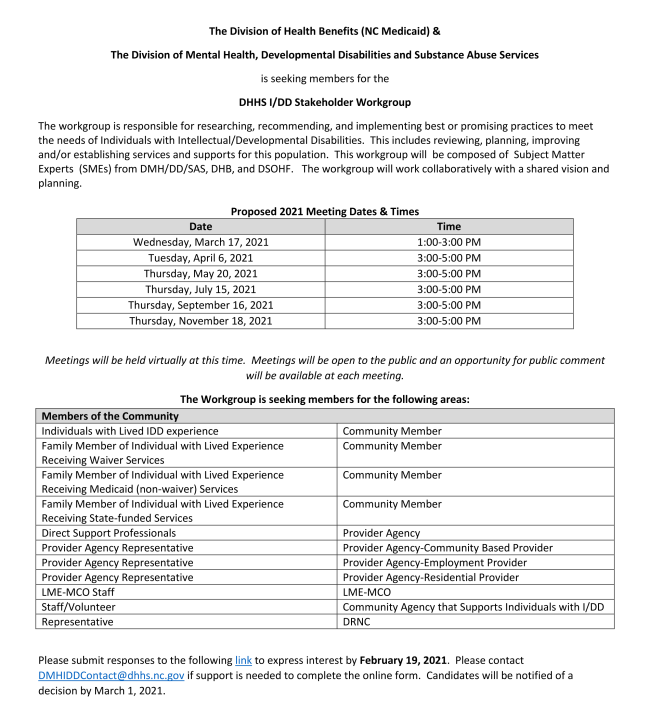
DHHS IDD Stakeholder Workgroup
The Division of Mental Health, Developmental Disabilities and Substance Abuse Services along with the Division of Health Benefits (Medicaid) are looking for individuals that would like to participate on the DHHS I/DD Stakeholder workgroup a description is below. If you are interested in participating follow the directions below:
Please submit responses to the following link to express interest by February 19, 2021. Please contact DMHIDDContact@dhhs.nc.gov if support is needed to complete the online form. Candidates will be notified of a decision by March 1, 2021.
DHHS I/DD Stakeholder Workgroup
The Division of Mental Health, Developmental Disabilities and Substance Abuse Services along with the Division of Health Benefits (Medicaid) are looking for individuals that would like to participate on the DHHS I/DD Stakeholder workgroup a description is below. If you are interested in participating follow the directions below.
Please submit responses to the following link to express interest by February 19, 2021. Please contact DMHIDDContact@dhhs.nc.gov if support is needed to complete the online form. Candidates will be notified of a decision by March 1, 2021.
The workgroup is responsible for researching, recommending, and implementing best or promising practices to meet the needs of Individuals with Intellectual/Developmental Disabilities. This includes reviewing, planning, improving and/or establishing services and supports for this population. This workgroup will be composed of Subject Matter Experts (SMEs) from DMH/DD/SAS, DHB, and DSOHF. The workgroup will work collaboratively with a shared vision and planning.
Please share this widely, especially within individuals with IDD and their families, as we are seeking representation from various stakeholders.
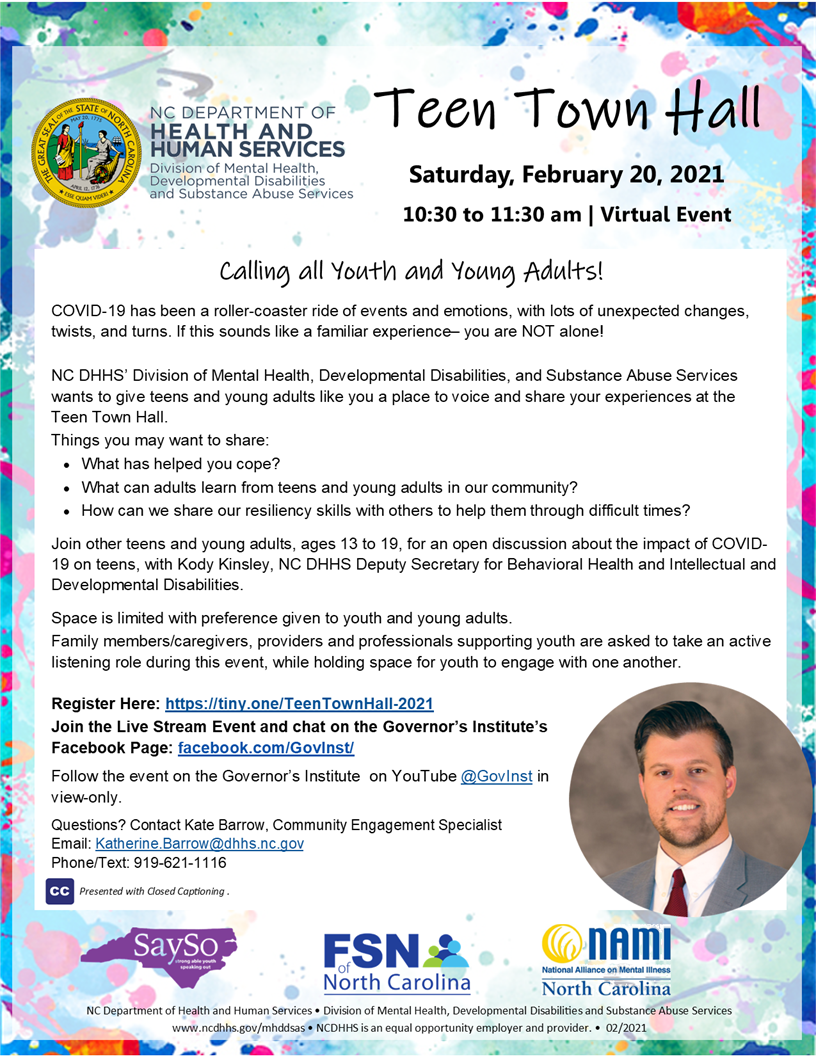
DMHDDSAS: Teen Town Hall- Saturday, February 20, 2021
Joint Communication Bulletin J389 - Money Follows the Person Demonstration Project Changes Programmatic Changes
On Dec. 27, 2020, Congress passed the COVID-19 Stimulus Bill that included continuation funding for the Money Follows the Person Demonstration Project (MFP) until the end of FFY2023 and enacts policy changes to the program. These changes were codified in Public Law No: 116-260 and affect two important components for individuals applying for MFP:
1. The 90 consecutive day stay in a qualified in-patient facility has been changed to a 60 consecutive day stay in a qualified in-patient facility.
2. The days reimbursed under Medicare Part A previously excluded from the count toward the 90 consecutive day stay can now be included as part of the count toward the 60 consecutive day stay to meet eligibility requirements.
The policy changes were effective Jan. 26, 2021 and any applicant who meets the updated eligibility requirements is eligible for MFP transition services.
If you have any questions, please contact Steve Strom, MFP Project Director, at steve.strom@dhhs.nc.gov. Previous bulletins can be accessed at:
LTC Weekly Update
Hope4Healers - Therapy Resource for Healthcare Professionals
The Hope4Healers Helpline (919-226-2002) provides to access free confidential brief therapy for health care professionals, childcare providers, educators/school personnel, emergency services and first responders. Call Hope4Healers day or night, 24 hours a day, seven days a week statewide for support from a licensed mental health professional. Interpreters and 711/TTY access are available.
Hope4Healers is implemented in partnership between the DHHS/DMHDDSAS and the North Carolina Psychological Foundation. It provides free and confidential mental health and resilience supports for health care professionals, emergency medical specialists, first responders, other staff who work in health care settings, childcare providers, educators/school personnel and their families statewide who are experiencing stress from being on the front lines of the state's COVID-19 response.
We are grateful for your continued work to support individuals and our communities throughout this pandemic and want to remind you to also care for yourself and know that Hope4Healers is here to support you.
Electronic Reporting of COVID Data - NHSN
- Guidance for facilities (nursing homes) currently reporting detailed positive and negative COVID-19 antigen tests results through NHSN:
- Do not send these results to the state (via secure spreadsheet or fax) or report these via eCATR.
- If you are getting reminders from eCATR, please respond to the email and let us know you are sending data through NHSN. The team will verify that records are being received and deactivate your eCATR account.
- Confer rights to DPH, Group ID 15728
- Guidance for facilities planning to report to NHSN but have not begun to do so:
- Please email us at catr@dhhs.nc.gov with a target date for this transition.
- Within NHSN, confer rights to DPH, Group ID 15728
- Guidance for facilities already reporting detailed positive and negative COVID-19 antigen test results through eCATR:
- Stop sending secure spreadsheets or faxes to the state health departments with lab results.
- Guidance for facilities currently sending secure spreadsheets to the state for COVID-19 reporting and you do not plan to send detailed results through NHSN:
- We will be onboarding facilities into eCATR gradually. We will contact you via email. Please register for eCATR once you have received an email invitation to do so.
- Once your registration is confirmed and you are sending all of your COVID 19 results using the portal, stop sending secure spreadsheets.
- If you are currently reporting volume surveys through eCATR, your facility will no longer need to provide those surveys once you are providing detailed reports through eCATR.
- Please reach out (to catr@dhhs.nc.gov) if you have questions about this process. We will work to answer your questions and also send you an invitation to schedule office hour sessions to walk through a demo of the portal and answer any questions.
LTC Vaccination 101 Webinar Recordings
Missed a previous webinar for LTCF Staff? See links to the recordings below.
Fever, fatigue, headache, chills, myalgia, and arthralgia can occur following COVID-19 vaccination. Most symptoms are mild to moderate in severity, occur within the first three days of vaccination, resolve within 1-2 days of onset, and are more frequent and severe following the second dose and among younger persons compared to those who are older (>55 years).
Cough, shortness of breath, rhinorrhea, sore throat, or loss of taste or smell are not consistent with postvaccination symptoms, and instead may be symptoms of SARS-CoV-2 or another infection.
Healthcare Personnel/LTCF Staff:
- Until more is known, vaccinated HCP/staff should continue to follow all current infection prevention and control recommendations. This includes use of all PPE for the care of patients or residents requiring transmission-based precautions, and adhering to universal facemask and eye protection, physical distancing, and hand hygiene.
- If staff exhibit typical post-vaccination signs/symptoms, evaluate and exclude from work for 48-72 hours.
- Staff with fever should be excluded from work pending further evaluation, including consideration for SARS-CoV-2 testing.
- Follow return to work criteria for the suspected or confirmed diagnosis. If symptomatic HCP/staff return to work, they should be advised to contact occupational health services (or another designated individual) if symptoms are not improving or persist for more than 2 days.
In facilities where critical staffing shortages are anticipated or occurring, HCP with fever and systemic signs and symptoms limited only to those observed following vaccination could be considered for work if they feel well enough and are willing. These HCP should be re-evaluated, and viral testing for SARS-CoV-2 considered, if fever does not resolve within 2 days.
Strategies to minimize the impact of post-vaccination systemic signs and symptoms on healthcare staffing and limit unnecessary work restrictions include:
- Vaccinating HCP preceding 1-2 days off.
- Staggering delivery of vaccine to HCP in the facility so that not all HCP in a single department, service, or unit are vaccinated at the same time.
- Informing HCP about the potential for short-term signs and symptoms post-vaccination and use of nonsteroidal anti-inflammatory medications or acetaminophen.
- Provide timely assessment of HCP with signs and symptoms post-vaccination.
- Offering nonpunitive sick leave options (e.g., paid sick leave) for HCP remove barriers to reporting symptoms.
LTCF Residents:
For symptomatic LTCF residents who have received COVID-19 vaccination in the prior 3 days:
- Pending evaluation, these residents should be restricted to their current room or placed in a single person room (if available) and cared for by healthcare personnel wearing all PPE recommended for residents with suspected or confirmed SARS-CoV-2 infection. They should not be cohorted with residents with confirmed SARS-CoV-2 infection unless they are also confirmed to have SARS-CoV-2 infection through testing.
- Criteria for when Transmission-Based Precautions may be discontinued depend on the results of the evaluation. If the resident's symptoms resolve within 2 days, precautions can be discontinued. Fever, if present, should have resolved for at least 24 hours before discontinuing precautions.
- Consider viral testing for SARS-CoV-2 if symptoms do not improve or persist for longer than 2 days.
LTC Facilities - Staffing Shortages
NC DHHS acknowledges that staffing shortages are a difficult challenge faced by some LTC facilities during their outbreak response. NC DHHS does NOT recommend allowing positive HCP to work before completing their isolation period.
It is important for the facility to communicate with LHD and local emergency manager as soon as possible if there is potential for unmet staffing needs.
- If the mitigation strategies listed below have been unsuccessful in meeting staffing needs the facility may consider allowing positive HCP to work with positive residents prior to completing their isolation period.
- Contact temporary staffing agencies/nursing pools
- Contact corporate leadership or other sister facilities for temporary staffing support
- Contact the local emergency manager and local healthcare coalitions for temporary staffing support
- Implement plans to allow asymptomatic HCP who have had a high-risk unprotected exposure to SARS-CoV-2 but are not known to be infected to continue to work
- Implement regional plans to transfer patients with COVID-19 to designated healthcare facilities or alternate care sites
- If staffing shortages continue despite pursuing the strategies listed above, consider implementing criteria to allow HCP with suspected or confirmed COVID-19 who are well enough and willing to work but have not met all the Return to Work criteria to work with positive residents and must follow all appropriate precautions.
LTC Federal Pharmacy Partnership with CVS/Walgreens Updates
LTC facilities can inform residents who have been discharged upon completion of the first dose of the COVID-19 vaccine that they can return to the facility during the next clinic date for their second dose. CVS and Walgreens teams can provide the second dose of COVID-19 vaccine at the appropriate clinic dates based on when the first dosage was administered.
LTC Vaccination Provider Enrollment
If your long term care pharmacy wishes to enroll as a COVID-19 vaccine provider go to the CVMS Vaccine Support page and click the Register link at the top right of the page to start the process. Follow this link for CVMS Enrollment Instructions/Training it has a large amount of training information including training videos as well.
As a reminder, COVID-19 vaccine providers must be qualified under the CDC agreement to prescribe COVID-19 vaccines and authorized under the appropriate NC licensing authority. Enrolled COVID-19 vaccine providers must be credentialed/licensed in North Carolina.
Please understand that while currently qualified providers are welcome to enroll, requests will be addressed in an order aligned with the prioritization phases and the timeline for approval will vary. The State will continuously reassess enrollment prioritization based on needs.
|
New Medicaid Bulletins Available
The NC Division of Health Benefits (DHB) has recently published new Medicaid Bulletin articles:
Rituximab-arrx Injection, for Intravenous Use (Riabni™) HCPCS Code J3590: Billing Guidelines
Effective with date of service Jan. 5, 2021, the Medicaid and NC Health Choice programs cover rituximab-arrx injection, for intravenous use (Riabni™) for use in the Physician Administered Drug Program (PADP) when billed with HCPCS code J3590 - Unclassified biologics. More information
Lumasiran Injection, for Subcutaneous Use (Oxlumo™) HCPCS Code J3490: Billing Guidelines
Effective with date of service Dec. 22, 2020, the Medicaid and NC Health Choice programs cover lumasiran injection, for subcutaneous use (Oxlumo™) for use in the Physician Administered Drug Program (PADP) when billed with HCPCS code J3490 - Unclassified drugs. Details
Addition of Licensed Professionals Eligible to Bill Screening, Brief Intervention and Referral to Treatment (SBIRT) CPT Codes
This bulletin informs LME-MCOs and providers about the amendments made to provider types eligible to bill the Screening, Brief Intervention and Referral to Treatment (SBIRT) CPT codes effective March 1, 2021. Read more
Checkwrite for the Week of Presidents Day
In keeping with the published approved checkwrite schedule, on weeks with a holiday, the checkwrite date is later than usual. Because of the Presidents Day holiday on Monday, Feb. 15, 2021, the next checkwrite date will be Wednesday, Feb. 17, 2021.
The posting and availability of funds to provider bank accounts will depend on the provider's financial institution. Bank of America customers should see their payments in their accounts on the day that the EFT is processed, which will be Thursday, Feb. 18, 2021. Providers who bank at other financial institutions should see payments the business day following the date that the EFT is processed, which will be Friday, Feb. 19, 2021 in the afternoon. (Some may post sooner.)
The NCTracks Call Center and Pharmacy Prior Approval Unit will be open normal working hours on Presidents Day holiday, Feb. 15, 2021.
|
Combination therapy for methamphetamine use disorder
At a Glance:
- A combination of two medications helped some people with heavy methamphetamine use to quit.
- Methamphetamine overdose deaths increased almost 5-fold between 2011-2018, highlighting the need for new therapies.
Physician-pharmacist collaboration may improve care for opioid addiction At a Glance
- In a pilot trial, a team approach to treating opioid use disorder that relies heavily on community pharmacists was effective and convenient.
- Collaboration between pharmacists and physicians may help improve treatments for opioid addiction.
Study Identifies Risk Factors for Elevated Anxiety in Young Adults During COVID-19 Pandemic
Findings on impact of childhood temperament could help with anxiety prevention efforts.
A new study has identified early risk factors that predicted heightened anxiety in young adults during the coronavirus (COVID-19) pandemic. The findings from the study, supported by the National Institutes of Health and published in the Journal of the American Academy of Child and Adolescent Psychiatry, could help predict who is at greatest risk of developing anxiety during stressful life events in early adulthood and inform prevention and intervention efforts.
NIH calls for greater inclusion of pregnant and lactating people in COVID-19 vaccine research
Longstanding obstacles to include pregnant and lactating people in clinical research have led to this population now deciding whether or not to receive a SARS-CoV-2 vaccine without the benefit of scientific evidence, writes Diana W. Bianchi, M.D., director of the Eunice Kennedy Shriver National Institute of Child Health and Human Development (NICHD), part of the National Institutes of Health, and colleagues. Their viewpoint article appears online in JAMA(link is external). Neighborhood Characteristics May Affect Epigenetic Predictors of Mortality Risk
Research has shown that people who live in poorer neighborhoods may have shorter lifespans. Urban areas of low socioeconomic status, for example, have more pollution and stressful environments, which are associated with an increased risk of death and therefore a shorter lifespan. But few studies explain the biological process that leads to this increased risk. A study funded by the U.S. Environmental Protection Agency and NIMHD found a potential new way to assess how neighborhood-level exposures affect health and mortality risk.
COVID-19 and the Legacy of Racism: Vaccine Hesitancy and Treatment Bias Webinar Video
|
| | COVID-19 and the Legacy of Racism: Vaccine Hesitancy and Treatment Bias |
|
An analysis of the nation's primary care practices revealed that 17 percent received no revenue from Medicaid, and fewer than half received "high" revenue (more than 10 percent of the practice's total revenue) from the insurance program.
The study, funded via AHRQ's Comparative Health System Performance Initiative, found that practices receiving no Medicaid revenue were more often small, independent and located in urban areas with higher household income; tended to have a higher proportion of primary care physicians in their practices; and had lower scores on population health measures. Access the abstract of the study, published in Health Affairs.
|
National Leadership Consortium Shares Collection of 50 Apps
From the National Leadership Consortium in Developmental Disabilities: "Technology has become an essential tool for many of us to continue providing our services during the ongoing pandemic...
Here is a fantastic App Resource List provided by Community Living, Essex County that details over 50 different apps you may find useful for yourself, your organization, and those receiving services."
|
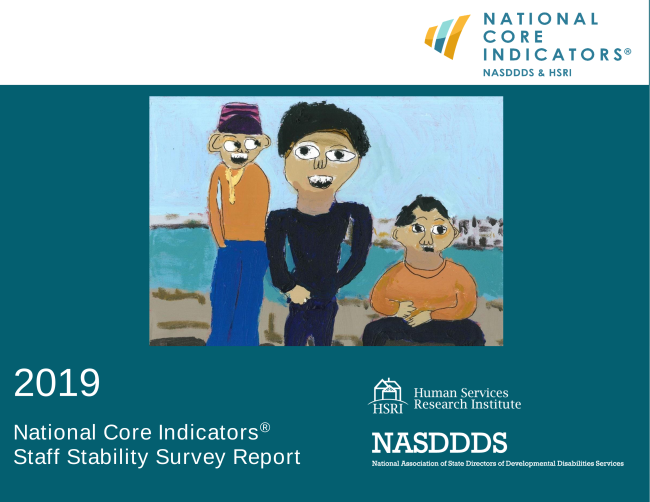
Announcing 2019 NCI Staff Stability Results
NASDDDS and HSRI are very pleased to send you the final report link on the 2019 NCI© Staff Stability Survey results. 2019 saw 26 states participating, with 3604 provider agencies responding to the survey.
As in prior reports, you will find information on tenure; turnover; vacancy rates; benefits offered; and wages for Direct Support Professionals (DSPs) employed by provider agencies. For example, 2019 saw a turnover rate of 42.8% across the 26 states, with 23.8% the lowest rate of turnover, and 64.8% the highest rate among states.
The median wage for DSPs is $12.00/hr. The 2019 final report also shows that vacancy rates for full-time positions ranged from 4.1% to 13.7% with an NCI Average of 8.5%. Vacancy rates for part-time positions ranged from 4.5% to 20.5% with an NCI Average of 11.2%. To see more, please click on the link below.
The NCI Staff Stability report is now a go-to source of information on the experience of DSP's in our field and is the only data source focused exclusively on the I/DD field.
|
Job Quality in Direct Care Relies on Long-Term Care Financing
The Biden-Harris administration is exciting news for direct care workers and the long-term care field.
In July 2020, then-presidential candidate Joe Biden released a 10-year, $775 billion plan to build a "robust 21st century caregiving and education workforce." This much-needed plan included measures to improve job quality in direct care, expand access to home and community-based services (where millions of home care workers are employed), and establish a long-term services and supports innovation fund (that will ideally also resource innovations related to the direct care workforce).
This shocking outbreak revealed how rapidly COVID-19 can spread in congregate settings. Tragically, it was only a hint of the catastrophe to come. The New York Times reports that, as of Jan. 12, 2021, the virus has infected more than a million people in nursing homes and other congregate care settings since that first outbreak-and caused more than a third of the U.S.'s COVID-19 deaths.
This has been a horrifying time for long-term care residents, families and staff, primarily certified nursing assistants (CNAs) and residential care aides. These workers provide direct, hands-on care and are disproportionately at risk of contracting COVID-19 and suffering adverse outcomes due to their role and the health inequities they face (workers are predominantly people of color).
|
e-News for Small Business
Increased deduction limit for corporate cash contributions for disaster relief; recordkeeping relief - Must act before February 25
Qualified contributions must be paid by the corporation during the period beginning on January 1, 2020 and ending on February 25, 2021.
Updated FAQs and new IRS form available for sick and family leave credits
The IRS published updated FAQs about recent legislation that extended and amended tax relief to certain small- and mid-sized employers under the Families First Coronavirus Response Act (FFCRA).
Unemployment guidance and reminders
IRS offers guidance to taxpayers on identity theft involving unemployment benefits The IRS urges taxpayers who receive Forms 1099-G for unemployment benefits they did not actually get because of identity theft to contact their appropriate state agency for a revised Form 1099-G showing they did not receive these benefits. Taxpayers who are unable to obtain a timely, corrected form from states should still file an accurate tax return, reporting only the income they received.
Reminder to report unemployment compensation when filing taxes Taxpayers who received unemployment compensation should receive a Form 1099-G, Certain Government Payments showing the amount of unemployment compensation paid to them during the year in Box 1, and any federal income tax withheld in Box 4. They need this form for reporting unemployment when filing taxes.
Taxpayers who don't receive the form by mail may need to visit the website of the unemployment agency who paid the benefits to get a copy of the Form 1099-G.
^^Please share this useful information with employees. More information can be found by visiting IRS.gov/uc.
Important reminders before filing 2020 tax returns
Following an unpredictable year with many changes and challenges, the IRS shares important reminders for taxpayers who are about to file their 2020 federal tax returns about:
- Direct deposit
- Earned Income Tax Credit
- Taxable unemployment compensation
- Interest is taxable income
- Home office deduction
- Workers moving into the gig economy
- Charitable donation deduction for people who don't itemize
- Disasters such as wildfires, flooding or hurricanes
Double-check for missing or incorrect Forms W-2, 1099 before filing taxes
With some areas seeing mail delays, the IRS reminds taxpayers to double-check to make sure they have all of their tax documents, including Forms W-2 and 1099, before filing a tax return. The IRS also provides guidance on what to do if the documents are missing or incorrect to still file on time and as accurately as possible.
Critical tax credit provides significant refund boost to millions
The Earned Income Tax Credit is the federal government's largest refundable federal income tax credit for low- to moderate-income workers. See the IRS EITC news release for information on how to check eligibility, to see a list of workers who may be at risk for overlooking this important credit, helpful IRS YouTube videos and more.
New look-back rule
Under the COVID-related Tax Relief Act of 2020, taxpayers can use their 2019 earned income to figure their 2020 EITC if their 2019 earned income was more than their 2020 earned income. To qualify for EITC, people must have earned income, so this option may help workers who earned less in 2020, or received unemployment income instead of their regular wages, get bigger tax credits and larger refunds in the coming year.
^^Please share this useful information with employees.
Post-release changes to Schedule K-1, Form 1041 instructions
Avoid tax schemes - Report abusive tax promotions; Beware of "ghost" preparers
Abusive tax promotions
The IRS would like your help to identify promoters of "too good to be true" abusive tax scams and tax preparers using illegal scams to avoid paying taxes.
Small business owners should be careful not to let promoters of tax scams mislead them. Those who do take part in scams could face owing more taxes and substantial penalties and interest.
"Ghost" preparers
The IRS reminds taxpayers to avoid "ghost" tax return preparers whose refusal to sign returns can cause a frightening array of problems. It is important to file a valid, accurate tax return because the taxpayer is ultimately responsible for it.
- Requirements for anyone who is paid to prepare or assists in preparing federal tax returns
- What unscrupulous tax return preparers might do
- What to do before signing no matter who prepares the return
- How to report preparer misconduct
IRS creates new Chief Taxpayer Experience Officer position; Ken Corbin to lead new focus to improve service to taxpayers
As part of a larger effort related to the Taxpayer First Act, the IRS announces the creation of a new Chief Taxpayer Experience Officer position to help unify and expand efforts across the agency to serve taxpayers.
Inside the IRS with "A Closer Look"
"A Closer Look" covers a variety of timely issues of interest to taxpayers and the tax community. It also provides a detailed look at key issues affecting everything from IRS operations and employees to issues involving taxpayers and tax professionals. People can check here for prior posts and new updates.
|
Upcoming Events
|
Tuesday, February 16, 2021
A Focus on Peer Support Sub-Population Services
This is the 2nd part of a 3-part series
Time: 10:00 am thru 11:00 am
|
New: Tuesday, February 16, 2021
A Pandemic Results Of The 2020 National Behavioral Health EHR Survey
Time: 1:00 pm thru 2:00 pm
|
Wednesday, February 17, 2021
IER Webinar for Refugee and Asylee Service Providers Refugees' and Asylees' Right to Work (Identical to the webinar on 2/11/21)
Time: 2:00 pm thru 3:00 pm
|
New: Wednesday, February 17, 2021
COVID-19 Vaccine Presentation with NCCDD & NC Down Syndrome Alliance
Time: 7:00 pm thru 8:00 pm
|
Thursday, February 18, 2021
Telehealth Policy Update: What Has Happened and What to Look for in 2021
Time: 2:00 pm thru 3:00 pm
|
Thursday, February 18, 2021
Bridging the Digital Divide for HCBS Beneficiaries (Part I)
Time: 3:00 pm thru 4:30 pm
|
Thursday, February 18, 2021
COVID-19 Vaccine Administration
Time: 5:30 pm thru 6:30 pm
|
New: Thursday, February 18, 2021
Time: 7:00 pm thru 8:00 pm
|
Friday, February 19, 2021
Benchmarks' Friday Membership Webinar
Time: 8:30 am thru 9:30 am
|
New: Monday, February 22, 2021
Nurses on the Frontline: Strengthening America's Health Care Workforce
Time: 2:00 pm thru 3:00 pm
|
Tuesday, February 23, 2021
Voices of Peer Support & Where to Get PSS Services
This is the 3rd part of a 3-part series
Time: 10:00 am thru 11:00 am
|
Wednesday, February 24, 2021
The Drivers Shaping The Movement To A Value-Based Contracting Business Model Key Competitors & Potential Partners
Time: 10:00 am thru 11:15 am
|
Tuesday, March 2, 2020
Medication Options for Treatment of Stimulant Use Disorders: Optimistic Update and New Research
Time: 1:00 pm thru 2:00 pm
|
Registration Now Open:
Tuesday and Wednesday, March 2 & 3, 2020
2021 CMS Quality Conference
Healthcare Innovation During a Time of Disruption
|
Wednesday, March 3, 2021
Addressing the Adverse Impacts of COVID-19 on Children with Serious Emotional Disorders
Time: 1:00 pm thru 2:30 pm
|
Thursday, March 4, 2021
Medicaid Managed Care Fireside Chat Series: Policy Approvals, Process Changes and Appeals
Time: 5:30 pm thru 6:30 pm
|
Friday, March 5, 2021
Benchmarks' Friday Membership Webinar
Time: 8:30 am thru 9:30 am
|
Thursday, March 11, 2021
Benchmarks' Membership Child Welfare Webinar
Lisa Cauley Joins Karen McLeod
Time: 8:00 am thru 9:00 am
|
Wednesday, March 24, 2021
Are You Ready For Value-Based Reimbursement? An Executive Guide For Assessing Readiness In A Value-Based Market
Time: 10:00 am thru 11:15 am
|
Friday, March 26, 2021
NC DHHS Supported Living Level 2 &3
STAKEHOLDERS MEETING
Time: 2:30 pm thru 4:30 pm
|
Wednesday, April 21, 2021
Bridging The Gap From Data To Data-Driven Performance
Time: 10:00 am thru 11:15 am
|
Wednesday, May 26, 2021
Developing New VBP Services That Increase Quality & Decrease Service Costs
Time: 10:00 am thru 11:15 am
|
Please click on each of the following links to view details sent out from each LME/MCO.
Benchmarks' wants to be sure to make the following list handy for our members to visit and suggests a peek at least once per week to find information that may be pertinent to your agency and contracts.
|
|
|
|
|
|