|
Benchmarks' Friday Membership Webinar Recording
|
| | Benchmarks Membership Webinar: February 19, 2021 |
Upcoming Benchmarks' Webinars
(Reminder: We will NOT be holding webinars next week, please align your calendars with the dates below.)
Benchmarks' Friday Membership Webinar
Dave Richard Joins Karen McLeod
Date: Friday, March 5, 2021
Time: 8:30 am thru 9:30 am
Benchmarks' Membership Child Welfare Webinar
Lisa Cauley Joins Karen McLeod
Date: Thursday, March 11, 2021
Time: 8:00 am thru 9:00 am
Register Here
Benchmarks' Friday Membership Webinar
Date: Friday, March 19, 2021
Time: 8:30 am thru 9:30 am
|
Please Read and Review
Repeat Post: Tailored Care Management Certification Deadline Extended to June 1, 2021
To continue supporting providers interested in obtaining certification as a Tailored Care Management Advanced Medical Home Plus (AMH+) practice or Care Management Agency (CMA), the Department is extending the Round 1 application deadline from March 1, 2021 to June 1, 2021.
The Department plans to use this additional time to engage stakeholders in additional listening sessions and educational opportunities. More Information will also be provided on the certification process, capacity-building funds, technical assistance and the rate model for AMH+/CMAs.
The Department believes that Tailored Care Management is critical to ensuring that Behavioral Health and Intellectual/Developmental Disability (I/DD) Tailored Plan members obtain integrated, well-coordinated care. Over the next several months, the Department will continue working to empower providers to successfully implement the model and will offer opportunities for additional education.
The Department appreciates interest and feedback to date from providers and other stakeholders on the Tailored Care Management model. Thank you for your help in supporting NC Medicaid beneficiaries and providers.
February 19, 2021 COVID-19 Stakeholder Updates
PRESS RELEASES since the last update include:
NEW resources since the last update include:
UPDATED guidance since the last update include:
UPDATED reports since the last update include:
2021 Summer Camp Directory
The Family Support Program at the School of Social Work at the University of North Carolina is pleased to provide you with the updated 2021 Summer Camp Directory: A Free Resource Guide for Families with Children who have Special Needs. COVID-19 has impacted every area of life, including the ability for children to be able to enjoy summer camp.
As the state of the country is constantly evolving each summer camps will make a decision on what is best for the camp and children on whether to continue camp in person, virtually, or to cancel. This directory was completed with the information that was provided at the end of 2020 and is likely to change in the coming months. Please reach out to individual camps you are interested in to confirm if and how they will be doing camp Summer 2021. You may also access the 2021 Summer Camp Directory.pdf at our website. Please share this information with families and colleagues.
Long-Term Care Weekly Update
Infection Prevention Guidance Updates
- We / CDC recommend use of appropriate PPE including NIOSH-approved N95 respirator (or equivalent or higher level respirator), gown, gloves, and eye protection when caring for patients with suspected or confirmed SARS-CoV-2 infection.
- For source control, we / CDC recommend universal use of well-fitting source control for everyone in a healthcare setting (including long-term care facilities). Personnel options for source control include:
- Updated quarantine guidance for vaccinated persons. This guidance states that vaccinated persons with an exposure to someone with suspected or confirmed COVID-19 are not required to quarantine if they meet if they meet all of the following criteria:
- Are fully vaccinated (i.e., ≥2 weeks following receipt of the second dose in a 2-dose series, or ≥2 weeks following receipt of one dose of a single-dose vaccine) AND
- Are within 3 months following receipt of the last dose in the series AND
- Have remained asymptomatic since the current COVID-19 exposure.
- LTCF staff: These updated quarantine criteria could be applied when considering work restrictions for fully vaccinated healthcare personnel with higher-risk exposures as a strategy to alleviate staffing shortages.
- Residents of LTCFs: Vaccinated inpatients and residents in healthcare settings should continue to quarantine following an exposure to someone with suspected or confirmed COVID-19. This exception is due to the unknown vaccine effectiveness in this population, the higher risk of severe disease and death, and challenges with social distancing in healthcare settings.
- Residents of LTCFs: New admissions, regardless of vaccination status, should continue to be placed in quarantine.
Reminder on Visitation and Compassionate Care Guidance
As a reminder, current visitation guidance is available at links below and outline when facilities can conduct outdoor, indoor, and compassionate care visitation.
As a reminder on compassionate care visitation specifically, while end-of-life situations have been used as examples of compassionate care situations, the term "compassionate care situations" does not exclusively refer to end-of-life situations. Examples of other types of compassionate care situations include, but are not limited to:
* A resident, who was living with their family before recently being admitted to a nursing home, is struggling with the change in environment and lack of physical family support.
* A resident who is grieving after a friend or family member recently passed away.
* A resident who needs cueing and encouragement with eating or drinking, previously provided by family and/or caregiver(s), is experiencing weight loss or dehydration.
* A resident, who used to talk and interact with others, is experiencing emotional distress, seldom speaking, or crying more frequently (when the resident had rarely cried in the past).
Allowing a visit in these situations would be consistent with the intent of, "compassionate care situations." Also, in addition to family members, compassionate care visits can be conducted by any individual that can meet the resident's needs, such as clergy or lay persons offering religious and spiritual support. Furthermore, the above list is not an exhaustive list as there may be other compassionate care situations not included.
NC DHHS also recognizes the critical role that family members or other close caregivers have in the care and support of residents. We encourage facilities to consider how they can best protect their residents while recognizing that compassionate care is not limited to end of life or to the specific examples provided by CMS. Facilities may utilize the role of individuals who support residents with safe activities of daily living and provide additional support for the residents' physical and mental wellbeing to promote individualized care.
Compassionate care visits may be facilitated regardless of a facility's or resident's COVID-19 status. Visitors to a resident on transmission-based precautions for COVID-19 should adhere to the additional PPE requirements. Compassionate care visits can occur indoors or outdoors depending on the resident's needs.
Lastly, at all times, visits should be conducted using social distancing; however, if during a compassionate care visit, a visitor and facility identify a way to allow for personal contact, it should only be done following all appropriate infection prevention guidelines, including providing access to appropriate PPE, and for a limited amount of time. Through a person-centered approach, facilities should work with residents, families, caregivers, resident representatives, and the Ombudsman program to identify the need for compassionate care visits.
LTC Vaccination 101 Webinar Recordings
Missed a previous webinar for LTCF Staff? See links to the recordings below.
LTC Vaccination Provider Enrollment
If your long term care pharmacy wishes to enroll as a COVID-19 vaccine provider go to the CVMS Vaccine Support page and click the Register link at the top right of the page to start the process. Follow this link for CVMS Enrollment Instructions/Training it has a large amount of training information including training videos as well.
As a reminder, COVID-19 vaccine providers must be qualified under the CDC agreement to prescribe COVID-19 vaccines and authorized under the appropriate NC licensing authority. Enrolled COVID-19 vaccine providers must be credentialed/licensed in North Carolina.
Please understand that while currently qualified providers are welcome to enroll, requests will be address in an order aligned with the prioritization phases and the timeline for approval will vary. The State will continuously reassess enrollment prioritization based on needs.
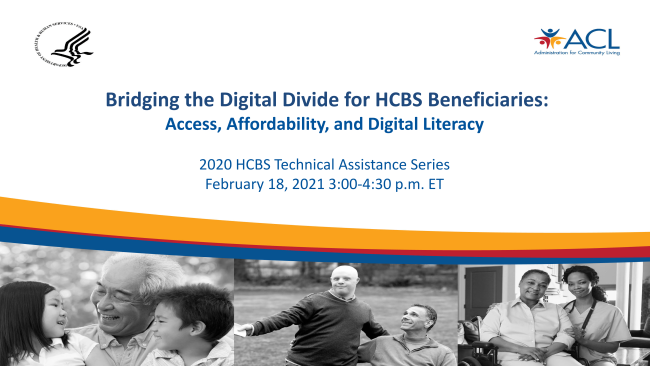
ACL/CMS Promising Practices Training: Bridging the Digital Divide for HCBS Beneficiaries: Access, Affordability, and Digital Literacy (Part 1)-Slide Deck
(**There were problems with this webinar so it may be rescheduled for a "do-over". Benchmarks' will keep you posted as this evolves.)
Traumatic Brain injury Waiver Application Update
H/T Eastpointe
A draft application for § 1915 (c) Home and Community-Based Services (HCBS) Traumatic Brain Injury Waiver is posted for a 30-day public comment period. The public comment period is from January 27-February 26, 2021.
The currently approved TBI Waiver with an effective date of May 1, 2018 will continue to operate at the levels that are previously approved.
Submit your comment via email to
|
|
| |
Supporting A Trained Direct Care Workforce In Facility Settings During And After The Covid-19 Pandemic
The direct care workforce is a critical component of a well-functioning health system. These occupations are reliable entry points into the health sector, but limited wage potential as well as physical and emotional demands of the jobs contribute to high turnover and shortages.
Executive Summary
The COVID-19 pandemic exacerbated existing challenges in recruiting and retaining direct care workers. The Centers for Medicare & Medicaid Services issued several waivers to address staffing challenges across the continuum of care during the public health emergency, including a waiver to temporarily reduce certain training requirements, and some states have taken complementary action creating new flexibilities to quickly train and deploy a qualified workforce. While responding to urgent direct care staffing needs is a top priority for states in the short-term, it will be critical for states and employers to consider strategies for retaining this workforce when the waiver expires.
|
|
| |
STATISTICAL BRIEF #533:
Concentration of Healthcare Expenditures and Selected Characteristics of High Spenders, U.S. Civilian Noninstitutionalized Population, 2018
Highlights
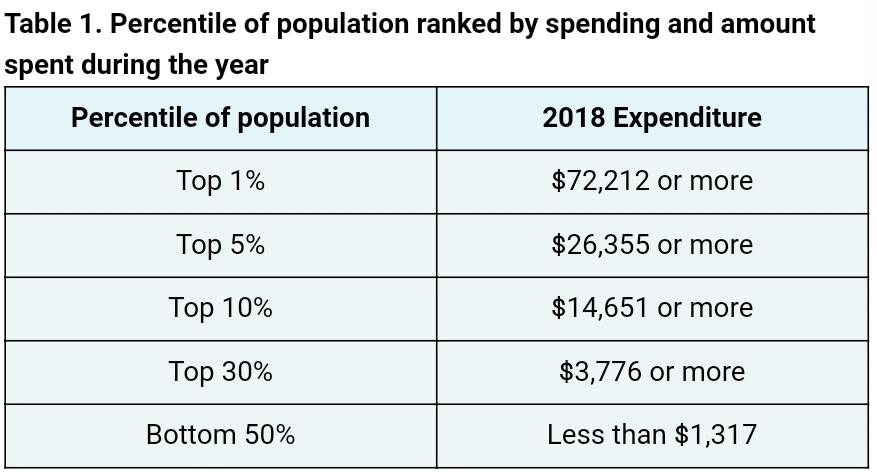
- In 2018, the top 1 percent of persons ranked by their healthcare expenditures accounted for about 21 percent of total healthcare expenditures, while the bottom 50 percent accounted for only about 3 percent.
- Persons ages 65 and older and whites were disproportionately represented in the top spending tiers.
- Inpatient hospital care accounted for 36 percent of spending for persons in the top 5 percent of the spending distribution.
- About three-quarters of aggregate expenses for persons in the top 5 percent of spenders were paid for by private insurance or Medicare.
Introduction
In 2018, spending on healthcare accounted for 17.7 percent of the United States gross domestic product, ¹ yet the majority of this spending was concentrated in a small percentage of the population. Medical Expenditure Panel Survey (MEPS) data show that about 13 percent of the U.S. civilian noninstitutionalized population had no personal healthcare expenditures in 2018. On the other hand, only 5 percent of the population accounted for nearly half of healthcare spending. This spending includes all sources of payments for medical care, including private insurance payments, Medicare, Medicaid, out-of-pocket spending, and other sources.
In this Statistical Brief, data from the Agency for Healthcare Research and Quality (AHRQ) Medical Expenditure Panel Survey Household Component (MEPS-HC) are used to describe the overall concentration of healthcare expenditures across the U.S. civilian noninstitutionalized population in 2018. In addition, the most commonly treated conditions among top spenders are identified, and the shares of spending by age group, race/ethnicity, type of medical service, and source of payment are compared across the distribution. All differences discussed in the text are statistically significant at the 0.05 level.
|
Downloadable Factsheets Now Available Through the NIAAA Publications Order Form
The National Institute on Alcohol Abuse and Alcoholism (NIAAA), part of the National Institutes of Health (NIH), offers free, research-based publications, including factsheets for downloading.
Factsheet topics include:
- Alcohol treatment and physical distancing
- Alcohol overdose
- Hangovers
- Alcohol-Induced blackouts
- Binge drinking
- Underage and college drinking
- Facts and statistics
See More
|
Head Into the Weekend Song
(Oh fun!)
|
| | Wellerman (Sea Shanty / 220 KID x Billen Ted Remix) |
|
Upcoming Events
|
Wednesday, February 17, 2021
IER Webinar for Refugee and Asylee Service Providers Refugees' and Asylees' Right to Work (Identical to the webinar on 2/11/21)
Time: 2:00 pm thru 3:00 pm
|
Wednesday, February 17, 2021
COVID-19 Vaccine Presentation with NCCDD & NC Down Syndrome Alliance
Time: 7:00 pm thru 8:00 pm
|
Thursday, February 18, 2021
Telehealth Policy Update: What Has Happened and What to Look for in 2021
Time: 2:00 pm thru 3:00 pm
|
Thursday, February 18, 2021
Bridging the Digital Divide for HCBS Beneficiaries (Part I)
Time: 3:00 pm thru 4:30 pm
|
Thursday, February 18, 2021
COVID-19 Vaccine Administration
Time: 5:30 pm thru 6:30 pm
|
Thursday, February 18, 2021
Time: 7:00 pm thru 8:00 pm
|
Friday, February 19, 2021
Benchmarks' Friday Membership Webinar
Time: 8:30 am thru 9:30 am
|
New: Monday, Feb. 22 - Wednesday, Feb. 24, 2021
|
Monday, February 22, 2021
Nurses on the Frontline: Strengthening America's Health Care Workforce
Time: 2:00 pm thru 3:00 pm
|
Tuesday, February 23, 2021
Voices of Peer Support & Where to Get PSS Services
This is the 3rd part of a 3-part series
Time: 10:00 am thru 11:00 am
|
Wednesday, February 24, 2021
The Drivers Shaping The Movement To A Value-Based Contracting Business Model Key Competitors & Potential Partners
Time: 10:00 am thru 11:15 am
|
New: Monday, March 1, 2021
For Behavioral Health-Focused Providers: Listening Session on Support Needed from Trillium for Providers Applying to Become a CMA/AMH+ in Trillium BH/IDD Tailored Plan
Time: 9:00 am thru 10:00 am
|
New: Monday, March 1, 2021
For I/DD-Focused Providers: Listening Session on Support Needed from Trillium for Providers Applying to Become a CMA/AMH+ in Trillium BH/IDD Tailored Plan
Time: 2:00 pm thru 3:00 pm
|
Tuesday, March 2, 2020
Medication Options for Treatment of Stimulant Use Disorders: Optimistic Update and New Research
Time: 1:00 pm thru 2:00 pm
|
Tuesday and Wednesday, March 2 & 3, 2020
2021 CMS Quality Conference
Healthcare Innovation During a Time of Disruption
|
Wednesday, March 3, 2021
Addressing the Adverse Impacts of COVID-19 on Children with Serious Emotional Disorders
Time: 1:00 pm thru 2:30 pm
|
Thursday, March 4, 2021
Medicaid Managed Care Fireside Chat Series: Policy Approvals, Process Changes and Appeals
Time: 5:30 pm thru 6:30 pm
|
Friday, March 5, 2021
Benchmarks' Friday Membership Webinar
Time: 8:30 am thru 9:30 am
|
Thursday, March 11, 2021
Benchmarks' Membership Child Welfare Webinar
Lisa Cauley Joins Karen McLeod
Time: 8:00 am thru 9:00 am
|
Wednesday, March 24, 2021
Are You Ready For Value-Based Reimbursement? An Executive Guide For Assessing Readiness In A Value-Based Market
Time: 10:00 am thru 11:15 am
|
Friday, March 26, 2021
NC DHHS Supported Living Level 2 &3
STAKEHOLDERS MEETING
Time: 2:30 pm thru 4:30 pm
|
Wednesday, April 21, 2021
Bridging The Gap From Data To Data-Driven Performance
Time: 10:00 am thru 11:15 am
|
Wednesday, May 26, 2021
Developing New VBP Services That Increase Quality & Decrease Service Costs
Time: 10:00 am thru 11:15 am
|
Please click on each of the following links to view details sent out from each LME/MCO.
Benchmarks' wants to be sure to make the following list handy for our members to visit and suggests a peek at least once per week to find information that may be pertinent to your agency and contracts.
|
|
|
|
|
|