|
Benchmarks' Friday Membership Webinar & Written Update
Karen McLeod, Benchmarks & Leza Wainwright, Trillium
|
| | Benchmarks' Friday Membership Webinar: November 20, 2020 |
NC Cases: 325,198
Cases Hospitalized: 1,463
NC Deaths: 4,898
Positive Tests: 7-day average was 7.7%
North Carolina reported 4,296 new cases of COVID-19 Thursday, exceeding by hundreds the state's previous record for daily cases. The previous record, set Saturday, was 3,885.
The total number of confirmed cases during the pandemic now stands at 325,158 statewide, according to the N.C. Department of Health and Human Services.
The new daily high came with a significant jump in tests reported Thursday to 54,560, up from 33,029 tests reported Wednesday.
Virus Treatment
Rose Hoban, NC HEALTH NEWS
As the number of COVID-19 cases climbs in North Carolina, hospitals across the state are feeling the strain of an influx of patients sickened by the lingering coronavirus. Daily case counts topped 3,000 several times over the past week. Along with those growing cases, the number of people filling hospital beds with COVID-19 generated disease has also ticked up to more than 1,500 patients as of Tuesday, with 370 COVID-19 patients in ICUs statewide. One recent development has been that many patients from rural areas are landing in beds in smaller hospitals, particularly in the northwestern part of the state, where more than a quarter of the state's patients - and close to a third of the state's ICU patients - currently are hospitalized.
"Over the past four weeks or so we've seen a significant uptick in our community, in our county and certainly in our hospital," said Joseph Mazzola, a physician leader at the Statesville-based Iredell Health System, which falls in the Triad Healthcare Preparedness Coalition area. Though the sheer volume of patients has tested the mettle of health care workers, lessons learned in ICUs across the state and country over the past eight months of treating illness related to COVID-19 offer glimmers of hope in this notably dark time. These lessons might even change how intensive care is provided beyond the pandemic, including ways to avoid the use of mechanical breathing machines which can often bring as many problems as they solve.
One technique that is now almost universally practiced among hospitals is to separate patients who have COVID from those who do not. In the past, a ward in a hospital might have a handful of patients with an infectious disease, alongside those with other problems. That was back in the day when there wasn't such an overwhelming demand for personal protective equipment. Health care personnel were able to put on and take off the PPE for patient care. But with shortages of PPE, that comparatively wasteful technique was quickly abandoned. Instead, hospitals clustered all their COVID patients, either in the far end of the hallway or on a different floor. This has allowed for medical workers to conserve their PPE.
As COVID spread across the state, Cone Health's old Women's Hospital had just closed in late February as the system opened a new Women's & Children's Center. Only weeks later, patients sick with COVID-19 started filling up beds at Cone, generating difficulties with segregating those infected with the novel coronavirus from others. Standing empty, the facility a few blocks away beckoned. Now that building has been dubbed the Green Valley COVID unit and will serve the system for treating patients until the pandemic wanes.
Another thing that will likely remain once the pandemic subsides is the increased use of telemedicine. "I also think the utilization of tele-visits or telemedicine or bringing the family and having discussions using some sort of iPad technology or virtual technology will be something that will stick long into the future," Mazzola said. "Those are things we've talked about, probably for the past 15 years in medicine, but have been slow to adopt."
Viral Winter
Zachery Eanes, THE NEWS & OBSERVER
You should be nervous about this upcoming winter, with COVID-19 surging across the U.S., says Ralph Baric, a UNC professor who is one of the world's preeminent researchers of coronaviruses. Things are likely to get much worse before they get better. "We are looking at five months of extensive and rapid virus spread," Baric said in a phone interview with The News & Observer. "The good news is there is a light at the end of the tunnel." That light appears to be a new vaccine by Pfizer, which delivered promising results on its experimental vaccine this month. A number of other vaccines are being tested as well. But they won't be ready for weeks or months and the weather is quickly getting colder, sending more Americans indoors to places where the virus may spread rapidly.
"I think it is important [to note] that before vaccines become widely delivered," Baric said, "that we are looking at about 250,000 more deaths in the U.S., despite the development of new drugs. That is probably going to still occur because of the massive increases in cases." Nationwide, and in North Carolina, records are being set for daily positive coronavirus cases. On Friday, more than 181,100 new cases were reported across the country, a record that came only eight days after the U.S. reported its first 100,000-case day, The New York Times reported. On Wednesday, North Carolina set a daily record with 3,119 reported cases, The N&O reported. More than 244,000 people have died from COVID-19 in the U.S.; more than 4,700 in North Carolina alone.
Medicaid Transformation
Dana Miller Ervin, WFAE RADIO
North Carolina's 2.36 million Medicaid recipients are in for a big change next July. That's when the state's Medicaid system will be transformed into a managed care program run by private health care companies. Right now, only behavioral and mental health care is handled by managed care companies like Cardinal Innovations Healthcare. Cardinal serves 20 counties in the state, but that's likely to change. Several counties, including Mecklenburg, say Cardinal has done such a poor job they want to switch to another provider. But under the state law requiring transformation, all medical care - including doctor visits, hospital stays and prescription drugs - will be coordinated by private companies. And controversy over Cardinal Innovations could raise questions about whether North Carolina will be ready to embark on Medicaid transformation next July.
Department of Health and Human Services' Deputy Secretary Dave Richard told WFAE he's optimistic about Cardinal's new plan to reduce wait times for treatment. And he says Cardinal has been told DHHS will impose financial penalties if it falls short. Cardinal says it has yet to learn the specifics of potential penalties. But DHHS has been responsible for overseeing Cardinal for five years. And the department's oversight role will increase enormously under transformation.
Under the plan, Medicaid recipients without behavioral or mental care needs will sign up with one of five managed care companies chosen by the state. So will those with mild or moderate behavioral problems. They'll choose between plans offered by Carolina Complete Health, Wellcare, United Healthcare, Blue Cross and Blue Shield and AmeriHealth Caritas. Those with severe mental and behavioral issues will transfer all their care a year later to one of the companies which currently provides behavioral health care - including Cardinal Innovations.
All managed care companies will be paid a set amount for each patient they serve, and they'll get to keep any money they don't spend. State lawmakers say that will cut the cost of unnecessary care. The theory is that companies will have an incentive to spend more on preventative care so they don't have to spend money on expensive treatments for avoidable illnesses. But companies will also have an incentive to cut other costs, so the need for accountability and oversight will grow.
That worries state Auditor Beth Wood. In a May 2019 audit of the DHHS oversight of the managed care companies currently providing behavioral care - like Cardinal - she found the department didn't have formal policies and procedures for evaluating performance or for designing corrective action plans and imposing penalties when necessary.
Suicide Prevention
NEWS RELEASE, DHHS
The NC Department of Health and Human Services announced it has received $870,000 per year over the next five years for suicide prevention. The Centers for Disease Control and Prevention's new Comprehensive Suicide Prevention Program is the first to take a comprehensive public health approach which addresses data-informed family, community and societal issues that contribute to suicide. North Carolina, along with nine other states, received funding to improve the timeliness of state surveillance data on emergency department visits for nonfatal firearm injuries. The funding is part of a new cooperative agreement with the CDC's Division of Violence Prevention for the Firearm Surveillance Through Emergency Rooms (FASTER) project and includes partners at UNC's Carolina Center for Health Informatics and Injury Prevention Research Center. With these grants, NCDHHS will be better able to gather and analyze data for use in support of evidence-based interventions statewide to reduce suicide deaths and nonfatal firearm injuries.
The collection and dissemination of near real-time data from emergency department visits for nonfatal firearm injuries overall and by intent (suicidal, unintentional, assault-related and undetermined) at the state and local level will improve state and local practitioners' ability to identify and respond to emerging public health problems.
NC COVID-19 County Alert System
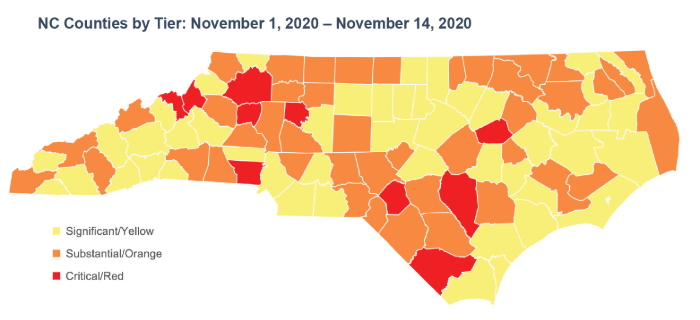
Governor Roy Cooper and Dr. Mandy Cohen, Secretary of the North Carolina Department of Health and Human Services (NC DHHS) announced a new COVID-19 County Alert System to pinpoint counties with the highest levels of viral spread and offer specific recommendations to bring numbers down. This system will help give local leaders another tool to understand how their county is faring and to make decisions about actions to slow viral spread. The map will be updated every four weeks.
"By pinpointing counties with high virus transmission and asking everyone in those counties to work with us and do more right now to slow the spread of the virus, we can succeed," Governor Cooper said. "It can help bring down their case rates, keep their communities safer, save lives and keep their hospital systems working."
"It's going to take all of us working together to avoid tightening restrictions like so many states are now doing," said NCDHHS Secretary Mandy K. Cohen. "The COVID-19 County Alert System gives North Carolinians an easy way to see how their county is doing and know what they can do protect their family and neighbors and slow the spread of this virus."
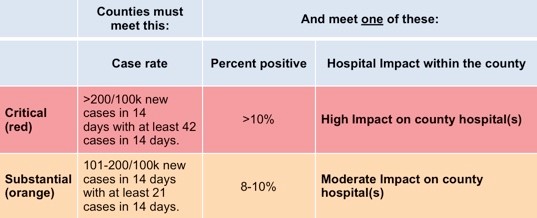
The system uses metrics informed by the White House Coronavirus Task Force and North Carolina's key metrics to categorize counties into three tiers:
Yellow: Significant Community Spread
Orange: Substantial Community Spread
Red: Critical Community Spread
Because no one metric provides a complete picture, the COVID-19 County Alert System uses a combination of three metrics: case rate, the percent of tests that are positive, and hospital impact within the county.
To be assigned to the red or orange tier, a county must meet the threshold for case rate for that tier AND the threshold for either percent positive OR hospital impact.
Case Rate: The number of new cases in 14 days per 100,000 people
Percent Positive: The percent of tests that are positive over 14 days
Hospital Impact: A composite score based on the impact that COVID-19 has had on hospitals including percent of COVID-19 hospitalizations, COVID-19 related visits to the Emergency Department, staffed open hospital beds, and critical staffing shortages over 14 days
Counties that do not meet criteria for red or orange are categorized as being in the yellow tier (significant community spread) and should continue to be vigilant to prevent further spread of COVID-19.
To see the full COVID-19 County Alert System guidance for individuals, businesses and communities, and government officials, please click here.
House Leadership
Lucille Sherman, THE INSIDER
Standing outside of the GOP headquarters on Hillsborough Street in Raleigh Monday afternoon, House Speaker Tim Moore announced the legislators who will lead the Republican majority in North Carolina's statehouse for at least the next two years. "We did elect a strong group of leaders for this next biennium," said Moore, who was selected for a fourth term as House speaker. Moore's formal election will come when the legislature convenes in January. He'll tie the record for longest serving speaker, which was set by Speaker Liston Ramsey in the 1980s.
The six other members who will assume leadership roles in the coming session were also unanimously re-elected to their positions by the House Republican caucus. Rep. Sarah Stevens, R-Surry, will serve as speaker pro tempore; Rep. John Bell, R-Wayne, will serve as House majority leader, and Rep. Brenden Jones, R-Columbus, was elected deputy majority leader; Rep. John Szoka, who won a close race in Cumberland County's District 45, will serve as conference leader; Rep. Jon Hardister, R-Guilford, was elected majority whip; and Rep. Pat Hurley, R-Randolph, will serve as joint conference leader.
"There were a lot of folks who said we were going to be in the minority," Moore said. "I never thought for a moment that we would. I always knew we would maintain the majority." Moore touted the strides the Republican-led legislature made in tackling the coronavirus in the latest session, saying they made wise budgeting decisions and avoided both layoffs and tax hikes. "I think the fact that we received a vote - that we actually expanded our numbers - shows that we have a mandate to continue the legislative leadership that we've had," Moore said, "and this team pledges to continue doing that."
On redistricting, which Republicans will have control over in the next session, Moore said they'll likely use the latest process for redrawing districts, which occurred in 2019 under a court order, as a starting point and go from there. Moore liked the transparency aspect of that process, he said.
Moore said he hopes the legislature and Democratic Gov. Roy Cooper, who was elected for a second term, can find ways to work together. "One thing that I will continue to say to the governor is don't take one issue - which for example, last time was Medicaid expansion - and use that to hold up everything else," Moore said. "That's not right. That's not right to the people of this state."
|
Benchmarks' Health & Human Services Insurance Crisis Webinar Recording
|
| Benchmarks HHS Insurance Crisis Webinar:
November 18. 2020 |
Contact Information:
|
Behavioral Health/IDD Tailored Plan RFA
- BEHAVIORAL HEALTH AND INTELLECTUAL/DEVELOPMENTAL DISABILITY TAILORED PLANS (Nov. 13, 2020) Applications are due by Feb. 2, 2021, by 2 p.m. ET. Instructions to submit questions and applications are included in the RFA.
- Addendum 1: Section V Scope of Services, A-B (Nov. 13, 2020)
- Addendum 2: Section V Scope of Services, C and Section VI (Nov. 13, 2020)
- Addendum 3:Â Section VII Attachments A-P (Nov. 13, 2020)
- Addendum 4: Section VIII Attachment Q (Nov. 13, 2020)
- Addendum 5: Section IX Medicaid Tailored Plan Draft Rate Book (Nov. 13, 2020)
Holiday Guidance for Residents, Staff, and Visitors of Residential Care Settings: November 19, 2020
This guidance applies to residents, staff, residents' families, and visitors of nursing homes, adult care homes, behavioral health and intellectual/developmental disability facilities, intermediate care facilities, and psychiatric residential treatment facilities.
As we move into the holiday season, we wanted to remind staff, families, and visitors of residents in residential care settings of the importance of protecting this vulnerable population.
CDC states on their Holiday Celebrations and Small Gatherings webpage, "if you are an older person... you should avoid in-person gatherings with people who are not in your household." For people who live in a residential care setting, their "household" is composed of the residents and staff within their facility. Leaving the facility to spend time with a different group of people can put the health of the resident and others in the facility at risk.
For this reason, we recommend that residents do not leave the facility to attend holiday events with individuals outside of their household. We also recommend that staff do not attend holiday events or gatherings with individuals outside of their household.
Residential care facilities are at a very high risk for COVID-19 transmission and activities that residents and staff engage in outside of the facility may impact the health of the entire facility.
North Carolina strongly encourages that facilities, families and staff plan lower-risk activities such as those listed in the NC Holiday Guidance such as delivering holiday meals to higher risk individuals, having a virtual meal, or doing an outdoor visit at the facility. Families bear responsibility to assure the health and safety of their loved ones, since additional risk is incurred in activities conducted outside the facility. If a resident or staff engage in events or gatherings with those outside of their household, the following guidelines are recommended:
Residents:
- Residents and families should be educated and encouraged to follow masking, social distancing and hand hygiene practices. They must notify the facility if anyone who attended the holiday gathering tests positive for COVID-19 or exhibits symptoms of COVID-19 within 48 hours of the resident visit/stay outside the facility.
- Residents who leave the facility for holiday visits or gatherings should follow CMS guidance. (Note: While CMS guidance is directed to nursing homes and their residents and families, the guidance is appropriate for other residential care settings as well. NC DHHS urges all residential care facilities to follow the CMS guidance.) Quarantine may be considered based on identified risks.
- Develop a plan with families for residents who leave the facility in advance.
- Consider testing residents upon return to the facility.
- A person with a positive test should be placed on isolation.
- A person with a negative test should remain in quarantine for the full 14 days
- Consider increased testing intervals for residents throughout the holidays and in the following 14 days.
Family / Visitors:
- Consider getting a screening test ahead of your visit/gathering.
- If you test positive, cancel any holiday plans, stay home, and isolate.
- Even if you test negative, it's important to continue to follow the prevention measures and practice the 3Ws.
- Limit the number of guests and households at holiday visits/gatherings.
- Follow the North Carolina holiday guidance
Staff:
- Instruct staff to follow the North Carolina holiday guidance to prevent the introduction of COVID-19 into the facility.
- Follow masking, social distancing and hand hygiene practices.
- Since you will have to return to work and not be able to quarantine after family gatherings, introduction of COVID-19 into the facility may occur if guidelines are not followed.
- Maintain consistency in staffing patterns - assign the same staff to the same residents to minimize exposures. Consider cohorting residents and staff who participated in holiday events/gatherings outside of the facility.
- Consider increased testing intervals for staff throughout the holidays and in the following 14 days.
Facilities should communicate their plan with residents, families, and staff. Provider Contracting Deadline for Inclusion in Open Enrollment and Auto-Enrollment
Today the North Carolina Department of Health and Human Services (NCDHHS) issued guidance for Provider and Health Plan contract deadlines for inclusion in open enrollment and auto-enrollment as part of North Carolina's transition to Medicaid Managed Care.
Provider contracts must be signed and mailed to health plan by:
- Feb. 1, 2021, for inclusion in open enrollment, and
- April 12, 2021, for inclusion in auto-enrollment.
During open enrollment for Medicaid Managed Care (March 15, 2021 through May 14, 2021), beneficiaries will choose a health plan and primary care provider (PCP). Those beneficiaries who do not make a choice will be auto-enrolled (commences on May 15, 2021 and runs for six days) in a health plan.
These recommended provider contracting deadlines allow health plans to process provider contracts and ensure that provider records are loaded correctly and transmitted to our Enrollment Broker. This typically takes at least two to three weeks, but it may take longer. Additional time is then needed to transmit information to the Department for inclusion in the open enrollment and auto-enrollment processes.
COVID-19 Updates
PRESS RELEASES since the last update include:
NEW resources since the last update include:
UPDATED guidance since the last update include:
UPDATED reports since the last update include:
UPDATED
Contact Tracing numbers
|
Meet the recipients of the 2020 Advocacy and Leadership Awards!
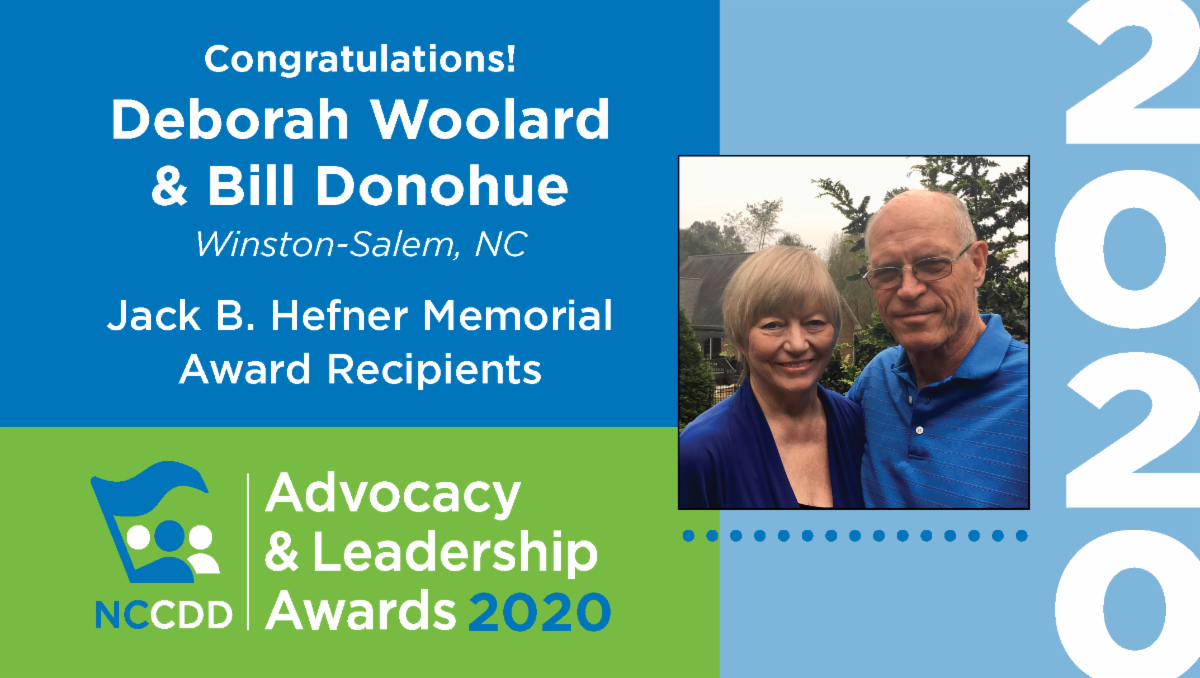
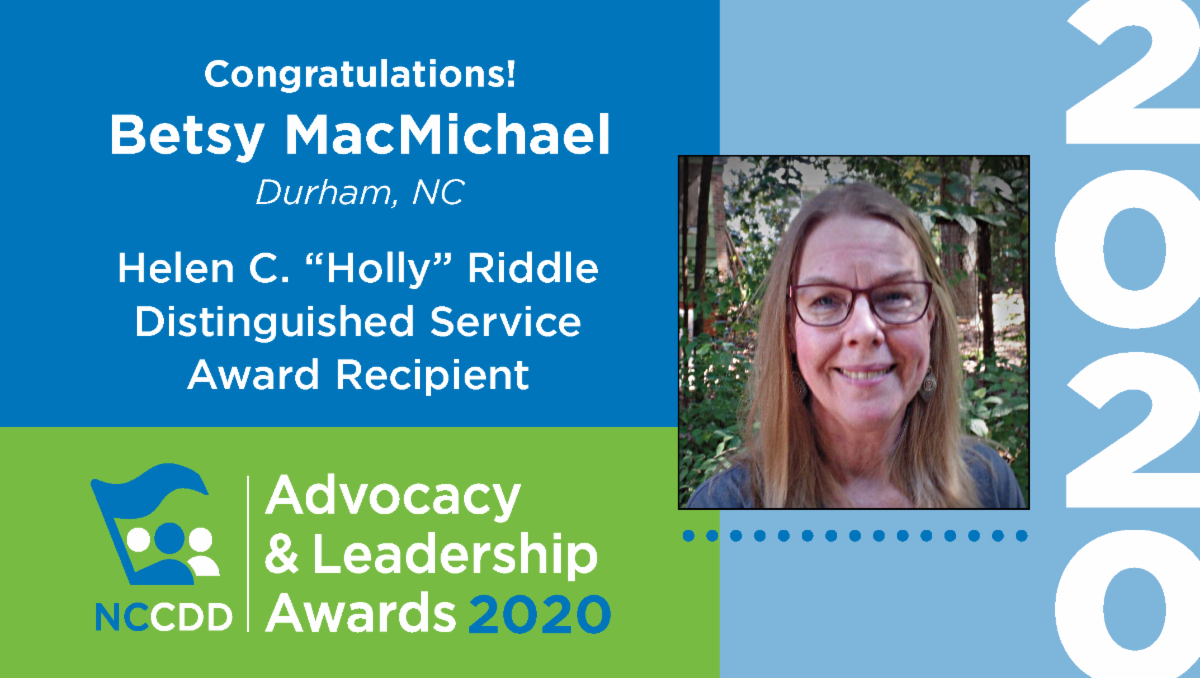
Raleigh, NC (November 19, 2020) - Four North Carolina leaders in disability advocacy were honored the annual Advocacy and Leadership Awards presentation during the November meeting of the North Carolina Council on Developmental Disabilities (NCCDD).
The North Carolina Leadership Achievement Award, which recognizes an outstanding North Carolina self-advocate whose work has improved the quality of life for people with intellectual and other developmental disabilities (I/DD), was awarded to Suvya Carroll.
A self-advocate who has cerebral palsy, Carroll has served as an unofficial consultant on accessibility in Durham, NC by identifying barriers to access in local churches, nonprofits and restaurants. Her attention to accessibility details has resulted in her church, CityWell, putting in a paved parking lot and a wheelchair-accessible elevator.
The Jack B. Hefner Memorial Award honors family members or volunteers who are advocating and building a better North Carolina for people with I/DD. This award was presented to Deborah Woolard and Bill Donohue of Winston-Salem, who have served on the boards for Disability Rights NC, the Arc (both state and local chapters), and the Piedmont Down Syndrome Support Network.
For years they have been involved with planning Forsyth County's Buddy Walk supporting the Down Syndrome Society. The two started and remain active in the North Carolina Innovations Waiver Action Committee. Both Woolard and Donohue are working on the North Carolina registry of unmet needs on behalf of individuals with disabilities, bringing attention to the issue through social media posts as well as holding a live rally last March with over 100 legislators, media, and North Carolinians in attendance.
The Helen C. "Holly" Riddle Distinguished Service Award recognizes professionals who have made lasting contributions towards improving opportunities, breaking down barriers and promoting increased quality of life for people with I/DD in North Carolina.
Receiving this award is Betsy MacMichael, the Executive Director for
First In Families of NC (FIFNC), who notes the state of North Carolina that is "First in Flight" and "First in Freedom" should certainly be "First in Families." MacMichael began to find ways to break down barriers for individuals with disabilities and has guided FIFNC over the years to where it now supports over 2,500 families impacted by I/DD.
She is the mother of Janie Desmond, a young adult with I/DD. Together they speak throughout the area about the importance of inclusion, self-determination, and contribution. MacMichael currently serves as Community Co-Chair of the Olmstead Plan Stakeholders Advisory Committee, as well as on the Supported Living Action Team, the Rethinking Guardianship initiative, and the Family Supports Community of Practice Collaborative.
|
CMS Urging Nursing Homes to Follow Established COVID Guidelines This Holiday Season
Today, in advance of the approaching holiday season, the Centers for Medicare & Medicaid Services (CMS) is urging nursing home staff, residents and visitors to follow established guidelines for visitation and adherence to the core principles of infection prevention. These guidelines include remaining six feet apart from individuals, wearing a face covering, and limiting the number of visitors in the nursing home at any one time. Adherence to these principles is critical in preventing the spread of the coronavirus disease 2019 (COVID-19) in America's nursing homes. While the holiday season is typically a time for family and friends to gather, CMS implores staff, residents and visitors to exercise extreme caution this year.
To view the alert, please visit: CMS' current emergencies page:
A copy of the press release can be found here:
Nursing Home Series for Front Line Clinicians and Staff
The Centers for Medicare & Medicaid Services (CMS) is airing the first episode in a series of short podcasts for frontline nursing home staff. The series, "CMS Beyond the Policy: Nursing Home Series for Frontline Clinicians and Staff," is designed to reinforce training and infection control practices in nursing homes to help combat the spread of coronavirus disease 2019 (COVID-19).
This podcast features a discussion between Dr. Shari Ling, CMS Deputy Chief Medical Officer and David Wright, Director of CMS's Quality Safety & Oversight Group. They will be talking about three important actions every frontline clinician or caregiver can take to prevent the spread of COVID-19 within nursing homes and sharing reminders about personal protective equipment (PPE). To listen to the podcast, please click here: https://www.cms.gov/podcast/nursing-home-series-front-line-clinicians-and-staff.
CMS is announcing the Request for Application (RFA) open period (November 19, 2020 to January 3, 2021) for the Value in Opioid Use Disorder Treatment (ViT) Initiative
The Centers for Medicare & Medicaid Services (CMS), Center for Medicare and Medicaid Innovation (Innovation Center) is announcing the Request for Application (RFA) for a new initiative that aims to increase access to opioid use disorder (OUD) treatment services to eligible Medicare Fee-For-Service (FFS) beneficiaries, including those dually eligible for Medicare and Medicaid. This is one of a number of new initiatives required under The Substance Use-Disorder Prevention that Promotes Opioid Recovery and Treatment for Patients and Communities Act (the SUPPORT Act). The statute makes available $10,000,000 each of fiscal years 2021-2024 for demonstration payments.
Value in Opioid Use Disorder Treatment (Value in Treatment) is a four-year demonstration that creates two new payments to participating providers: 1) a per beneficiary per month care management fee (CMF) and 2) a performance-based incentive payment. These new payments will be made in addition to the OUD treatment services Medicare currently covers. Value in Treatment participants may use these payments to furnish certain patient-centered OUD treatment services and have a reasonable expectation of improving or maintaining the health or overall function of participating beneficiaries. The demonstration is open to a wide range of eligible participants, including: - Individual physicians
- Group practices comprised of at least one physician or Nurse Practitioner
- Hospital outpatient departments
- Federally qualified health centers
- Rural health clinics
- Community mental health centers
- Certified community behavioral health clinics (CCBHCs)
- Opioid treatment programs (OTPs)
- Critical Access Hospitals (CAHs)
CMS encourages eligible participants to apply to the demonstration from November 19, 2020 to January 3, 2021. Selected participants are expected to implement the demonstration by April 1st, 2021, at which point demonstration payments will also start.
CHART Model Shares a Medicaid Participation Factsheet
Today, the Centers for Medicare & Medicaid released a State Medicaid Participation Factsheet that provides an overview of the State Medicaid Agency's role in the CHART Model Community Transformation Track. This factsheet provides a high-level breakdown of each aspect of the State Medicaid Agency's role, responsibilities, and associated timeline in the Community Transformation Track. The factsheet can be found on the CHART Model webpage.
|
Children and COVID-19: State Data Report: A Joint Report from the American Academy of Pediatrics and the Children's Hospital Association: Summary of Publicly Reported Data from 49 states, NYC, DC, PR, and GU.
American Academy of Pediatrics. Children's Hospital Association. 2020
Parental Drug Use and Family Reunification
Sanmartin, Maria X. Ali, Mir M. Meinhofer, Angélica. 2020 Psychiatric Services in Advance p. 1
Why Parenting Matters for Children in the 21st Century: An Evidence-Based Framework for Understanding Parenting and its Impact on Child Development
OECD Education Working Papers ; no. 222. Ulferts, Hannah. Organisation for Economic Co-operation and Development. 2020
US: Intercountry Adoptions: Regulatory Changes to Accreditation and Approval Regulations in Intercountry Adoption (Press release)
The Department of State (the Department) is proposing revisions to the Code of Federal Regulations to amend requirements for accreditation and authorization by the United States to provide adoption services in intercountry adoption cases. This proposed rule amends regulations to provide clarification, updating, or other adaptation of familiar accreditation and approval standards for intercountry adoption. It includes long-awaited provisions for intercountry adoption by relatives.
The new regulations simplify and streamline the process by limiting the number of adoption services the primary provider must provide and capitalizing on the adoptive family's understanding of local culture and institutions. It provides a comprehensive definition of relative to clarify the relationships that are encompassed in the amendments to the accreditation rule. Also featured in this proposed rule is a new focus on supporting children and families in the event their adoptive placement disrupts.
|
Key Policy Challenges and Opportunities to Improve Care for People with Mental Health and Substance Use Disorders
The National Academies of Sciences, Engineering, and Medicine (NAM) recently published, "Key Policy Challenges and Opportunities to Improve Care for People with Mental Health and Substance Use Disorders: Proceedings of a Workshop." This HRSA-supported report is a product of NAM's Forum on Mental Health and Substance Use Disorders and describes the presentations and discussions held in October 2019 during the inaugural workshop.
|
New Housing Concepts Emerge For Adults With Developmental Disabilities
Communities of varying shapes and styles are popping up across the country, all aiming to address the severe shortage of housing options for those with developmental disabilities.
Among the newest projects underway is a 15-acre community planned about 20 miles outside of Indianapolis that will offer homes for adults with and without developmental disabilities.
The $12 million project that's expected to open in 2023 will include various size homes as well as a community center and feature clubs and classes promoting independent living skills. Known as Crossbridge Point, the community being developed by the nonprofit ILADD, Inc. is among the first aimed at people with developmental disabilities that will allow families to purchase homes, though the plan also calls for rental units to be available.
Disability-Related Hate Crimes Down, FBI Says
As hate crimes rose across the U.S. to a level that hasn't been seen in over a decade, fewer of them targeted people with disabilities.
Figures released this week from the FBI's Uniform Crime Reporting Program indicate that there were 169 reported hate crime offenses rooted in disability bias in 2019, down slightly from 177 the year before.
The numbers are based on data submitted by 15,588 law enforcement agencies nationwide about incidents motivated by disability as well as race, ethnicity, ancestry, religion, sexual orientation, gender and gender identity.
|
Analysis of Patient Spending Points to
Interventions that May Prevent Rising Care Costs
Understanding which patients are likely to see their health care costs increase quickly over time, and why, is key to managing health care spending. While most cost prediction methods focus on assessing aggregate spending over a short time, a research team led by Julie Lauffenburger, PhD, an assistant professor of Medicine at Harvard Medical School, found that using trajectory modeling to assess spending over a period of two years produced more accurate predictions. The researchers found that: - Over this longer time horizon, five distinct spending patterns were clear-patients with consistently minimal, low, moderate, or high costs and patients whose initially low costs rose significantly over the period.
- Compared to other patients who also had initially modest costs, patients in the rising care cost group used fewer medications, had fewer office visits, saw many different doctors and used tobacco.
This innovative use of data may not only help health care providers and health plans better identify patients expected to incur rising care costs, the method also provides insight on how to improve care for those patients. Ensuring that at-risk patients receive more integrated care, including support for adherence to medication regimens and coordinating physician visits, may produce better health outcomes for patients and lower costs for providers.
Read Research Here
|
Justice Department Reaches Landmark Agreement with Massachusetts Department of Children and Family to Address Discrimination Against Parents with Disabilities
The agreement resolves findings by the Justice Department and HHS that DCF discriminated against parents with disabilities in the administration of its child welfare program in violation of the Americans with Disabilities Act (ADA) and Section 504 of the Rehabilitation Act. This is the first Department of Justice settlement to address disability discrimination by a state child welfare agency. "The stakes are never higher than when a parent faces the possibility of losing a child," said Assistant Attorney General Eric Dreiband of the Civil Rights Division. "Individuals with disabilities have just as much a right to raise their children as any other person in this free country, and no government should unnecessarily infringe upon that sacred right. While child welfare agencies are faced with challenging and weighty decisions on a daily basis, they must always strive to ensure that no child is removed from a parent on the basis of unsupported stereotypes, discriminatory attitudes, or other unlawful reasons. This agreement will ensure that parents with disabilities are treated as individuals, and that they receive the supports and services they need to have an equal opportunity to retain or regain custody of their children. We believe this agreement will not only help thousands of families in Massachusetts, but also will provide a roadmap for child welfare agencies nationwide on how to treat parents with disabilities with the fairness, dignity, and respect that they deserve." "Parents with disabilities should never lose custody of their children due to discriminatory assumptions about their abilities. The love of a parent, coupled with proper support services, can overcome a multiplicity of challenges," said Roger Severino, Director of the HHS Office for Civil Rights. "We are pleased to have reached this great result with the Department of Justice and Massachusetts." In 2015, the Department of Justice and HHS jointly found that DCF discriminated against a mother with a developmental disability and sought to terminate her parental rights to her infant daughter based on assumptions about her disability. Over the past five years, the Department of Justice and HHS received similar complaints against DCF from parents with physical, hearing, developmental, and other disabilities. The departments also received numerous complaints alleging that DCF denied requests for reasonable modifications, failed to provide interpreters to individuals with hearing impairments, and otherwise denied parents with disabilities an equal opportunity to benefit from DCF's programs and services. The Justice Department investigated and substantiated many of these allegations, as well as allegations that DCF's methods of administering its programs and services have the effect of discriminating against parents with disabilities.
Read Entire Press Release Here
|
Upcoming Events
|
Monday, November 23, 2020
The American Osteopathic Academy of Addiction Medicine offers a free online training series for physicians, nurse practitioners, and physician assistants that satisfies some of the requirements to obtain a Medication Assisted Treatment (MAT) waiver for prescribing buprenorphine to treat opioid use disorder.
|
Tuesday, November 24, 2020
Caring for the Caregiver
Keeping Your Tank Full While Caring for Others
Time: 12:00 pm thru 1:00 pm
|
Monday, November 30, 2020 & Tuesday, December 1, 2020
Alcohol Across the Lifespan: 50 Years of Evidence-Based Diagnosis, Prevention, and Treatment Research
Day 1: November 30, 2020, 1:00 p.m. ET
Day 2: December 1, 2020, 1:00 p.m. ET
|
Wednesday, December 2, 2020
A Multigenerational Approach to Prevention & Treatment of SUDs
Through both environmental and genetic factors, substance use disorders frequently perpetuate from one generation to another within families. Treating individuals struggling with a substance use disorder in isolation often represents a missed opportunity to provide both treatment and preventive measures for others in their family who have been directly impacted by, are at risk for or also struggle with a substance use disorder.
|
Wednesday, December 2, 2020
The Collaborative Care Model: A Proven Approach for Integrating Physical and Behavioral Health Care
Collaborative care programs are a proven approach to integration in which primary care providers, care managers, and psychiatric/behavioral health consultants work together to provide team-based care and monitor patients' progress. The model provides the platform for a range of targeted behavioral health services such as brief psychosocial treatments; pharmacotherapies for substance use (medication-assisted treatment) and mental disorders; Screening, Brief Intervention, and Referral to Treatment (SBIRT); and patient education.
Time: 3:00 pm thu 4:00 pm
|
Thursday, December 3, 2020
Black Foster Youth Handbook
Time: 7:00 pm
|
Thursday, December 3, 2020
Strategies to Support Clients with Increased Stress and Substance Use during the COVID-19 Pandemic
Time: 1:00 pm
|
New: Wednesday, December 9, 2020
Virtual Lecture "All Health Is Not Created Equal"
Time: 12:00 pm
|
Thursday, December 10, 2020
Benchmarks' Child Welfare Webinar with Lisa Cauley, NC-DSS
Time: 8:00 am thru 9:00 am
|
Friday, December 11, 2020
Medical Care Advisory Committee (MCAC) Quarterly Meeting
Time: 10:30 am thru 12:30 pm
|
Friday, December 11, 2020
NCDHHS Supported Living Level 2 & 3 STAKEHOLDERS MEETING
Time: 1:00 pm thru 3:00 pm
|
Friday, December 11, 2020
Ethics, COVID-19 & Telehealth: Part 1
Time: 2:00 pm thru 3:30 pm
|
Thursday, December 13, 2020
Medicaid Managed Care Fireside Chat Webinar Series-Beneficiary Attribution
Time: 5:30 pm thru 6:30 pm
|
Thursday, December 17, 2020
Clinical Quality Webinar Series-Behavioral Health
Time: 5:30 pm thru 6:30 pm
|
Thursday, January 7, 2021
Medicaid Managed Care Fireside Chat Webinar Series-Policy Approvals, Process Changes & Appeals
Time: 5:30 pm thru 6:30 pm
|
Friday: January 8, 2021
Dave Richard Joins Benchmarks' Friday Membership Webinar
Time: 8:30 am thru 9:30 am
|
Thursday, January 21, 2021
Clinical Quality Webinar Series-TBD
Time: 5:30 pm thru 6:30 pm
|
Please click on each of the following links to view details sent out from each LME/MCO.
Benchmarks' wants to be sure to make the following list handy for our members to visit and suggests a peek at least once per week to find information that may be pertinent to your agency and contracts.
|
|
|
|
|
|