|
Benchmarks' Upcoming Webinar
Benchmarks' Thursday Child Welfare Webinar w/Lisa Cauley
Date: December 10, 2020
Time: 8:00 am
Note: Benchmarks has suspended our Friday Membership Webinars for the next few weeks and will resume our meetings on January 8th with Dave Richard joining Karen McLeod!
|
Benchmarks' Friday Written Update
December 4, 2020
NC Cases: 377,231
Cases Hospitalized: 2101
NC Deaths: 4,898
Positive Tests: 7-day average was 9.21
COVID-19 Cases
Sophie Kasakove, THE NEWS & OBSERVER
North Carolina reported 5,637 newly confirmed COVID-19 cases Thursday, shattering the state's previous daily record by over 1,000 cases. That brings the total to 377,231 confirmed coronavirus cases statewide since the pandemic began in March. The state set its previous record on Nov. 22, when the Department of Health and Human Services reported 4,514 cases in one day. The daily case count has been increasing rapidly in recent weeks. The seven-day average for cases is currently 3,793. At the end of October, that number was just 2,300.
The state also reported 78 additional hospitalizations, bringing the total to 2,101 hospitalized with 97% of hospitals reporting. The number of empty hospital beds is now 4,761, the lowest number since mid-October. Cases, hospitalizations, and deaths are surging across the country. On Wednesday, the U.S. recorded 2,760 deaths, an all-time high. During the pandemic's last peak in April, the highest daily death count reported was 2,752. Hospitalizations topped 100,000 Wednesday. That's more than double the number at the beginning of November. Coronavirus Today - Dec. 3 More grim NC milestones; Explainer on COVID-19 vaccine distribution; 'No COVID virus in the vaccine itself' Anne Blythe, NC HEALTH NEWS With the prospect of COVID-19 vaccine shipments coming to North Carolina in mid-December, Mandy Cohen, secretary of the state Department of Health and Human Services, and other public health officials are stepping up the campaign to get public buy-in for the newest tool that could help guide the state toward an end of the coronavirus pandemic. Gov. Roy Cooper and Cohen shared details earlier this week about the early stages of North Carolina's vaccine distribution plan as two pharmaceutical companies, Pfizer and Moderna, await decisions from the federal Food and Drug Administration about whether their COVID-19 vaccines will win approval for emergency use. Cohen discussed the FDA review process during a briefing with reporters on Thursday, sending several strong messages to anybody who might be reluctant to be vaccinated. "It is important for people to understand, there is no COVID-19 virus in the vaccine itself," Cohen said. "The vaccine imitates the infection so that our bodies think a germ, like the virus, is attacking, and this creates the antibody defenses we need to fight off COVID if and when the real germ attacks." Because the vaccines were developed during a presidential election year when political rhetoric often failed to accurately reflect decades of scientific progress and research used to develop the new products, public health officials find themselves having to assure people that it will be OK to roll up their sleeves for inoculation. "Although vaccines were developed quickly over the course of this year, corners were not cut," Cohen said. "The vaccines were built upon years of work in developing vaccines for similar viruses, such as SARS."
SARS, or severe acute respiratory syndrome, also was caused by a coronavirus that first was reported in Asia in February 2003 and spread to countries in Europe, North America and South America before it was contained. Since then, according to the Centers for Disease Control and Prevention, no new cases have been reported. For the vaccine candidates awaiting emergency use authorization from the FDA and other trials underway billions of dollars were invested so clinical trials could proceed without delay and also allow manufacturing of the products as researchers studied their effects on trial participants. More than 70,000 people participated in the Pfizer and Moderna vaccine trials in which some received the vaccine and others got a placebo to weigh the safety and effectiveness. "Both companies worked to recruit people from historically marginalized populations," Cohen said. Vaccine Timeline Dawn Baumgartner Vaughan and Josh Shaffer, THE NEWS & OBSERVER Dr. Mandy Cohen said Thursday that COVID-19 vaccines could arrive as soon as mid-December for high-priority health care workers, but it will take several months to build up enough supply for the rest of the population. Cohen, secretary of North Carolina's Department of Health and Human Services, said North Carolina will likely receive the vaccine developed by Pfizer once it receives approval from the U.S. Food and Drug Administration, but not all hospitals will receive the initial 85,000 samples. Still, vaccines could arrive in North Carolina as soon as Dec. 15.
Cohen devoted a Thursday press conference to further outlining the state's vaccine distribution plan and offering assurances about the science used to develop them. She stressed that the vaccines now being tested were developed by "career scientists" rather than political appointees and that significant percentages of non-white patients took part in clinical trials. "Corners were not cut," Cohen said.
The biggest hospitals in the state will receive vaccines first and can determine who among their staff should get it first. Priorities are healthcare workers who care for COVID-19 patients, staff who clean up around COVID-19 patients, and staff in emergency rooms. The second round of tests will go to those in longterm care facilities and will be managed by the federal government, but come from the state's allotment of vaccines. The number of vaccines sent to each state is determined by the federal government and based on population size, Cohen said. By early 2021, health officials hope that health departments and community health centers will be able to start vaccinating adults with two or more high-risk conditions. Children are not slated to get vaccinations yet, as more clinical trials are needed. Health Care Panel Gary D. Robertson, THE ASSOCIATED PRESS North Carolina Democratic Gov. Roy Cooper was blocked from expanding Medicaid in his first term by Republicans in the legislature, and any repeated push could again face more stalemates with the GOP after the status quo election results of November. Now shifting to his second term, Cooper is unveiling a high-powered bipartisan blue ribbon commission he hopes will plow aside acrimony with the still Republican-controlled General Assembly and improve health care access through consensus legislation in 2021.
The extended COVID-19 pandemic also has made coverage gaps more acute with job losses and illness.
"I think that there are core principles that we can agree to, like the fact that more people in North Carolina deserve health insurance," Cooper said in an interview this week with The Associated Press. "This is not just purely a Medicaid expansion issue."
The North Carolina Council for Health Care Coverage, which holds its first meeting Friday, includes big names from North Carolina health care, business, nonprofits and state government from both sides of the political aisle. The council will be convened by the Duke-Margolis Center for Health Policy at Duke University, whose leader worked in both Republican and Democratic presidential administrations. The three-dozen members include the heads of Blue Cross Blue Shield of North Carolina and associations representing hospitals and physicians, as well as the presidents of the North Carolina Chamber and N.C. Retail Merchants Association, according to a list provided by Cooper's office.
Perhaps most telling: the list shows more Republican legislators than Democrats. They include GOP senators who've been chronically opposed to expanding Medicaid. House Majority Leader John Bell, R-Wayne, accepted the Cooper administration's invitation to participate. But he warned he would have better things to do if the panel is "a dog-and-pony show and push for Medicaid expansion."
North Carolina is one of a dozen states that haven't accepted expansion, which would require it to pay 10% of coverage costs. Some House Republicans have been more willing to consider an expansion that contains monetary or work requirements. Pat Ryan, a spokesman for Senate Republicans, pointed out that Republicans proposed to Cooper in 2019 a special session to discuss health care access. "So it's an encouraging sign for progress on this front that the executive branch appears to be open to ideas other than traditional, all-or-nothing expansion," Ryan wrote in an email. Cooper said voters decided in November that they wanted divided state government.
He said he's already had many conversations with Republican leaders since the election to try to avoid impasses like the one in 2019, in which a traditional two-year budget was never approved in part to differences on expansion. "I believe that there is a real effort on the other side and from my office and some Democrats in the legislature to come at this from a different perspective," Cooper told the AP.
The council will finish its work by the end of January, when the General Assembly begins its session in earnest. The goal is to provide recommendations on where consensus is possible, or "at least some path forward that we can all agree to," Duke-Margolis Center director Mark McClellan said. "All options are on the table for expanding health care access to people," Cooper said Coronavirus Surge Zachery Eanes, THE NEWS & OBSERVER Gov. Roy Cooper said Thursday that no measure to prevent the spread of COVID-19 is off the table, as the state faced another day of record-breaking coronavirus cases. North Carolina reported 5,637 confirmed COVID-19 cases on Thursday, over 1,000 more cases than on the state's previous worst day. The governor said he's deeply concerned about the numbers, adding that North Carolinians need to "take personal responsibility" for following the state's current COVID-19 orders, like face-covering requirements and restricted gatherings.
"There are a lot of people who are doing the right things," he said. "But it's irresponsible to ignore the rules and to create situations where people can become infected. This is why we are concentrating on enforcing the rules that we have in place."
"But everything is on the table in the weeks to come," Cooper added after being asked about 40 positive cases being tied to a Raleigh gym and a planned Christmas parade in Youngsville. "I hope that people who are planning to have these large gatherings will reconsider."
The governor toured a medical device manufacturer in Pittsboro Thursday that has shifted its production to making personal protective equipment in response to COVID-19. Gilero, a Morrisville, N.C.-based maker of medical devices, had just opened a manufacturing facility in a vacant hosiery mill in Pittsboro when the pandemic began to spread rapidly across the U.S. Ted Mosler, the company's CEO, said the company quickly shifted its design and manufacturing work to make face shields and self-contained negative pressure units for hospitals in the early weeks of April.
Cooper sounded a hopeful note on Thursday about the potential roll out of vaccines in North Carolina. But he said the state needs more assistance from the federal government to do a good job of it. He said it is "extremely important" that Congress allocate more money for local and state governments as well as small businesses and individuals before the end of the year. School Reentry Keri Brown, WFDD RADIO A group of experts is working with school systems across the state to help them interpret community COVID-19 data and make informed decisions about returning for in-person learning. Members of ABC Science Collaborative met virtually with educators to discuss their concerns. The North Carolina Association of Educators hosted the Zoom event.
Researchers outlined twelve steps they're recommending prior to reopening schools. They include being transparent about the number of reported infections, developing a dashboard to track data, starting back to in-person slowly, and acknowledging pandemic fatigue by staying adherent to protocols such as mask wearing. The ABC Science Collaborative is currently working with more than 50 school districts across North Carolina, including Winston-Salem/Forsyth County Schools and Guilford County Schools. Hospital Merger THE ROBESONIAN Southeastern Health leaders announced Thursday the hospital's entry into the UNC Health system during a ceremony livestreamed over social media. Southeastern Health leaders have signed a long-term, comprehensive Management Services Agreement and the Lumberton-based health-care system is now a part of UNC Health, North Carolina's leading public academic health system.
Southeastern Health now will be known as UNC Health Southeastern. The new name and logo were displayed during a ceremony that lasted less than 10 minutes and took place in a Southeastern Regional Medical Center parking lot. The hospital will transition its daily operations to align with policies and practices set forth by other hospitals in the UNC Health Care network, hospital leaders said.
|
Vaccine Information (and more) from DHSR
From Michiele Elliot: Good afternoon, I have received inquiries about procuring the COVID vaccine from multiple providers in the past week. We are all heartened to hear that the emergency use authorization and distribution of the vaccine are hoped to take place soon. The North Carolina Division of Public Health (DPH) has asked DHSR to share the information below with all our licensed providers. Understandably, rapid and equitable distribution of the vaccine across North Carolina is a massive undertaking and the limited supply of the vaccine initially requires prioritization of those receiving the vaccine first. As we receive additional information regarding the logistics of distribution from DPH we will pass it along. Thank you.
COVID-19 Vaccine Update
COVID-19 vaccines will help us defeat this virus and get back to the people and places we love. Vaccines are being tested on thousands of volunteers across the country and globe. Promising vaccines are being manufactured at the same time they are being tested, so there will be an initial supply ready to go right away when the science shows which vaccines are found to be safe and effective.
As of November 30th, 2020, there are two vaccines that are at the end of the last phase of testing in clinical trials with promising results. One is from Pfizer and one from Moderna. For more information on the two vaccines available and some commonly asked questions, please refer to the NC DHHS COVID-19 Vaccine Update.For facilities that signed up for the CDC's Pharmacy Partnership for Long-Term Care Program for COVID-19 Vaccinations, they will be receiving communications from CVS and Walgreens over the next several weeks with next steps. Visitor Testing Per CMS Guidelines for nursing homes, while not required, CMS encourages facilities in medium or high-positivity counties to test visitors, if feasible. If so, facilities should prioritize visitors that visit regularly (e.g., weekly), although any visitor can be tested. Facilities may also encourage visitors to be tested on their own prior to coming to the facility (e.g., within 2-3 days) with proof of negative test results and date of test. A negative test result does not preclude the need for adhering to all other infection prevention practices including wearing of mask/face covering, hand hygiene, and social distancing. NC Holiday Guidance for Residents, Staff, and Visitors of Residential Care Settings As we move into the holiday season, we wanted to remind staff, families, and visitors of residents in residential care settings of the importance of protecting this vulnerable population. We recommend that residents do not leave the facility to attend holiday events with individuals outside of their household. We also recommend that staff do not attend holiday events or gatherings with individuals outside of their household. Residential care facilities are at a very high risk for COVID-19 transmission and activities that residents and staff engage in outside of the facility may impact the health of the entire facility.
CDC, CMS, and NC DHHS have provided guidance for safe way to celebrate the holidays. - Residents and families should be educated and encouraged to follow masking, social distancing and hand hygiene practices.
- Consider getting a screening test ahead of your visit/gathering.
- If you test positive, cancel any holiday plans, stay home, and isolate.
- Even if you test negative, it's important to continue to follow the prevention measures and practice the 3Ws.
- Limit the number of guests and households at holiday visits/gatherings.
PPE Resource Request for LTC Facilities If you have questions about how to put in a PPE request, email
Medicaid Beneficiary Portal
The Beneficiary Portal is available in English and Spanish and retains all the information that was on the previous "Beneficiaries" page, but organizes it in a more user-friendly way, adding easy-to-follow graphics and links. The portal adds a knowledge center starting with over 70 common questions and answers and a Help Center Assistant search feature that guides users to their most applicable topics of interest. More questions and answers are being added as they come in from users through the Medicaid Contact Center and other sources. The Portal will also offer new educational materials regarding telehealth services to help beneficiaries feel more confident accessing health care in a virtual format during COVID-19 and beyond.
Information and functionality will continue to be expanded to support greater self-service and more ways for beneficiaries to manage their Medicaid account. These will include personalized account views, single password to access the portal and integration with NC FAST and other systems. It will also include the ability to get real-time assistance with an agent online through a bi-lingual chat feature.
COVID-19 Updates
PRESS RELEASES since the last update include:
NEW resources since the last update include:
UPDATED guidance since the last update include:
UPDATED reports since the last update include:
Support for Older and Disabled Adults in Our Community
6 Month DSP COVID-19 Follow-Up Survey
Thank you to all those who shared the COVID DSP survey with the providers and their DSPs in your networks.
The initial DSP COVID-19 survey was conducted in April. Here are the results from the first survey. Per Amy Hewitt,Institute on Community Integration, this survey was the single largest survey ever completed where we heard the voices of nearly 10,000 DSPs across the country.
A 6 month follow up survey is now being conducted, and eventually 12 months follow up will come. We are asking for your support again as Institute on Community Integration conducts it's 6 month follow up.
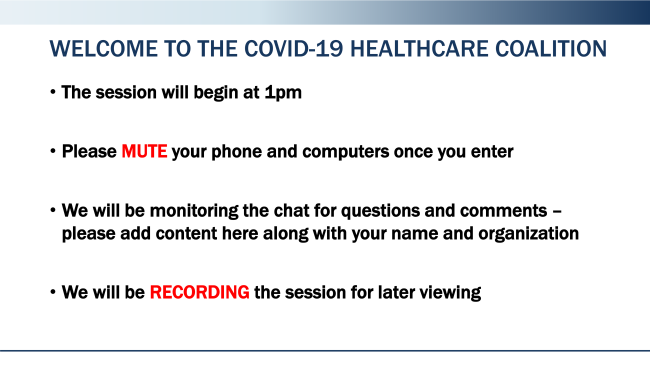
December 2nd DHHS Healthcare Coalition Slidedeck
State Rehabilitation Council Meeting- Submit Questions today!
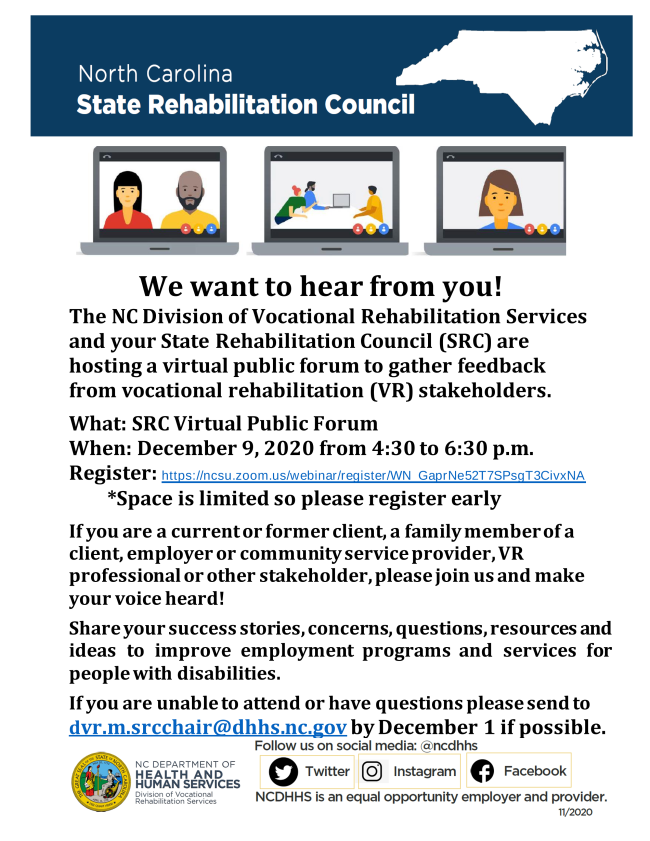
The NC Division of Vocational Rehabilitation Services and your State Rehabilitation Council (SRC) are hosting a virtual public forum to gather feedback from vocational rehabilitation (VR) stakeholders.
What: SRC Virtual Public Forum
When: December 9, 2020 from 4:30 to 6:30 p.m.
*Space is limited so please register early
If you are a current or former client, a family member of a client, employer or community service provider, VR professional or other stakeholder, please join us and make your voice heard!
Share your success stories, concerns, questions, resources and ideas to improve employment programs and services for people with disabilities.
|
New Medicaid Bulletins Available
The NC Division of Health Benefits (DHB) has recently published new Medicaid Bulletin articles dated Dec. 1, 2020:
Applying with New DEA Licenses and Sending Transcripts via Email for Faster Processing
Guidance for Providers Applying with New DEA Licenses
It has come to the attention of NCTracks that some providers completing an application with a new DEA license are unable to complete their application because NCTracks has not yet received the DEA file update (containing new DEA licenses) to match to their application. Because the file update has not yet been made, when the provider attempts to enter their new DEA license number, they receive an error message from NCTracks. While NCTracks receives this file monthly, it is possible that if a provider's number was not issued before the cutoff date, the new license may not appear in this list until a later date.
Providers with new DEA licenses should wait to submit their application with the DEA license information until NCTracks receives the information on the DEA file the next month. Providers may check to see if their license information has populated by trying to enter their DEA license number on an application the first week of the following month, when the DEA license file update has usually been received. Thank you for your patience and understanding. More updates will be provided as available.
Sending Transcripts via Email for Faster Processing
Individual providers who receive a request for their medical school or residency program transcripts after applying are encouraged to have their school or program use the email provided in the request letter (rather than the mailing address) if their school or program is able to do so.
Sending the transcript via the secure email address provided (rather than mailing in the information) will avoid any mail delays and will allow for quicker processing and turnaround time for the application.
Federal Enrollment Application Fee Increase for Calendar Year 2021 and Nov. Pharmacy Newsletter Available
Federal Enrollment Application Fee Increase for Calendar Year 2021
The federal fee for Medicaid enrollment has increased from $595 for calendar year (CY) 2020 to $599 for CY 2021.
NCTracks is now providing a record of federal fees and NC Enrollment fees by year so that providers can note the price changes. This can be found under Quick Links on the provider enrollment home page by clicking on the link Federal Fees & NC Enrollment Fees by Year.
The N.C. Division of Health Benefits (DHB) collects the federal fee as required under Section 1866(j)(2)(C)(i)(l) of the Affordable Care Act (ACA) from certain Medicaid and N.C. Health Choice (NCHC) providers. The Centers for Medicare & Medicaid Services (CMS) set the fee, which may be adjusted annually.
The federal fee is required for the following:
- Initial enrollment application
- Re-enrollment application
- Manage Change Request (MCR) to add a new site location
- Re-verification application
Nov. Pharmacy Newsletter Now Available
The latest Medicaid Pharmacy Newsletter, dated Nov. 2020, is now available on the N.C. Medicaid website. In addition to the Dec. 2020 checkwrite schedule, this edition of the newsletter includes the articles:
- Preferred Brands with Non-Preferred Generics on the Preferred Drug List (PDL) - Current as of Nov. 23, 2020
- POS Pharmacy Claims with DAW 8
- 72-Hour Emergency Supply Available for Pharmacy Prior Authorization Drugs
Providers are encouraged to review this important information. The 2020 Medicaid Pharmacy Newsletters can be viewed here.
|
This recently updated toolkit provides promising models, program best practices, and resources to aid in the implementation of substance use disorder prevention and treatment programs.
Dec 1, 2020 -- Analyzes new COVID-19 infection rates between November 22-28, 2020, finds that for the first time in 10 weeks, rural counties saw a decrease in the number of new infections, with a drop of eight percent from the previous week. Discusses how the Thanksgiving holiday could have impacted reporting, as more than a third of U.S. states altered their reporting schedule.
Details a study on the effect of a community-based intervention on a rural Colorado community's perception and knowledge of medication-assisted treatment (MAT) for opioid use disorder (OUD). Bases findings on surveys of community members both before and after the intervention. Breaks down participant data by age, race, and affiliation to the study, among other measures.
Author(s): Kristen Curcija, Linda Zittleman, Mary Fisher, et al.
Location: Journal of Rural Health
Date: 2020
Access Study Here
Provides an overview of state and federal telehealth flexibilities implemented during the COVID-19 pandemic. Discusses long-term considerations for governors regarding the impact of these flexibilities on healthcare delivery and payment and the appropriateness of these policies in the future.
Sponsoring organization: National Governors Association
Date: 11/2020
Access Document Here
|
In support of the national response to COVID-19, the Department of Health and Human Services (HHS) is distributing $175 billion from the CARES Act Provider Relief Fund (PRF) to hospitals and healthcare providers. The PRF Frequently Asked Questions (FAQs) provide guidance to recipients regarding terms and conditions, attestation, reporting and auditing requirements, and the general and targeted distributions. On November 18, new questions were added under the headings Use of Funds and Miscellaneous.
On November 27, the U.S. Department of Health & Human Services (HHS) issued a Request for Information (RFI) seeking input from the public to improve existing regulations, and eliminate unnecessary or duplicative regulations, through future exercise of rulemaking authority. As this RFI seeks input on regulations issued by any HHS office or agency, those responding may consider addressing regulatory issues of particular interest to rural health.
Read More Here
There are a number of innovative programs, policies, and best practices that prevent and mitigate the consequences of COVID-19 in urban and rural areas, while also preserving access to healthcare services for non-COVID-19 medical conditions. The Department of Health and Human Services (HHS) requests information on these innovative approaches and best practices in health care for both COVID-19 and non-COVID-19 conditions to inform and improve HHS priorities and programs.
Read More Here
As part of its Measuring Broadband America Program, the Federal Communications Commission (FCC) seeks input from the public on the types of information that should be collected to determine the speed and performance of broadband connections. Specifically, the FCC would like to receive comments on how they might "further reduce the information collection burden for small business concerns with fewer than 25 employees."
Currently, there are software-based tools and online tools that can test consumers' broadband connections. However, these tools track speeds experienced by consumers, rather than speeds delivered directly to a consumer by an internet service provider. The Measuring Broadband America Program will focus on the broadband performance delivered.
The Centers for Medicare & Medicaid Services (CMS) seek participants in a four-year demonstration project designed to improve treatment for opioid use disorder and reduce Medicare costs. Eligible participants include physicians, hospital outpatient departments, Rural Health Clinics, Critical Access Hospitals, and opioid treatment programs.
The Health Resources and Services Administration (HRSA) will make 32 awards with total funding of $16.1 million to increase nursing education opportunities for individuals from disadvantaged backgrounds. Eligible applicants include accredited schools of nursing, nursing centers, academic health centers, State or local governments, and other private or public non-profit entities.
This week the Centers for Medicare & Medicaid Services (CMS) released the final policy, payment, and quality updates for the Medicare Physician Fee Schedule, the Medicare Shared Savings Program, the Quality Payment Program, and the Diabetes Prevention Program for calendar year 2021. In addition to payment updates, it adds new services to the telehealth list, updates the scope of practice policies to allow teaching physicians to use interactive, real-time audio/video to interact with residents, and finalizes billing codes for Principal Care Management (PCM) services for Rural Health Clinics and Federally Qualified Health Centers.
Read More Here
Last week, the Centers for Medicare & Medicaid Services (CMS) released proposed regulations for states and health insurers planning on offering Qualified Health Plans (QHPs) through Federal and State Health Exchanges in 2022. In addition to proposing new special enrollment periods and options for direct enrollment through private sector entities, this rule also proposes to make QHP Enrollee Experience Survey results publicly available in an annual public use file.
The Department of Health and Human Services (HHS) finalized changes to two rules that will allow healthcare providers to participate in care coordination activities and value-based arrangements without violating laws. The first rule creates exceptions to the Physician Self-Referral law (aka the Stark Law), which prohibits a physician from referring a patient to any entity with which they have a financial relationship. The second rule adds safe harbors to the Anti-Kickback Statute, which imposes criminal penalties when someone solicits, pays, or receives a reward in exchange for referrals.
|
National COVID-19 Resiliency Network
This year the HHS Office of Minority Health (OMH) announced a partnership with the Morehouse School of Medicine to mitigate the impact of COVID-19 in racial and ethnic minority and vulnerable communities. Through this cooperative agreement, the Morehouse School of Medicine launched the National COVID-19 Resiliency Network (NCRN) which will share important messages and linkages to healthcare and social services in communities across the nation and areas hardest hit by the pandemic.
The NRCN will focus on identifying and engaging disproportionately impacted communities, nurture existing and develop new partnerships, disseminate culturally and linguistically appropriate information, leverage technology to connect communities to resources, monitor and evaluate outcomes, and apply broad and comprehensive dissemination methods.
OMH and the Morehouse School of Medicine invite organizations and individuals across the country to be a part of this initiative. To sign up for updates and become a part of this effort, please visit the NCRN website. Read More
Mental Wellness during the Holidays
The following are tips from SAMHSA to help recognize and manage stressors this holiday season:
- Take time to notice your own responses.
- Ask yourself "What helps and what hurts?"
- Talk about what the holidays may bring up for you.
- Pay attention to nutrition and exercise.
For additional resources to help manage mental health and emotional wellness including addressing mental health myths and facts, visit MedlinePlus and MentalHealth.gov.
|
The Within Our Reach Office of the Alliance for Strong Families and Communities has recently released the report, Transforming Child Welfare Systems to a 21st Century Model that Strengthens and Supports Families and Communities: Innovations from the Field.
This new report provides a framework and description of a prevention-aligned, public health approach to child welfare, providing examples of innovations states and communities are implementing in their efforts to become a 21st century model of child welfare.
Learn More
|
Person-Centered Practices Self-Assessment
November 20 ADvancing States shared, ACL funded, NCAPPS guide
COVID-19 Accessible Materials for People with Disabilities - 4 Upcoming Webinars
November 25 CDC NCBDDD announced GA Tech Center for Inclusive Design and Innovation Dec-Feb upcoming webinars
How Clinical Practices Can Advance the Implementation of Behavioral Health-Primary Care Integrated Care in the COVID-19 Era
November 17 Commonwealth Fund report
Learn more here.
Mental Health and Substance Use Disorders in the Era of COVID-19: Special Focus on the Impact of the Pandemic on Communities of Color
November 23 National Academy of Medicine part one webinar
Understanding the Impacts of COVID-19 on Substance Abuse Disorder and Treatment
November 25 NCBH shared Rutgers University Center for Health Services Research blog
Innovative State Initiatives & Strategies Providing Housing-Related Services & Supports Under Medicaid To Persons with SUD Who Are Experiencing or At-Risk of Homelessness
November 19 CMS report to Congress
|
AHRQ Stats: Counties With High Rates of Opioid-Related Medical Care
Criteria Developed for Assessing Feasibility of Implementing Evidence-Based Practices in Clinical Settings
Five criteria can help determine the feasibility of implementing promising patient-centered outcomes research findings in clinical practice, according to an AHRQ-funded study published in the Journal of General Internal Medicine (JGIM). Among the criteria were acceptability of research findings among healthcare professionals responsible for implementation, the "generalizability, adaptability and ease" of implementation, and the alignment between the purpose of the intervention and "external policies and incentives" such as regulations, mandates and payment structures. The authors developed the criteria based on a literature review, key informant interviews, input from a technical expert panel and pilot testing. Although developed for AHRQ, the criteria may help other funders and healthcare organizations determine the feasibility of implementing evidence-based practices.
Access the abstract.
|
CMS Announces New Model to Advance Regional Value-Based Care in Medicare
Geographic Direct Contracting Model Builds on CMS' Long-Standing Commitment to Improving Quality and Lowering Costs for Medicare Beneficiaries
The Centers for Medicare & Medicaid Services announced a new and transformative voluntary payment model that builds on CMS' focus to deliver Medicare beneficiaries value through better care and improved quality. The Geographic Direct Contracting Model (the "Model") will test an approach to improving health outcomes and reducing the cost of care for Medicare beneficiaries in multiple regions and communities across the country. Through the model, participants will take responsibility for beneficiaries' health outcomes, giving participants a direct incentive to improve care across entire geographic regions. Within each region, organizations with experience in risk-sharing arrangements and population health will partner with health care providers and community organizations to better coordinate care.
Beneficiaries in the model will maintain all of their existing Original Medicare benefits, including the ability to see any provider they choose. Beneficiaries may also receive enhanced benefits, including additional telehealth services, easier access to home care, access to skilled nursing care without having to stay in a hospital for three days, and concurrent hospice and curative care. Participants will also have the ability to reduce beneficiary cost sharing for Medicare Part A and Part B services as well as offer beneficiaries a Part B premium subsidy. Lower out-of-pocket costs will allow participants to encourage beneficiaries to seek high-value care while maintaining the freedom and choice beneficiaries have in the Original Medicare program. While providers and participants may choose to voluntarily enter into value-based arrangements, the Model will not change how Medicare-enrolled providers care for beneficiaries in Original Medicare today.
"The need to strengthen the Medicare program by moving to a system that aligns financial incentives to pay for keeping people health has long been a priority," said CMS Administrator Seema Verma. "This model allows participating entities to build integrated relationships with healthcare providers and invest in population health in a region to better coordinate care, improve quality, and lower the cost of care for Medicare beneficiaries in a community."
Participants will work within defined geographic regions to maintain and improve care coordination, leveraging beneficiaries' existing provider relationships as well as developing innovative care delivery solutions that take into account a region's unique, local needs.
Specifically, Model participants will coordinate care and clinical management for beneficiaries in Original Medicare in their region. This coordination may include care management services, telemedicine, as well as help for beneficiaries to understand which providers have a history of delivering better results and lower costs over the long-term. Beneficiaries in the model will remain in Original Medicare and maintain all of their benefits and coverage rights. Beneficiaries will also keep all of the protections of Original Medicare, including access to all Medicare providers and suppliers, the freedom to choose and change providers at any time, and a strong appeals and Ombudsman system.
To help with delivering improved outcomes, participants may create a network of preferred providers, armed with the Model's enhanced flexibilities to provide the right care for beneficiaries at a lower cost. Participants and preferred providers may choose to enter into alternative payment arrangements, including prospective capitation and other value-based arrangements. Participants will also work to augment Medicare's current program integrity efforts, reducing fraud, waste, and abuse in their region and decreasing costs for beneficiaries and taxpayers.
"The Geographic Direct Contracting Model is part of the Innovation Center's suite of Direct Contracting models and is one of the Center's largest bets to date on value-based care," said CMMI Director Brad Smith. "The model offers participants enhanced flexibilities and tools to improve care for Medicare beneficiaries across an entire region while giving beneficiaries enhanced benefits and the possibility of lower out-of-pocket costs. By initially testing the model in a small number of geographies, we will be able to thoughtfully learn how these flexibilities are able to impact quality and costs."
Organizations that are potentially interested in participating in the Model should submit a non-binding Letter of Interest to CMS by 11:59pm PT, December 21, 2020 through this link: Geographic Direct Contracting Model Letter of Interest. Letters of Interest will be used to determine the final regions in which CMS will solicit participants.
The Request for Applications will be made available in January 2021, and Applications will be due on April 2, 2021. Model Participants will be selected by June 30, 2021. The first three-year performance period will run from January 1, 2022 through December 31, 2024. A second three-year performance period will run from January 1, 2025 through December 31, 2027.
|
Supporting Children and Families Affected by the Opioid Epidemic: Emerging Policy Considerations.
Urban Institute Research Report Aron, Laudan Y. Benatar, Sarah. Peters, Rebecca. Health Policy Center (Urban Institute) 2020
Expanding Role and Reach: A Community-Centered Child Welfare Response to COVID-19.
Oliver, Carolyn. 2020
NC: B&GH to provide 'extended family' for children while parents receive substance abuse treatment (May require subscription)
News Reporter - November 26, 2020
A $585,620 grant will allow Boys and Girls Homes of North Carolina to provide residential care for children of parents suffering from substance use disorder. B&GH, in partnership with Brunswick Christian Recovery Center, has received a grant from the Governor's Crime Commission to create Bright Hope, a no-fee, residential family-based treatment program. This family-based treatment and unification service will provide housing and treatment while the parent is in recovery services.
OH: Ohio sued over lower payments to relatives caring for kids
Associated Press - December 02, 2020
People in Ohio who have taken custody of children they're related to are being illegally denied state foster care payments to help cover their child-raising costs, according to a federal lawsuit filed recently. At issue are payments to relatives who aren't licensed caregivers but are approved to care for children taken from their parents. The arrangement is often referred to as kinship care.
|
As the COVID-19 pandemic wears on, a new 24-hour support line is working to help individuals with developmental disabilities and those who care for them cope during this tough time.
The multi-sensory fidget mouse is specially designed with elements from a fidget toy to increase focus for those with developmental disabilities.
|
Upcoming Events
|
|
New: Tuesday, December 8, 2020
Rural Faith Leaders Workshop Series: Empowering Faith Leaders to Help Persons with Substance Use Disorder
Time: 1:00 pm thru 2:30 pm
|
|
New: Tuesday, December 8, 2020
Regulatory, Financial and Workforce Impact of COVID-19 for Behavioral Health
Time: 1:00 pm thru 2:00 pm
|
|
New: Tuesday, December 8, 2020
Coordinating Services that Support the Whole Child
Time: 2:00 pm thru 3:00 pm
|
|
New: Tuesday, December 8, 2020
CMS COVID-19 Office Hours Calls
Office Hour Calls provide an opportunity for hospitals, health systems, and providers to ask questions of agency officials regarding CMS's temporary actions that empower local hospitals and healthcare systems to:
- Increase Hospital Capacity - CMS Hospitals Without Walls;
- Rapidly Expand the Healthcare Workforce;
- Put Patients Over Paperwork; and
- Further Promote Telehealth in Medicare
Time: 5:00 pm thru 6:00 pm
Toll Free Attendee Dial In: 833-614-0820;
Access Passcode: 3129517
|
|
New: Wednesday, December 9, 2020
Wage and Hour Virtual CLE Breakfast - Part 2: Resolving Class and Collective Action Claims
Time: 11:00 am
|
|
New: Wednesday, December 9, 2020
Serving Children with Disabilities and Special Health Care Needs
Time: 3:30 pm thru 5:00 pm
|
Wednesday, December 9, 2020
Virtual Lecture "All Health Is Not Created Equal"
Time: 12:00 pm
|
Thursday, December 10, 2020
Benchmarks' Child Welfare Webinar with Lisa Cauley, NC-DSS
Time: 8:00 am thru 9:00 am
|
New: Thursday, December 10, 2020
Medicare Update & Education Webinar
Time: 1:00 pm thru 2:30 pm
|
New: Thursday, December 10, 2020
Physician Fee Schedule Final Rule: Understanding 4 Key Topics Call
The calendar year 2021 Physician Fee Schedule final rule provisions reduce burden, recognize clinicians for the time they spend taking care of patients, remove unnecessary quality measures, and make it easier for clinicians move toward value-based care:
- Extending telehealth and licensing flexibilities beyond the public health emergency
- Updating Evaluation and Management (E/M) coding guidance
- Updating the Quality Payment Program and Merit-based Incentive Payment System Value Pathways
- Updating opioid use disorder and substance use disorder provisions
Time: 1:30 pm thru 3:00 pm
|
New: Thursday, December 10, 2020
Joint NC DMHDDSAS and DHB COVID 19 Update for NC Providers
Time: 3:00 pm thru 4:00 pm
|
New: Thursday, December 10, 2020
Advanced Medical Home Webinar Series Kickoff
Time: 5:30 pm thru 6:30 pm
|
Friday, December 11, 2020
Medical Care Advisory Committee (MCAC) Quarterly Meeting
Time: 10:30 am thru 12:30 pm
|
Friday, December 11, 2020
Using Medicaid to Support Parents with Disabilities
Time: 12:30 pm thru 2:00 pm
|
Friday, December 11, 2020
NCDHHS Supported Living Level 2 & 3 STAKEHOLDERS MEETING
Time: 1:00 pm thru 3:00 pm
|
Friday, December 11, 2020
Ethics, COVID-19 & Telehealth: Part 1
Time: 2:00 pm thru 3:30 pm
|
Thursday, December 13, 2020
Medicaid Managed Care Fireside Chat Webinar Series-Beneficiary Attribution
Time: 5:30 pm thru 6:30 pm
|
New: Wednesday, December 16, 2020
Post-Election: What Can Employers Expect in 2021?
Time: 11:00 am
|
New: Thursday, December 17, 2020
Behavioral Health: This series features Medicaid Managed Care topics specific to clinical quality on the third Thursday of every month.
Time: 5:30 pm thru 6:30 pm
|
|
New: Tuesday, December 22, 2020
CMS COVID-19 Office Hours Calls
Office Hour Calls provide an opportunity for hospitals, health systems, and providers to ask questions of agency officials regarding CMS's temporary actions that empower local hospitals and healthcare systems to:
- Increase Hospital Capacity - CMS Hospitals Without Walls;
- Rapidly Expand the Healthcare Workforce;
- Put Patients Over Paperwork; and
- Further Promote Telehealth in Medicare
Time: 5:00 pm thru 6:00 pm
|
New: Thursday, December 17, 2020
COVID-19 Q&A Webinar for Behavioral Health Care Accreditation
Time: 1:30 pm thru 3:00 pm
|
Thursday, December 17, 2020
Social Connections Using Technology for People with IDD & Autism
Times Available:
|
Thursday, December 17, 2020
Clinical Quality Webinar Series-Behavioral Health
Time: 5:30 pm thru 6:30 pm
|
Thursday, January 7, 2021
Medicaid Managed Care Fireside Chat Webinar Series-Policy Approvals, Process Changes & Appeals
Time: 5:30 pm thru 6:30 pm
|
Friday: January 8, 2021
Dave Richard Joins Benchmarks' Friday Membership Webinar
Time: 8:30 am thru 9:30 am
|
Thursday, January 21, 2021
Clinical Quality Webinar Series-TBD
Time: 5:30 pm thru 6:30 pm
|
Please click on each of the following links to view details sent out from each LME/MCO.
Benchmarks' wants to be sure to make the following list handy for our members to visit and suggests a peek at least once per week to find information that may be pertinent to your agency and contracts.
|
|
|
|
|
|