|
November is National Adoption Month
Tools for Promoting National Adoption Month
Plan now for National Adoption Month with free "Spread the Word" outreach materials presented by the Children's Bureau in partnership with Child Welfare Information Gateway and AdoptUSKids.
What You Can Do
- Focus on this year's theme-Engage Youth: Listen and Learn-in your marketing and communications plans. Use key facts and statistics, sample press releases, and resources to educate the public and professionals in adoption and related fields.
- Use our sample social media posts to bring wider attention to the initiative. Include the hashtag #NationalAdoptionMonth to join and expand the conversation!
- Choose from our graphics and email signatures to encourage your networks to get involved in highlighting the voices of youth waiting to be adopted.
Youth are never too old to be adopted. This November, help us bring attention to all the different ways we can support and improve positive outcomes for thousands of older youth.
Did you miss this year's National Adoption Month webinar? Watch it now!
|
| Adoption Call to Action Webinar:
Authentic Youth Engagement and Empowerment |
|
Benchmarks' Friday Update
October 30, 2020
(We apologize for the delay!)
|
| Benchmarks' Friday Membership Webinar:
October 30, 2020 |
NC Cases: 269,021
Cases Hospitalized: 1,185
NC Deaths: 4,245
Positive Tests: 7-day average was 6.8%
Trump Administration Faces Pressure To Track COVID-19 At Institutions, Group Homes
Lawmakers are pressing the Trump administration to track COVID-19 among people with disabilities living in group homes and institutions, where more than six months into the pandemic cases are still largely going undocumented.
Three U.S. senators are calling on the Centers for Medicare & Medicaid Services to start collecting and reporting data about the number of coronavirus cases in a broader array of congregate settings - including those serving people with disabilities - by the end of the month.
Currently, CMS requires nursing homes to report COVID-19 cases to federal officials and notify residents and their families, but no similar mandate exists for other types of congregate settings even though their residents also face a high risk of transmission. Advocates have been pressuring Medicaid officials for months to institute similar procedures for facilities serving people with disabilities, but CMS has remained mum on the issue.
"Despite the high risk of contracting COVID-19 for older Americans, children and adults with mental illness, and children and adults with disabilities living in or receiving services in congregate care settings, there are huge gaps in federal reporting requirements for these facilities," wrote Sens. Patty Murray, D-Wash., Maggie Hassan, D-N.H., and Elizabeth Warren, D-Mass., in a letter to CMS Administrator Seema Verma. "As a result, federal government officials, public health experts, and the public have no comprehensive information on COVID-19 occurrence and fatality rates in various congregate care settings - all while residents continue to face a significant public health threat."
The request comes as the country sees a new surge in coronavirus cases amid an ongoing pandemic that has disproportionately affected those with developmental disabilities. Research shows that people in this population who are living in group homes are significantly more likely to contract the virus and die from it as compared to others.
Nonetheless, the senators indicated in their letter that a review of state-level requirements across the nation found that only nine states are reporting on COVID-19 cases at institutions for people with disabilities, seven report on group homes and just one is reporting on day facilities for those with disabilities.
The lawmakers said that even in cases where CMS does not have the authority to impose requirements on the facilities themselves, the agency should use its regulatory power to set "standardized, comprehensive COVID-19 reporting requirements on states to collect data across different types of congregate care settings in which providers participate in Medicaid."
The senators are asking CMS to act by Oct. 30, but so far, Murray's office indicated that the lawmakers have not received any reply.
CMS told Disability Scoop that it would respond directly to the senators. The agency noted that in many states COVID-19 transmission in group homes is considered a "critical incident" and, in those cases, such data would be included as part of regular quality assurance reporting to the federal government.
However, CMS acknowledged that it is not undertaking broad efforts to track COVID-19 across congregate settings serving people with developmental disabilities. "Intermediate Care Facilities (ICF) for Individuals with Developmental Disabilities (IDD) and waiver-funded group homes ICF/IDDs are not covered by CMS's coronavirus disease 2019 (COVID-19) data collection efforts," the agency said. "They are under a different regulatory authority. These facilities are funded fully by Medicaid, which is a state-managed program."
COVID Website
Bethany Chafin, WFDD RADIO, 10/23/20
Cone Health has built a website to help people understand more about COVID-19 and how it's spreading in North Carolina. When the pandemic began, data scientists started tracking the numbers that were available and used the information to help the health care system predict needs such as hospital beds, PPE, and more.
Now, Cone Health's Enterprise Analytics team is making their current work available to the public through a new website. It shows how and where the virus is spreading, county case numbers, and other demographic information. In addition, it includes current reproduction numbers, or the average number of new cases a single infection could cause. Cone Health data scientist Michael DeWitt says the site has a new risk-assessment tool. "We can estimate how many likely infectious people are in the community, and then for a particular gathering size or a number of unique contexts, you can understand what's the probability that you'll run into someone with COVID," he says.
North Carolina to get nearly 3.2M BinaxNOW virus tests
RALEIGH, N.C. (AP) - The U.S. Department of Health and Human Services announced Monday it's sending nearly 3.2 million rapid coronavirus tests to North Carolina.
The Abbott BinaxNOW COVID-19 point of care antigen tests can diagnose coronavirus infection in as little as fifteen minutes.
The tests will support testing K-12 students, teachers, nursing home patients and staff, higher education, critical infrastructure, first responders, and other priorities, the department said.
North Carolina plans to send most of the 3.1 million COVID-19 "rapid tests" to local health departments. The rapid "antigen tests" are different from most of the COVID-19 tests that have been conducted in North Carolina so far. Antigen tests look for a COVID-related protein on the surface of the virus cells. "Molecular tests," which North Carolina has been relying on, looks for the presence of the virus itself. Antigen tests are faster than molecular tests sent to a lab - they can produce results in minutes instead of days - but molecular tests are more accurate.
"The challenge with the antigen test is really how well they work. They're not as sensitive as our (molecular) tests, which means you're going to have false negative results," Melissa Miller, the director of the University of North Carolina's clinical molecular biology laboratory, said in an interview with The News & Observer. False negatives tell people that they are not carrying the virus when in fact they are. The tests the federal government is distributing come from the Abbott drug company and are called BinaxNOW. DHSS will send out shipments weekly with local health departments in counties with more than 10 cases per 100,000 people or test positivity rates of at least 5% receiving tests.
The N.C. Department of Health and Human Services is telling local health departments that the BinaxNOW test is most accurate when used on people who are already showing symptoms, a stance backed by the Food and Drug Administration's emergency use authorization of the test. The FDA says the test is most effective when it is used on people who started showing symptoms five to seven days earlier, a period when the virus levels are expected to be at their highest. But state and federal health officials as well as outside experts all say that the test can and likely will be used to screen people who are not showing symptoms but are likely to have been exposed to the virus. That is not ideal, Miller said, but may be necessary to ramp up testing among COVID-19 clusters and in schools.
COVID Clusters
Ben Sessoms, THE NEWS & OBSERVER, 10/26/20
Private schools from kindergarten to 12th grade across North Carolina have more COVID-19 clusters than public schools and have generally had more confirmed cases in those clusters. As of Friday, there were 14 active coronavirus clusters reported at private K-12 schools across the state with 138 confirmed cases, according to data from the state Department of Health and Human Services. At K-12 public schools, 11 active coronavirus clusters had been reported with a total of 79 cases. No deaths have been reported from these active COVID-19 clusters.
According to the state, there are over 2,500 public schools and 751 private schools in N.C., as of the 2019-20 academic year. A majority of public schools started the semester online. Many private schools opted for full-time, in-person classes, but an exact number could not be determined. The largest reported cluster at a private school is at Wayne Christian School in Goldsboro, which has 35 reported cases. The largest at a public school is North Wilkes High School in Wilkes County with 20 reported cases.
Contact Tracing
Greg Barnes, NC HEALTH NEWS, 10/27/20
About a quarter of a million people in North Carolina have now downloaded a cell phone app that alerts them when they come into close contact with someone who has tested positive for the coronavirus. The idea behind the app, launched by the N.C. Department of Health and Human Services on Sept. 22, is to help quickly track infections and slow the spread of COVID-19, which is increasing dramatically across the state and the country as the weather turns colder.
The app, called SlowCOVIDNC, relies on users to voluntarily and anonymously report a close contact with an infected person and to then get tested and self-quarantine if necessary. The app can be downloaded for free on iPhone or Android cell phones through the Apple App Store and the Google Play Store. Since the app's launch, DHHS has focused its use at the state's colleges and universities and is now also seeking to involve more businesses, DHHS spokeswoman Kelly Haight Connor said in an email last week.
So far, Haight Connor wrote, the app has sent 346 exposure notifications, most of those beginning Oct. 3. The app has led 46 people to anonymously notify others of their positive COVID-19 test results. It is not clear where those 346 exposure notifications came from or whether the bulk of people downloading the app are college students.
Eviction Protections
Dawn Baumgartner Vaughan and Ben Sessoms, THE NEWS & OBSERVER, 10/28/20
North Carolina residents who can't afford their rent won't be evicted if tenants provide a sworn statement to their landlords, Gov. Roy Cooper said Wednesday, keeping the state's housing protections in line with federal guidelines. Cooper issued a new executive order Wednesday afternoon that will enforce the Centers for Disease Control and Prevention's nationwide eviction moratorium. It will stay in effect through the end of the year, the order said. In early September, the CDC issued an order that bans evictions nationwide if tenants provide a sworn statement that they are unable to pay rent due to the pandemic and they have exhausted all options to pay their rent.
Cooper addressed other pandemic-related topics in a press conference on Wednesday, including avoiding large gatherings during the holidays and how to celebrate Halloween. Clusters of coronavirus cases have emerged in social and religious gatherings in recent weeks. While North Carolina did not experience a spike in coronavirus cases like other states, new cases and hospitalizations continue to rise. The state, like others across the country, is seeing a new surge in cases as some restrictions have lifted and people head indoors with cooler weather. With that comes renewed concerns about hospital capacity, especially as flu season begins.
Cooper's order also requires that landlords, if they take an action to evict, provide tenants with a sworn statement they can fill out and provide to the court. Households are limited to one sworn statement per household. Landlords also cannot legally file a writ of possession for the rental property if they are provided with the tenant's sworn statement. Evictions for reasons other than nonpayment of rent are still allowed under this order.
DHHS reported over 2,200 new COVID-19 cases on Wednesday, following a trend throughout October as new cases and hospitalizations have steadily risen. Wednesday was the second straight day that new cases topped 2,000. Last week there were two days that topped 2,500 new cases. Friday saw a new record for single-day new cases - 2,716 - since the beginning of the pandemic.
But Cooper and Dr. Mandy Cohen, secretary of the N.C. Department of Health and Human Services, have not said they would tighten restrictions again. On Oct. 21, Cooper extended Phase 3 of the state's reopening plan until Nov. 13, keeping a "dimmer switch" approach to easing restrictions. Instead, Cooper's administration asked local governments in 36 counties to do more to get residents to comply with restrictions. In a letter last week, DHHS urged them to adopt ordinances that would impose fines for violating COVID-19 executive orders and allow local health directors to issue imminent hazard abatement orders.
Infant Deaths
Lynn Bonner, THE NEWS & OBSERVER, 10/26/20
North Carolina and the rest of the United States have been staring at a racial gap in infant survival for years. Complete information on infant deaths in North Carolina in 2019 and the first half of 2020 is not available, but what there is shows the gap persists. In 2019, according to state Department of Health and Human Services statistics, 53.5% of the state's babies were born to white mothers, and 24.4% were born to Black mothers. In the first nine months of 2019, 199 white babies died in infancy, while 258 Black babies did not live to see their first birthdays, according to provisional data.
In the first half of 2020, 52.7% of babies were born to white mothers, and 24.6% had Black mothers. In those same months, 44.6% of the babies who did not live to their first birthdays were Black, and 31.7% were white, according to provisional data. The overall infant mortality rate in 2018, the most recent year available, was 6.7 deaths per 1,000 births in North Carolina, according to the CDC, higher than the national average of 5.7 deaths per 1,000 births.
In 2016, DHHS developed a plan to improve infant and maternal health and reduce the racial gap in infant death rates. An NC Institute of Medicine task force this year published recommendations for improving health care for women before and after childbirth. A state Maternal Health Task Force, which the Institute of Medicine has organized, started meeting this year as part of a federal grant worth $2 million a year over five years to develop and promote practices that will improve the health of women, and by connection, their children.
Taskforce members are focusing on family planning, labor, health during pregnancy and postpartum care, said James Coleman, the research specialist at the Institute of Medicine who coordinates the task force work. The group is also talking about ways to get more specialists in women's health care in eastern and western counties, he said. The task force recommendations are intended to help all North Carolinians, said Michelle Ries, the Institute of Medicine's interim director. It is also identifying ways to address the racial disparities in maternal and infant health, she said. The task force includes women who had serious health problems, and those whose children had health problems or died, who have spoken about ways they could have been cared for differently, Ries said. Doulas who work with women of color are also on the task force, she said.
Disrupting the cycle of addiction, one mother at a time
A Robeson County program for pregnant and postpartum women and their infants helps mothers grow their recovery skills while growing a life.
By Liora Engel-Smith, NC Health News
Baby Tyler uttered his first word the other day, and much to Kerry T.'s surprise, that word was "dada."
"I'm the one taking care of you, not your daddy," Kerry, 21, who did not want her full name used to protect her privacy, chided the six-month-old. Tyler grinned at his mom, flapping his arms this way and that. Kerry, from Maxton, a town of roughly 2,500 less than 20 miles from the South Carolina border, knows that she is lucky. She could have just as easily lost her child to foster care. The drugs she used could have killed him too, she knows.
Kerry got hooked on opioid pills in her late teens. She was almost halfway into her pregnancy, with Tyler, still addicted, when she found out. Learning she was pregnant was a turning point for her, she said, helping her realize that she needed to be sober for her child.
But she had a terrifying thought when she considered getting help. "Nobody will take my baby away from me," she said. "I would die. He's literally the only thing I have."
It's a reality that many addicted moms contend with when they consider getting help. Substance misuse was cited as a reason for separating children from their parents in 40 percent of North Carolina foster care cases in fiscal year 2017-18, up from 25 percent a decade ago, data from the state shows.
As of August, almost half of children and teens in the North Carolina foster care system - roughly 4,600 - were there because of parental substance use, including alcohol and drugs, according to data from the state. Of these, more than a thousand were babies, the data shows.
The number of families affected is likely much higher, as the state's data does not account for informal custody arrangements between family members, said Renee Rader, assistant director for policy and programs at the state Division of Mental Health, Developmental Disabilities and Substance Abuse Services, which is part of the state Department of Health and Human Services.
Kerry had another choice, though. She got a bed at Our House, a Pembroke-based rehabilitation program that allows mothers and their babies to stay together. With a more than 30-year history, Our House is the longest-running program for mothers and children in the state. It is one of only 13 rehabilitation facilities for mothers and their children in the state. Between them, the facilities have 264 beds, most of them in urban centers such as Chapel Hill and Charlotte.
Demand for beds fluctuates, so it's hard to know if the state's bed supply for new and expecting moms is enough, but an Oct. 6 snapshot showed that roughly 15 of these beds were open. Approximately 20 mothers and pregnant women in North Carolina were placed on a waiting list for specific facilities across the state, data shows.
Tucked on a side street on the outskirts of downtown Pembroke, a town of roughly 3,000 and the seat of the Lumbee tribe of North Carolina, the nondescript structure that holds Our House can accommodate up to 10 moms and their babies. While the women are the clients and most of the services are geared toward them, the babies also receive medical care there.
Babies born to women who use drugs can develop a dependence on the drugs they were exposed to. Unlike addiction, which has an emotional component, the condition babies experience is purely physical. The condition, termed neonatal abstinence syndrome, is linked to tremors, seizures, sleep problems, poor weight gain and a host of other symptoms. Tyler, for example, spent nine days in the hospital weaning off of opioids, Kerry said, after medical providers noticed he was jerking his legs and sleeping poorly.
Under the soft lights at Our House - which often have a calming effect - babies get screened for developmental delays and receive basic medical care. There's no day care onsite, so the children attend support groups and counseling with their mothers. To aid their recovery, women whose substance of choice is opioids also receive suboxone or other medications to reduce cravings and prevent an overdose.
"We treat the mind, body and soul," said program director Shirley Williams.
The women there have two big jobs: learning to care for their children and navigating the rough waters of recovery. As many new mothers know, babies don't always sleep through the night. The turmoil of addiction, a disease so powerful that it upends people's lives, coupled with a lack of coping skills could easily push even the most motivated of new moms to the brink.
Throughout their stay, which can last months or more than a year,women develop the confidence to care for themselves and their children, even when things don't go as planned. That's how Kerry discovered a powerful motivator to get her through the rough patches with Tyler. "I [don't] want him to grow up and look at me and be like 'you picked drugs over me,'" she said. "You don't love me, you love drugs, and that would be devastating.'"
A critical window
Pregnancy can be a powerful motivator for recovery, Williams said, but it can also be a deterrent. Mothers who use drugs experience the additional stigma of potentially harming their babies. Pregnant women who use drugs can also find themselves criminally charged for child neglect or even murder.
In June, the General Assembly passed a bill that would have defined drug use during pregnancy, regardless of the impact on the infant, as child abuse. The bill failed after Gov. Roy Cooper vetoed it. The state senate attempted to pass a similar bill in 2015, but it died in committee.
Such bills, on top of stigma, advocates worry, can deter women from seeking help. Kerry, for her part, said the thought of losing her child to foster care did cross her mind, but she worried more about inadvertently killing her baby. It was fear for his welfare that prompted her to seek help.
At the same time, North Carolina covers opioid treatment for expecting mothers under a Medicaid rule that offers temporary coverage during pregnancy and up to 60 days after delivery, removing some cost barriers on low-income women seeking recovery. The existence of this rule goes beyond helping individual women. Medicaid only covers medical treatment - not room and board - but that revenue stream has allowed programs such as Our House to have a stable source of income, said Rader, of the state health department. Programs can also cover room and board through flow-through state and federal funds.
The best outcome of all, Rader said, is finding a way to keep mothers and children together, with comprehensive interventions, such as parenting assistance and medical care, as early in the process as possible.
"We know that children entering the foster care system experience trauma," she said. "That separation from the family members has a lasting impact on children." But addiction doesn't always resolve after one episode in rehab. An estimated 40 to 60 percent of people with substance use disorders relapse after treatment, data from the Federal National Institute on Drug Abuse shows.
Cardinal Plan
Richard Craver, WINSTON-SALEM JOURNAL, 11/01/20
Forsyth and Mecklenburg county officials have sent a letter to the state's health secretary outlining their formal concerns about Cardinal Innovations' oversight and funding decisions. The joint Oct. 23 letter was directed to Dr. Mandy Cohen and Trey Sutten, Cardinal's chief executive. It was signed by Forsyth manager Dudley Watts and Mecklenburg manager Dena Diorio. The letter was first reported on Friday by Charlotte TV station WSOC. Cardinal, based in Charlotte, is the state's largest behavioral health managed care organization. The MCOs oversee providers for mental health, substance abuse and developmental disabilities services for more than 800,000 North Carolinians, utilizing federal and state Medicaid funds.
Forsyth and Mecklenburg said the letter represents "formally outlining our concerns as it relates to the behavioral health services managed, coordinated, facilitated and monitored by Cardinal Innovations."
"It is important for us to outline our specific concerns and to request action." The counties want Cardinal to provide an action plan by Nov. 9. Forsyth officials said Oct. 20 that requesting such a plan was one of their options.
|
Upcoming Benchmarks' Webinars
Benchmarks' Child Welfare Group Captive Insurance Solution Discussion with Mark Renske, Hylant Insurance
Date: Thursday, November 5, 2020
Time: 11:00 am thru noon
Benchmarks' Friday Membership Webinar w/Brian Ingraham, Vaya, CEO
Date: Friday, November 6, 2020
Time: 8:30 am thru 9:30 am
Benchmarks' Child Welfare Webinar w/Lisa Cauley Date: Thursday, November 12, 2020 Time: 8:00 am thru 9:00 am Benchmarks' Friday Membership Webinar w/Dave Richard, NC Medicaid Date: Friday, November 13, 2020 Time: 8:30 am thru 9:30 am
|
PRESS RELEASES since the last update include:
NEW resources since the last update include:
UPDATED guidance since the last update include:
UPDATED reports since the last update include:
NCDHHS and Cherokee Indian Hospital Authority to Create First-in-Nation Indian Managed Care Entity
The North Carolina Department of Health and Human Services and the Cherokee Indian Hospital Authority (CIHA) have entered into a contract to support the Eastern Band of Cherokee Indians (EBCI) in addressing the health needs of American Indian/Alaskan Native Medicaid beneficiaries.
This Indian Managed Care Entity is the first of its kind in the nation and will establish a new delivery system called the EBCI Tribal Option. The EBCI Tribal Option is a managed care option for federally recognized tribal members and other individuals eligible to receive Indian Health Services. The EBCI Tribal Option is part of North Carolina's transition to Medicaid Managed Care which will launch on July 1, 2021.
The EBCI Tribal Option will manage the health care for North Carolina's approximate 4,000 Tribal Medicaid beneficiaries primarily in Cherokee, Haywood, Swain, Jackson and Graham counties. The program will have a strong focus on primary care, preventive health, chronic disease management and providing care management for high-need members. More information is available here.
Funding Announcement: Supporting Justice-Involved Individuals with SUD during COVID
During the COVID-19 pandemic, North Carolina has seen a resurgence in another epidemic - the opioid overdose crisis. Since March, North Carolina has seen a 24% increase in emergency department visits for opioid overdoses. Individuals exiting incarceration with substance use disorder are particularly vulnerable to an overdose. According to data prior to the pandemic, formerly incarcerated individuals are 40 times more likely than other North Carolinians to die of an overdose in the first two weeks of re-entering the community. For many residents, COVID-19 has further complicated navigating returning to their community from prisons or jails, as many service providers have shifted the way they operate or now have limited services or hours.
Community-based organizations, local law enforcement agencies, substance use disorder treatment providers, and others, may apply for grants of up to $350,000 per year for two years to:
- Create and expand pre- and post-arrest programs to divert people with substance use disorders from jail to appropriate treatment options,
- Create re-entry programs that help connect people to care upon release from incarceration
OR they may apply for a total award of up to $500,000 per for two years to:
- Act as a technical assistance provider to advise and support awardees and other statewide justice-involved overdose prevention initiatives and foster peer to peer learning between groups awarded through this grant.
Applications are due by 5:00 PM ET on Monday, December 14.
Questions may be submitted through November 10, 2020.
|
New Medicaid Bulletins Available as of Oct. 27, 2020
The NC Division of Health Benefits (DHB) has recently published new Medicaid Bulletin articles dated Oct. 20, 2020:
Quarterly HCPCS Code (J codes) Update October 1, 2020
Effective with the date of service Oct. 1, 2020, CMS has added new HCPCS codes (J codes), deleted others and changed the description of some existing codes.
Managing Your Primary Care Assignments
Attention Advanced Medical Homes, Carolina Access and CCNC Primary Care Practices: Eligible Medicaid and NC Health Choice beneficiaries are linked to a Carolina Access/CCNC primary care practice by enrolling with a practice through the local Division of Social Services (DSS) agencies or through NCTracks auto-assignment.
Clinical Coverage Policies
New or amended clinical coverage policies are available on the Clinical Coverage Policies web page on NC Medicaid's website. These policies supersede previously published policies and procedures.
Providers are encouraged to review this information. All bulletin articles, including those related to COVID-19, are available on DHB's Medicaid Bulletin webpage.
November Provider Training Now Available
Registration is open for the Nov. 2020 instructor-led provider training courses listed below. Slots are limited. WebEx courses can be attended remotely from any location with a telephone, computer and internet connection. Please note that as of January 1, 2020, the WebEx information has changed. See the Training Enrollment Instructions below for details.
Ordering, Prescribing and Rendering Provider Enrollment (WebEx)
Monday, Nov. 9, 2020, 1:00 p.m. - 3:00 p.m.
This course will guide the authorized user through the process of submitting an Ordering, Prescribing and Referring (OPR) Provider Full and Lite enrollment application. At the end of this training authorized user will be able to:
- Understand the differences between a Full Enrollment & OPR Lite Provider enrollment
- Submit an OPR Lite Application
- Upgrade from a OPR Lite to a Full Provider via Manage Change Request (MCR)
ES Authorized user Role Abbreviated MCR Upload Documents (WebEx)
Tuesday, Nov. 10, 2020, 10:00 a.m. - 12:00 p.m.
This course will guide you through the following enhancements to the provider enrollment application processes:
- Enrollment Specialist authorized user role
- Upload supporting documents
- Abbreviated Manage Change Request (MCR) applications
Prior Approval institutional (WebEx)
Wednesday, Nov. 11, 2020, 9:30 a.m. - 12:00 p.m.
The purpose of this training is to show authorized user how to submit Prior Approvals electronically via NCTracks. The Prior Approval functional area accepts PA data from provider-initiated information entry through the NCTracks web portal. This course will cover:
- Submitting Prior Approval requests, to help ensure compliance with Medicaid clinical coverage policy and medical necessity.
- Inquiring about Prior Approval requests to determine their status
Submitting an Institutional Claim (WebEx)
Wednesday, Nov. 11, 2020, 1:00 p.m. - 4:00 p.m.
This course will provide instructions for authorized user to submit institutional claims electronically in NCTracks. At the end of this training, the authorized user will be able to:
- Create an institutional claim via the NCTracks web portal
- Save a claim draft
- Submit a claim
- Search claim status
- Review claim status
- Copy a claim
- Void or replace a previous claim
New Office Administrator (WebEx)
Thursday, Nov. 12, 2020, 9:00 a.m. - 11:00 a.m.
This course describes the process for changing the current Office Administrator (OA) to a new Office Administrator for an Individual Provider or Organization with a National Provider Identification (NPI) number or Atypical Provider. At the completion of training, you will be able to:
- Update the Office Administrator for an
- Individual Provider
- Organization
- Upgrade existing authorized user to
- Managing Relationships
How to Add or Update Credentials (WebEx)
Friday, Nov. 13, 2020, 9:00 a.m. - 11:00 a.m.
This course shows authorized user how to add or update credentials on a provider's record in NCTracks. At the end of training, authorized user will be able to:
- Add/update accreditation
- Add/update certification
- Add/update license
Provider Web Portal Applications (WebEx)
Friday, Nov. 13, 2020, 1:00 p.m. - 4:00 p.m.
This course will guide you through an overview of the Enrollment, Re-enrollment, Re-verification, Abbreviated Manage Change Request, Manage Change Request, Maintain Eligibility, and Fingerprinting required application processes. At the end of training, authorized user will be able to:
- Understand the Provider Enrollment Application process
- Navigate to the NCTracks Provider Portal and understand how to complete the following Provider Enrollment Application processes:
- Provider Enrollment
- Out-of-State (OOS)
- Ordering, Prescribing, and Referring (OPR) Lite
- Re-enrollment
- Re-verification
- Abbreviated Manage Change Request
- Manage Change Request (MCR)
- Maintain Eligibility
- Fingerprinting Required
Prior Approval Medical (WebEx)
Monday, Nov. 16, 2020, 9:30 a.m. - 12:00 p.m.
This course shows authorized user how to electronically submit and inquire about, and void prior approvals for different kinds of medical services. At the end of this training, authorized user will be able to:
- Submit Medical Prior Approval requests
- Inquire about Prior Approvals
- Void a Prior Approval
Submitting a Professional Claim (WebEx)
Monday, Nov. 16, 2020, 1:00 p.m. - 4:00 p.m.
This course will show authorized user how to submit Professional (CMS-1500/837P) Claims using the NC Tracks web portal. The authorized user will learn what they need to know to file a claim and how to easily navigate the claims entry screens. At the end of this training, authorized user will be able to
create a Professional claim via NCTracks web portal for:
- Save a Draft
- Use Claims Draft Search
- Submit a claim
- View results of a claim submission
- Claim Status and Claim Copy
- Resubmit a Claim
- Void Prior Claim or Replacement Prior Claims
Submitting an NEMT Claim (WebEx)
Tuesday, Nov. 17, 2020, 1:00 p.m. - 3:00 p.m.
This course will review the process of submitting Non-Emergency Medical Transportation (NEMT) claims through NCTracks. At the end of training, authorized user will be able to perform all aspects of submitting a Professional claim via the NCTracks web portal, including:
- Understand Claims Terminology
- Understand the Payment Authorization Process
- Create a Claim
- Save a Claim Draft
- Use Claims Draft Search
- Submit a Claim
- View Results of a Claim Submission
- Perform a Claim Status Search
- Copy a Claim
- Resubmit a Claim
- Void and Replace Claims
- Understand Your Remittance Advice
- Prior Authorization Inquiry
Dental Helpful Hints (WebEx)
Thursday, Nov. 19, 2020, 9:00 a.m. - 12:00 p.m.
At the end of this training, authorized user will be able to:
- Identify the three (3) methods of Prior Approval submission.
- Identify how to upload documents when submitting a Prior Approval via NCTracks and how to upload documents to an existing Prior Approval.
- Identify the most common errors when completing the American Dental Association (ADA) form.
- Identify common errors that require requests for Prior Approval additional information.
- Identify the common mistakes when submitting claims.
Ordering, Prescribing and Rendering Provider Enrollment (WebEx)
Friday, Nov. 20, 2020, 1:00 p.m. - 3:00 p.m.
This course will guide the authorized user through the process of submitting an Ordering, Prescribing and Referring (OPR) Provider Full and Lite enrollment application. At the end of this training authorized user will be able to:
- Understand the differences between a Full Enrollment & OPR Lite Provider enrollment
- Submit an OPR Lite Application
- Upgrade from a OPR Lite to a Full Provider via Manage Change Request (MCR)
Prior Approval Dental/Orthodontic (WebEx)
Monday, Nov. 23, 2020, 9:30 a.m. - 12:00 p.m.
This course shows authorized user how to electronically submit and inquire about prior approvals for dental procedures. At the end of this training, you will be able to:
- Submit Dental Prior Approval Requests
- Inquire About Prior Approval Requests
Submitting a Dental/Orthodontic Claim (WebEx)
Monday, Nov. 23, 2020, 1:00 p.m. - 4:00 p.m.
This course will provide instructions for authorized user to submit dental/orthodontic claims electronically in NCTracks. At the end of this training, the authorized user will be able to:
- Create a dental claim via the NCTracks web portal
- Save a claim draft
- Submit a claim
- Search claim status
- Review claim status
- Copy a claim
- Void or Replace previous claim
Ortho Helpful Hints (WebEx)
Tuesday, Nov. 24, 2020, 9:00 a.m. - 12:00 p.m.
At the end of this training, authorized user will be able to:
- Identify the three (3) methods of Prior Approval submission.
- Identify how to upload documents when submitting Prior Approvals via NCTracks or to existing Prior Approvals.
- Identify the most common errors when completing the American Dental Association form.
- Identify common errors that require requests for Prior Approval additional information.
- Requesting payment for orthodontic records.
- Submitting Prior Approval for orthodontic treatment requiring orthognathic surgery.
- Using the Orthodontic Prior Approval attachment forms
Training Enrollment Instructions
Providers can register for these courses in SkillPort, the NCTracks Learning Management System. Log onto the secure NCTracks Provider Portal and click Provider Training to access SkillPort. Open the folder labeled Provider Computer-Based Training (CBT) and Instructor Led Training (ILT). The courses can be found in the sub-folder labeled ILTs: Remote via WebEx.
To access WebEx online training sessions:
2.Enter 711 563 557 in the enter meeting information field
3.Enter your first and last name
4.Enter your email address
If this is your first time using the new GDIT Web Meeting, it is suggested that you begin the process 15 minutes prior to the start of the call. This will allow you sufficient time to download the required software to access the Web Meeting. To hear the audio portion of the class, dial 1-866-523-9994. Enter access code 711 563 557.
Refer to the Provider User Guides & Training page of the public provider portal for specific instructions on how to use SkillPort. The Provider Training Tool Kits page also includes a quick reference regarding Java, which is required for the use of SkillPort.
Advanced Medical Home Webinar
Please tune in to the next webinar in the Medicaid Managed Care Fireside Chat Series offered by the North Carolina Department of Health and Human Services (NCDHHS) and North Carolina Area Health Education Center (AHEC) on Thursday, Nov. 5 from 5:30 p.m. - 6:30 p.m. Hosted by Chief Medical Officer of the NC Division of Health Benefits Shannon Dowler, MD, this event will orient providers to the Advanced Medical Home (AMH) program. The agenda will include:
- Orientation to AMH and tiers 1, 2, & 3
- Standard quality metrics & practice vs. plan responsibilities
- How to change your AMH tier
- Q&A discussion
This webinar series, which will reoccur on the first Thursday of each month, is one of two monthly evening webinar series designed to help prepare providers, practice managers and quality managers for Medicaid Managed Care going live on July 1, 2021. More information and registration for the webinars is available here.
Portal for COVID-19 Primary Care Services Reimbursement Now Live-Detailed Bulletin and Training Courses Available
SPECIAL BULLETIN COVID-19 #140: Portal Live - Reimbursement for COVID-19-Related Primary Care Services for Uninsured Individuals Living in NC
Last month a program to reimburse primary care providers (PCP) for providing COVID-19 related primary care services (e.g. follow-up care) to uninsured individuals living in North Carolina was announced. The portal for providers to submit the request for reimbursement is live and can be accessed through the NCTracks secure portal.
Key Program Facts
- $7.8M is available to support the program on a first-come, first-served basis until exhausted or until Dec. 30, 2020, whichever comes first
- A payment of $150 per eligible in-person or telehealth visit enables providers to recoup costs for COVID-19 related services provided for uninsured patients
Eligibility
Individuals are eligible for the program if they live in North Carolina and have no health care coverage (e.g. Medicaid, Medicare, or other health insurance). Eligible providers are PCPs that operate in the state of North Carolina and are registered in NCTracks, North Carolina's Medicaid payment platform.
NCTracks Attestation Form includes the following language:
By submitting this transaction to the NC Department of Health and Human Services, I attest that the service performed is accurately represented as shown, and the patient was uninsured, and the service was a COVID-19 related primary care service. I further attest that claims have been either submitted to the HRSA portal and denied or were not submitted because they were ineligible for HRSA reimbursement. I understand this transaction is a request for payment from CARES Act funding and is subject to audit by the Office of the State Auditor and other oversight organizations.
Action Items for Providers
2.Submit all qualifying claims from Sept. 1, 2020 to present
3.Continue providing COVID-19 related care to patients
4.Continue submitting all qualifying claims as frequently as funding is available on a first-come, first-served basis until exhausted or by Dec. 30, 2020, whichever comes first
Finance Updates
Funding is first-come, first-served until exhausted or until Dec. 30, 2020, whichever comes first. PCPs will be reimbursed in subsequent NCTracks checkwrites issued by the Division of Health Benefits. PCPs should check the COVID-19 Related Services for Uninsured Individuals webpage for finance updates. Remaining funds will be updated on the website weekly.
Other Provider Benefits
There are multiple programs available to support providers who are responding to the COVID-19 pandemic. A fact sheet and chart listing other supports available are on the DHHS COVID-19 Response - Providers, Hospitals and Labs webpage under Resources to Support NC Providers Responding to COVID-19.
NCTracks ORH Provider Training Courses & Resources
ORH training courses held in November are available now for registration in NCTracks and additional resources are coming soon. Please see the notes below for more information.
- PCPs can attend training to better understand how to submit qualifying claims through NCTracks; training dates are Nov. 9, 10, 12, 17, 18 and 20. Click here for more information and to register for a training session.
- Job Aids will be available in NCTracks to review in advance of the training sessions, however, PCPs should not wait until the training to submit claims.
- Providers are encouraged to check their email and the NCTracks provider portal for future announcements about the availability of Job Aids and other training materials.
|
Call for Nominations for the FFTA Board of Directors
The Board Development Committee of the Family Focused Treatment Association (FFTA) is seeking applications & nominations from agency members to serve on the FFTA Board of Directors. Nominations will be considered for four (4) board seats, with service beginning January 1, 2021. The FFTA strives to have a Board of Directors that represents a diverse leadership as defined by race, ethnicity, gender, gender identity, religion, age, sexual orientation, nationality, disability, geographic location, agency size, lived experience and skill set. We know that the majority of our member agencies work directly in or support the public child welfare system, where we see Non-White children and families disproportionately over-represented, including 56% of children in foster care in the United States in FY 2019 being Non-White (AFCARS, June 2020). Yet according to the Building Movement Project's Race to Lead Study, nearly 60% of respondents reported their Non-Profit had 25% or less people of color on their Boards' of Directors & in Top Leadership Positions. We recognize that the more our Board of Directors reflects the children and families we serve, the better our association will be at meeting the needs of our members. As such, we encourage applications/nominations from candidates who self-identify as: * Black or African American
* Hispanic or Latinx
In addition, the committee seeks candidates that will complement the expertise of our existing Board of Directors and can contribute knowledge and expertise that supports the execution of FFTA's strategic plan. As such, candidates with experience, skills and knowledge in the following areas are encouraged to apply: * Communications & Marketing
* Fund Development
* Talent Development/Human Resources
* Strategy and Innovation Planning
* Digital or Technology Solutions
* Direct Service Areas:
o Primary Prevention, Kinship Care & Specialized Foster Care Recruitment
|
Supporting Families Project - Referrals and "Lunch" meeting!
Greetings all! I hope everybody is faring well enough during these unsettling times.
I'm writing for two reasons. First and foremost, we are now actively accepting parents (with substance use problems) and their children (8-15 yrs old) into the online Triple P program. Please contact Sam at scarsancole@yahoo.com to refer families or ask them to write to her directly. Thank you!
Second, we ask if you will please attend a short lunch meeting (zoom) about the project. We will send you $20 gift cards to purchase your lunch!
During the meeting, we plan to cover the following topics:
- Adaptations made to the protocol to adjust for circumstances around the pandemic.
- Update on our recruitment effort and the number of surveys and families we have been able to serve.
- Results of the needs assessment we conducted with many of you and others that identified the needs of this population and barriers the professionals who work with them encounter.
- Results from surveys of clinicians and providers who completed the surveys before and after viewing the educational videos.
- Our outreach activities to inform the public about the growing needs of this population.
We would also like to talk about the next phase of the study, which may involve the expansion of existing Triple P state-wide infrastructure and working integrally with agency partners, clinical providers and policymakers to ensure that these families systematically receive services. Obtaining your feedback is so critical to these efforts! I hope you will be able to join us. Please let me know whether Nov. 10th or 13th at noon will work for you.
Thanks and please stay safe!
|
New Brief Highlights Impossible Choices Confronting Disability Providers During the Pandemic
Racing Against the Clock offers in-depth profiles of a diverse group of eight providers that are working to stay afloat as the pandemic worsens long-standing challenges, while ensuring the health and well-being of the people with intellectual and developmental disabilities (I/DD) they serve. These profiles include information about the revenue losses and increased expenses experienced by the providers, what federal aid has been made available to them, the steps they're taking to make ends meet and more.
Although the situations highlighted are tenuous at best, they also underscore the incredible resilience of community-based organizations dedicated to supporting people in the community. The stories-which represent the experiences of ANCOR's broader 1,600-member community-also make clear the significant investments that are needed if people with I/DD are to have the options and resources needed to be included in the community long after the pandemic subsides.
In particular, Racing Against the Clock highlights several troubling findings:
- The pandemic has generated such deep financial loss for providers that it threatens their ability to deliver supports at all.
- Current funding is insufficient to address the increased responsibilities placed on direct support professionals, exacerbating a long-standing direct support workforce crisis.
- The financial duress wrought by the pandemic is forcing providers to confront impossible choices, including decisions about which services to continue delivering and which services to permanently discontinue.
- Even when the contributions of federal programs like the Provider Relief Fund and the Paycheck Protection Program are supplemented by states' efforts to fund disability services, long-standing structural challenges make recent progress vulnerable to being undone by surges in the number of new COVID-19 cases.
"Given the dire nature of this situation," the brief argues, "Congress must prioritize legislation to fund Medicaid supports that both keep people with I/DD healthy and safe during the pandemic, and ensure people with I/DD have the options and resources they need to live, work and thrive in the community long after the pandemic has subsided."
|
Updated state-level data for understanding child welfare in the United States
Each year, hundreds of thousands of children are removed from their families and subsequently enter foster care. Our newly updated data resource provides the most recent state and national data on child maltreatment, foster care, kinship caregiving, and adoption from foster care. The resource also recommends that states consider certain contextual information when interpreting and responding to data, including systemic racism and bias, economic stressors, neighborhood characteristics, and more. State leaders can use this information to ensure that their child welfare systems support the safety, stability, and well-being of all families in their states.
|
Watch NIMH Expert Dr. Mary Rooney Discuss Managing ADHD in Children & Adolescents
In observance of ADHD Awareness Month, the National Institute of Mental Health (NIMH) hosted a livestream event on October 21, 2020. Mary Rooney, Ph.D., clinical psychologist and chief of the Child and Adolescent Psychosocial Interventions Research Program at NIMH, discussed signs, symptoms, treatments, and tips for helping children and adolescents manage ADHD during the pandemic.
|
| | NIMH Expert Dr. Mary Rooney Discusses Managing ADHD in Children and Adolescents |
|
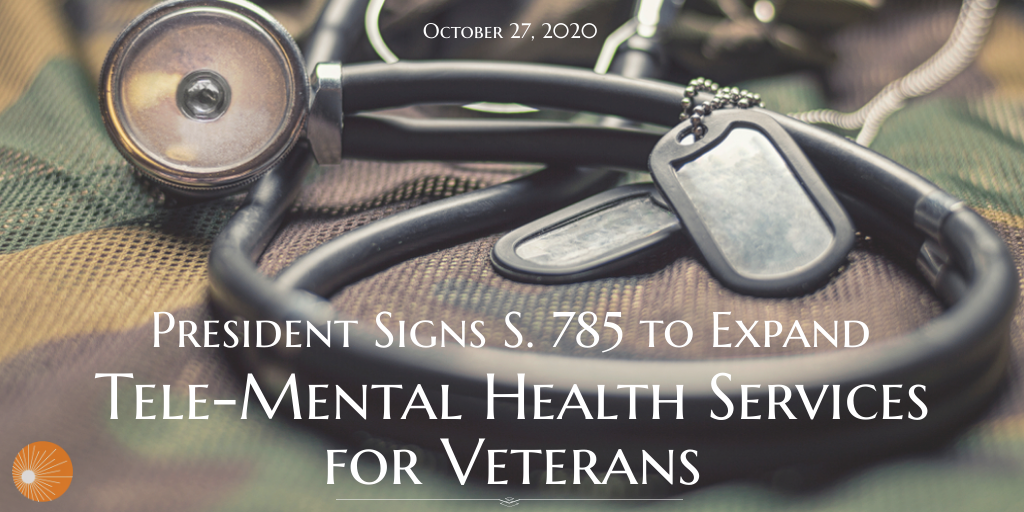
- Purchasing, replacing or upgrading hardware or software necessary for the provision of secure and private telehealth services.
- Upgrading security protocols for consistency with the security requirements of the Department of Veterans Affairs.
- Training of site attendants, including payment of those attendants for completing that training.
- Upgrading existing infrastructure owned or leased by the entity to make rooms more conducive to telehealth care.
- Upgrading existing infrastructure to comply with the Americans with Disabilities Act of 1990.
- Upgrading internet infrastructure and sustainment of internet services.
- Sustainment of telephone services.
Entities that do not require grants but seek to establish a telehealth access point for veterans would also be able to enter into an agreement with the Department for establishment of the access point as long as it is adequately private, secure, clean and accessible for veterans.
Within 18 months after the date of enactment, the Secretary will be responsible for completing an assessment of the barriers faced by veterans in accessing telehealth services. The assessment will include the following:
- A description of the barriers veterans face in using telehealth while not on property of the Department.
- A description of how the Department plans to address the barriers.
- Such other matters related to access by veterans to telehealth while not on property of the Department as the Secretary considers relevant.
A report on the assessment is required to be submitted to Congress within 120 days after completion including any recommendations for legislative or administrative action based on the results of the assessment.
S. 785 is a large bill with 34 other sections related to improving mental health care provided by the Department of Veterans Affairs. To learn more, read the full text.
|
New Listserv Topic for Rural Populations
The Centers for Medicare & Medicaid Services (CMS) has a new rural health care listserv dedicated to sharing information about programs, policies and resources to help ensure rural populations have access to quality health care.
Our goal at CMS is to develop programs and policies that ensure rural Americans have access to high quality care, support rural providers and not disadvantage them, address the unique economics of providing health care in rural America, and reduce unnecessary burdens in a stretched system to advance our commitment to improving health outcomes for Americans living in rural areas. Rethinking Rural Health is a vital part of CMS's push to transform the health care delivery system to a model that delivers high quality, affordable, and accessible health care for every American.
Subscribe to the rural health care listserv to receive the latest information and resources on:
- CMS Rural Health Strategy
- Maternal health care
- Payment and billing
- Policies and regulation
- Resources for partners
Press Release: CMS Releases Toolkit to Accelerate State Efforts to Rebalance Long-term Care Systems and Enhance Home and Community-Based Services for Eligible Medicaid Beneficiaries
The Trump Administration and Centers for Medicare & Medicaid Services (CMS) are delivering on their commitment to foster innovation in Medicaid by providing states with new tools to help beneficiaries return home from institutional settings without sacrificing safety or quality of care. Today, CMS launched a new toolkit designed for state Medicaid agencies to strengthen their infrastructure and develop robust home and community-based services (HCBS) for eligible beneficiaries. This toolkit is the latest in a series of CMS efforts to promote high quality, person-centered HCBS to safely transition older adults and individuals with disabilities back to their homes and communities, and decrease reliance on nursing home care.
"The COVID-19 crisis has shone a harsh light on the human costs of a long-term care system that relies too heavily on institutional services like nursing homes. Too often, they are seen as the default option, even for those who may not require round-the-clock care," said CMS Administrator Seema Verma. "While nursing homes will always be an important part of a complete care continuum, many elderly individuals and their families should have access to a more robust set of home care and community-based care options. That's exactly the opportunity President Trump is delivering with this toolkit."
The toolkit provides states with examples of innovative state models and best practices to rebalance their long-term services and supports (LTSS) programs to expand the use of HCBS over institutional services. LTSS enables millions of Americans, including children, individuals with disabilities, and older adults, to have their care needs met in a variety of settings, which are often more cost-effective than traditional institutional settings. As the primary funder of LTSS nationally, Medicaid plays an important role in supporting state efforts to achieve a more equitable balance between the share of spending and use of services and supports delivered in individuals' homes and communities as compared to institutional care.
States continue to be at the forefront of innovation in designing new models for the delivery and financing of LTSS. CMS supports state efforts to help older adults and people with disabilities to access care and services at home and in other community settings, so they may live their lives with as much dignity and independence as possible. CMS is committed to helping states to strengthen and enhance their LTSS systems, and ensure that Medicaid beneficiaries receive high quality, cost-effective, person-centered services in the setting of their choice.
For further information, visit:
To view the fact sheet on Long-term Services and Supports (LTSS) Rebalancing Toolkit, visit:
|
Upcoming Events
|
New: Wednesday, November 4, 2020
|
Thursday, November 5, 2020
Benchmarks' Child Welfare Group Captive Insurance Solution w/ Mark Renske, Hylant Insurance
|
Thursday, November 5, 2020
Health and Human Services Industry Deep Dive
|
New: Thursday, November 5, 2020
Joint NC DMHDDSAS and DHB COVID 19 Update for NC Providers
Time: 3:00 pm thru 4:00 pm
|
New: Friday, November 6, 2020
Benchmarks' Friday Membership Webinar w/Brian Ingraham, Vaya CEO
Time: 8:30 am thru 9:30 am
|
Monday: November 9, 2020
Bridging the Gap: Behavioral Health and Oral Health in Public Housing
The National Network for Oral Health Access (NNOHA) will join the National Center for Health in Public Housing (both HRSA-funded NTTAPs) to host a webinar to review behavioral health data and resources from a recent survey of residents of public housing. Speakers will highlight how a health center dental program located in public housing integrates behavioral health screenings and referrals into oral health care. 1.0 Continuing Dental Education (CDE) credit will be offered.
Time: 1:00 pm thru 2:00 pm
|
Tuesday: November 10, 2020
A Virtual Discussion on New Jersey's Direct Care Workforce
Time: 11:00 am thru 12:30 pm
|
Tuesday: November 10, 2020
Virtual Groups for Tobacco Use Treatment
Time: 12:00 pm thru 1:30 pm
(Includes 1.5 CEUs from the NC Substance Abuse Professonal Practice Board)
|
Tuesday: November 10, 2020
|
Tuesday: November 10, 2020
When IDD Co-Occurs with Mental Illness Training
Time: 1:30 pm thru 4:30 pm
|
New: Thursday, November 12, 2020
Benchmarks' Child Welfare Webinar w/Lisa Cauley
Time: 8:00 am thru 9:00 am
|
New: Friday, November 13, 2020
Benchmarks' Friday Membership Webinar w/Dave Richard, NC Medicaid
Time: 8:30 am thru 9:30 am
|
Thursday: November 12, 2020
When IDD Co-Occurs with Mental Illness Training
Time: 1:00 pm thru 1:30 pm
|
Tuesday: November 17, 2020
Social Determinants of Health in Rural Populations
Time: 1:00 pm
|
New: Wednesday: November 18, 2020
Level Up: Enhancing Behavioral Telehealth Services in the COVID Era Webinar
Time: 12:00 pm thru 1:00 pm
Speaker: Dr. Nora Dennis, MD, MSPH, is Chief Medical Officer of Monarch, one of the largest behavioral health services providers in NC. At Monarch, Dr. Dennis ensures all medical administrative processes for the company's mental health locations and telemedicine procedures meet the everevolving healthcare standards, as well as providing a continuum of excellent care to the thousands of people Monarch supports. Dr. Dennis is also an adjunct Assistant Professor in the Department of Psychiatry and Behavioral Sciences at Duke University School of Medicine. She attended Duke University School of Medicine, UNC Gillings School of Public Health, and completed her residency in psychiatry at Duke University Medical Center. She holds additional board certification in Addiction Medicine. Dr. Dennis is an enthusiastic physician educator and public health leader, and current participant in the NC Medical Society Leadership College.
|
Friday, December 11, 2020
Ethics, COVID-19 & Telehealth: Part 1
Time: 2:00 pm thru 3:30 pm
|
Thursday, December 13, 2020
Medicaid Managed Care Fireside Chat Webinar Series-Beneficiary Attribution
Time: 5:30 pm thru 6:30 pm
|
Thursday, December 17, 2020
Clinical Quality Webinar Series-Behavioral Health
Time: 5:30 pm thru 6:30 pm
|
Thursday, January 7, 2021
Medicaid Managed Care Fireside Chat Webinar Series-Policy Approvals, Process Changes & Appeals
Time: 5:30 pm thru 6:30 pm
|
Thursday, January 21, 2021
Clinical Quality Webinar Series-TBD
Time: 5:30 pm thru 6:30 pm
|
Please click on each of the following links to view details sent out from each LME/MCO.
Benchmarks' wants to be sure to make the following list handy for our members to visit and suggests a peek at least once per week to find information that may be pertinent to your agency and contracts.
|
|
|
|
|
|