November is National Adoption Month


November is National Adoption Month. The 2020 theme is "Engage Youth: Listen and Learn." It is well known that teenagers are less likely to be adopted, often because of their age, and are much more likely to age out of foster care without strong or stable family support. Securing lifelong connections for teens in foster care, both legally and emotionally, is a critical component in determining their future achievement, health and well-being. Visit 2020 National Adoption Month for valuable permanency resources for agencies, families and youth.
Benchmarks' Friday Update
November 6, 2020

Benchmarks' Friday Membership Webinar: November 6, 2020
Benchmarks' Friday Membership Webinar:
November 6, 2020

NC Cases: 285,661
Cases Hospitalized: 1,172
NC Deaths: 4,548

COVID Payments
Michael Gordon, THE CHARLOTTE OBSERVER, 10/31/20
The $335 check that families will receive under North Carolina's new COVID-19 relief program is made for parents like Ronshell Parker. The Charlotte resident is a single mother of four who earns less than $10 an hour at a fast-food place. She lives in an extended-stay hotel - largely because the free internet allows her daughter, J.C., to use a school-issued laptop to connect with her remote classroom. But as it stands now, Parker and her children won't benefit from the state's Extra Credit grant program, even though it is designed to provide families with the very help Parker needs - a little extra money for childcare and schooling during the pandemic.

According to a new lawsuit, Parker is one of an estimated 200,000 low-income households who have been unfairly excluded by the state due to a "discriminatory, irrational and unconstitutional process" for dispersing the money. Under program guidelines, the checks automatically will be sent to more than 1 million of the state's middle- and upper-income families, with household incomes as high as half a million dollars annually. The state hopes to disperse some $440 million by Dec. 15.

But low-income families - annual incomes of between $10,000 and $20,000 - who did not file a 2019 state tax return had to apply by Oct. 15 to receive a check. Tens of thousands of other needy families missed the deadline. According to the lawsuit, only 1 in 14 low-income households in North Carolina are now in line to receive a check. The complaint, filed in the Wake County courts, wants to improve the numbers. It accuses the state of violating the equal protection and due process clauses of the state Constitution. It also asks a judge to order the state Department of Revenue to extend the filing deadline while it devises a better way to make sure needy families get paid.

A team of attorneys filed the suit on behalf of the Charlotte Center for Legal Advocacy, Legal Aid of North Carolina along with Parker and two other low-income N.C. families. It names the state Revenue Department and Revenue Secretary Ronald Penny as defendants. The lawsuit surfaces with some urgency. The federal COVID-19 relief money being used for the family grants must be spent on costs incurred before Dec. 30. Charlotte attorney Adam Doerr, one of five Robinson Bradshaw lawyers who filed the complaint, said he hopes to have the case before a judge as soon as next week.
 
Insurance Losses
Sophie Kasakove, THE NEWS & OBSERVER, 11/02/20
An estimated 257,000 people in North Carolina lost their health insurance due to job loss during the first six months of the COVID-19 pandemic, according to estimates released Monday in the North Carolina Medical Journal, a publication of NC Institute of Medicine and The Duke Endowment. That's on top of the more than 1.1 million people who were already uninsured in North Carolina in 2019. Last year, 11.4% of the state's population was uninsured - one of the highest rates in the country - and above the nationwide average of 9.2%.

The estimated increase during the pandemic would amount to a 3% increase in the uninsured rate statewide. The analysis, conducted by Mark Holmes at UNC Gillings School of Global Public Health, is based on both historical trends in the relationship between uninsurance and unemployment in North Carolina and a national June survey on loss of employment and insurance. According to that survey, by the Commonwealth Foundation, 21% of respondents who said that they or a partner had coverage through a job affected by COVID-19 reported that at least one of them is now uninsured.

The loss of income and private health insurance has sent tens of thousands of people in North Carolina seeking public coverage. In August, 2,337,492 North Carolinians were covered by Medicaid, up from 2,186,142 people in February, according to the North Carolina Department of Health and Human Services. That's an increase of 151,350 or 7%. Medicaid enrollment increased by over 9% in Wake County, one of the highest increases in the state. Between the same months last year, enrollment decreased by more than 5,000. The same trends are true across the country: enrollment from February to June increased in nearly every state, after declines from 2017 to 2019. 

According to the June survey by Commonwealth, seven percent - one-third of those who lost coverage - were newly insured by Medicaid or a similar state plan.

But for many uninsured people in North Carolina, Medicaid is not an option. North Carolina is one of 12 states that has not adopted Medicaid expansion, a major piece of the Affordable Care Act, which expands eligibility for Medicaid to people with incomes below 138% of the federal poverty level. In North Carolina, eligibility is far more limited: for non-elderly adults to qualify for full Medicaid in North Carolina, they must either have a qualifying disability or dependent children in the house.
 
Mask Warnings
WRAL NEWS, 11/03/20
The North Carolina Department of Health and Human Services has begun warning individual businesses that they must get in line with Gov. Roy Cooper's executive orders that require masks and social distance to slow the spread of the coronavirus. It was not immediately clear how many businesses got the warnings, but in Wayne County, County Manager Craig Honeycutt shared a copy of the letter and summarized the complaints. "These complaints were not generated by County Officials, but rather private citizens. We were not made aware of any issues with local businesses prior to receiving the copies of the letters," Honeycutt said.

He shared one of the letters addressed to a business in Goldsboro, with identifying information about the company blacked out. The letter begins, "We have received complaints regarding non-compliance with applicable face covering and social distancing requirement(s)." Businesses that get the letter are required to sign and return an enclosed form, committing to following the governor's guidelines. "Be advised that violating any provision of the Governor's Executive Order is a Class 2 misdemeanor," the letter says. "Continued failure to cooperate and abide by the restrictions in the Executive Order may result in further actions ... or referral to law enforcement."
 
Governor Cooper Briefing
Dawn Baumgartner Vaughan and Josh Shaffer, THE NEWS & OBSERVER, 11/05/20
North Carolina Gov. Roy Cooper said Thursday he hopes politics can be taken out of COVID-19 response now that the election has passed. In a press briefing, he highlighted the state's highest daily increases in newly reported cases since the coronavirus pandemic began, urging caution as Thanksgiving approaches and hoping for a greater federal response. Thursday's news conference marked Cooper's first since winning reelection Tuesday night.

Before Tuesday, Cooper said many citizens have made decisions about wearing masks based on political outlook. He hopes that now people will look at the coronavirus "holistically" to work together to stop the spread. "The politicizing of the pandemic was central in many things, many ways," Cooper said. "Now we don't have to worry about that. And hopefully, we can move forward with science and facts and making sure that we're protecting the health and safety of North Carolinians."

North Carolina voters chose Cooper, a Democrat, and his cautious approach to the pandemic over challenger, Republican Lt. Gov. Dan Forest, who campaigned on lifting the mask mandate and reopening schools immediately. Cooper mentioned Democrats who won Council of State offices Tuesday but said the election left "a lot of status quo" with the General Assembly still controlled by Republicans. He said he thought citizens will continue to press for Medicaid expansion in the state - a priority for his administration - despite political opposition in the past. "People want us to close this health care coverage gap, particularly during a pandemic," he said. "We all got elected and people of North Carolina expect us to do our jobs."

Dr. Mandy Cohen, secretary of the N.C. Department of Health and Human Services, said she fears the coming holidays and winter months will bring higher caseloads as people are tempted to gather inside. That's where there is a greater risk of spreading COVID-19. She encouraged families to get COVID-19 screenings in advance, and to gather outside if possible with separate tables set up for people who live together. "I know folks want and need to be together during the holiday," Cohen said. "We can't eliminate risk, but we can decrease it."

Cooper said he does not want the state to roll back into tighter restrictions or move into lockdowns that European countries are experiencing. "We don't have an overload at our hospitals," he said. "We don't have a massive spike. So we're doing some things right." More school systems are sending students back to campus for in-person learning, which also means new places for coronavirus cases to spring up.
 
Election Result Impact
While the election results aren't completely final, at this point we know that the House and Senate remain Republican majorities and Governor Cooper, a democrat, remains in power. The only change at this point is that it appears that the Republicans gained 4 more seats in the House and the Democrats gained one in the Senate.
 
This means that we will continue with the same challenging dynamic of a House and Senate in conflict with the Governor over Medicaid Expansion. This dynamic has led to the veto of the legislative approved budget, and this past session, a refusal by the House and Senate to pass a full budget that risked a veto and instead opted to pass a few "mini" budgets.
 
It is unlikely we will see any agreement to move forward with Medicaid expansion from the House and Senate in the 2021 long legislative session. In a press conference this week, the Republican Speaker of the House and the Senate Pro Temp noted that their re-election indicated voters supported their position against the expansion of Medicaid. If the Governor maintains his current position to veto any budget that doesn't include expansion, we could be looking at budget gridlock for four more years.
 
Cardinal Plan
Richard Craver, WINSTON-SALEM JOURNAL, 11/01/20
Forsyth and Mecklenburg county officials have sent a letter to the state's health secretary outlining their formal concerns about Cardinal Innovations' oversight and funding decisions. The joint Oct. 23 letter was directed to Dr. Mandy Cohen and Trey Sutten, Cardinal's chief executive. It was signed by Forsyth manager Dudley Watts and Mecklenburg manager Dena Diorio. The letter was first reported on Friday by Charlotte TV station WSOC.
 Cardinal, based in Charlotte, is the state's largest behavioral health managed care organization. The MCOs oversee providers for mental health, substance abuse and developmental disabilities services for more than 800,000 North Carolinians, utilizing federal and state Medicaid funds.

Forsyth and Mecklenburg said the letter represents "formally outlining our concerns as it relates to the behavioral health services managed, coordinated, facilitated and monitored by Cardinal Innovations."

"It is important for us to outline our specific concerns and to request action." The counties want Cardinal to provide an action plan by Nov. 9. Forsyth officials said Oct. 20 that requesting such a plan was one of their options.
 
Mecklenburg wants to break ties with a healthcare agency.
Here's what happens next.
Mecklenburg County is preparing to sever ties with Cardinal Innovations Healthcare, the managed care organization that oversees behavioral-health treatment in 20 counties across
North Carolina.

Local officials leveled accusations against Cardinal in February just before the COVID-19 pandemic hit - detailing a pattern of inadequate access to service and substantial wait times for some of Mecklenburg's neediest residents. The county, for example, blasted Cardinal's faulty handling of emergency placements for children who are abandoned or neglected.

Months later, county administrators say those problems persist, with piecemeal progress made for overhauling treatments tied to behavior health, criminal justice and child welfare, among other critical programs.

Cardinal is slated to submit an improvement plan next week, but county commissioners unanimously voted Wednesday to allow County Manager Dena Diorio to start what's known as the "disengagement" process from Cardinal.

"We believe beginning this process is still warranted because of a lack of confidence in Cardinal's ability to make the necessary changes," Assistant County Manager Anthony Trotman told commissioners. "Mecklenburg County residents continue to go without appropriate services and timely treatment."

As a temporary solution, Trotman said, Mecklenburg has been forced to enter into contracts directly with providers to ensure patients are not overlooked.

Trey Sutten, Cardinal's chief executive officer, argued Mecklenburg's decision is "disappointing" and "inconsistent" with the organization's efforts so far.

He reaffirmed Cardinal's intent to deliver a concrete plan to county leadership, while shifting blame for certain lapses on a complex state funding structure. Commissioners and county staff also repeatedly discussed the complex web of behavioral health care, exacerbated by Mecklenburg's limited role as outlined by state statute.

"No single organization can single-handedly solve the issues raised today - they're systemic," Sutten said during the public comment period. "By increasing the risk of interruption to care, we're talking about further jeopardizing the health and well-being of some of your most vulnerable constituents at the worst time while we're dealing with this pandemic."

'ACTION IS REQUIRED'
Wednesday's vote means Mecklenburg must find another agency better equipped to handle individuals with developmental disabilities, in addition to mental health and substance abuse concerns. Diorio mentioned Partners Behavioral Health Management, another licensed entity serving some of Mecklenburg's adjacent counties, as a viable option.
Diorio said about nine of Mecklenburg's peer counties - including Cabarrus and Union counties - are pursuing the same disengagement action with Cardinal, partially fueled by a Medicaid transformation that could further complicate matters when it takes effect in July.

"It's all the same stories - it's all the same frustrations," Diorio said. "I need to make sure that I protect the interests of the county so if we need to get out, we can get out."

Commissioners openly criticized Cardinal's shortcomings, describing the pain of people desperate for proper care.

"We've been patient for a long time. I think for the good of the families involved, it's good to start this," Commissioner Pat Cotham said. "Action is required now."

Commissioner Susan Rodriguez-McDowell said the county's move is long overdue, adding Cardinal has lost "all credibility."
"With the window closing, we have to accelerate and go as fast as we can," Rodriguez-McDowell said. "We have to think of the children and all of the people who have been reaching out to us with problems."

Discussions are already underway with Dr. Mandy Cohen, secretary of the state Department of Health and Human Services. If Cohen approves Mecklenburg's intent to break away from Cardinal, the county must then publish its plan and next steps online - while allotting two months to seek public feedback.

Cardinal has been embroiled in controversy since its inception. Cardinal replaced MeckLINK, the county's own behavioral healthcare system that received federal Medicaid funds, in 2014.
In May 2017, Cardinal drew sharp scrutiny when a state audit revealed "unreasonable spending," including lavish Christmas parties, expensive in-state flights and an inflated salary for Richard Topping, the ousted chief executive officer who was paid more than three times the limit set by state policy.

By November 2017, after Topping and three other executives were paid $3.8 million in severance, DHHS took control over Cardinal and fired its board members.

Upcoming Benchmarks' Webinars 

Benchmarks' Child Welfare Webinar w/Lisa Cauley
Date:  Thursday, November 12, 2020
Time:  8:00 am thru 9:00 am

Benchmarks' Friday Membership Webinar w/Dave Richard, NC Medicaid
Date:  Friday, November 13, 2020
Time:  8:30 am thru 9:30 am

Save the Date:  Wednesday, November 18, 2020
Time:  10:00 am thru 12:00 pm
Benchmarks' will be hosting a webinar regarding ALL THINGS INSURANCE related!  More details to come SOON!

Benchmarks' Friday Membership Webinar w/Leza Wainwright, CEO Trillium
Date:  Friday, November 20, 2020
Time:  8:30 am thru 9:30 am

Benchmarks' Captive Insurance Webinar 11-5-2020
Benchmarks' Captive Insurance
Webinar November 5, 2020

Associated Documents: 

COVID-19 Updates

Reimbursement for COVID-19 Related Primary Care Services for Uninsured Individuals Living in NC
The North Carolina Department of Health and Human Services (NC DHHS) has developed a program to reimburse primary care providers (PCPs) for providing COVID-19 related primary care services (e.g. follow-up care) to uninsured individuals living in North Carolina. The portal for providers to submit the request for reimbursement is live and can be accessed through the NCTracks secure portal. You can view this special bulletinĂ‚ for more information.
 
Resources to Support NC Providers Responding to COVID-19
There are multiple programs available to support providers who are responding to the COVID-19 pandemic. Providers can receive much needed funds to help cover COVID-19 related primary care services and expenses. A fact sheet and chart listing other supports available are on the DHHS COVID-19 Response - Providers, Hospitals and Labs webpage under Resources to Support NC Providers Responding to COVID-19.
 
PRESS RELEASES since the last update include:
NEW resources since the last update include:
 
UPDATED guidance since the last update include:
UPDATED reports since the last update include:
NEW EVENTS ADDED to the community testing events page
UPDATED Contact Tracing numbers

Medicaid Managed Care Fireside Chat:  Advanced Medical Home Recording 

Medicaid Managed Care Fireside Chat: Advanced Medical Home
Medicaid Bulletins, Veterans Day Reminder and Thanksgiving Holiday
Modified NCTracks AMH Tier Attestation Tool Available
The Advanced Medical Home (AMH) Tier Attestation Tool, available on the NCTracks Secure Provider Portal Status and Management page has been modified. Providers who no longer wish to serve as a state approved AMH Tier 3 provider may use this tool to downgrade from an AMH Tier 3 level provider to an AMH Tier 2 level provider.  More information
 
NC Medicaid Electronic Health Record Incentive Program Announcements
Updates including Program Year 2020 Stage 3 Meaningful Use (MU) attestations, Program Year 2020 webinar series and Security Risk Analysis (SRA).  Details
 
Providers are encouraged to review this information. All bulletin articles, including those related to COVID-19, are available on  DHB's Medicaid Bulletin webpage. 
 
Reminder - 2020 Veterans Day Holiday and Checkwrite Schedule
As a reminder, the NCTracks Call Center will be closed Wednesday, Nov. 11 in observance of the Veterans Day holiday. (The Pharmacy Prior Approval Unit will be open holiday hours from 7:00 a.m. to 6:00 p.m.)
 
In keeping with the published 2020 checkwrite schedules, there will be no effect on the NCTracks checkwrite date. However, EFT funds transfer to banks a day late (on Thursday Nov. 12 instead of Wednesday) because of the federal holiday. The posting and availability of funds to provider bank accounts will depend on the provider's financial institution. Bank of America customers should see their payments in their accounts on the day that the EFT is processed, which will be Thursday Nov. 12, 2020. Providers who bank at other financial institutions should see payments the business day following the date that the EFT is processed, which will be Friday Nov. 13, 2020 in the afternoon. (Some may post sooner.)
 
The 2020 and 2021 checkwrite schedules can be found under Quick Links on the provider portal home page.
 
NCTracks Call Center Closed for Thanksgiving Holiday
GDIT will observe the Thanksgiving holiday on Thursday, Nov. 26, and Friday, Nov. 27, 2020. The NCTracks Call Center will be closed both days. (The Pharmacy Prior Approval Unit will be open holiday hours from 7:00 a.m. to 6:00 p.m. on Thursday and Friday.)
 
The NCTracks checkwrite schedule is not affected by the Thanksgiving holiday.
 
The 2020 and 2021 checkwrite schedules can be found under Quick Links on the  provider portal home page.

Pharmacy Newsletter Available and Reminder: Portal for COVID-19 Primary Care Reimbursement Training and Job Aids;  Reminder: Portal for COVID-19 Primary Care Reimbursement Training and Job Aids 
As previously announced , NC Medicaid will reimburse primary care providers (PCPs) who are providing COVID-19 related primary care services to North Carolina residents without medical insurance. A payment of $150 per eligible encounter will be available to PCPs.
 
Funding is first-come, first-served until exhausted or until Dec. 30, 2020, whichever comes first. PCPs will be reimbursed in subsequent NCTracks checkwrites issued by the Division of Health Benefits. PCPs should check the COVID-19 Related Services for Uninsured Individuals webpage for finance updates. Remaining funds will be updated on the website weekly.
 
Training Begins November 9
  • PCPs can attend a training to better understand how to submit qualifying claims through NCTracks; training dates are November 9, 10, 12, 17, 18 and 20. Click here for more information and to register for a training session.
  • The Job Aid (ORH COVID-19 Claim Submission) is located under the heading Claims Submission on the User Guides & Fact Sheets page. The Job Aid is also accessible in SkillPort (the secure NCTracks Learning Management System). SkillPort can be accessed via the  secure portal. 
 
Oct. Pharmacy Newsletter Now Available
 
The latest Medicaid Pharmacy Newsletter, dated Oct. 2020, is now available on the N.C. Medicaid website. In addition to the Nov. 2020 checkwrite schedule, this edition of the newsletter includes the articles: 
  • Preferred Brands with Non-Preferred Generics on the Preferred Drug List (PDL) - Current as of Oct. 18, 2020
  • 72-Hour Emergency Supply Available for Pharmacy Prior Authorization Drugs  
Providers are encouraged to review this important information. The 2020 Medicaid Pharmacy Newsletters can be viewed here.

Funding Opportunities

Program that engages adults age 55 and over to provide mentorship for children and youth with special or exceptional needs, or who would benefit from the one-one-one attention. AmeriCorps Seniors volunteers serve an average of 20 hours per week in schools, hospitals, drug treatment centers, correctional institutions, and childcare centers. Rural communities are a priority.
Geographic coverage: Nationwide
Application Deadline: Feb 3, 2021
Sponsor: AmeriCorps

Program that engages adults age 55 and over to provide companionship and support to other adults in need of extra assistance to remain at home or in the community for as long as possible. Volunteers serve an average of 20 hours per week, providing companionship to ease loneliness and social isolation, assisting with transportation and light chores, helping to serve as eyes and ears to professionals who can intervene in the case of medical or other deterioration on the part of the clients, and giving support to informal caregivers. Rural communities are a priority.
Geographic coverage: Nationwide
Application Deadline: Feb 3, 2021
Sponsor: AmeriCorps
Read Here

New Resources
Presents a study on the availability of suicide prevention services for youths age 15-19 at mental health facilities in rural versus urban areas. Compares the rates of prevalence of mental health facilities, youth-serving mental health facilities, and youth-serving mental health facilities with suicide prevention programs by rural-urban continuum codes.
Author(s): Janessa M. Graves, Demetrius A. Abshire, Jessica L. Mackelprang, et al.
Location: JAMA Network Open, 3(10), e2021471
Date: 10/2020
Community Resiliency Webinar Series

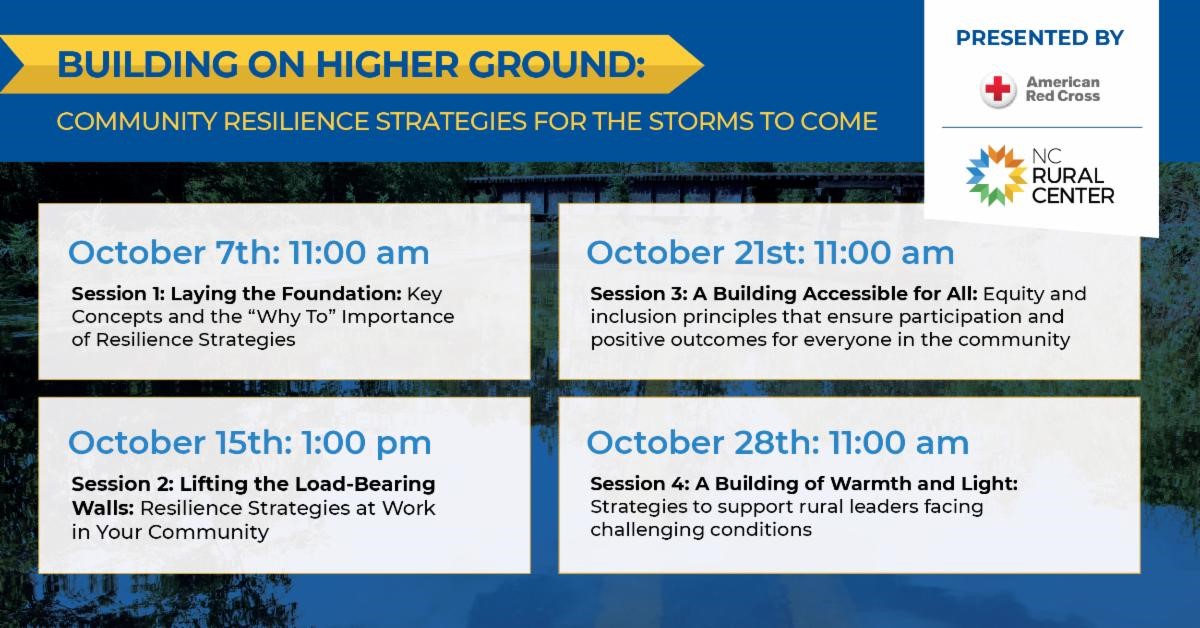
Thank you to the 1,024 registrants who signed up to attend our new webinar series. With the support of the American Red Cross, and in partnership with the North Carolina Office of Recovery and Resiliency, the NC Rural Center hosted an introductory series of four FREE webinars during the month of October on community resilience. 
 
Participating rural leaders learned:  
  • Key concepts that distinguish resilience strategies from natural disaster recovery practices.
  • The climatic and economic conditions that make adaptation of resilience strategies so critical.
  • Practical resilience strategies communities can adopt.
  • Principles and practices for inclusionary planning.
  • Strategies to address the ongoing needs of rural leaders so they too can be as resilient as their communities. 
If you missed any of the sessions,  visit this website to view presentations, speaker information, and webinar recordings.

NEW Health Center Dashboard: COVID-19 Survey Operational Capacity
Interact with the most recent health center COVID-19 survey operational data through a new dashboard! Data measures include: weekly testing capacity, temporary closures, and staff ability to work. The enhanced maps on the dashboard replace the static map images previously posted weekly.
Prevention, Diagnosis, and Management of Opioids, Opioid Misuse, and Opioid Use Disorder in Older Adults
Background. Opioid-related harms are increasing among older adults. Until we better understand the factors contributing to this trend, we will be unable to design and implement effective interventions to optimally manage opioid use and its potential harms among older adults. Although considerable research has been done in younger or mixed-age populations, the degree to which it is directly applicable to older adults is uncertain.

Objectives. To provide a framework for understanding how to reduce adverse outcomes of opioid use among older adults, and to describe the evidence available for different factors associated with and interventions to reduce adverse outcomes related to opioid use in this population.

Approach. With input from a diverse panel of content experts and other stakeholders, we developed a conceptual framework and evidence map to characterize empirical studies of factors associated with opioid-related outcomes and interventions to reduce opioid-related harms in older adults. We identified relevant literature among older adults (age ≥60 years) for an evidence map by systematically searching PubMed, PsycINFO, and CINAHL for studies published in English between 2000 and May 6, 2020.

Neighborhood conditions associated with children's cognitive function:  NIH-funded research from ABCD Study finds association despite household income.

A study published today in JAMA Network Open shows that children from poorer neighborhoods perform less well on a range of cognitive functions, such as verbal ability, reading skills, memory, and attention, and have smaller brain volumes in key cognitive regions compared to those from wealthier neighborhoods.

While multiple studies have shown that household socioeconomic status affects a child's cognitive development, less is known about the effect of the broader neighborhood context. By revealing a role that the neighborhood environment may play in shaping brain development,  research findings can inform interventions aimed at improving outcomes for children from disadvantaged backgrounds. The study is funded by the National Institute on Drug Abuse, and nine other institutes, centers, and offices that are part of the National Institutes of Health.

The researchers analyzed data from the Adolescent Brain Cognitive Development (ABCD) Study(link is external), which focuses on how environmental and biological factors influence adolescent development. The team looked at data from brain imaging and neurocognitive testing from 11,875 9- and 10-year-old children (48% female) from 21 sites within the United States, largely reflecting urban and suburban areas.

The researchers found that youth living in high poverty neighborhoods had lower volumes of certain brain regions, partially explaining the possible relationship between high neighborhood poverty and lower scores on cognitive tests. The affected areas of the brain were in the prefrontal cortex and the hippocampus, areas known to be involved in language and memory. The differences in volume were significant even after the researchers adjusted for the effects of household income. For every unit increase in neighborhood poverty, children scored 3.22 points lower on cognitive testing, even when accounting for household income.
Case preview: Court will tackle dispute involving religious foster-care agency, LGBTQ rights
In the past five years, the Supreme Court has ruled that the Constitution guarantees a right to same-sex marriage and that federal employment discrimination laws protect LGBTQ employees. On Nov. 4, the justices will hear oral argument in a clash between religious freedom and laws and policies that protect LGBTQ rights. The court's decision in Fulton v. City of Philadelphia could have a significant impact for state and local governments that use private companies to provide services to their residents - if the justices decide to reach the broader issues presented by the case.

The question of how to balance sincere religious beliefs against the government's interest in protecting LGBTQ rights is one with which the justices have struggled. In 2018, the justices confronted this question in the case of a Colorado baker who refused to create a custom cake for a same-sex couple because he believed that doing so would violate his religious beliefs. The justices ultimately issued a narrow ruling for the baker, holding that the state administrative agency that had ruled against him had treated him unfairly by being too hostile to his religious beliefs. The justices did not decide, however, whether requiring the baker to bake a cake for a same-sex couple would violate his right to freedom of speech under the First Amendment.
Impact of COVID-19 on State Mental Health Services
State Mental Health Agencies (SMHAs) are the critical safety net providing evidence-based mental health services to individuals in need in every state. Each year over 8 million individuals (2.5% of the U.S. population) receive mental health services and supports from SMHA systems. The COVID-19 pandemic has highlighted and exacerbated existing challenges in the state systems that expend over $40 billion annually to provide mental health services. COVID-19 affects all aspects of state behavioral health systems, including inpatient care in state hospitals, crisis services, community-based treatment services, and services to school-aged children.

To understand and assess the magnitude of the COVID-19 impact on state mental health systems, and how these systems have adapted to challenges presented by COVID-19, NRI, in collaboration with the National Association of State Mental Health Program Directors (NASMHPD), surveyed the SMHAs during the summer of 2020. This report represents the results of this survey.
Job Crafting May Be an Under-Utilized Strategy to Improve Job Satisfaction and Performance for Workers with Disabilities
People with disabilities have lower employment rates than people without disabilities. Although some people with disabilities receive job supports from Vocational Rehabilitation (VR) or other agencies, many people with disabilities may negotiate job tasks and accommodations on their own. Job crafting is an informal process of actively changing aspects of one's job, such as job tasks (task crafting) or relationships with coworkers (relational crafting), or focusing on positive aspects of work (cognitive crafting). 

Workers may engage in task crafting by changing their job tasks, such as by taking on extra job tasks that fit their skills and interests or changing how tasks are performed; relational crafting by intentionally building relationships with coworkers; or cognitive crafting by focusing on positive aspects of their job or the benefits of being employed. Past research with workers without disabilities has found that job crafting may help to increase job satisfaction and productivity, leading to career growth and better engagement at work. In a recent NIDILRR-funded study, researchers looked at the extent of job crafting behaviors reported in a sample of workers with disabilities. 

They wanted to find out whether these workers with disabilities engaged in job crafting more or less than a sample of workers in the general population. They also wanted to find out what factors were associated with higher levels of job crafting for the workers with disabilities.

People with Disabilities Describe Features of Mobile Health Apps that Would Increase Accessibility
Mobile health (mHealth) apps are health-related apps that people can use on a smart phone or tablet to manage their own health. Examples may include exercise or fitness apps, nutrition trackers, apps for meditation and stress relief, or apps to connect patients with their doctors between visits. 

mHealth apps have been gaining popularity, and they may present a convenient, affordable way for people with disabilities to manage their own wellness. However, these apps may not be optimally accessible to people with a variety of disabilities. 

In a recent NIDILRR-funded study, researchers asked people with disabilities whether they used mHealth apps and which types of mHealth apps they used. They wanted to find out how commonly people with disabilities use these apps, and which types of apps were most and least popular. The researchers also asked the respondents what features they wanted from mHealth apps that are not yet available.
Job Crafting May Be an Under-Utilized Strategy to Improve Job Satisfaction and Performance for Workers with Disabilities
The Rosalynn Carter Institute for Caregiving (RCI) recently released a report with the results of a survey of caregivers nationwide. RCI surveyed caregivers through its partner network and 422 provided responses in the summer of 2020. The study sought to explore the direct experience of caregiver stress since the beginning of the COVID-19 pandemic. The survey includes data on financial stressors, medical stressors, isolation, and other factors affecting caregiver stress in the pandemic.
City Health Dashboard
37 measures of health, the factors that shape health, and drivers of health equity to guide local solutions for U.S. cities
As we often see depicted in maps on the City Health Dashboard, health outcomes can vary considerably across neighborhoods, reflecting the reality that some areas have been cut off from resources or opportunities more than others.  Part of this is driven by demographic distribution - how groups of people spread or cluster throughout a community.  Understanding the racial/ethnic makeup of a city or neighborhood can help policymakers better understand how structural drivers, including historical disinvestment and present-day policies and institutions that drive racial inequities, may impact health outcomes and work to reverse the harms caused by these systemic issues.

Demographic information is often only available in broad categories, limiting our ability to understand the distribution of many population groups. For example, the Asian population is growing across the United States, driven in large part by an increase in first generation immigrants - those who are foreign-born. These communities often face language barriers, making it hard to receive essential information related to their health. This is indicative of a larger trend, as COVID-19 has illuminated systemic racial/ethnic divides in our health care system and beyond, raising important questions about who gains access to quality health care, who doesn't, and the impact of these disparities on health.

Data has an important role to play here. A new feature on the Dashboard now allows you to access maps and tables describing who lives in your city and the neighborhoods where they live. This will help city leaders, advocates, and residents better understand the local population and equip them with more tools to improve public health.
IRS issues new relief for taxpayers experiencing COVID-19-related financial difficulties
The IRS issued  new details this week to help taxpayers who are experiencing financial difficulties due to COVID-19. The IRS is committed to helping taxpayers wherever possible, including offering many options for those struggling to pay their tax bills.

The IRS also published additional details in a  new post of "A Closer Look." This feature will be updated frequently and will include articles from a variety of IRS leaders. The online publication will cover a variety of timely issues of interest to taxpayers and the tax community. It will also provide a detailed look at key issues affecting everything from IRS operations and employees to issues involving taxpayers and tax professionals
 
November 10 is National EIP Registration Day; Register at IRS.gov for Economic Impact Payment
Employers can help spread the word that November 10 is National EIP Registration Day.

The IRS set November 10 as National EIP Registration Day, to launch a final push to encourage everyone who doesn't normally file a tax return to  register to receive an Economic Impact Payment.

National EIP Registration Day will take place just a few days ahead of the extended November 21 registration deadline. This special event will feature support from IRS partner groups inside and outside of the tax community, including those that work with low-income and underserved communities. These groups will help  spread the word about the new November 21 deadline and, in some cases, provide special support for people who still need to register for the payments.

SB/SE releases 2021 focus guide
The IRS Small Business and Self-Employed business unit released its  Fiscal 2021 Focus Guide -- It's Still the Time -- laying out the compliance and service strategies for the coming year.

This document provides an overview for both internal and external audiences to understand the agency operational priorities for SB/SE's audit and collection activities, which continue to focus on the health and safety of employees and taxpayers.

This is a newly revised operational update and is the first year of public distribution. In addition to the SB/SE Annual Report, its purpose is to provide transparency to the public and employees on the operational direction and assessment of SBSE responsibilities.

Don't forget the Work Opportunity Tax Credit
There's a valuable tax credit available to those who hire long-term unemployment recipients and others certified by their state workforce agency if the individual began or begins work for the employer after Dec. 31, 2014 and before Jan. 1, 2021.

The Work Opportunity Tax Credit is a Federal tax credit available to employers for hiring individuals from certain targeted groups who have consistently faced significant barriers to employment.

Impact of Presidential Memorandum on Forms W-2 and W-2c
The IRS issued instructions to employers and employees on the issuance of Forms W-2 and W-2c to employees for whom the employee share of Social Security tax is deferred under the Presidential Memorandum (Aug. 8, 2020). In short, the 2020 Form W-2 must reflect only the amount of Social Security tax actually withheld from 2020 wages, and a Form W-2c will need to be issued when the 2020 Social Security tax is withheld in 2021. This follows previous guidance in  Notice 2020-65.
Upcoming EventsUpcomingEvent3
Monday:  November 9, 2020
Bridging the Gap: Behavioral Health and Oral Health in Public Housing 
The National Network for Oral Health Access (NNOHA) will join the National Center for Health in Public Housing (both HRSA-funded NTTAPs) to host a webinar to review behavioral health data and resources from a recent survey of residents of public housing. Speakers will highlight how a health center dental program located in public housing integrates behavioral health screenings and referrals into oral health care. 1.0 Continuing Dental Education (CDE) credit will be offered.

Time:  1:00 pm thru 2:00 pm
 
Tuesday:  November 10, 2020
A Virtual Discussion on New Jersey's Direct Care Workforce

Time:  11:00 am thru 12:30 pm
 
New:  Tuesday:  November 10, 2020
Centering Individuals with Intellectual and Developmental Disabilities During Crises & Emergencies

Time:  2:00 pm thru 3:00 pm
 
Tuesday:  November 10, 2020
Virtual Groups for Tobacco Use Treatment

Time:  12:00 pm thru 1:30 pm
 
(Includes 1.5 CEUs from the NC Substance Abuse Professonal Practice Board)
Open Minds
Tuesday:  November 10, 2020
When IDD Co-Occurs with Mental Illness Training

Time:  1:30 pm thru 4:30 pm
 
Thursday, November 12, 2020
Benchmarks' Child Welfare Webinar w/Lisa Cauley

Time:  8:00 am thru 9:00 am
New:  Thursday, November 12, 2020
Benchmarks' Child Welfare Webinar w/Lisa Cauley

Time:  1:00 pm thru 1:30 pm
Friday, November 13, 2020
Benchmarks' Friday Membership Webinar w/Dave Richard, NC Medicaid

Time:  8:30 am thru 9:30 am
Thursday:  November 12, 2020
When IDD Co-Occurs with Mental Illness Training

Time:  1:00 pm thru 1:30 pm
 
Tuesday:  November 17, 2020
Social Determinants of Health in Rural Populations

Time:  1:00 pm
 
Wednesday:  November 18, 2020
Level Up: Enhancing Behavioral Telehealth Services in the COVID Era Webinar

Time:  12:00 pm thru 1:00 pm
 
Speaker:  Dr. Nora Dennis, MD, MSPH, is Chief Medical Officer of Monarch, one of the largest behavioral health services providers in NC. At Monarch, Dr. Dennis ensures all medical administrative processes for the company's mental health locations and telemedicine procedures meet the everevolving healthcare standards, as well as providing a continuum of excellent care to the thousands of people Monarch supports. Dr. Dennis is also an adjunct Assistant Professor in the Department of Psychiatry and Behavioral Sciences at Duke University School of Medicine. She attended Duke University School of Medicine, UNC Gillings School of Public Health, and completed her residency in psychiatry at Duke University Medical Center. She holds additional board certification in Addiction Medicine. Dr. Dennis is an enthusiastic physician educator and public health leader, and current participant in the NC Medical Society Leadership College.
New:  Friday, November 20, 2020
Benchmarks' Friday Membership Webinar w/Leza Wainwright, CEO Trillium

Time:  8:30 am thru 9:30 am
Friday, December 11, 2020
Ethics, COVID-19 & Telehealth: Part 1

Time:  2:00 pm thru 3:30 pm
 
(Includes 1.5 CEUs)
Thursday, December 13, 2020
Medicaid Managed Care Fireside Chat Webinar Series-Beneficiary Attribution

Time:  5:30 pm thru 6:30 pm
 
Thursday, December 17, 2020
Clinical Quality Webinar Series-Behavioral Health

Time:  5:30 pm thru 6:30 pm
 
Thursday, January 7, 2021
Medicaid Managed Care Fireside Chat Webinar Series-Policy Approvals, Process Changes & Appeals

Time:  5:30 pm thru 6:30 pm
 
Thursday, January 21, 2021
Clinical Quality Webinar Series-TBD

Time:  5:30 pm thru 6:30 pm
 
LME/MCO Updates
Please click on each of the following links to view details sent out from each LME/MCO.

Benchmarks' wants to be sure to make the following list handy for our members to visit and suggests a peek at least once per week to find information that may be pertinent to your agency and contracts.