|
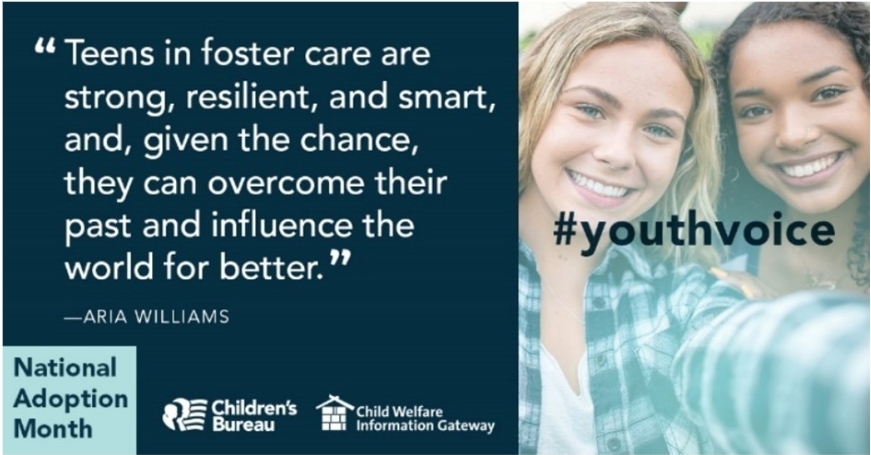
November is National Adoption Month
Engaging "Voices of Youth" Can Make A Difference
What does it mean to be a youth in foster care-and how does achieving permanency change that experience?
For some, it is the realization that home isn't always a place-it can be a state of mind, or a moment in time. It can also mean great personal transformation when meaningful connections are finally secured.
In "Voices of Youth," hear directly from young men and women who share their experience in foster care and adoption.
When we open a channel of communication with youth, we can begin to address the barriers to achieving permanency, and we create opportunities for their well-being along the way.
Read and watch firsthand accounts of what it means to be a youth in the foster care system and why these young people need to be engaged, listened to, and validated.
Their unique perspectives can help child welfare professionals improve programs, practices, and permanency outcomes.
Share their stories with professionals, youth in foster care, and prospective adoptive families to draw attention to why permanency and youth engagement are so important.
Find out how Aria learned the meaning of unconditional love from her adoptive parents, how McKayla learned what home means for her through healing therapy, and how Celia's adoption boosted her confidence and sense of security and belonging.
Help us raise awareness about the importance of engaging with youth during National Adoption Month.
|
Benchmarks' Thursday Child Welfare Webinar w/Lisa Cauley & Karen McLeod
Recording and Slidedeck
|
| | Benchmarks' Thursday Child Welfare Webinar: November 12, 2020 |
|
Upcoming Benchmarks' Webinars
Tomorrow: Benchmarks' Friday Membership Webinar w/Dave Richard, NC Medicaid
Date: Friday, November 13, 2020
Time: 8:30 am thru 9:30 am
New: The HHS Insurance Crisis: What You Need to Know & What You Can Do
NOTE: This webinar is geared towards ALL of Benchmarks' member agencies, all populations, and for/non profit agencies. We hope you will join us!
Date: Wednesday, November 18, 2020
Time: 10:00 am thru 12:00 pm
Register Here
Benchmarks' Friday Membership Webinar w/Leza Wainwright, CEO Trillium
Date: Friday, November 20, 2020
Time: 8:30 am thru 9:30 am
|
Launch of NC Medicaid's Enrollment Website
DHHS has announced the launch of NC Medicaid's enrollment website, www.ncmedicaidplans.gov, in preparation for the launch of Medicaid Managed Care scheduled for July 1, 2021. Medicaid Managed Care open enrollment will begin March 15, 2021, and will continue through May 14, 2021.
The purpose of the enrollment website is to help Medicaid beneficiaries learn more about Medicaid Managed Care. In 2015, the NC General Assembly enacted legislation directing NCDHHS to transition Medicaid and NC Health Choice from a primarily fee-for-service delivery system to managed care. Under managed care, the state contracts with insurance companies, which are paid a predetermined set rate per enrolled person to provide all services.
The enrollment website provides information about who will have to choose a health plan, who will stay in the traditional Medicaid program (NC Medicaid Direct) and who can choose between the two. It will also share the basic medical and behavioral health benefits that are offered. There will be a list of frequently asked questions and answers to help beneficiaries understand the changes.
Most people currently receiving Medicaid benefits will need to enroll in Medicaid Managed Care. Medicaid beneficiaries will be able to choose from five health plans - WellCare, United HealthCare, Healthy Blue, AmeriHealth Caritas and Carolina Complete Health (serving regions 3, 4 and 5). Those who are federally recognized tribal members or qualify for Indian Health Services are exempt from managed care. Those who live in Cherokee, Graham, Haywood, Jackson or Swain counties or in a neighboring county may choose to enroll in the Eastern Band of Cherokee Indians (EBCI) Tribal Option.
A small number of people will not need to choose a Medicaid Managed Care health plan because of the type of health services they need. They will stay enrolled in NC Medicaid Direct. To learn more, beneficiaries can visit the NC Medicaid Direct services page on the enrollment website.
|
SPECIAL BULLETINS COVID-19 #141 and #142 Available
SPECIAL BULLETIN COVID-19 #141: Reminder of Requirement to Report Antigen Test Results
Facilities using a point-of-care antigen test device for detection of SARS-CoV-2 are required by State Health Director Order to report all results, positive and negative, of diagnostic testing for SARS-CoV-2, the virus that causes COVID-19. This includes antigen test results. Facilities that are reporting detailed results through Electronic Laboratory Reporting (ELR) or COVID-19 Laboratory Data Automation (CLDA) should include all Antigen testing in your reporting results. More Details.
SPECIAL BULLETIN COVID-19 #142: REMINDER - Reimbursement for COVID-19-Related Primary Care Services for Uninsured Individuals Living in NC
Following the Oct. 30, 2020, announcement that the NCTracks secure portal is live, providers are encouraged to submit qualifying COVID-19 related primary care services claims for reimbursement through the NCTracks secure portal. Providers can also attend training to learn more about submitting qualifying claims through NCTracks. More Details.
New Medicaid Bulletins Available as of Nov. 10, 2020
The NC Division of Health Benefits (DHB) has recently published new Medicaid Bulletin articles:
Providers are encouraged to review this information. All bulletin articles, including those related to COVID-19, are available on DHB's Medicaid Bulletin webpage.
|
Nov 10, 2020 -- Blog post discusses the Centers for Medicare and Medicaid Services' Accountable Care Organization (ACO) Investment Model (AIM) and its impacts. Analysis finds that the ACO Investment Model can help underresourced providers reduce spending to offset the costs of delivery system investments, even under an upside-only financial risk model. Describes how management companies support rural ACOs.
Nov 9, 2020 -- Blog post discusses the positive impact playgrounds have on the health and well-being of rural children and highlights KABOOM!, a nonprofit who works with rural communities in transforming playspaces for kids. Discusses how the KABOOM! model is scalable to rural communities' needs and can help address high rates of obesity and mental health issues.
Nov 5, 2020 -- The Food and Drug Administration will hold a virtual public workshop on December 11, 2020 to obtain scientific input on methods to evaluate the Opioid Analgesics Risk Evaluation and Mitigation Strategy (OA REMS) education program. Background information on the program, as well as evaluation challenges, are outlined in an issues paper, Methods for Evaluating the Opioid Analgesic Risk Evaluation and Mitigation Strategy. Comments on the workshop are due by February 11, 2021.
Source: Federal Register
Community Health Grant SFY22 RFA
Application period opened November 2, 2020
Application period closes January 15, 2021
Community Health Grant funds, supported through the North Carolina General Assembly, are for assuring access to primary and preventive care to meet the health needs of our state's most vulnerable populations.
Primary care safety net organizations that care for underserved and medically indigent patients in the state are eligible to apply for this funding to pay for patient care through encounter-based reimbursement or through reimbursement for eligible expenses.
Applicants may request up to $150,000 per year of the grant.
Please join us for Technical Assistance Webinars in November and December to find out more information on agency eligibility, length of award, how to apply, and other items specific to this upcoming grant cycle. Interested applicants may attend any session at their convenience.
Webinars by Medicaid Regions will be held on the following dates:
November 16, 2020 at 10:00 a.m. - Regions 4 and 6
Meeting number: 173 412 4222
Password: CHG2021
Join by phone
+1-415-655-0001 US Toll
Access code: 173 412 4222
November 16, 2020 at 2:00 p.m. - Regions 3 and 5
Meeting number: 173 813 2880 Password: CHG2021
Join by phone
+1-415-655-0001 US Toll
Access code: 173 813 2880
December 7, 2020 at 10:00 a.m. - Regions 1 and 2
Meeting number: 173 128 0700 Password: CHG2021
Join by phone
+1-415-655-0001 US Toll
Access code: 173 128 0770
Funding Agency Contact/Inquiry Information:
Ginny Ingram at ginny.ingram@dhhs.nc.gov or 919-527-6457
|
New Chartbook Compares Quality of Healthcare for Veterans With Other Populations
Veterans received better care than nonveterans in areas such as vaccinations and health screenings between 2015 and 2018, according to a new chartbook from AHRQ. However, veterans received worse care than nonveterans when it came to access to care and prescription medications. The new analysis provides contextual health data on veterans and nonveterans, such as comparisons on smoking rates, experience with chronic pain and prevalence of health conditions. Its findings on access to care, quality of care and mortality rates were based on 65 quality measures. Among comparisons with nonveterans, it indicated that veterans:
- Had higher rates of vaccinations for flu, shingles, pneumonia and tetanus
- Had higher rates of screening for blood pressure, cholesterol and glucose
- Had more difficulty contacting their usual source of care by phone during regular business hours
- Were more likely to receive an inappropriate medication for older adults
Comparisons among different groups of veterans and Veterans Healthcare Administration (VHA) enrollees identified disparities related to age, sex and disability status. Some racial/ethnic disparities were also found but tended to be smaller than disparities observed among nonveterans. The chartbook is a collaboration between AHRQ, the Department of Veterans Affairs Office of Health Equity, and the National Healthcare Quality and Disparities Inter-Agency Workgroup. Access the chartbook.
Prevention, Diagnosis, and Management of Opioids, Opioid Misuse, and Opioid Use Disorder in Older Adults
Structured Abstract
Background. Opioid-related harms are increasing among older adults. Until we better understand the factors contributing to this trend, we will be unable to design and implement effective interventions to optimally manage opioid use and its potential harms among older adults. Although considerable research has been done in younger or mixed-age populations, the degree to which it is directly applicable to older adults is uncertain.
Objectives. To provide a framework for understanding how to reduce adverse outcomes of opioid use among older adults, and to describe the evidence available for different factors associated with and interventions to reduce adverse outcomes related to opioid use in this population.
Approach. With input from a diverse panel of content experts and other stakeholders, we developed a conceptual framework and evidence map to characterize empirical studies of factors associated with opioid-related outcomes and interventions to reduce opioid-related harms in older adults. We identified relevant literature among older adults (age ≥60 years) for an evidence map by systematically searching PubMed, PsycINFO, and CINAHL for studies published in English between 2000 and May 6, 2020.
Pharmacologic and Nonpharmacologic Treatments for Posttraumatic Stress Disorder
Main Points
- This update adds newly published studies on posttraumatic stress disorder (PTSD, 47 randomized controlled trials [RCTs]), studies targeting comorbid PTSD and substance use disorders (SUDs, 21 RCTs), and variables related to comorbidities such as SUDs and suicidal ideation/behavior, to the PTSD-Repository, a database of RCTs of interventions to treat PTSD.
- We abstracted data from 389 RCTs, which included psychotherapeutic interventions (63%), pharmacologic interventions (25%), and complementary and integrative or nonpharmacologic biological treatments (12%).
- Reporting was incomplete for many data elements in published studies: less than half of studies reported on the loss of PTSD diagnosis (i.e., no longer meeting criteria for PTSD) or clinically meaningful response/remission of symptoms.
- Risk of bias (ROB) was assessed for all included studies; most were rated as having a medium ROB (57%), and only 6 percent were rated as having a low ROB.
- An exploration of an expanded ROB system was developed and pilot tested.
|
This report from the National Academy for State Health Policy examines how Colorado, Minnesota, and Rhode Island are using accountable care programs to improve the delivery of behavioral health services. It was developed through HRSA's cooperative agreement with the National Organizations of State and Local Officials.
|
Press Release: Trump Administration Announces Medicaid and CHIP Managed Care Final Rule, Continues Commitment to Transform Medicaid by Delivering Greater Flexibility to States
Today, the Centers for Medicare & Medicaid Services (CMS) released the 2020 Medicaid and Children's Health Insurance Program (CHIP) Managed Care final rule. The final rule fulfills one of the Trump Administration's earliest commitment to states by reducing unnecessary administrative burden and federal regulatory barriers. The purpose of the rule is to ensure state Medicaid and CHIP agencies are able to work effectively to develop and implement managed care programs that better serve each state's growing number of Medicaid and CHIP beneficiaries.
"The era of prescriptive regulations has failed," said Administrator Seema Verma. "This rule represents a concerted effort to transform Medicaid to improve quality and access for its beneficiaries. This will remove the burden on states while ensuring appropriate oversight of managed care organizations. The government should identify expected outcomes, results, and standards - not micromanage processes."
Today's final rule was designed to improve federal oversight and state flexibility while maintaining beneficiary protections and providing high quality of care for the 55 million beneficiaries who are enrolled in Medicaid managed care plans. This also includes the 79 percent of CHIP children in 32 states who enrolled in CHIP managed care plans. The rule fosters accountability by ensuring CMS issues guidance to help states more quickly complete the federal rate review process, while preserving the requirement for states to implement a Quality Rating System (QRS) for the managed care plans they contract with, so beneficiaries can have information about their plan and make informed decisions about their healthcare. The rule also reinforces CMS's commitment to providing access and quality care to beneficiaries living in rural America by changing the minimum standards states must use in developing network adequacy requirements in a way that supports state facilitation for telehealth options. In 2016, CMS issued a Medicaid & CHIP Managed Care Final Rule to update the regulations governing Medicaid and CHIP managed care programs. However, numerous stakeholders complained that the 2016 regulations were overly prescriptive and burdensome. As a result, CMS formed a working group with the National Association of Medicaid Directors (NAMD) and State Medicaid Directors to review and prioritize areas of concern within the managed care regulations. The recommendations from this group culminated in the proposals that CMS put forward for comment in November 2018.This final rule strengthens provisions in the 2016 rule taking into consideration the comments the agency received, giving states greater flexibility to establish appropriate payment for Medicaid and CHIP services and to set standards that effectively address the healthcare needs specific to their state, while ensuring appropriate beneficiary protections. The majority of provisions will be effective thirty days after issuance of the Final Rule. There are two provisions that will be effective with contract rating periods starting on or after July 1, 2021 and two provisions that states will be required to come into compliance with for certain reports and quality strategies submitted on or after July 1, 2021.
|
Research Highlight: Using Mobile Technology to Improve Care for Teens with Depression
The need for mental health services that help teens manage and treat their symptoms has never been greater, but these services are not always available or easy to access. Current smartphone technology offers a means of collecting and evaluating much of this health data with minimal effort. In a project funded by the National Institute of Mental Health (NIMH) Small Business Technology Transfer program, researchers are investigating whether this technology can be used to create a passive monitoring system that can predict teens' depressive symptoms and improve the quality of their care.
|
Who Cares: A National Count of Foster Homes and Families (New 2020 data released today)
Who Cares is the nation's first public resource on foster care capacity. The Imprint collects data directly from each state, and combines that with specially obtained federal reports to shed light on two critical questions: How many kids are in foster care today? And where are they living? This year the data suggests that nationwide, the number of youth in care is going down, and so is the number of licensed foster homes. Across the nation, the reliance on relatives continues to grow in many systems as the use of group homes and residential care declines.
|
The 5 Pillars of Direct Care Job Quality
To guide employers, policymakers, and industry leaders in transforming the direct care workforce, PHI's new framework for direct care job quality includes 29 elements across five pillars: quality training, fair compensation, quality supervision and support, respect and recognition, and real opportunity.
FAIR COMPENSATIONA quality direct care job should enable workers to achieve economic stability, safeguard their health, and plan for the future.LIVING WAGE AS A BASE WAGEA quality job for direct care workers requires a living wage that accounts for the local and regional cost of living (a formula based on common expenses such as housing, food, clothing, transportation, and more). This living wage should be set as a base wage, with benefits, raises, bonuses, and other job supports layered on top. As noted earlier, direct care workers earn a median hourly wage of about $12, which has remained virtually stagnant over the last decade, and this substandard wage drives many of these workers into poverty or out of this sector. Establishing a base wage for direct care that is aligned with the cost of living makes it affordable for workers to pursue these jobs.
|
Upcoming Events
|
Tomorrow: Friday, November 13, 2020
Benchmarks' Friday Membership Webinar w/Dave Richard, NC Medicaid
Time: 8:30 am thru 9:30 am
|
Thursday: November 12, 2020
When IDD Co-Occurs with Mental Illness Training
Time: 1:00 pm thru 1:30 pm
|
Tuesday: November 17, 2020
Social Determinants of Health in Rural Populations
Time: 1:00 pm
|
New: Wednesday, November 18, 2020
The Health & Human Services Insurance Crisis: What You Need to Know & What You Can Do (Benchmarks' Members Only)
Presented By: Brown & Brown Insurance and Nonprofits Insurance Alliance
Note: This webinar applies to ALL of our members, for-profit & non-profit agencies, and all populations
Time: 10:00 am thru 12:00 am
|
Wednesday: November 18, 2020
Level Up: Enhancing Behavioral Telehealth Services in the COVID Era Webinar
Time: 12:00 pm thru 1:00 pm
Speaker: Dr. Nora Dennis, MD, MSPH, is Chief Medical Officer of Monarch, one of the largest behavioral health services providers in NC. At Monarch, Dr. Dennis ensures all medical administrative processes for the company's mental health locations and telemedicine procedures meet the everevolving healthcare standards, as well as providing a continuum of excellent care to the thousands of people Monarch supports. Dr. Dennis is also an adjunct Assistant Professor in the Department of Psychiatry and Behavioral Sciences at Duke University School of Medicine. She attended Duke University School of Medicine, UNC Gillings School of Public Health, and completed her residency in psychiatry at Duke University Medical Center. She holds additional board certification in Addiction Medicine. Dr. Dennis is an enthusiastic physician educator and public health leader, and current participant in the NC Medical Society Leadership College.
|
Friday, November 20, 2020
Benchmarks' Friday Membership Webinar w/Leza Wainwright, CEO Trillium
Time: 8:30 am thru 9:30 am
|
Friday, December 11, 2020
Ethics, COVID-19 & Telehealth: Part 1
Time: 2:00 pm thru 3:30 pm
|
Thursday, December 13, 2020
Medicaid Managed Care Fireside Chat Webinar Series-Beneficiary Attribution
Time: 5:30 pm thru 6:30 pm
|
Thursday, December 17, 2020
Clinical Quality Webinar Series-Behavioral Health
Time: 5:30 pm thru 6:30 pm
|
Thursday, January 7, 2021
Medicaid Managed Care Fireside Chat Webinar Series-Policy Approvals, Process Changes & Appeals
Time: 5:30 pm thru 6:30 pm
|
Thursday, January 21, 2021
Clinical Quality Webinar Series-TBD
Time: 5:30 pm thru 6:30 pm
|
Please click on each of the following links to view details sent out from each LME/MCO.
Benchmarks' wants to be sure to make the following list handy for our members to visit and suggests a peek at least once per week to find information that may be pertinent to your agency and contracts.
|
|
|
|
|
|