Benchmarks' Thursday Child Welfare Webinar
September 9, 2021
Karen McLeod & Lisa Cauley
|
|
Benchmarks' Upcoming Webinars
Benchmarks' Friday Webinar
Dave Richard Joins Karen McLeod
Date: Friday, September 17, 2021
Time: 8:30 am thru 9:30 am
Benchmarks' Child Welfare Webinar
Lisa Cauley Joins Karen McLeod
Date: Thursday, October 7, 2021
Time: 8:00 am thru 9:00 am
Benchmarks' Friday Webinar
Dave Richard Joins Karen McLeod
Date: Friday, October 15, 2021
Time: 8:30 am thru 9:30 am
|
|
Interim Process for Submitting Prior Authorization Requests for Beneficiaries Disenrolled to NC Medicaid Direct
A Medicaid beneficiary enrolled in a Standard Plan Prepaid Health Plan (PHP) may be later identified as a member of a Medicaid population that is exempt or excluded from Standard Plan enrollment. This will result in a beneficiary’s disenrollment from the PHP and return to NC Medicaid Direct.
A PHP may be currently waiving PA requirements for some or all of its covered services. If a PHP member is moved back to NC Medicaid Direct, the beneficiary may not have a PA transferred for a service that requires an authorization in NC Medicaid Direct. The absence of a PA may result in service disruption upon a beneficiary’s return to NC Medicaid Direct.
To ensure beneficiaries and providers do not experience service disruption in the scenario previously outlined, a provider may be required to submit a prior authorization request to the applicable NC Medicaid Direct vendor in order to continue services to the beneficiary. To support providers through this process, the Department will allow retroactive review of prior authorization requests for beneficiaries who have been moved back to NC Medicaid Direct from a Standard Plan.
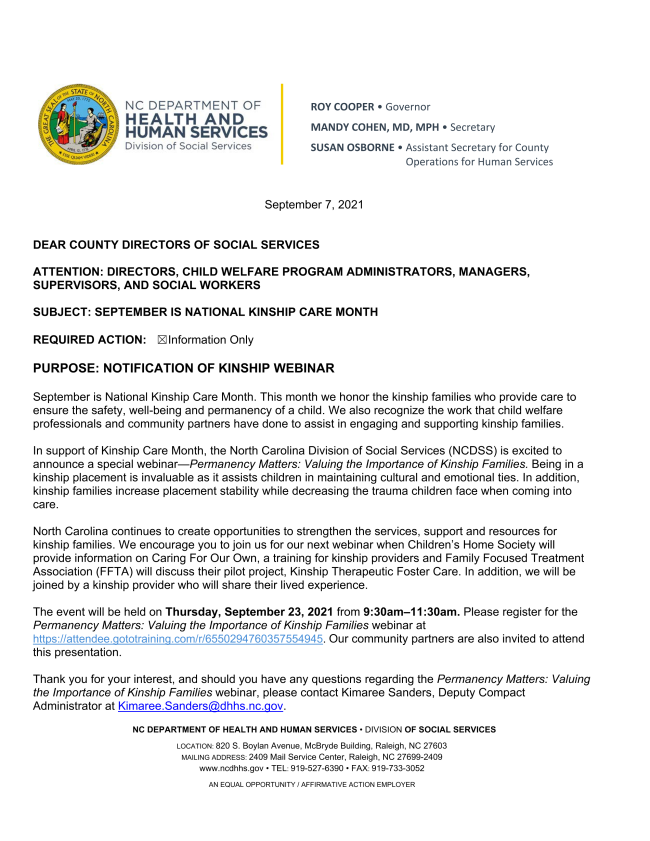
NC DSS: Notification of Kinship Webinar
September is National Kinship Care Month. This month we honor the kinship families who provide care to ensure the safety, well-being and permanency of a child. We also recognize the work that child welfare professionals and community partners have done to assist in engaging and supporting kinship families.
In support of Kinship Care Month, the North Carolina Division of Social Services (NCDSS) is excited to announce a special webinar—Permanency Matters: Valuing the Importance of Kinship Families. Being in a kinship placement is invaluable as it assists children in maintaining cultural and emotional ties. In addition, kinship families increase placement stability while decreasing the trauma children face when coming into care.
|
|
NC Blueprint: Child Welfare Workforce Development Month, Event
NCDHHS Celebrates Child Welfare Workforce Development Month
Throughout the month of September, NCDHHS is recognizing you – our state’s child welfare workforce – and all that you do for North Carolina children and families. We hope you’ll join us for a special virtual event on Wednesday, Sept. 15 at noon to celebrate.
The child welfare workforce in North Carolina is a force for good, and your work improving safety, permanence and wellbeing is invaluable to the communities you serve.
NCDHHS will be taking this opportunity to focus on how we can better support and appreciate our workforce. We encourage you to join us by celebrating your child welfare colleagues throughout the month, and please take a moment to celebrate yourself for all you do.
Mark your calendars for some state and national Child Welfare Workforce Development Month events happening in September:
- Sept. 13-17: Child Welfare Worker Appreciation Week
-
Sept. 14: NCWWI Child Welfare Worker Recognition Event – register here
-
Sept. 15: NCDHHS Thank You to Child Welfare Workforce Virtual Event – details to follow
-
Sept. 17, 20, 22, 30: Trauma-informed Yoga for Child Welfare Professionals – register here
-
Sept. 23: Children’s Bureau and the Capacity Building Center for States’ Virtual Expo – register here
|
|
New SPECIAL BULLETIN COVID-19 #178 Now Available
The NC Division of Health Benefits (DHB) has recently published a new Medicaid Bulletin articles related to COVID-19:
SPECIAL BULLETIN COVID-19 #178: Temporary Provisions for COVID Surge: Post-Acute PA Exceptions and Hospital at Home Program
This bulletin includes details on the temporary suspension of prior authorization requirements for post-acute placements; medically necessary new admissions being directly discharged from a hospital setting into a nursing home (NH); and inpatient rehabilitation and long-term care hospital admissions. The article also details enhanced swing bed reimbursement rates and temporary availability of the Acute Hospital Care at Home (HAH) program. More Information
Providers are encouraged to review this information. All bulletin articles, including those related to COVID-19, are available on DHB's Medicaid Bulletin webpage.
Upcoming NC Medicaid Managed Care Webinars
Back Porch Chat: Medicaid Managed Care Hot Topics
Thursday, Sept. 16 | 5:30 to 6:30 p.m. Register
Join us for important Medicaid updates at the next Back Porch Chat on Medicaid Managed Care Hot Topics scheduled for Thursday, September 16 from 5:30-6:30 p.m. Carrie Brown, MD, MPH Chief Medical Officer for Behavioral Health & IDD, NC Department of Health and Human Services will host the event, which will include presentations on:
- Quick Updates on Hot Topics
- Hope4Healers
- Standard Plan Claims & Taxonomy
- COVID-19
- Advanced Medical Home (AMH) vs AMH+
- Medicaid Managed Care & Behavioral Health and Intellectual/Developmental Disability (BH/IDD) Tailored Plan Overview
- Tailored Care Management (TCM)
- Request to Move to TP or NC Medicaid Direct
- Questions from the Field
Do you have a question you would like addressed during the webinar? Please access this link by Monday, Sept. 13 to enter your questions. We look forward to hearing from you!
Virtual Statewide Primary Care Quality Forum
Tuesday, Oct. 12 | Noon to 1:30 p.m. Register
The North Carolina Department of Health and Human Services Division of Health Benefits and North Carolina AHEC, in conjunction with the five prepaid health plans, will host a Virtual Statewide Primary Care Quality Forum to help providers, practice managers and quality managers succeed with NC Medicaid Managed Care quality initiatives. Join us for this informative session which will cover:
- Legislative/DHHS Updates
- DHHS Quality Strategy
- Performance Improvement Initiatives
- Childhood Immunizations
- Diabetes Control
- Timeliness of Prenatal/Postpartum Care
- Advanced Medical Home Measures
- Data and resources
Visit the AHEC Medicaid Managed Care webpage for additional information and registration for upcoming webinars, as well as recordings, slides and transcripts from previous webinars.
New Medicaid Bulletins Available as of Sept. 8
The NC Division of Health Benefits (DHB) has recently published new Medicaid Bulletin articles:
- North Carolina Standard & Tailored Plan Tobacco-Free Policy Requirement
- NC Medicaid EHR Incentive Program Announcements - September, 2021
- Interim Process for Submitting Prior Authorization Requests for Beneficiaries Disenrolled to NC Medicaid Direct
- Clinical Coverage Policy 11A-17 CAR T-Cell Therapy Revision Effective Oct. 1, 2021
- Eyeglasses Prior Approval and Dispensing Fee Claims Submission When a Beneficiary Transitions to NC Medicaid Direct – Aug. 30, 2021
Providers are encouraged to review this information. All bulletin articles, including those related to COVID-19, are available on DHB's Medicaid Bulletin webpage.
|
|
CWLA Celebrates Kinship Care Month
September is Kinship Care Month. Please join CWLA as we celebrate three decades of dedication to kinship caregiving families and recognize all of the relatives, members of the extended family, and tribes and clans who provide round-the-clock protecting and nurturing for children, either through informal family arrangements or child protective services.
Nearly three million kinship caregivers across the country provide safety, support, cultural ties, and affection for the children in their care. Unique family circumstances cause stress for relatives, parents, and children including health and mental health challenges, financial and other burdens. Yet kinship caregivers – grandparents, aunts and uncles, siblings who are older, and members of the extended family who are not related – prevail. Let’s use Kinship Care Month to recognize their dedication! CWLA resources to support kinship caregivers include:
|
|
Interventional Treatments for Acute and Chronic Pain: Systematic Review
Objective. To evaluate the benefits and harms of selected interventional procedures for acute and chronic pain that are not currently covered by the Centers for Medicare & Medicaid Services (CMS) but are relevant for and have potential utility for use in the Medicare population, or that are covered by CMS but for which there is important uncertainty or controversy regarding use.
Data sources. Electronic databases (Ovid® MEDLINE®, PsycINFO®, the Cochrane Central Register of Controlled Trials, and the Cochrane Database of Systematic Reviews) to April 12, 2021, reference lists, and submissions in response to a Federal Register notice.
Review methods. Using predefined criteria and dual review, we selected randomized controlled trials (RCTs) for 10 interventional procedures and conditions that evaluated pain, function, health status, quality of life, medication use, and harms. Random effects meta-analysis was conducted for vertebral compression fracture; otherwise, outcomes were synthesized qualitatively. Effects were classified as small, moderate, or large using previously defined criteria.
|
|
The Power of Peers: Who Influences Your Health?
Do birds of a feather really flock together? The science says yes. People do tend to choose friends who are similar to them. You also become more like your friends over time. And that can influence your health.
Many behaviors spread socially. Examples include how much you exercise, how much alcohol you drink, whether you smoke, and what foods you eat.
Scientists are still trying to untangle why that is. Studies have found that activity in certain brain areas changes when other people are around. That can affect what you choose to do.
But this work also suggests that you can harness the power of social relationships to gain healthier habits—and motivate others to do the same.
|
|
Recognizing RSV: More Than the Common Cold
COVID-19 measures lessened how often we get sick from many other viruses. But one common virus has been on the rise this year. It’s called respiratory syncytial virus, or RSV.
RSV is usually more common in the fall, winter, and spring. But this year, infections have surged over the summer. This is likely because of the lifting of COVID-19 precautions, like masking and social distancing, says Dr. Barney Graham, a physician who studies viruses at NIH.
Almost everyone catches RSV before the age of 2. It’s one of the most common causes of illness in children. But unlike many other viruses that infect the lungs, you can catch RSV over and over again.
|
|
Changes in Socioeconomic Mix and Health Outcomes in Rural Counties with Hospital Closures, 2005-2018
- Noncore (rural) counties experienced a higher number of complete hospital closures than their micropolitan peers, with this gap widening over time.
- Compared to micropolitan areas, noncore counties with closures experienced higher poverty and unemployment rates since the early 2010s.
- Compared to micropolitan areas, noncore counties with hospital closures began experiencing heightened age-adjusted all-cause and cardiovascular mortality rates since the early 2010s.
\When rural hospitals close their doors (as opposed to scaling back services or converting to a critical access hospital), the communities where they operate lose access to a host of general and acute
inpatient services. From 2005 to 2020, almost 200 rural hospitals have closed their doors, with the number of closures rising rapidly since the Great Recession of 2008/2009.
Previous studies, as well as recent Government Accountability Office (GAO) reports, have found that hospital closures affect rural residents’ access to health care services particularly those who are elderly and low income.
These trends are expected to continue, raising questions about the long-term impact that rural hospital closures will have on access to health care services and health outcomes for over 46 million Americans living in rural communities.
|
|
CDC Rolls Out New COVID-19 Resources For People With IDD
As the delta surge renews concerns about COVID-19 across much of the country, the Centers for Disease Control and Prevention is taking steps to help people with intellectual and developmental disabilities understand and protect themselves against the virus.
The agency is introducing a series of resources specifically aimed at this population.
The new offerings include a toolkit with social stories, videos, posters and interactive activities. The materials address five topics — getting a COVID-19 vaccine, wearing a mask, social distancing, hand washing and getting a COVID-19 test.
“People with intellectual and developmental disabilities can experience communication barriers that make it harder for them to understand and act on crucial health guidance,” said Dr. Karen Remley, director of CDC’s National Center on Birth Defects and Developmental Disabilities. “The aim of these materials is to help people with IDD, their parents and other caregivers share critical information with their loved ones about COVID-19 and what to expect when getting a COVID-19 test or vaccine and explain how to stay safe if they are not vaccinated.”
|
|
PHI Releases New Data on the Direct Care Workforce
New research depicts the job-related struggles of these essential workers in the face of an unprecedented health crisis.
Direct Care Workers in the United States: Key Facts provides a new annual snapshot on the direct care workforce, including its demographics, occupational roles, job quality challenges, and projected job openings. The report includes detailed overviews of three segments of this workforce: home care workers, residential care aides, and nursing assistants in nursing homes.
Every year, PHI releases new data on the direct care workforce, which in 2020 included 4.6 million workers, including 2.4 million home care workers, 675,000 residential care aides, 527,000 nursing assistants in nursing homes, and about 1 million direct care workers employed in other settings.
“Our new report emphasizes how longstanding poor job quality in direct care has prevented our country from effectively responding to the COVID-19 crisis and keeping workers and the people they support healthy and safe,” said Jodi M. Sturgeon, president of PHI, a national research, advocacy, and workforce innovations organization based in the Bronx, New York.
“This data should serve as a call to action to further invest in this essential workforce,” added Sturgeon.
|
|
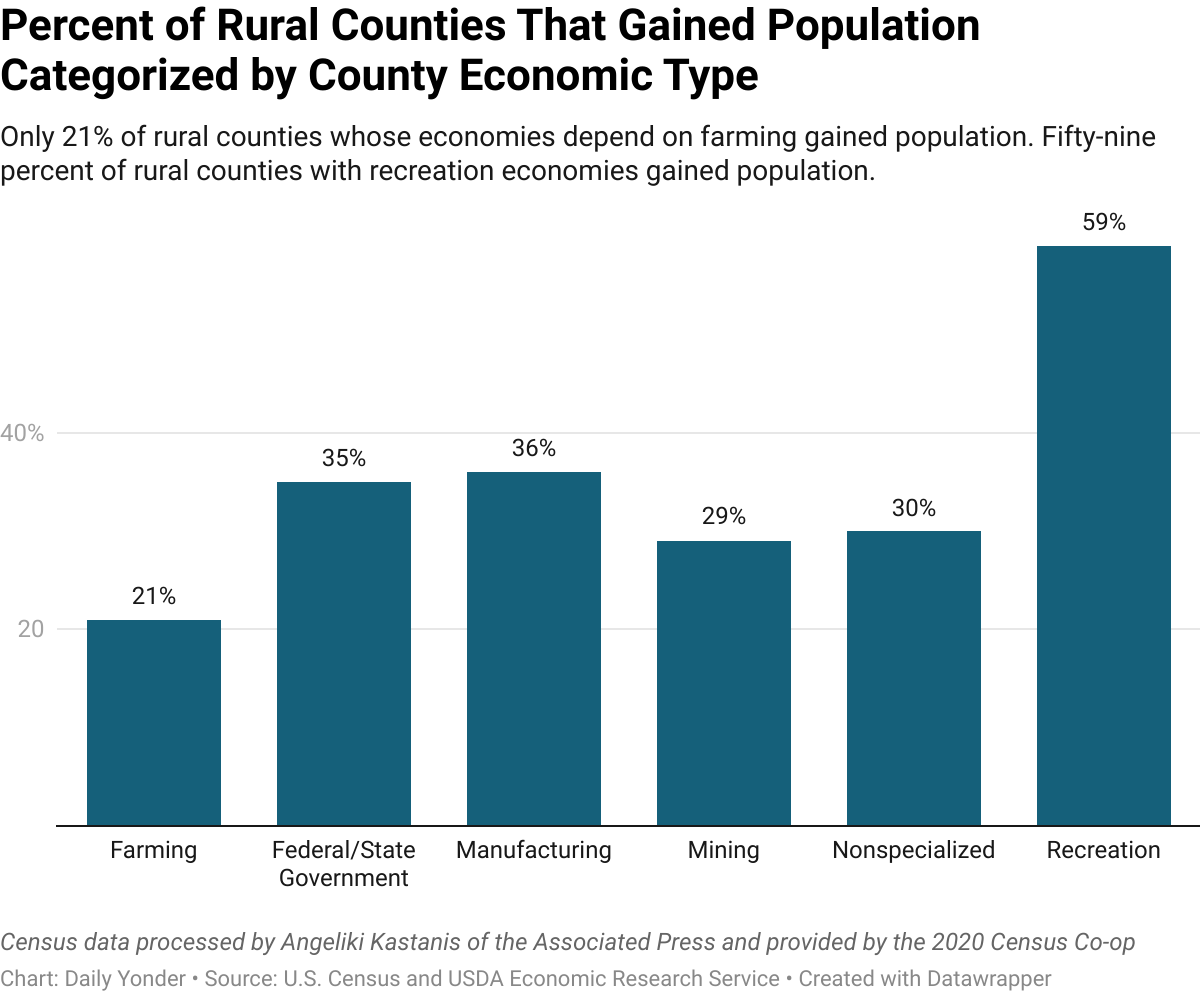
Nearly 80% of Rural Farming-Dependent Counties Lost Population in Last Decade
Counties with recreation economies, on the other hand, were more likely to gain population.
Rural counties where farming makes up a major part of the local economy were more likely than the rest of rural America to lose population over the past decade, according to a Daily Yonder analysis of U.S. Census data.
Counties that depend on recreation, on the other hand, were more likely to gain population than rural America overall.
Only 21% of rural counties with farming-dependent economies gained population from 2010 to 2020, the analysis shows.
Nearly six out of every 10 rural counties with a recreation-based economy gained population over the last decade.
Nationwide, about a third of the nation’s 1,976 rural counties gained population in the last 10 years.
|
|
Improving the Use of Psychotropic Medication with Youth in Residential Treatment Facilities
The September 21 Best Practices Committee meeting will feature a presentation by Christopher Bellonci, M.D., FAACAP, on the above-titled, three-year Quality Collaborative launched in 2017. Among the participants were NACBH members: Canopy Children’s Solutions in Jackson, Mississippi, and Devereux Advanced Behavioral Health centers in Arizona, Colorado, Georgia, Florida, Massachusetts, New York, Pennsylvania, and Texas. Dr. Bellonci, a child and adolescent psychiatrist, is Senior Policy Advisor and Assistant Professor, Harvard Medical School, and Vice President of Policy and Practice and Chief Medical Officer for Harvard’s Judge Baker Children’s Center in Boston.
Please watch your email inboxes for a reminder and Zoom information on Friday, September 17, for the next week’s committee meeting. If you missed last February’s presentation about Devereux’s experience in the Quality Collaborative, you can review the recording and slides on the committee’s web page. The May 2021 final report on the quality collaborative is available here.
|
|
CMS Issues Informational Bulletin on Coverage of Medical Transportation
The Centers for Medicare & Medicaid Services (CMS) issued guidance for states about section 209 of last December’s Consolidated Appropriations Act, regarding Medicaid coverage of non-emergency medical transportation. This section codifies in law the longstanding CMS interpretation that generally requires states to assure necessary transportation for beneficiaries to and from covered services, helping remove transportation barriers for Medicaid enrollees seeking needed health care. It is a benefit that was under considerable threat in recent years, and NACBH participated in a lengthy advocacy effort to protect it as a mandatory benefit.
|
|
Child Welfare Interventions: Clearinghouse Ratings
|
|
Monday, September 13, 2021
FFTA Family Search & Engagement Training 4-Parts
Time: 1:00 pm thru 2:30 pm
Free for FFTA members
|
|
New: Tuesday, September 14, 2021
Advocacy, Collaboration & Coalition Building
Time: 9:00 am thru 11:30 am
|
|
New: Tuesday, September 14, 2021
Exploring Short-term Strategies to Address Workforce Shortages
Time: 3:00 pm thru 4:00 pm
|
|
New: Thursday September 16, 2021
Back Porch Chat: Medicaid Managed Care Hot Topics
Time: 5:30 pm thru 6:30 pm
|
|
Thursday September 16, 2021
Share your ideas with NC's leading disability organizations!
Time: 7:00 pm thru 8:30 pm
|
|
Friday, September 17, 2021
Benchmarks' Friday Membership Webinar
Dave Richard Joins Karen McLeod
Time: 8:30 am thru 9:30 am
|
|
Friday, September 17, 2021
SESSION 1: Medicaid & Audio Only
Time: 2:00 pm thru 3:30 pm
|
|
Monday, September 20, 2021
FFTA Family Search & Engagement Training 4-Parts
Session 2: Identifying Critical Family Relationships
Time: 1:00 pm thru 2:30 pm
Free for FFTA members
|
|
Tuesday, September 21, 2021
Tailoring, Targeting, And Addressing What Matters: Supporting People with Intellectual and Developmental Disabilities Who are Living With Dementia
Time: 2:00 pm thru 3:00 pm
|
|
Friday, September 24, 2021
SESSION 2: Medicaid & Telehealth Data Collection: Surveys, Studies & Advisory Groups
Time: 2:00 pm thru 3:30 pm
|
|
Monday, September 27, 2021
FFTA Family Search & Engagement Training 4-Parts
Session 3: Outreach is Key!
Time: 1:00 pm thru 2:30 pm
Free for FFTA members
|
|
New: Tuesday, September 28, 2021
Local Level Advocacy
Time: 9:00 am thru 11:30 am
|
|
Friday, October 1, 2021
SESSION 3: Medicaid & Other State Agencies Telehealth Policies for Patients with Disabilities
Time: 2:00 pm thru 3:30 pm
|
|
Monday, October 4, 2021
FFTA Family Search & Engagement Training 4-Parts
Session 4: Focusing on Engagement in FSE
Time: 1:00 pm thru 2:30 pm
Free for FFTA members
|
|
New: Tuesday, October 5, 2021
State Level Advocacy
Time: 9:00 am thru 11:30 am
|
|
Tuesday, October 5, 2021
NC Children with Complex Needs Training Series
Evidence-Based and Promising Practices to Support the Workforce and Partners Serving Individuals with Mental Illness and Intellectual and Developmental Disabilities
Session 2: Adaptation of Dialectical Behavior Therapy for Work with Autistic Youth: 1.5 Contact Hours
Time: 10:00 thru 11:30 am
|
|
Thursday, October 7, 2021
Benchmarks' Child Welfare Webinar
Lisa Cauley Joins Karen McLeod
Time: 8:00 am thru 9:00 am
|
|
Friday, October 8, 2021
SESSION 4: Medicaid & Permanent COVID-19 Telehealth Policies
Time: 2:00 pm thru 3:30 pm
|
|
Friday, October 15, 2021
Benchmarks' Friday Membership Webinar
Dave Richard Joins Karen McLeod
Time: 8:30 am thru 9:30 am
|
|
New: Tuesday, October 19, 2021
Federal Level Advocacy
Time: 9:00 am thru 11:30 am
|
|
Tuesday, November 2, 2021
NC Children with Complex Needs Training Series
Evidence-Based and Promising Practices to Support the Workforce and Partners Serving Individuals with Mental Illness and Intellectual and Developmental Disabilities
Session 3: Psychopharmacology for Children with Complex Needs: 1.5 Contact Hours
Time: 10:00 thru 11:30 am
|
|
|
|
|
|
|