|
Upcoming Benchmarks' Webinars
Benchmarks' Friday Membership Webinar: Dave Richard Joins Karen McLeod to Ring in the New Year! Date: Friday, January 8, 2021 Time: 8:30 am thru 9:30 am Benchmarks' Child Welfare Webinar with Lisa Cauley Date: Thursday, January 14, 2021 Time: 8:00 am thru 9:00 am
|
COVID-19 Update
Thank you for all that you are doing to support North Carolina's response to COVID-19.
A tested, safe and effective vaccine will be available to all who want it, but supplies are currently limited and will continue to be for the next few months. To save lives and slow the spread of COVID-19, independent state and federal public health advisory committees recommend first protecting health care workers caring for patients with COVID-19, people who are at the highest risk of being hospitalized or dying, and those at high risk of exposure to COVID-19.
Based on new federal recommendations issued last week by the CDC Prevention's Advisory Committee on Immunization Practices, the Department has updated and simplified the vaccine prioritization plan.
North Carolina's updated phases include:
- Current Phase - Phase 1a: Health care workers fighting COVID-19 & Long-Term Care staff and residents
- Phase 1b (to begin in early January): Adults 75 years or older and frontline essential workers
- Phase 2: Adults at high risk for exposure and at increased risk of severe illness
- Phase 3: Students
- Phase 4: Everyone who wants a safe and effective COVID-19 vaccination
Because currently there is not enough vaccine for everyone to be vaccinated at the same time, NCDHHS will open the next phase of vaccinations (1b) in groups, starting only with persons above the age of 75 in order to best manage vaccine dose availability. To see all the groups for Phases 1b and Phase 2, please review this Infographic of Vaccine Phases.
In the coming days, we will be sending more information on how North Carolinians over age 75 will access vaccinations beginning in early January. For those who engage this population, please consider sharing our flyer (English / Spanish) as a first step.
All vaccine providers are expected to ensure that vaccine is equitably administered within each group. NCDHHS has a specific focus on building trust with historically marginalized populations. Longstanding and continuing racial and ethnic injustices in our health care system contribute to lack of trust in vaccines. The Department is partnering with trusted leaders and organizations to provide accurate information about the vaccine.
In addition, we encourage you to share vaccine resources below with your networks.
- Flyer on Vaccines (English / Spanish)
- Presentation COVID-Vaccination 101 ( English / Spanish)
- Frequently Asked Questions ( English / Spanish)
- Videos on Vaccine Rollout
- NCDHHS Secretary Mandy Cohen shares information on the COVID-19 vaccine rollout plan ( 45-second, 30-second)
- NCDHHS Deputy Secretary Ben Money shares information on the COVID-19 vaccine rollout plan (link )
- Videos for Long-Term Care
- North Carolina long-term care workers share their reason for taking the newly developed COVID-19 vaccine ( 90-second, 60-second, 30-second)
- NCDHHS Secretary Mandy Cohen shares information on the COVID-19 vaccine rollout plan long-term care facility workers (60-second)
- NCDHHS Secretary Mandy Cohen shares information on the COVID-19 vaccine rollout plan for families of long-term care residents ( link)
- NCDHHS Deputy Secretary Ben Money shares information on the COVID-19 vaccine rollout plan for long-term care facilities (60-second, 30-second)
Joint NC DMHDDSAS and DHB COVID 19 Update for NC Providers January 7th
Date: Thursday, January 7, 2021
Time: 3:00 p.m.
During this call, panelists will present policy updates from DMHDDSAS and DHB representatives followed by an open Q&A session. NC Start will be giving a short presentation on identifying and coping with stress, depression and other issues in individuals with IDD. Division of Public Health will provide information of Tobacco Free policies as they relate to Medicaid. In addition to DMHDDSAS and DHB subject matter experts we will also have a representative from DHSR on the call to answer questions you might have. In consideration of the limited time we have on the call, we ask that you review the guidance links (below) on the DHHS website and FAQs on the NC Medicaid site to see if an answer to your question has already been provided. These calls will be held monthly on the first Thursday of each month.
As things continue to change and move quickly during the COVID-19 pandemic, please continue to stay abreast of emerging issues, guidance, and policies by visiting:
Please join us from 3-4 p.m. on January 27, 2021, for a webinar on NC Medicaid transition to Managed Care
From Dave Richard
I'd like to invite you to join me, NC Department of Health and Human Services Secretary Mandy Cohen M.D., Assistant Secretary for NC Medicaid Jay Ludlam and other senior leaders for a webinar on the state's transition to Medicaid Managed Care.
The webinar, designed for our community partners, will provide an overview of Medicaid Managed Care, NCDHHS' vision for whole-person centered, coordinated care and key milestones leading up to the statewide launch on July 1, 2021.
As a leader in your community, we know you are a trusted source of information for Medicaid beneficiaries and the many partners that will be impacted by this transition. We want to make sure you have the most up-to-date information, are aware of NCDHHS' efforts to prepare for the launch, and have the opportunity to share questions, comments or concerns.
Please register for the webinar by clicking on the registration link below. Feel free to share the webinar invitation and registration link with other community partners you feel would be interested in attending.
NC Medicaid Transition to Managed Care
Date: Jan. 27, 2021
Time: 3:00 p.m.
After registering, you will receive a confirmation email with information about joining the webinar.
NCDHHS Receives Approval to Expand Reach Out and Read through New Medicaid Initiative
The North Carolina Department of Health and Human Services recently received approval to use up to $3,013,000 in federal matching funds to expand services for Reach Out and Read, the evidence-based childhood brain development intervention initiative. This partnership with Reach Out and Read is one of the first in the country among Medicaid programs.
Reach Out and Read is an evidence-based intervention that partners with pediatric primary care locations to deliver training for medical providers, literacy tools for families, and to encourage healthy routines and relationships through shared stories. In every well-visit, children and families receive a "prescription for reading" with new, developmentally appropriate books to help grow children's home libraries.
Research shows that children who participate in this program have improved literacy and language comprehension, and clinics have improved patient-clinician relationships and well-child visit attendance.
For more information:
|
COVID-19 Bulletin #146 and Electronic Visit Verification - Implementation Update
SPECIAL BULLETIN COVID-19 #146: Update on CARES Act-Funded Payments to Nursing Facility Providers and Availability of Extension Funding
This bulletin updates and extends NC Medicaid's reimbursement for allowable COVID-19 testing of nursing facility staff and healthcare personnel currently established under Secretarial Orders No. 2 and No. 4. It also updates the original end date communication under Special Bulletin COVID-19 #129 Reporting Requirements and Financial Support to Nursing Homes under Secretarial Order No. 2.
Providers are encouraged to review this information. All bulletin articles, including those related to COVID-19, are available on DHB's Medicaid Bulletin webpage.
New Medicaid Bulletin Available as of Dec. 31, 2020
The NC Division of Health Benefits (DHB) has recently published a new Medicaid Bulletin article:
Updates to NCTracks Prior Approval Attachment Functionality and Updates to NCTracks Prior Approval Attachment Functionality
Effective Jan. 31, 2021, an enhancement will be made to the existing provider attachment functionality during prior approval (PA) entries and inquiries. Providers will need to select the attachment type from the list provided based on the PA type.
Furthermore, once these updates have been made and the provided documents have been uploaded, they will be listed by the selected attachment type instead of the generic PA_MEDICAL_ATTACH label.
Please note that any documents uploaded prior to this change will retain the current PA_MEDICAL_ATTACH label. Also, NCTracks generated documents for the cover sheet used when sending information will be labeled as ATTACH CVR, while conformation forms will be listed as CNFRM PDF.
Updates for Health Information Exchange Providers
As part of Session Law 2019-23, certain providers are required to connect to and participate in North Carolina's Health Information Exchange (HIE) Network known as NC HealthConnex.
Based upon the provider's taxonomy codes on file, some providers are voluntary to connect with the HIE while other providers are eligible for a Hardship Extension.
Beginning Jan. 31, 2021, providers that wish to request a Hardship Extension will utilize a new process available through the NCTracks Secure Provider Portal.
For more information about NC HealthConnex connectivity requirements, see the Medicaid Bulletin titled Legislation Gives Certain Providers More Time to Connect to NC HealthConnex. For detailed information about the processes available through the NCTracks Secure Provider Portal, see the corresponding job aid located on the User Guides and Fact Sheets page under Provider Record Maintenance.
New Medicaid Bulletins Available as of Dec. 29, 2020
The NC Division of Health Benefits (DHB) has recently published new Medicaid Bulletin articles:
Providers are encouraged to review this information. All bulletin articles, including those related to COVID-19, are available on DHB's Medicaid Bulletin webpage.
PFIZER-BioNTech COVID-19 Vaccine (N/A) HCPCS code 91300: Billing Guidelines (this information is for the Pfizer COVID-19 vaccine only)
This is the first general communication regarding the COVID-19 vaccine. Medicaid will issue subsequent information related to the guidance of specific vaccination programs and/or specific FDA approved vaccines as information becomes available.
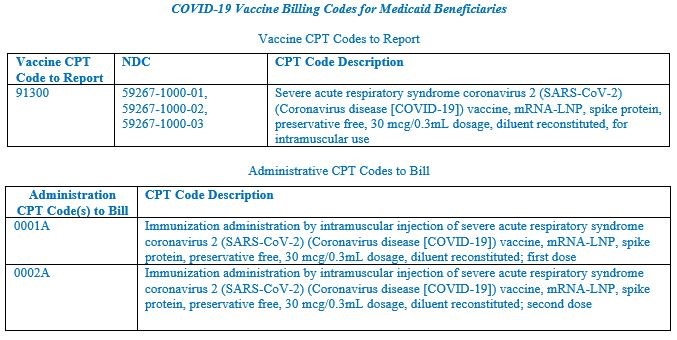
Effective with date of service Dec 12, 2020, the Medicaid and NC Health Choice programs cover Pfizer-BioNTech COVID-19 Vaccine for use in the Physician Administered Drug Program (PADP) when billed with HCPCS code 91300 - Severe acute respiratory syndrome coronavirus 2 (SARS-CoV-2) (Coronavirus disease [COVID-19]) vaccine, mRNA-LNP, spike protein, preservative free, 30 mcg/0.3mL dosage, diluent reconstituted, for intramuscular use.
Strength/Package Size(s): Injection: Pfizer-BioNTech COVID-19 Vaccine is a preservative-free, frozen suspension for injection in a multiple dose vial.
Pfizer-BioNTech COVID-19 Vaccine is authorized for use under an Emergency Use Authorization (EUA) for active immunization to prevent coronavirus disease 2019 (COVID-19) caused by severe acute respiratory syndrome coronavirus 2 (SARS-CoV-2) in individuals 16 years of age and older.
Recommended Dose:
- The Pfizer-BioNTech COVID-19 Vaccine is administered intramuscularly as a series of two doses (0.3 mL each) three weeks apart.
- Individuals who have received one dose of Pfizer-BioNTech COVID-19 Vaccine should receive a second dose of Pfizer-BioNTech COVID-19 Vaccine to complete the vaccination series.
- Vaccine products from different manufacturers are not interchangeable.
The CDC has released Interim Guidance for Immunization Services During the COVID-19 Pandemic. This guidance is intended to help immunization providers in a variety of clinical and alternative settings with the safe administration of vaccines during the COVID-19 pandemic.
If you have any questions about product specific information, please contact the Immunization Branch Help Desk at 1-877-873-6247 and press option 6. If you have any questions about billing NC Medicaid, please call the NCTracks Call Center at 1-800-688-6696.
For Medicaid and NC Health Choice Billing
- The ICD-10-CM diagnosis code required for billing is: Z23 - Encounter for immunization
- Providers must bill with HCPCS code: 91300 - Severe acute respiratory syndrome coronavirus 2 (SARS-CoV-2) (Coronavirus disease [COVID-19]) vaccine, mRNA-LNP, spike protein, preservative free, 30 mcg/0.3mL dosage, diluent reconstituted, for intramuscular use
- One Medicaid and NC Health Choice unit of coverage is: 0.3 mL
- The maximum reimbursement rate per unit is: N/A
- Providers must bill 11-digit NDCs: 59267-1000-01, 59267-1000-02, 59267-1000-03
- The NDC units should be reported as "UN1"
- The fee schedule for the PADP is available on Medicaid's PADP web page
Important Claims Information:
- Medicaid and NC Health Choice will reimburse at the Medicare approved COVID-19 vaccination administration rate at 1st dose $16.94 and 2nd dose $28.39
- Claims must have appropriate NDCs that correspond to the vaccine used for administration and corresponding CPT code
- Claims must contain both administration codes and vaccine codes to pay
- Vaccine codes should be reported as $0.00
- Claims for 1st vaccine dose must have been processed in NCTracks prior to processing a claim for 2nd dose
- Medicaid and NC Health Choice does not allow copays to be charged for COVID-19 immunization or administrations
- COVID-19 vaccines are exempt from the Vaccines For Children (VFC) program
- TJ modifier should be used for NC Health Choice claims (age 6 through 18 years)
- EP modifier should be used for all non-NC Health Choice (only Medicaid beneficiaries) younger than 21 years of age
CG modifier should be used for claims submitted by a pharmacy participating in the immunization program for both the vaccine and administration codes (EXCEPTION - CVS/Walgreens pharmacies participating in the Long-Term Care immunization program for beneficiaries residing at the participating LTC facility).
|
2018-19 At-A-Glance Report North Carolina Data
H/T Eastpointe:
What is National Core Indicators (NCI)? Since 1997, state developmental disability service systems have used the National Core Indicators™ (NCI™) surveys to gather information about the satisfaction, quality of life, and critical life outcomes of those they support. States use this information to track their own performance over time and to compare results across states. NCI's outcome data contributes key information to states seeking to improve services that support people with Intellectual and Developmental Disabilities (IDD) to live and contribute as valued members of their communities.
What is the At-A-Glance Report? This report uses graphics and icons to demonstrate selected NCI findings from North Carolina for quick and easy reading.
|
COVID-19 Vaccine Presentation
Join Carrie Brown, MD, MPH and Chief Medical Officer
for Behavioral Health & IDD at NC DHHS and
Talley Wells, Executive Director, NCCDD for this important communication on ZoomGov for any of the three times below:
Date: Wednesday, January 6, 2021
Time: 1:00 pm
Date: Wednesday, January 6, 2021
Time: 6:00 pm
Date: Tuesday, January 12, 2021
Time: 1:00 pm
|
Recently Passed Coronavirus Relief Bill Includes Changes to Paycheck Protection Program
President Donald Trump signed into law on Sunday, December 27, 2020, the omnibus spending bill to fund the federal government. This federal appropriations bill includes approximately $900 billion in targeted COVID-19 relief.
The relief bill includes additional support for and changes to the Paycheck Protection Program (PPP). The PPP was created to provide aid to struggling small businesses in the Coronavirus Aid, Relief, and Economic Security Act (CARES Act) passed last March. The relief bill allocates an additional $284 billion for the Paycheck Protection Program and updates certain requirements for eligible borrowers.
Many of the relief bill's modifications apply retroactively to those existing PPP borrowers that have not yet had their PPP loans forgiven in addition to those businesses applying for a PPP loan for the first time or a "second draw" PPP loan.
|
CMS Rule Expands States' Flexibilities for Network Adequacy and Telehealth
In November the Centers for Medicare and Medicaid Services (CMS) released its 2020 Medicaid and Children's Health Insurance Program (CHIP) Managed Care Final Rule. CMS states that its goal with the rule was to reduce federal regulatory barriers, support flexibility and promote transparency and innovation when states develop and implement managed care programs for Medicaid and CHIP. The rule addresses telehealth specifically in relation to how telehealth visits should be counted towards meeting a managed care plan's network adequacy requirement. CMS states in the rule the following:
We defer to each state to determine the criteria to be applied to telehealth providers and how such providers would be taken into account when evaluating network adequacy of the state's Medicaid managed care plans. Section 438.68(b) does not set criteria of this nature that states must use. Under Section 438.68(c)(1)(ix),states must consider the availability and use of telemedicine when developing their network adequacy standards. If states elect to include telehealth providers in their network adequacy analysis, we believe that the states will establish criteria that appropriately reflect the unique nature of telehealth, as well as the availability and practical usage of telehealth in their state.
CMS also states in its press release on the rule that the adjustments it made to the minimum standards states must use in developing network adequacy requirements will support state facilitation for telehealth options. Specifically, the rule removes the requirement for states to set time and distance standards and adds a more flexible requirement that states set a quantitative network adequacy standard for network adequacy. It also broadens its definition of provider types, and allows states to have authority to define a 'specialist'. They do note however that they expect states to apply network adequacy standards to all providers types and specialties necessary to ensure that all services covered under the contract are available and accessible to all enrollees in a timely manner. For more information on the final rule, see CMS' factsheet or read the rule in its entirety.
|
| CCHP Animated Video on
Telehealth Reimbursement Basics |
|
NC: Cardinal Innovations CEO Trey Sutten says the health-care company is tackling its problems. Here's how.
Cardinal Innovations Healthcare Solutions is moving ahead with its latest action plan in response to widespread criticism of its services. Sutten said Cardinal is also starting to authorize foster homes at the agency level. In the past, Cardinal has required each foster home within a partner agency to have credentials and onboarding. The company now wants to approve care based on each agency, instead of each home, to further streamline the process.
NC: Greensboro Organization Looks To Close Gap In Foster Care Placement System
Since August, 2,300 kids have called a three-bedroom, three-bathroom house in Greensboro home. It's spacious, quiet and full of toys, books and has a fully stocked fridge and a playground. And it's the first of its kind in North Carolina. The Anchor Hope home is an interim foster home. It serves as a place where children who have been removed from their homes can stay while waiting for placement into a foster home.
|
Federal Response on Human Trafficking-New Website
We are proud to announce a new whole-of-government human trafficking website with federal resources for victims, current funding opportunities, public awareness and training efforts and information on survivor leadership.
The United States has made the global fight against human trafficking a policy priority and employs a whole-of-government approach to stop human traffickers, protect victims, and prevent this crime. Combating human trafficking requires a comprehensive, multidisciplinary effort. Within government, this means the participation and coordination among agencies with a range of responsibilities, including criminal enforcement, labor enforcement, victim outreach and services, public awareness, education, trade policy and promotion, international development and programs, customs and immigration, intelligence, and diplomacy. Coordinated federal efforts that incorporate state, local, and tribal entities; the private sector; civil society; survivors; religious communities; and academia are essential to an integrated response to human trafficking that leverages resources and amplifies results.
|
Upcoming Events
|
New: Tuesday, January 5, 2021
NC DHHS COVID-19 Vaccine Distribution Plan and Q&A Session
Time: 6:00 pm thru 7:00 pm
(646) 558 8656 (New York)
(312) 626 6799 (Chicago)
Meeting ID: 131 899 801
One-tap mobile access
|
New: Wednesday, January 6, 2021
COVID-19 Vaccine Presentation for I/DD
Time: 1:00 pm
|
New: Wednesday, January 6, 2021
COVID-19 Vaccine Presentation for I/DD
Time: 6:00 pm
|
New: Thursday, January 7, 2021
Time: 10:00 am and thru 12:00 pm
|
New: Thursday, January 7, 2021
Joint NC DMHDDSAS and DHB COVID 19 Update for NC Providers
Time: 3:00 pm
|
Thursday, January 7, 2021
Medicaid Managed Care Fireside Chat Webinar Series-Behavioral Health
Time: 5:30 pm thru 6:30 pm
|
Friday: January 8, 2021
Dave Richard Joins Benchmarks' Friday Membership Webinar
Time: 8:30 am thru 9:30 am
|
New: Tuesday, January 12, 2021
COVID-19 Vaccine Presentation for I/DD
Time: 6:00 pm
|
New: Thursday, January 14, 2021
Benchmarks' Child Welfare Webinar with Lisa Cauley
Time: 8:00 am thru 9:00 am
|
Friday, January 15, 2021
SESSION 1: CMS Waivers and State Plan Amendments to Address COVID-19 (NC's Dr. Shannon Dowler will be presenting)
Time: 2:00 pm thru 3:30 pm
|
Thursday, January 21, 2021
Clinical Quality Webinar Series-Diabetes
Time: 5:30 pm thru 6:30 pm
|
Friday, January 22, 2021
SESSION 2: Provider Engagement and Education (NC's Dr. Shannon Dowler will be presenting)
Time: 2:00 pm thru 3:30 pm
|
Friday, January 29, 2021
SESSION 3: Patient Engagement and Education
Time: 2:00 pm thru 3:30 pm
|
Thursday, February 4, 2021
Medicaid Managed Care Fireside Chat Series: Value-Based Payment/Advanced Payment Models & Quality
Time: 5:30 pm thru 6:30 pm
|
Friday, February 5, 2021
SESSION 4: What's Next? A Roadmap for Telehealth Policy Beyond the Pandemic
Time: 2:00 pm thru 3:30 pm
|
Thursday, February 11, 2020
Save The Date: A State-Wide Convening on the Direct Care Workforce
Time: 9:00 am thru 12:00 pm
|
Friday, February 12, 2020
Save The Date: A State-Wide Convening on the Direct Care Workforce
Time: 9:00 am thru 12:00 pm
|
Thursday, February 18, 2021
Clinical Quality Webinar Series-TBD
Time: 5:30 pm thru 6:30 pm
|
Tuesday and Wednesday, March 2 & 3, 2020
|
Thursday, March 4, 2021
Medicaid Managed Care Fireside Chat Series: Policy Approvals, Process Changes and Appeals
Time: 5:30 pm thru 6:30 pm
|
Please click on each of the following links to view details sent out from each LME/MCO.
Benchmarks' wants to be sure to make the following list handy for our members to visit and suggests a peek at least once per week to find information that may be pertinent to your agency and contracts.
|
|
|
|
|
|