|
Upcoming Benchmarks' Webinars
This Friday! Benchmarks' Friday Membership Webinar
Dave Richard Joins Karen McLeod
Date: Friday, February 5, 2021
Time: 8:30 am thru 9:30 am
Benchmarks' Membership Child Welfare Webinar Lisa Cauley Joins Karen McLeod Date: Thursday, February 11, 2021 Time: 8:00 am thru 9:00 am Benchmarks' Friday Membership Webinar Date: Friday, February 19, 2021 Time: 8:30 am thru 9:00 am
|
SAVE THE DATE & REGISTER for Supported Living 2&3 Stakeholders Meeting on Friday, March 26th at 2:30p
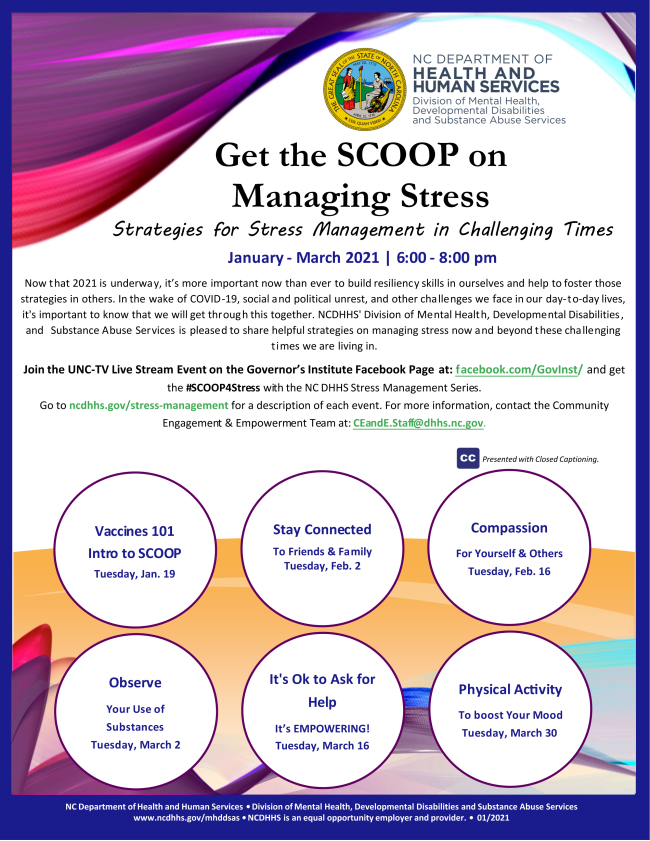
Get the SCOOP for Stress Series
|
United Healthcare Community Plan, NC Medicaid
Are you having trouble reaching someone to contract for United Healthcare Community Plan of NC-Medicaid?
Do you have questions about what contracting with United Healthcare means for you and your agency?
|
Children in Out-of-Home Care Are Less Likely to Receive Early Intervention or Special Education Services
A recent report from the Office of Planning, Research and Evaluation of the U.S. Department of Health and Human Services' Administration for Children and Families presents information on early intervention and special education trends among children in out-of-home care. According to the report, the Individuals with Disabilities Education Act allows each state to set the criteria for eligibility for early intervention services for children younger than 3 years old and special education services for children 3 years of age and older. Children who meet the criteria for receiving special education services should have an individualized education plan for receiving special education, and those meeting the criteria for early intervention services should have an individualized family services plan for receiving early intervention. In addition, the Keeping Children Safe Act requires states to implement procedures for referring children under 3 years old who have experienced maltreatment to early intervention services. The report goes on to note that, according to the National Survey of Child and Adolescent Well-Being, which is a nationally representative study of children involved with child welfare in the United States, children ages 0 to 2 who have been placed in nonrelative foster care are more likely to have a developmental delay (37 percent) than those placed in formal kinship care (22 percent) and voluntary kinship care (26 percent). Among children ages 3 to 17, developmental, cognitive, or academic needs were identified for 29 percent of children placed in nonrelative foster care, 36 percent of children placed in formal kinship care, and 21 percent of children placed in voluntary kinship care. In addition, among children who have been identified as having a condition that would potentially qualify them for early intervention or special education services, their caregivers reported that half or fewer of those children received an individualized family services plan for early intervention services or an individualized education plan for special education services. Having unmet early intervention and special education needs is particularly prevalent among children who are living in voluntary kinship care, but these deficiencies can be seen in all types of out-of-home care. Trauma-Informed Strategies for Supporting Child Welfare-Involved Children and Youth During COVID-19
Children and youth are facing increased emotional stress during the COVID-19 pandemic, especially those involved with child welfare. Child Trends released Trauma-Informed Strategies for Supporting Children and Youth in the Child Welfare System During COVID-19 to provide guidance for child welfare administrators and staff on how to use trauma-informed strategies to promote healing and increase the resilience of children, youth, and families during the COVID-19 pandemic and their involvement in the child welfare system. The COVID-19 pandemic presents unprecedented challenges to the child welfare system as well as to the families it serves. Disruptions to services and supports, increased financial hardship, increased stress among parents and caregivers, separation from family and social supports, and fear for their health are just some of the obstacles families are facing. It is during these difficult and ever-evolving times that it is as important to promote families' and workers' emotional safety and well-being as it is to make sure they stay physically healthy.
This brief highlights five trauma-informed ways child welfare administrators can promote emotional well-being, resilience, and healing during the pandemic:
- Develop and implement comprehensive agency policies that are trauma informed and prioritize the emotional and physical safety of children and youth.
- Ensure these policies and procedures are culturally informed and represent the unique needs of families.
- Establish regular contact with children, youth, and their families and help them to maintain the important social connections in their lives.
- Establish trauma-informed and pandemic-specific contingency plans and policies.
- Develop a plan to address the well-being of staff.
The brief also includes additional resources for supporting children and youth involved with child welfare during the pandemic.
|
New Child Trends research provides national and state-level estimates of the number of children and youth with special health care needs in the foster care system. The research finds that Black and Hispanic children and youth in foster care were more likely to have been identified with a special health care need than their peers in other racial/ethnic groups. This may highlight provider biases in the child welfare and health care systems.
|
'Childcare Gap' Greater in Rural Areas, Study Finds
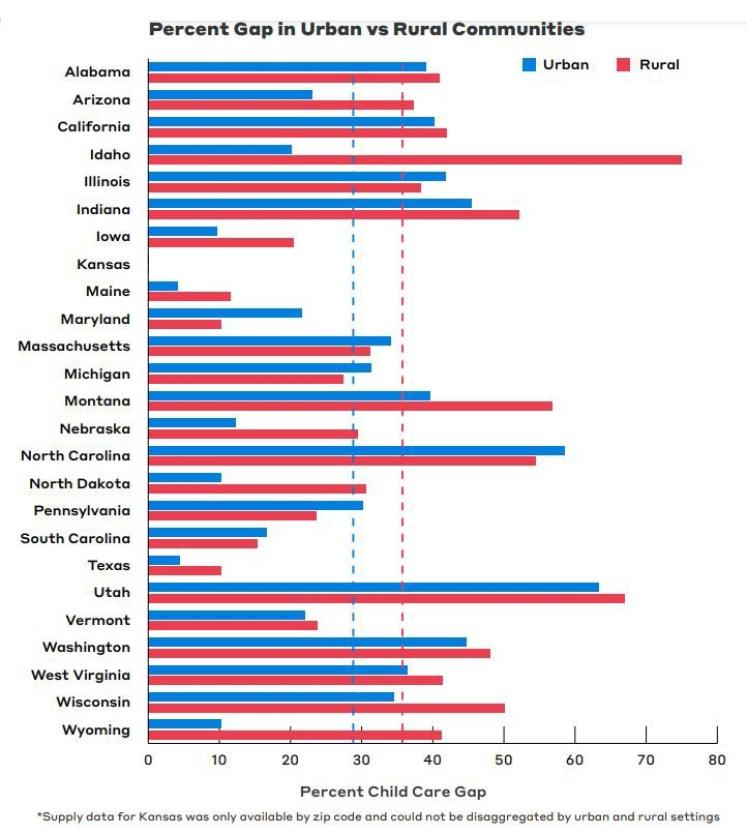
For rural families, there is a 35% gap between childcare supply and potential need, compared to a 29% gap in urban areas.
Unmet childcare needs could be as much as 20% higher in rural communities than in urban ones, a study conducted just before the start of the pandemic shows.
Researchers at the Bipartisan Policy Center calculated the number of childcare slots available locally and compared it to the number of children who likely needed such care because their parents were in the workforce. They found that the "childcare gap" in rural areas exceeded supply by 35%, compared to 29% in metropolitan areas.
|
|
Save the date for the Release of the Annual Disability Statistics Compendium
When: February 9 - 12, 2021
12:00 p.m. to 1:15 p.m. EST each day
This annual event shares the research and ongoing work of the Rehabilitation Research and Training Center on Disability Statistics and Demographics (StatsRRTC), which is part of the Institute on Disability at the University of New Hampshire.
RTC:Rural contributed updated rural data to the compendium, including statistics on poverty, income, employment, age, race, disability type, and insurance coverage.
|
Upcoming Events
|
Tuesday, February 2, 2021
Learn about loan repayment assistance for nurses specializing in women's health.
Time: 2:00 pm thru 3:00 pm
|
Tuesday, February 2, 2021
Medicaid Managed Care Organization (MCO) Learning Hub - Webinar on MCO Investments in Affordable Housing
Time: 2:00 pm thru 3:00 pm
|
Wednesday, February 3, 2021
NC Rural Coalition Fighting COVID- 19
Time: 9:00 am thru 10:30 am
|
Wednesday, February 3, 2021
Addressing COVID-19 Vaccine Hesitancy
Time: 1:00 pm thru 2:15 pm
|
Wednesday, February 3, 2021
COVID-19 and the Legacy of Racism: Vaccine Hesitancy and Treatment Bias
Time: 3:00 pm thru 4:00 pm
|
Thursday, February 4, 2021
Joint NC DMHDDSAS and DHB COVID 19 Update for NC Providers
Time: 3:00 pm thru 4:00 pm
|
Thursday, February 4, 2021
Medicaid Managed Care Fireside Chat Series: Value-Based Payment/Advanced Payment Models & Quality
Time: 5:30 pm thru 6:30 pm
|
Friday, February 5, 2021
Benchmarks' Friday Membership Webinar
Dave Richard Joins Karen McLeod
Time: 8:30 am thru 9:30 am
|
Friday, February 5, 2021
SESSION 4: What's Next? A Roadmap for Telehealth Policy Beyond the Pandemic
Time: 2:00 pm thru 3:30 pm
|
Wednesday, February 10 AND 12, 2021
Virtual Training: 2- Day Person-Centered Thinking
Time: 9:00 am thru 4:00 pm (both days)
Cost is $50.00 per person
|
Thursday, February 11, 2021
Benchmarks' Membership Child Welfare Webinar
Lisa Cauley Joins Karen McLeod
Time: 8:00 am thru 9:00 am
|
Thursday, February 11, 2021
IER Webinar for Refugee and Asylee Service Providers Refugees' and Asylees' Right to Work
Time: 12:00 pm thru 1:00 pm
|
Thursday, February 11, 2020
Save The Date: A State-Wide Convening on the Direct Care Workforce
Time: 9:00 am thru 12:00 pm
|
Thursday, February 11, 2021
Time: 10:00 am thru 12:00 pm
|
Thursday, February 11, 2021
What Does a Person-Centered System Look Like?
Time: 2:30 pm thru 4:00 pm
|
Friday, February 12, 2020
Save The Date: A State-Wide Convening on the Direct Care Workforce
Time: 9:00 am thru 12:00 pm
|
Wednesday, February 17, 2021
IER Webinar for Refugee and Asylee Service Providers Refugees' and Asylees' Right to Work (Identical to the webinar on 2/11/21)
Time: 2:00 pm thru 3:00 pm
|
Thursday, February 18, 2021
Clinical Quality Webinar Series-TBD
Time: 5:30 pm thru 6:30 pm
|
Friday, February 19, 2021
Benchmarks' Friday Membership Webinar
Time: 8:30 am thru 9:30 am
|
Tuesday and Wednesday, March 2 & 3, 2020
|
Thursday, March 4, 2021
Medicaid Managed Care Fireside Chat Series: Policy Approvals, Process Changes and Appeals
Time: 5:30 pm thru 6:30 pm
|
New: Friday, March 26, 2021
NC DHHS Supported Living Level 2 &3
STAKEHOLDERS MEETING
Time: 2:30 pm thru 4:30 pm
|
Please click on each of the following links to view details sent out from each LME/MCO.
Benchmarks' wants to be sure to make the following list handy for our members to visit and suggests a peek at least once per week to find information that may be pertinent to your agency and contracts.
|
|
|
|
|
|