Gratitude for Unexpected Grace |
|
In a normal election year, this day before Thanksgiving might involve a flight or drive to visit family; and if your family is like most, you’d be feeling both excited to reconnect with loved ones and a little apprehensive about what will happen when someone inevitably brings up politics. If you’re fortunate, such conversations, rather than ruining the meal, would serve as a needed reminder that disagreement is not incompatible with love—debate and demonization need not go hand in hand. Given the pandemic, that potentially reassuring experience is unlikely to happen this year for many of us.
For this reason, I was grateful for a small but significant gesture made by a friend about a week after the election—someone who voted differently than I did.
|
|
Preparing for Advent: a Conversation with Tami Cinquemani and Richard Hickam from Whole Life Church |
|
Best Practices for Adventist Worship (BP): Adventist congregations don’t usually follow the liturgical year, apart from possibly Easter. But for churches who are interested in a more seasonal, thematically structured approach to worship planning, Advent is a great place to start. How does Whole Life Church organize worship around the themes of Jesus’ First Advent?
Tami Cinquemani and Richard Hickam (TCRH): The primary traditional liturgical practice that we have adopted is the lighting of Advent candles on the Sabbaths that lead to Christmas.
The liturgical year has a lot of benefits—even if it’s considered on a more casual basis. During the holidays when we celebrate Christ’s first Advent, it’s a wonderful reminder that we are celebrating with Christians around the world. Though WholeLife Church doesn’t restrict ourselves to the readings and themes of the current year of the structured calendar, it can be a great resource. I think our main intention is to invite our congregation to move beyond much of what the Christmas season has become in a more consumer mindset. A liturgical approach reaches beyond the surface of Advent, considering themes of sacrifice, loss, and lament. It forces us to breathe in the season slowly, considering the full message rather than rushing to the manger.
|
|
What to Do About Virtual Church - A Two-Part Conversation |
|
In these conversations, pastors, tech experts, and worship leaders from around the North American Division discuss the challenges and opportunities of virtual worship ministry. You can watch part 1 here.
|
|
You can watch part 2 here.
|
|
18th Annual Andrews University Music & Worship Conference - February 18–20, 2021 |
|
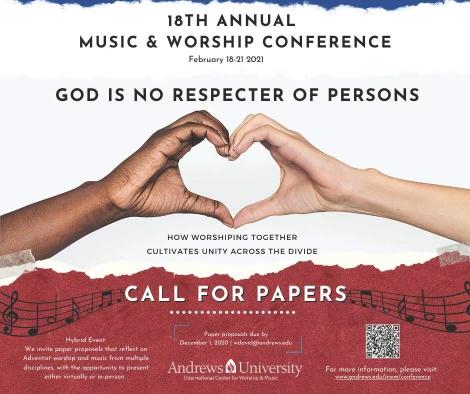
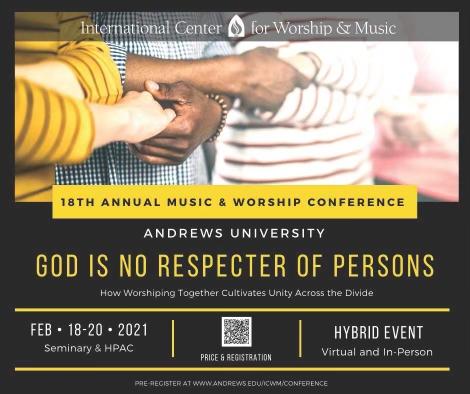
The Conference welcomes scholarship from a diversity of perspectives. At the Conference, presenters and participants interact to learn principles and practices for incarnational worship ministry that glorifies God, transforms worshipers, and changes the world.
Due to COVID-19, the Conference will be a hybrid event. Guest attendees are invited to attend and present virtually. Students, faculty and staff of Andrews University are encouraged to present at the Conference in-person. Limited seating will be available to students, faculty and staff of Andrews University who wish to attend in person—physical distancing and face masks are required.
Time is running out for the Call for Papers! Both scholars of theory and practice are invited to present their research at the conference.
Proposal must include a 200-word abstract and working title. Please submit paper proposals in MS Word format to David Williams (wdavid@andrdws.edu) no later than December 1, 2020. All presentations must be 15-20 minutes (absolute max) (approx. 2,500 words).
Non-AU presenters must present their papers virtually. These presentations must be pre-recorded, and must be sent no later than February 12. AU presenters should present via livestream from the Chapel where the paper presentations will be features. ALL presenters will engage in panel discussion via Zoom/livestream following the presentations.
General Online: $110 (for all non-AU individuals)
Face-to-face AU Students (credit): $95 (need code)
Remote AU Students (credit): $75 (need code)
Face-to-face AU students (non-credit): $45
Online Student (non-credit): $25
Faculty, presenters & guests: Free (need code)
Registrations
Schedule
For conference schedule, click here.
|
|
God is No Respecter of Persons: How Worshiping Together Cultivates Unity across the Divide |
|
“For there is no respect of persons with God” (Rom 2:11, KJV).
Worshiping together is central to Adventist identity (Rev 14:6, Isa 66:23). Adventist application of this theology has varied in our history.
Early Adventists, regardless of race, worshiped together. Millerite Adventists were mobbed for their racially integrated worship gatherings. Their insistence on diversity and inclusion in worship sprung from their theological stance of anti-slavery and the Three Angels’ Messages. This practice and conviction continued through most of the nineteenth century.
In the southern United States, however, racism challenged the normal practice of worship integration. On J. Edson White’s Morning Star steamboat mission to the South, Blacks and Whites sat in segregated sides of the chapel aboard the ship during worship gatherings. In southern churches, Whites prevented Blacks from worshiping with them. Ellen G. White strongly discouraged this practice.
|
|
Becoming REAL: a Conversation with Sandra Montes |
|
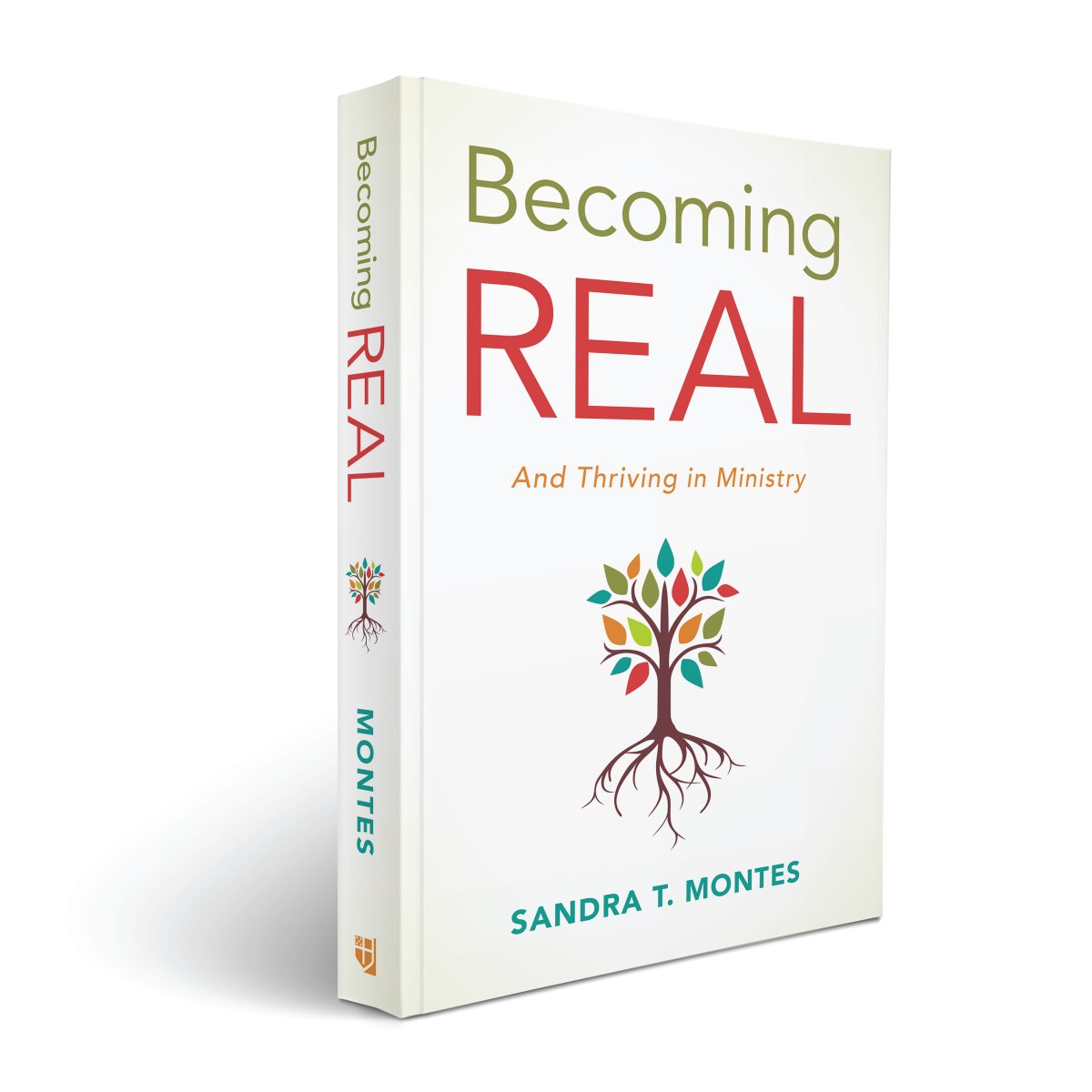
Best Practices for Adventist Worship (BP): In your new book, Becoming REAL: And Thriving in Ministry, you unpack key characteristics of churches who effectively fulfill God’s holistic Gospel mission in their communities. You describe what you refer to as “REAL" ministry—ministry that prioritizes Respectful relationships, Excellence, Authenticity, and Love. What are some ways you have observed or facilitated REAL ministry in the practices of Christian worship?
Sandra Montes (SM): One amazing thing that has happened in my time at Union is that I am able to put this into practice. I have four chapel ministers who help plan worship every week. We were all new to this ministry last year and established community and respectful relationships quickly. Union is a multi-religious seminary and asking students, staff and guests from different religious and cultural backgrounds to lead chapel was super important because we want for chapel to be filled with hope, excellence and authenticity. Because we were all new, it was not instant that everyone trusted us, but we continuously showed we were committed to doing things in love. That love helped us establish more relationships based on respect, and that love also propels us to do things authentically and with excellence. What does that look like? When we have an item—like fabric—that is not clean, we wash it. We keep our candles and other items we use frequently well stocked. We also started having snacks because we know that our chapel hour 12-12:30 is lunch hour and students are super busy. During the pandemic, we started online worship via Zoom and Facebook live. Because we are committed to excellence, we have improved from the first time we went live to now and we continue to talk about what goes right and what can improve.
|
|
O For a Thousand Tongues to Sing: Praising God Mine |
|
After this I looked, and behold, a great multitude that no one could number, from every nation, from all tribes and peoples and languages, standing before the throne and before the Lamb, clothed in white robes, with palm branches in their hands, and crying out with a loud voice, “Salvation belongs to our God who sits on the throne, and to the Lamb!” (Rev. 7:9-10)
The hymn Amazing Grace has been translated into over fifty different languages; however, the truest form of the song can only be felt in its native tongue. Worship in its most refined form is intimate and personal. Worshipping in your own tongue is an experience that can only elevate and intensify the quality of your worship. The worship that you offer in your most intimate self is called a “heart song.”
The purpose of a heart song in worship is to help foster a sense of intimacy with an immanent God, who longs for all to seek Him, who loves all people and languages, and who desires to be worshipped throughout eternity by people from every language and tribe.
|
|
West Coast Worship Collaborative |
|
Damian Chandler (DC): Ministry is already hard, and on the West Coast ministry is just different. It feels like the physical distance between our churches over here has historically made ministry even harder. So COVID-19 came along and magnified a problem that already existed. I did not want to do ministry by myself. Didn't thing think I could. That wasn't working. So I reached out to like minded pastors and asked them what they were feeling and we were all in that same place. Thats how WC2 was birthed.
BP: Is the collective a set group of churches or worship leaders or do you expect it to change over time?
DC: West Coast Worship Collaborative is right now made up of 12 African American churches, none with an attendance of more than 250 people. That range was chosen not only because they make up the larger demographic of Adventist churches, but also because I have found that smaller churches face similar financial resource and volunteer gifting challenges. The collaborative is open to any like minded church or pastor on the West Coast who no longer wants to do ministry alone.
|
|
"The Blessing" - An Adventist Collaboration (feat. Zamar Worship Collective) |
|
Zamar Worship Collective brought together Adventist worship leaders from around the North American Division to record this version of "The Blessing." During this challenging season, may this song encourage you to receive the peace of Jesus.
|
|
Church Streaming Liability |
|
Phyllip Baker from Adventist Risk Management writes, "An online ministry expands the walls of the physical church. Be aware of the many liabilities that could be faced by your church/conference whether your church already has an online ministry, or is considering starting one." Read more
|
|
Copyright 2020 North American Division Corporation of Seventh-day Adventists.
(443) 391-7182
|
|
|
|
|
|
|