Teaching and Leading with IntentionIDEAS WORTH PUTTING INTO PRACTICE |
|||||
Make Thinking Visible—and Build It TogetherMoving beyond simple answers to classrooms where students explain, examine, and build on one another's thinking. |
|||||
The Question Is Just the BeginningA teacher asks a thoughtful question. A student responds. The teacher acknowledges the answer and moves on to the next question. It's a familiar classroom exchange. But what if the student's response became the beginning of a conversation rather than the end? What if classmates were invited to consider the reasoning, offer another perspective, or build on the idea? In our previous issue on Questioning, we explored how purposeful questions can invite students into deeper thinking. But asking a good question is only the beginning. What happens after students respond can be just as important. In The Skillful Teacher, 8th Edition, Making Students' Thinking Visible (MSTV) offers a repertoire of 24 Operating Principles that help teachers create classrooms where students explain their reasoning, listen to one another, and develop understanding together. The goal isn't simply more student talk. It's more purposeful thinking. |
|||||
Why It Matters: Who Is Doing the Thinking?Consider two classroom discussions. In the first, a teacher poses a question, calls on a student, evaluates the response, and moves to another question. Several students participate, but most of the interaction flows through the teacher. In the second, a student offers an explanation. The teacher invites classmates to respond. One student adds an idea, another offers a different perspective, and a third compares the approaches. Both classrooms include student participation. But in the second, students are doing more of the intellectual work. They are listening, reasoning, and examining ideas together. This shift doesn't happen automatically. Students need to learn how to engage with one another's thinking, and teachers need a repertoire of moves that makes those interactions possible. |
|||||
From The Skillful Teacher: Three Moves That Change the ConversationAmong the 24 Operating Principles of MSTV, three focus specifically on encouraging students to interact with one another.
These three principles represent a small part of the larger MSTV repertoire. Together, they illustrate an important shift: students aren't simply expected to contribute their own ideas; they're expected to engage with the thinking of others. |
|||||
|
TRY THIS One Move, One DiscussionDuring an upcoming lesson, listen for a moment when two students offer different explanations, approaches, or perspectives. Rather than immediately evaluating the responses, try Operating Principle #20: Ask Students to Compare Thinking. You might ask:
Then give students time to consider the question and respond. Notice what happens. Do students identify connections? Clarify their reasoning? Recognize something they hadn't considered before? You don't need to change the entire structure of your lesson. Experiment with one intentional move and pay attention to what it makes possible. |
|||||
|
SMALL SHIFTS, BIG IMPACT Who Responds Next?One simple way to examine classroom discourse is to notice who responds after a student shares an idea. Does the teacher immediately evaluate the answer? Or do other students have an opportunity to consider, question, or build on it? The shift isn't simply about increasing student talk. It's about changing the nature of the intellectual work. Over time, students can learn that listening to a classmate's reasoning is just as important as preparing their own response—and that understanding can develop through examining ideas together. |
|||||
|
FOR INSTRUCTIONAL LEADERS Look Beyond ParticipationWhen observing classroom discussions, it's easy to focus on how many students participate or how frequently the teacher asks questions. But the quality of student-to-student interaction can reveal much more. Consider:
A useful coaching question might be: “What opportunities did students have to engage with one another's thinking, and what did you notice as a result?” This keeps the focus on instructional choices and their impact on student learning. |
|||||
A Question to Carry Into Your Next LessonThe next time a student offers an idea, consider: What could I do next to help students—not just me—engage with that thinking? Sometimes the most powerful instructional move isn't asking another question. It's creating an opportunity for students to think with one another. |
|||||
|
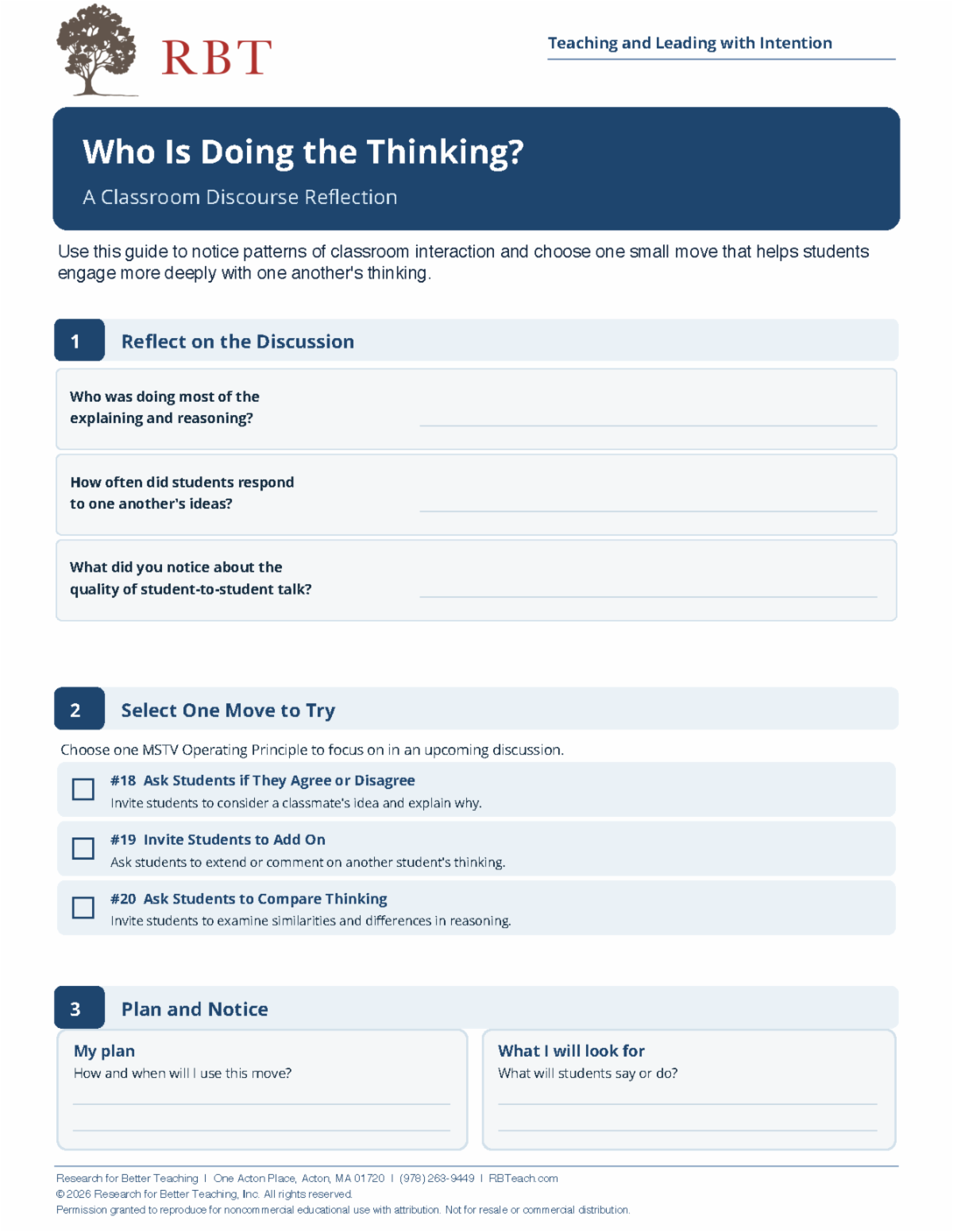
FEATURED RESOURCE Who Is Doing the Thinking? A Classroom Discourse ReflectionSometimes the most useful next step is simply to notice what's happening during a discussion. This one-page reflection guide helps teachers examine patterns of classroom interaction and identify an opportunity for experimentation. Use it to reflect on:
|
|||||
|
DEEPEN YOUR PRACTICE Making Students' Thinking VisibleThree moves. One much larger repertoire. Inviting students to agree or disagree, add on, and compare thinking is just the beginning. RBT's Making Students' Thinking Visible (MSTV) course explores the full repertoire of 24 Operating Principles—and how to use them intentionally to create classrooms where students explain, reason, and build understanding together. Through classroom video examples, guided analysis, and opportunities to apply new skills, educators deepen their capacity to facilitate productive student discourse. The goal isn't to memorize a list of strategies. It's to develop the instructional judgment to select and use the right moves for particular students, content, and learning goals. 
|
|||||
|
UPCOMING OPEN ENROLLMENT PROGRAMS Continue Learning with RBT This WinterRBT's open enrollment programs provide opportunities for individual educators and small groups to deepen their professional practice alongside colleagues from other schools and districts. |
|||||
|
WINTER OPEN ENROLLMENT Studying Skillful TeachingPromoting Motivation, Learning, and Achievement
Class format: Hybrid Instructor: Christina Olansen-Rilli
|
|||||
|
WINTER OPEN ENROLLMENT Analyzing Teaching for Student ResultsStrengthening Observation, Analysis, and Feedback Develop the knowledge and skills to analyze teaching practice, identify evidence of student learning, and engage in meaningful conversations about instructional improvement. Grounded in The Skillful Teacher, ATSR supports instructional leaders in making thoughtful, evidence-informed decisions about teaching and learning.
|
|||||
Share the Learning with ColleaguesFinding Teaching & Leading with Intention useful? Pass it along to a colleague! Invite others to subscribe for practical teaching strategies, research insights, ready-to-use resources, and professional learning opportunities from RBT.
Follow RBT
|
|||||
|
Research for Better Teaching More high-expertise teaching, for more students in more classrooms, more of the time. www.RBTeach.comInspired by The Skillful Teacher, 8th Edition, Chapter 11, Table 11.2: 24 Operating Principles of Making Students' Thinking Visible, pp. 243–247. |