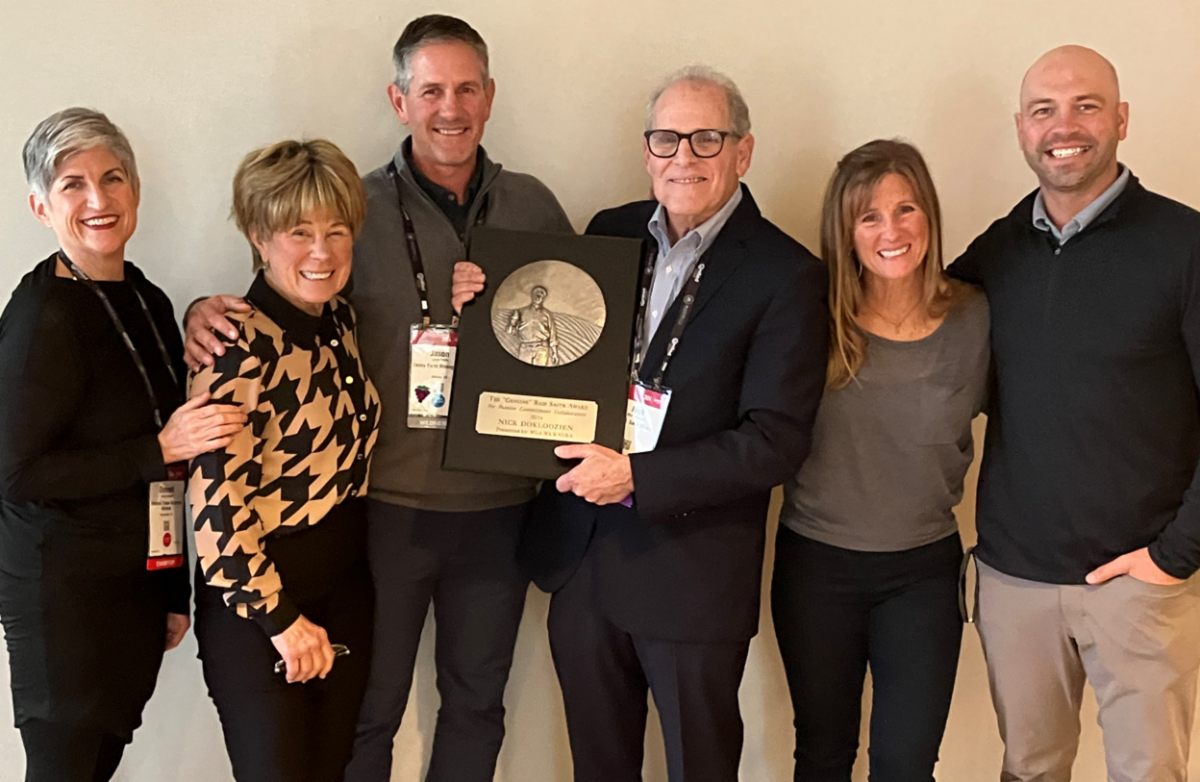
Nick Dokoozlian (third from right) receives the Rich Smith Award; see full story below. | |
CELEBRATING A QUIET MOMENT | |
|
Despite the frigid temperatures in some parts of the country, January came in hot for NGRA. So much happened this month! From the yearly meeting of the scientific and advisory team of a flagship NGRA research project, VitisGen3, and our First-of-Year Board meeting, to our first-ever booth at the Unified Wine & Grape Symposium (booth graphics sponsored by Wonderful Nurseries), the presentation of the Rich Smith Award of Excellence (see photo above and story below), and meetings and dinners in between, NGRA sustained an unprecedented level of activities and initiatives in four and a half rapid-fire weeks.
Through all the busy-ness of the month, one of the quieter moments stands out. At our Annual Meeting of the Members, held in conjunction with our First-of-Year Board meeting on January 22, 2024, we elected (or re-elected) our four officers and seven Board Directors, four of whom are brand-new to our Board:
Officers
All were re-elected for another one-year term.
- Chair: Jessica Youngblood
- Vice Chair: Rich Schaefers
- Secretary: Emily Hodson
- Treasurer: Dan Martinez
Board Directors
These seven Directors were either elected newly or re-elected for a three-year term.
- At-Large Representative: Nick Dokoozlian, E. & J. Gallo Winery (Renewing)
- At-Large Representative: Dan Martinez, Martinez Orchards (Renewing)
- At-Large Representative: Jennifer Montgomery, Arizona Wine Growers Association (Renewing)
- At-Large Representative: Jason Saling, Rodney Strong Wine Estates (New)
- Native/Hybrid Species Representative: Dennis Rak, Double A Vineyards (New)
- Rootstock/Nursery Representative: Dustin Hooper, Sunridge Nurseries (New)
- Vinifera Species Representative: Andrew Zaninovich, Sunview Vineyards (New)
As a routine element of our Annual Meeting, the election takes 10 minutes or less on the agenda each year. But it’s critically important to the work we do.
NGRA has a 30-member-maximum Board of Directors. They and our officers (drawn from the Board) are the lifeblood of our organization. They provide oversight, set strategic direction and ensure that NGRA has the resources we need to carry out our research mission. They serve on and/or chair NGRA committees, act as advisors and collaborators for research projects, and travel to our Board meetings and events all across the country. Whether they’ve served on our Board for decades or are just beginning their first terms, every one of them is helping to advance the sustainability, profitability and competitiveness of the grape and wine industry.
Please join me in thanking all our NGRA leaders for their service—and not just through a frenetic January. I (and the industry at large) am indebted to them for their extraordinary efforts to move the needle on grape research all year long.
| |
Nick Dokoozlian Wins the Rich Smith Award | |
|
Last week, the eighth annual Rich Smith Award of Excellence for outstanding contributions to the American grape and wine industry was presented to Dr. Nick Dokoozlian, Vice President of Winegrowing Research at E. & J. Gallo Winery and Research Chair of NGRA.
The prestigious award reflects the spirit and accomplishments of the late Richard (Rich) Smith, founder of Valley Farm Management and Smith Family Wines in California’s Santa Lucia Highlands wine region. Rich was a successful grape grower and winery owner, and a highly respected colleague known for the passion, commitment and collaboration with which he helped to advance the American grape and wine industry. He passed away in December 2015. This award is presented annually by the Smith Family in collaboration with NGRA, WineAmerica and Winegrape Growers of America—three organizations Rich helped to form—to honor an industry member who reflects and furthers Rich’s legacy.
Nick has been a leader of collaborative efforts locally, nationally and internationally. In addition to his vital role at Gallo, his active participation with many industry organizations and his direct involvement in critical grape research, Nick was instrumental in NGRA’s founding (with Rich) in 2003. He has been our Research Chair since 2017.
“When we talk about Rich and the other Rich Smith Award recipients, I’m reminded that we stand on the shoulders of giants. No one’s shoulders are bigger and broader today than Rich’s,” Nick said as he accepted the award. “I urge all of us to honor Rich’s legacy by moving forward and continuing to do the things Rich did, unselfishly, in dedicated and committed fashion, to advancing our industry.” See video of Nick’s remarks.
| |
USDA Invests in Specialty Crops | |
|
The USDA this month announced two investments designed to strengthen American specialty crops, exports of which, according to the announcement, totaled $24.6 billion in FY2023, or 13.8% of total US agricultural exports.
The newly launched Assisting Specialty Crop Exports initiative will provide $65 million to help increase global exports and expand specialty crops to new markets. And $72.9 million in grant funding made available through the Specialty Crop Block Grant Program will “ensure that specialty crops producers and businesses have the resources they need to remain competitive in markets across the world while improving the sustainability and profitability of their operations,” said USDA Marketing and Regulatory Programs Under Secretary Jenny Lester Moffit.
The Specialty Crop Block Grant Program is administered by USDA’s Agricultural Marketing Service via state departments of agriculture. Check the list of states’ deadlines and apply.
| |
USDA-ARS’ Peter Bretting Retired | |
|
After more than 32 years, Dr. Peter Bretting retired from his post as Senior National Program Leader for Plant Germplasm and Genomes with the USDA-ARS Office of National Programs. He had been with National Programs since 1998, where he oversaw the agency's germplasm collections.
Prior to his retirement last month, Peter architected the USDA’s new National Strategic Germplasm and Cultivar Collection Assessment and Utilization Plan. The 2018 Farm Bill mandated development and implementation of a national plan that “takes into consideration the resources and research necessary to address the significant backlog of characterization and maintenance of existing accessions considered to be critical to preserve the viability of, and public access to, germplasm and cultivars.” The outcomes from the plan will be a boon to plant (and certainly grape) breeders. Thank you to Peter for this tremendous parting gift.
| |
WineAmerica Is Spreading ‘The Magic of Wine’ | |
|
WineAmerica’s Jim Trezise, a longtime NGRA Board member, wrote in a guest editorial in Wine Industry Advisor this month that, “In 2024, the wine industry is facing multiple challenges, including generational shifts in consumption patterns, innovation of the spirits sector, the increasing effects of climate change and ongoing propaganda on the harmful effects of alcohol.
We can’t solve all these problems, but what we can do is collaborate and use our own resources to broadcast the uniqueness, value and magic of wine.”
To that end, WineAmerica has created a new section on its website called “The Magic of Wine,” with freely available content that can be used to highlight the positive aspects of wine and wine culture. Quotes on wine, toasts with which to raise a glass, facts about the roots of wine in agriculture, and more are included. Of course, audiences concerned about climate change and environmental sustainability can consider grape research a “magical” element of the industry, too.
| |
Leadership Changes at UC Davis | |
|
The Department of Viticulture & Enology at UC Davis changed leadership this month. Effective January 1, 2024, Dr. David Block stepped down as Department Chair after 12.5 years and Associate Professor Dr. Ben Montpetit was named Interim Chair.
David Block’s tenure as Chair is second only to that of the late Dr. Albert Winkler, who served as Chair for more than 20 years. David joined the V&E Department in 1996 and holds a joint appointment as a Professor in the UC Davis Department of Chemical Engineering.
Ben Montpetit has served as Vice Chair for two years. He joined the department in 2016 as a yeast microbiologist. As Interim Chair, Ben plans to focus on enhancing the teaching and classroom experience, and expanding student research opportunities so that they’re more beneficial and relevant to their future roles.
| |
Global Reference Framework to Compare Sustainability Standards | |
Last November, the Sustainable Wine Roundtable (SWR) launched a new Global Reference Framework to enable transparent benchmarking of wine sustainability standards around the world. “At present there are as many as 70 sustainability standards globally with relevance to the wine industry,” the organization explains. The new Global Reference Framework is intended to “enable a transparent cross-comparison of all of these existing standards. It is the first definitive statement of what ‘sustainable wine’ means.” The SWR will use the Framework to benchmark existing wine sustainability standards by the end of 2024. | |
CDFA to Define ‘Regenerative Ag’ | |
The California Department of Food and Agriculture (CDFA) has established a Regenerative Agriculture Work Group to define “Regenerative Agriculture” for state policies and programs. Using public input and CDFA’s Environmental Farming Act Science Advisory Panel proposed framework, the work group is expected to submit a draft definition in June 2024. | |
WA Research Vineyard Digs in to Soil Health | |
Washington established a dedicated soil health research vineyard last summer at WSU’s Irrigated Agriculture Research and Extension Center in Prosser to evaluate how management practices impact soil health, vine health, and grape and wine quality. The vineyard is one of the state’s six Long-Term Agroecological Research and Extension (LTARE) sites representing its diverse agricultural systems as part of the Washington Soil Health Initiative. It is believed to be the first publicly funded long-term research vineyard specifically designed to study management practices on soil health in the United States. | |
Research Project Seeks Industry Input | |
The newly funded SCRI-funded research and extension planning project, entitled “Enhancing Regional Grape and Wine Production and Quality,” is seeking input from all grape and wine industry members nationwide on challenges in viticulture, enology and winery business management. Survey results will be used to assist the research team in providing the industry with new extension and outreach resources and information. Participate in the survey. | |
Job Opportunities in Grape Research | |
|
Lead Grape Research in New Zealand
Bragato Research Institute (BRI) drives New Zealand’s grape and wine research, innovation, and knowledge transfer, ensuring New Zealand remains renowned as a world class industry leader. BRI is now seeking an innovative-thinking, business-skilled Chief Executive Officer to lead the organization through the next phase of its evolution. Learn more and apply by February 19, 2024.
Teach Vit & Enology in Sacramento
Los Rios Community College in Sacramento, CA, seeks a full-time Viticulture Assistant Professor. Conduct engaging lectures, laboratory sessions, and workshops to educate students on grape cultivation, fermentation and wine-making techniques, and wine analysis. Provide hands-on training on vineyard management and harvest. Mentor and advise students on internships and career opportunities within the wine industry. Learn more and apply by February 19, 2024.
Work on Plant Sensing and Decision Support in WA
The USDA-ARS Horticultural Crops Production and Genetic Improvement Research Unit based in Corvallis, OR, with a worksite in Prosser, WA, seeks a Research Biologist (Plants)/Research Agronomist/Agricultural Engineer. The successful candidate will be based in Prosser and lead research in plant sensing and modeling approaches to enhance decision support systems and automated processes for viticulture to improve vineyard management efficiency and reduce labor. Learn more and apply by February 21, 2024.
Snag a Postdoctoral Fellowship at GGRU
The USDA-ARS Grape Genetics Research Unit (GGRU) in Geneva, NY, has an available opportunity for a Postdoctoral Fellowship in Breeding and Genetics of Grapevines, part of a project aimed at the development of grape germplasm with stacked disease resistance alleles. It offers a unique opportunity to conduct research to help develop grapevine scion and rootstock germplasm for breeding programs serving US grape industry needs. Learn more and apply by April 26, 2024.
| |
|
WHERE’S THE MONEY FOR GRAPE RESEARCH?
by Kerana Todorov, Wine Business Monthly
Exactly how much money is available for research in viticulture and winemaking? And where does it come from? The answers aren’t as simple as you might expect.
According to the USDA, the amount of money spent on winegrape-related research by federal, state and other agencies amounted to about $20 million in 2019—the most recent year for which these statistics are available. Adding in table and raisin grapes brings the total to about $40 million. These numbers include research funding for USDA’s Agricultural Research Service (ARS) as well as research grants received by land-grant universities and other institutions. The data was sourced from the USDA’s National Institute for Food and Agriculture (NIFA) and its Research, Education & Economics Information System. The USDA is, itself, the main source of agricultural research funding in the United States.
Public Funding for Ag Research
Much of the money the wine industry has received for research comes from the Farm Bill, which includes the important (and highly competitive) SCRI program and is up for re-authorization in 2024. Scientists and others have asked for increased funding for research—which is just one of the 12 sections (called “titles”) of the Farm Bill. Broadly speaking, groups that lobby on behalf of specialty crops like grapes have lobbied for increasing funding for SCRI, particularly for research on mechanization and automation, and pests and diseases.
As the United States has fallen behind other countries such as China in terms of funding for agriculture research, more public money is needed, according to USDA’s Economic Research Service (ERS) and testimonies provided in Washington, DC. One ERS study, published in 2022, shows that public research and development funds about two-thirds of all US agricultural research projects. However, public investments in research and development projects have declined by about one-third since their peak in 2002. About 70% of US public agricultural research is done by scientists at land-grant universities, according to the report. The rest is conducted at USDA agencies.
Smoke Exposure Research Is a Priority
In 2020, wildfire losses cost the wine industry about $3.7 billion. It was a wake-up call that helped win federal funding for wildfire smoke exposure research. As of Summer 2023, Congress had appropriated $5 million a year for smoke taint research. So far, $15 million has been invested, reported Tim Rinehart, USDA-ARS crop production and protection national program leader for specialty crops, including grapes, in a June webinar organized by the West Coast Smoke Exposure Task Force. Wildfire smoke exposure was a topic the agency had not addressed, he said. Now, ARS’ top smoke-related research priorities include the foundational chemistry to understand risk assessment and thresholds and the development of new smoke mitigation technologies, Tim said.
And Congress is now considering new funding on top of the money that’s already been approved. A proposed federal bill, the Smoke Exposure Research Act of 2023, would set aside $32.5 million over five years for smoke exposure research. The bill, introduced last summer, would fund research on compounds responsible for smoke taint, establish sampling and testing standards and screening tools, and develop mitigation measures.
Another proposal, HR 4308, otherwise known as The Smoke Exposure Crop Insurance Act, would order the USDA and the Federal Crop Insurance Corporation to research and develop better policies to insure growers and wineries against smoke exposure. In California, the proposed Assembly Bill 54 calls for the California Department of Food and Agriculture to set aside $5 million for smoke exposure research.
But research on this critical issue isn’t on hold as these bills make their way through government channels. A team of researchers from Oregon State University, Washington State University and UC Davis received a $7.6 million Specialty Crop Research Initiative (SCRI) grant from the USDA-NIFA in 2021. The project stemmed from a $50,000 SCRI planning grant the team was awarded in 2019.
Other Sources of Support
Other national, state and regional organizations that support grape research include the National Grape Research Alliance (NGRA) and NGRA member organizations such as the American Vineyard Foundation, Washington State Wine Commission, New York Wine and Grape Foundation, and Lodi Winegrape Commission. Each has different models and levels of funding. Grape research is ongoing at land-grant institutions across the country.
This article was adapted from the original, titled “Research Funding: An Update on the Amount of Money Available for Viticulture, Winemaking and Smoke Taint Research,” published online on January 2, 2024, on the Wine Business Monthly website. Read the complete text in the January 2024 print edition, starting on page 72.
| |
|
The SCBGP is accepting proposals via state departments of agriculture. Deadlines are as soon as February 1, 2024 (Idaho, Nevada and Washington). Check the list of states’ deadlines.
The USDA-NIFA CPPM program addresses high-priority issues related to pests and their management using integrated pest management (IPM) approaches at the state, regional and national levels. CPPM also addresses IPM challenges for emerging issues and existing priority pest concerns that can be addressed more effectively with new and emerging technologies. Deadline is February 15, 2024.
FFAR Fellows
This graduate fellowship, offered by the Foundation for Food and Agriculture Research (FFAR), offers leadership and professional development training to PhD students studying food and agriculture-related sciences in the US and Canada. Applications for the 2024-2027 cohort are now open; deadlines are February 22, 2024, for the Stipend + Professional Development category and April 15, 2024, for the Professional Development category.
| |
Other Research-Related Opportunities | |
|
ASEV Seeks a Technical Program Director
The American Society for Enology and Viticulture (ASEV) seeks candidates for its Technical Program Director (TPD), a Board position. The TPD is a volunteer who serves a three-year term guiding ASEV’s Technical Program Committee in developing symposia, workshops, seminars, sessions for its national conference, webinars and more. This position shapes and delivers technical content impacting many sectors of the wine and grape industry, including winemakers, viticulturists, university researchers, students and other professionals. Candidates must have a strong interest in fostering a technical program platform that disseminates both fundamental and applied research. Learn more and apply by May 1, 2024.
Abstracts Due for ASEV National Conference
Are you interested in presenting your research at the ASEV National Conference, June 17-20, 2024, in Portland, OR? Submit your abstract by February 15, 2024. ASEV welcomes talks on original research and research updates in all areas of enology, viticulture and related sciences. See the abstract guidelines, including areas of special interest for submissions.
ASEV-Eastern Section Seeks Abstracts, Too
The American Society for Enology and Viticulture-Eastern Section is accepting abstracts for presentations and posters for its annual conference, to be held in Cleveland, OH, July 9-11, 2024. See the complete call for abstracts and apply by March 15, 2024.
| |
|
Applying for a grant? Request a letter of support!
NGRA is pleased to provide letters of support for research projects that directly address our industry research priorities. Request a letter via our online request form at least two weeks prior to the grant deadline (or any internal deadline you may have). Requests are reviewed and approved by NGRA Research Committee leadership, so processing times may vary.
| |
|
High Resolution Data from Space Helps Farmers Plan for Climate Change
January 18, 2024 | Sustainable Winegrowing with Vineyard Team
Joshua Fisher from Chapman University studies “ecosystem science,” a combination of biology, chemistry and physics. As the science lead at Hydrosat, where he launches thermal technology into space to monitor heat signals from plants (and other things like wildfires), he uses this approach to model and predict crop yield, water stress and disease progression. He also applies his freely available high-resolution data from space to help farmers plan for climate change.
How Simple Foliar Sprays in the Vineyard Can Boost White Wine Flavor
January 16, 2024 | AWRI Decanted
Researchers at the Australian Wine Research Institute found that applying a simple foliar spray of urea and sulfur late in the growing season could impact flavor. A several-season study showed that the concentrations of two wine flavor compounds—3-SH (grapefruit aroma) and 3-SHA (passionfruit aroma)—could be boosted with the sprays, which also contributed to increased YAN (yeast-assimilable nitrogen) in fruit.
Ice Wine Season: Frigid Temps Create Ideal Conditions for Northeast Ohio Winegrowers
January 15, 2024 | ABC News 5 Cleveland
Ohio winemakers are taking advantage of frigid temps to make “true ice wine,” made from grapes frozen on the vine. As one vineyard manager explains, “Ice wine (is) produced in the vineyard, rather than in the wine cellar. What ages ice wine is the heating and cooling that happens until we reach that temperature in the teens.” He adds that the fluctuation in temps this winter promises a lot of intensity, complexity and acidity in the finished wine.
Pruning & Training Vinifera for Harsh Winter Survival with Joe Juniper
January 9, 2024 | Vineyard Underground
NGRA Board member Joe Juniper’s Vermillion Valley Vineyards is the second-largest vineyard in Ohio, located near Lake Erie. Tune in as Joe shares his perspectives on successfully growing winegrapes—100% vinifera—under harsh climatic conditions, including temperature and precipitation extremes. Podcast host Fritz Westover calls him a “master of innovative cold pruning practices.”
The Future of Lodi Winegrowing
January 8, 2024 | Lodi Winegrowers Blog
In this look ahead at winegrowing in Lodi, CA, the Lodi Winegrape Commission’s Director of Sustainability Stephanie Bolton, an NGRA Board member, says Lodi “is more of a vineyard region, not a winery region, (as) the primary business of the appellation is to grow and sell grapes to wineries, many based outside the region itself.” She also cites directions in near-term research and innovation, including increased biodiversity, more robots in vineyards, “Goldilocks” deficit irrigation schemes, new climate-adapted grape varieties and more.
Nitrogen Retrieval in Grapevine Leaves by Hyperspectral Sensing
January 5, 2024 | Remote Sensing of Environment
Remote sensing has not been widely adopted for nitrogen management in vineyards because of the variability in spectral patterns in canopy images. But, research conducted as part of the NGRA-initiated HiRes Vineyard Nutrition project helps to correct the problem. The UC Davis team found that using the PROSPECT radiative transfer model in combination with hyperspectral sensing can accurately and consistently determine nitrogen levels in grape leaves—a breakthrough in monitoring and managing nitrogen.
Spraying Goodbye to Vineyard Chemicals
January 5, 2024 | Wine-Searcher
Winegrape growers around the world are going beyond organic-approved copper and sulfur-based sprays to find natural alternatives to vineyard chemicals. They say garlic and orange oil, seaweed, kelp and even skim milk can help combat disease, defend against crop competitors and fertilize vines.
Pierce’s Disease Devastates Vines. Are These New Hybrids the Answer?
January 4, 2024 | Wine Enthusiast
University scientists and grape growers from Alabama to California, Florida to Texas are finding success with the five Pierce’s disease-resistant “Walker varieties” (developed by UC Davis’ Andy Walker). The three reds and two whites, all with high percentages of vinifera in their backgrounds, also have been found to exhibit resistance to powdery mildew and have good wine quality. Field studies continue in some regions, but Texas A&M AgriLife Extension’s Jim Kamas says the vines herald “the dawn of a new age.”
Breakthrough Glove Swab Sampling Method for Powdery Mildew
January 2024 | Wine Business Monthly
University of Georgia Extension Viticulturist Sarah Lowder has developed a breakthrough method for the early detection of powdery mildew. It involves simply swabbing gloves worn by vineyard workers during routine vineyard tasks and sending a swab sample tube to a lab. The analysis can determine not only whether powdery mildew is present but also whether the strain is resistant to FRAC Group 11 fungicides. It removes the need for expert walk-throughs, spore traps and separate fungicide resistance sampling and testing.
Explaining Yield Dynamics During Vineyard Conversion to Organic Farming
December 30, 2023 | European Journal of Agronomy
What changes does a vineyard undergo as it’s converted from conventional to organic management? Two INRAE scientists followed 48 vineyards in France through the change, finding that a transitional period ensues, during which yield declines in years 1 and 2. Pest and disease control and soil management are key to a successful conversion, they say.
Nature-Based Strategies to Regenerate the Functioning and Biodiversity of Vineyards
December 28, 2023 | Journal of Sustainable Agriculture and Environment
What do microbial biodiversity and biostimulants, organic soil amendments and foliar fertilization, cover crops and animal integration in vineyard management have in common? They are nature-based strategies that, when used as part of a holistic, circular economy, can regenerate the functioning and health of vineyards.
Improving Wine Grapes for American Growers and Winemakers
December 27, 2023 | USDA National Institute for Food and Agriculture
In a large-scale, multi-year USDA-NIFA Hatch Multistate Research Fund project, researchers at land-grant universities across the country are developing and evaluating wine grapes, mostly cold-tolerant cultivars, that are better suited for use by US growers and winemakers. The multistate structure enables coordinated, long-term evaluation of grape varieties in different growing environments, helping to avoid duplication of effort and improving communication among researchers. The project has led to expanded wine production in most states, diversified American wines, and improved quality and economic viability for wines from emerging regions.
Grapevine Canopy Management Revisited Part 1
December 25, 2023 | Lodi Growers Blog
In a two-part blog post, viticulturist Stan Grant reminds us that canopy management is a relatively new viticultural practice, introduced in the 1980s. “This revolutionary approach to caring for grapevine foliage addressed specific viticultural concerns and its impact has been profound,” he writes, noting improvements in fruit quality and both vine and vineyard production efficiency. Here, he revisits canopy management practices in pursuit of even greater and more consistent gains.
Integrative Genomics Reveals the Polygenic Basis of Seedlessness in Grapevine
December 23, 2023 | bioRxiv
Ever wonder how table grapes became seedless? Even the grape breeders who developed varieties with this economically important trait weren’t sure. Now, a team of Chinese scientists has answers. Using comparative genomics, population genetics, quantitative genetics, integrative genomics, machine learning and genomic selection, they traced the evolution of seedlessness to its diverse genetic origins. Their findings provide novel, highly predictive candidate genes for grape breeding.
The AI Sommelier: AI Has Revolutionized the Wine Industry…
December 21, 2023 | Forbes
AI is being integrated into everything from vineyard management and weather forecasting to fermentation, customer engagement and inventory management. As winemakers balance the tech with the “artisanal nature of wine production” and the industry grapples with questions of access to AI for producers of all sizes, its “role in streamlining operations, enhancing product quality, and improving customer experiences is expected to grow, signaling a new era of innovation.”
Wine Magic: A Toast
December 20, 2023 | Wine Industry Advisor
How do I love thee? Let me count the wines—er, ways. WineAmerica President and NGRA Board member Jim Trezise reminds us how much there is to be grateful for in the grape and wine industry. He notes that vineyards preserve the earth and its open space, our businesses provide jobs and a robust infusion to the US economy, and that advances in new varieties help to expand wine’s reach. But most of all, Jim reminds us that “wine magic” brings people together. “If music is the universal language,” he writes, “wine is the global toast.” (He also includes toasts in 14 languages.)
Freeze-Drying Does Not Affect Bioactive Compound Contents and Antioxidant Activity of Muscadine Fruit
December 14, 2023 | Food and Bioprocess Technology
The peel of muscadine grapes is thick and chewy, and most often spat out. But the peel is loaded with valuable phytochemicals like antioxidants and anthocyanins that, as new research shows, are preserved when frozen. Freeze-drying halved, deseeded, skin-on muscadines creates a crisp product that allows the grapes to be consumed anytime. Noble and other purple varieties pack the most nutritional punch.
Will New Grape Varieties Change the Identity of Classic Wine Regions?
December 7, 2023 | SevenFifty Daily
In 2022, the regulating authority for Spain’s wine industry permitted wines to be made from native grape varieties that had nearly faded from memory. By sanctioning them, it hopes to promote diversity and innovation, and hedge against climate change. Other countries are following suit, not only with native varieties but newly developed hybrids.
Time to Budbreak Is Not Enough: Cold Hardiness Evaluation Is Necessary in Dormancy and Spring Phenology Studies
November 16, 2023 | Annals of Botany
Research from the University of Wisconsin-Madison provides a new way to model budbreak and understand spring phenology. Cold hardiness evaluation, the authors say, is key to clarifying physiological changes during dormancy. Different temperature treatments influence not only budbreak but also cold hardiness. In fact, manipulating temperatures to study increases in hardiness might unintentionally prolong the time to budbreak.
| |
Find these stories and more, published every weekday, on our Facebook and X (Twitter) feeds. You can also find us on LinkedIn. Use #graperesearch to join and grow the conversation! | |
|
February 5-7, 2024
WineVit
Kennewick, WA
February 6, 2024
72nd Annual Lodi Grape Day
Lodi, CA
February 6, 2024
SoilCon: Global Perspectives
Virtual event
February 13, 2024
SoilCon: Irrigated Perennials
Prosser, WA
February 13-14, 2024
Oregon Wine Symposium
Portland, OR
February 13-15, 2024
World Ag Expo
Tulare, CA
February 15-16, 2024
USDA’s Agricultural Outlook Forum
Arlington, VA + virtual option
February 16, 2024
National Academy of Sciences Committee on Grapevine Viruses and Diseases Research Webinar
Grapevine Red Blotch and Leafroll Viruses: Biology, Ecology and Management
Virtual event
February 19-20, 2024
50th-Annual Ohio Grape & Wine Conference
Dublin, OH
February 22-24, 2024
TWGGA Annual Conference & Trade Show
Denton, TX
February 27-29, 2024
Spotted Lanternfly Summit
Harrisburg, PA
February 28-29, 2024
Pennsylvania Wine and Grape Industry Conference
State College, PA
February 29, 2024
WSU Stop the Spread Webinar
Grapevine Leafroll Disease Management: Obstacles and Opportunities
Virtual event
March 5, 2024
UC Davis Viticulture & Enology Office Hours
Information about Spotted Lanternfly
Virtual event
March 5-6, 2024
B.E.V. NY
Syracuse, NY
March 12-14, 2024
Eastern Winery Exposition
Syracuse, NY
March 20, 2024
Eastern Viticulture and Enology Forum Webinar
Addressing Climate Change Challenges through Vineyard Management Strategies
Virtual event
| | | | |