|
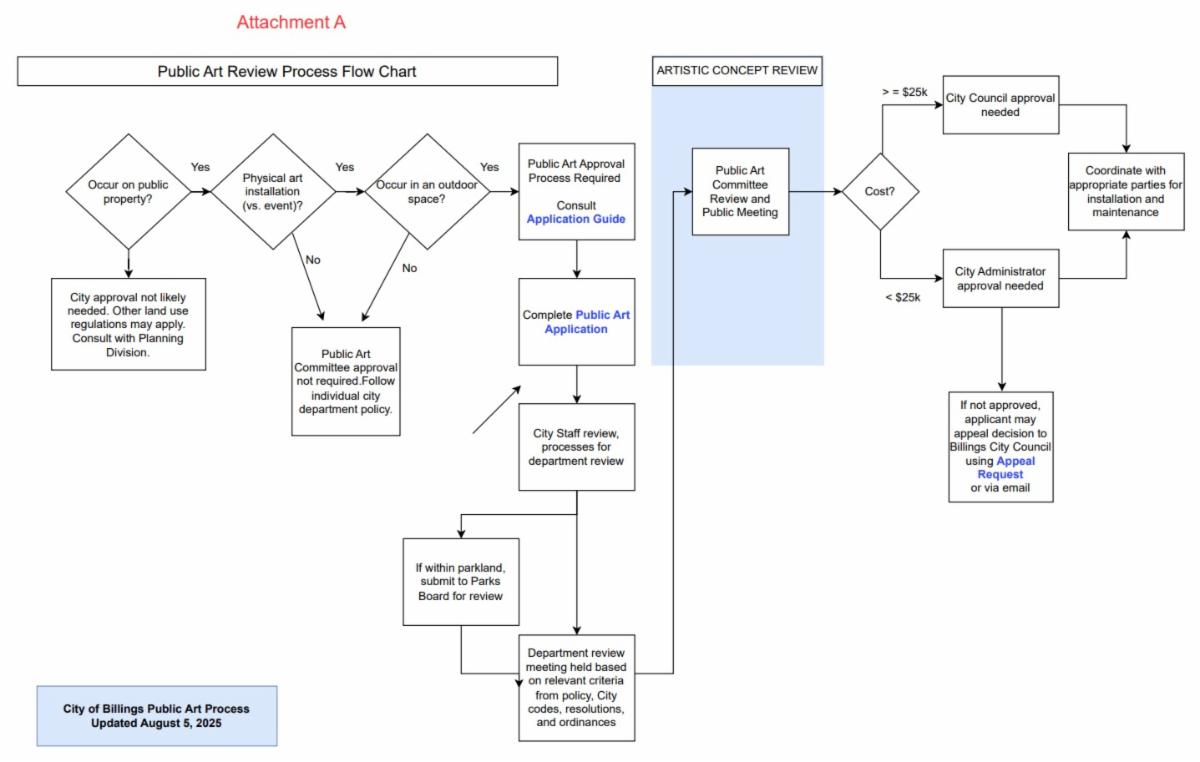
(click to view, pg. 9 of policy packet)
Step 1: Pre-Application - Contact Tate Johnson (johnsont@billingsmt.gov) at the Planning Division for guidance. Complete 3+ community engagement activities (public meetings, social media feedback, neighborhood outreach).
Step 2: Application Submission - Submit completed application with design concepts (3-10 digital images), maintenance plan, and funding details by 4th Wednesday of month prior to desired review. Include signed waiver from artist.
Step 3: Departmental Review - City staff schedules review meeting within 30 days addressing permits, safety, and code compliance. Parks Board review required for parkland installations.
Step 4: Committee Presentation - Present to Public Art Committee at monthly meeting (4th Wednesday). Public comment period included (3-minute limit).
Step 5: Final Approval - Committee forwards recommendation to City Administrator (<$25K projects) or Council (≥$25K projects). Installation coordination follows approval.
The Public Art Committee is made up of:
- One artist at large.
- One representative from the economic or community development field.
- One representative referred by the Billings Arts Association or, alternatively, any other art-related organization designated by the City Council.
- One representative referred by the Native American Development Corporation or, alternatively any other organization representing the interests of Native Americans designated by the City Council.
- One representative from the engineering, architecture, landscape architect, or three-dimensional art field.
- Two members of the public that have an interest in public art.
Estimated Timeline
August 18, 2025: Council work session review
September 2025: Final policy adoption expected
March 2026: Seven-member Public Art Committee operational
April 2026: First applications accepted
- Applications due by 4th Wednesday of month before desired committee review.
Leading up to this meeting Council spent over an hour discussing this policy at their July 7th work session, raising concerns about maintenance funding calculations, appeals criteria, and committee authority. Tonight's draft addresses previous issues.
"I am really concerned and maybe we should hear from Gina on whether or not the council can even delegate their authority to a committee for financial approval of items when all our other committees are advisory committees."
— Councilman Neese during July 7th discussion
Measuring Up
The draft public art policy extends to eight pages of detail and structure. Through Council discussion and identification of the old policy's weaknesses, the new policy comprehensively covers implementation of the public art policy. Time will tell if it's too much, not enough, or a Goldilocks option.
The bottom line
A previously ineffective public art process necessitated a revision to the public art policy, which now appears to provide a well-thought, fair, and comprehensive process for public art determinations. We hope this helps to encourage and produce more public art which can provide CPTED safety benefits for little cost.
But after tonight Council and staff will have spent a significant amount of time and resources on the topic of public art. Hopefully, Council moves this forward for a quick decision, freeing up time to shift focus to other policies that need attention and prioritization like the 2011 Infill Development Policy. A comprehensive revision similar to Yuma, AZ's infill plan, which outlines a suite of infill incentives, could help to address both housing supply needs and property tax revenues, two of the biggest challenges Billings faces.
|