BILLINGS CITY COUNCIL BULLETIN // jul.15.2024 | |
// COUNCIL CANCELED—LET'S TALK ABOUT GROWTH INSTEAD! | |
This 4th of July, the U.S. Chamber of Commerce announced their Growth and Opportunity Imperative, an initiative to unleash America's economic potential and improve the lives of all Americans. The following is from our friends at the U.S. Chamber of Commerce. | |
|
Today, many Americans do not feel like the economy is working for them. They’re feeling the burden of rising prices, homeownership seems increasingly out of reach, and the government is drifting further down the path of unsustainable debt and deficits with no clear plan to correct course.
To create the future we want, and the next generation deserves, we call on candidates and elected officials to pursue policies that will significantly boost America’s growth.
Economic growth is not just a static number on a chart. It is a snapshot into the lives of everyday people—the value of their efforts, their ability to provide for themselves and their families, the belief that their children’s lives will be better than their own. It is the driving force that powers the American Dream, where individual effort can lead to upward mobility regardless of one’s position on the socioeconomic spectrum. Sustained economic growth enhances the overall quality of life for all, increases incomes, expands opportunities, fosters innovation, and strengthens our nation.
The benefits of growth are clear, but the path to renewed growth is too often overlooked. At the U.S. Chamber of Commerce, we believe America needs a growth and opportunity imperative—a national priority, driven by people through innovation and productivity and fostered through sound public policy.
PRESIDENT AND CEO SUZANNE P. CLARK IN USA TODAY: Our ability to substantially improve our lives depends on how quickly the overall economy is growing
Synopsis
Many of the tailwinds that helped sustain rapid economic growth from 1950 to 2010 have dissipated. At the very time we need faster sustained growth to help solve problems, we face a future where growth will be dramatically slower. Going forward, public policy will play a decisive role in ensuring America can continue to grow and prosper, creating more and better opportunities for Americans.
The U.S. Chamber of Commerce is calling on all candidates and elected officials to embrace the Growth and Opportunity Imperative, establishing a goal of at least 3% economic growth annually and prioritizing policies that will support faster-sustained economic growth.
To inform policymakers, the Chamber will release a series of memos outlining the policies that can help support the growth the American people deserve.
What We Mean by Growth
This memo discusses economic growth in terms of the increase in real (inflation-adjusted) gross domestic product (GDP). What this economic statistic really represents is the increase in the quantity and quality of the goods and services that a country produces that improve our quality of life and standard of living.
| |
The Slowdown in Economic Growth
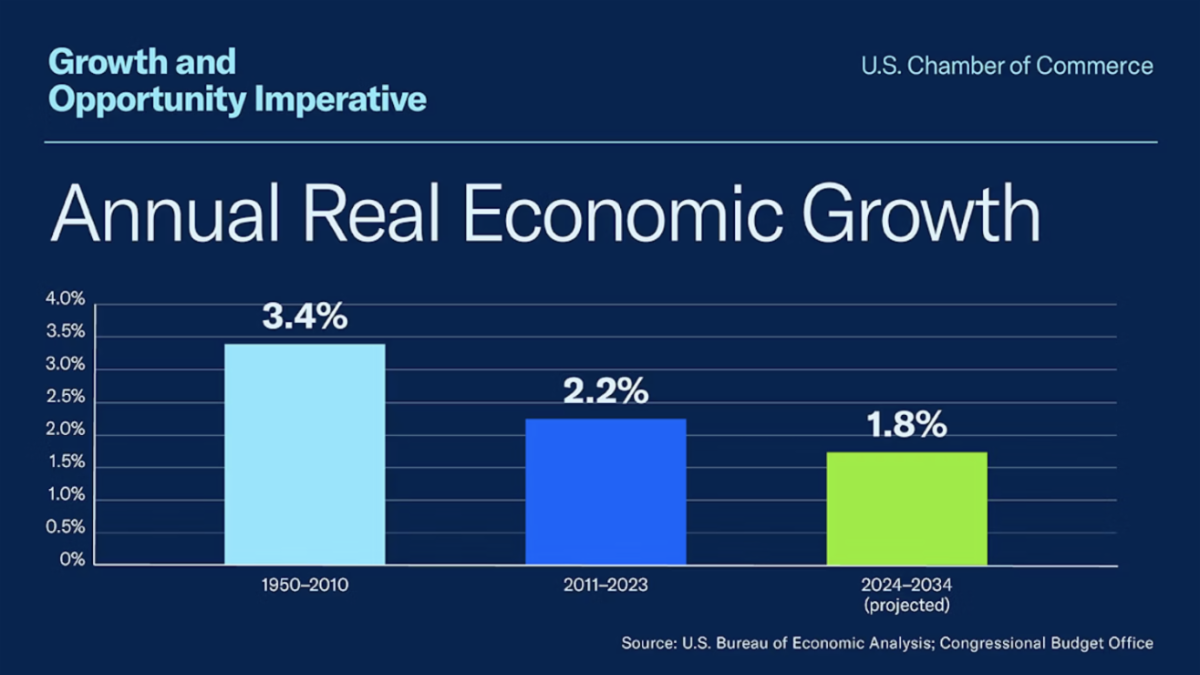
From 1950 to 2010, real economic growth in the United States averaged 3.4% a year, even with recessions.
- As a result, the 2010 economy was seven times larger than the 1950 economy.
- The population of the U.S. also grew during this period, but the economy grew faster. Real per capita GDP was more than three times larger in 2010 than in 1950.
| |
|
Since 2010, growth has averaged just 2.2% a year.
The nonpartisan Congressional Budget Office projects even slower growth, averaging just 1.8% for the next decade.
Much of the slowdown is attributed to the decline in tailwinds, which had supported faster economic growth:
- In the 1950s, in the aftermath of World War II, while the rest of the world was rebuilding, America was able to convert its vast military production into domestic manufacturing production. This burst of economic activity supported rapid growth.
- Since then, our economy has matured into a more service, technology, and innovation-based economy.
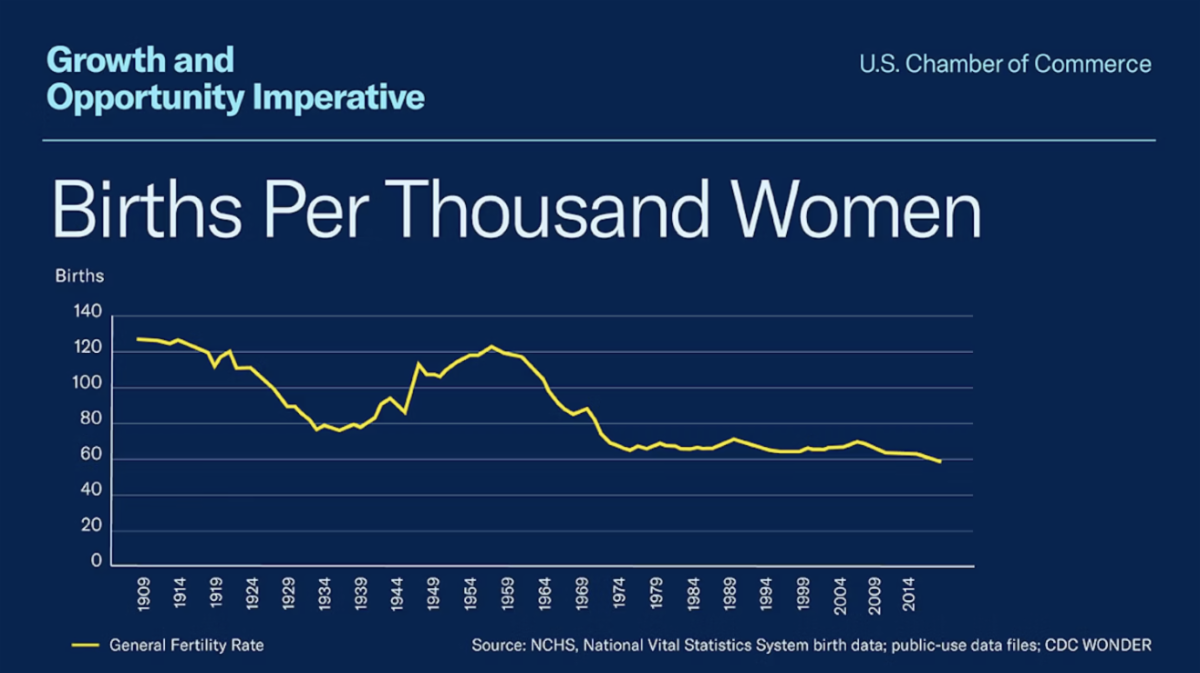
- In the 1960s, the baby boomer generation began entering the workforce and continued to do so through the early 1980s, leading to a rapid expansion of the labor pool.
- With the youngest baby boomers now reaching the age of 60, most of this generation has exited the workforce.
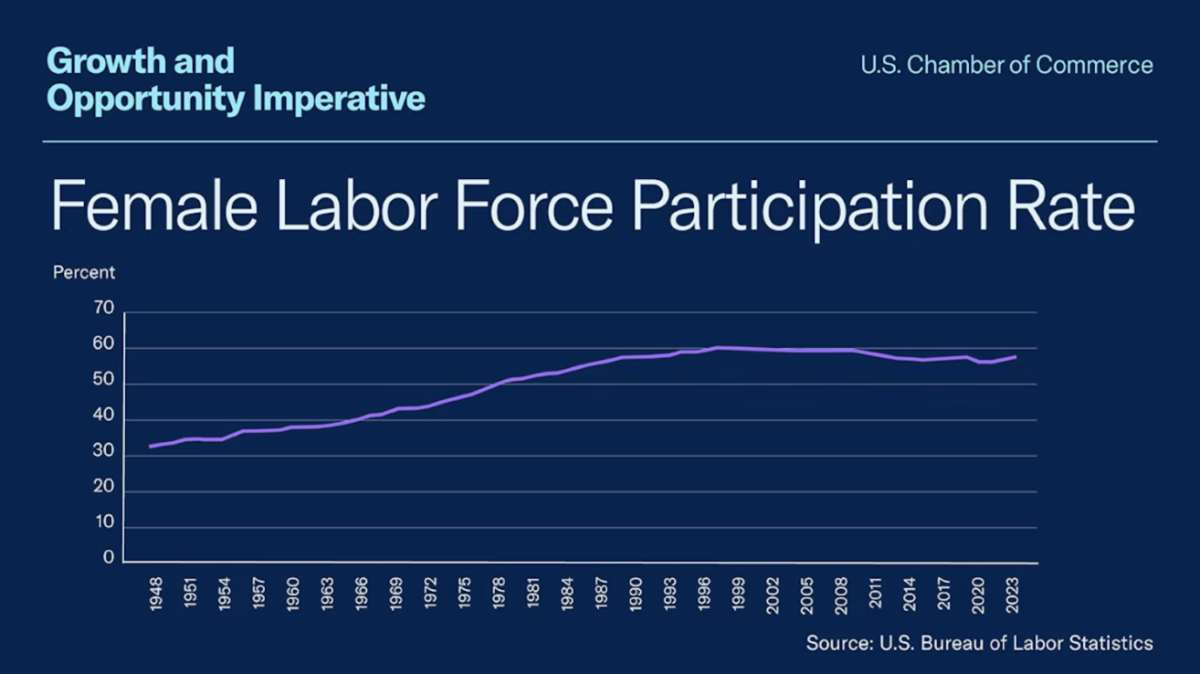
- Beginning in the 1960s and continuing through the 1990s, there was a dramatic increase in the number of women in the workforce, with female labor force participation jumping from 38% in 1960 to 60% in 1999.
- Today, female labor force participation is 57%.
| |
Why Growth Matters
Faster Growth Is Essential to the American Dream
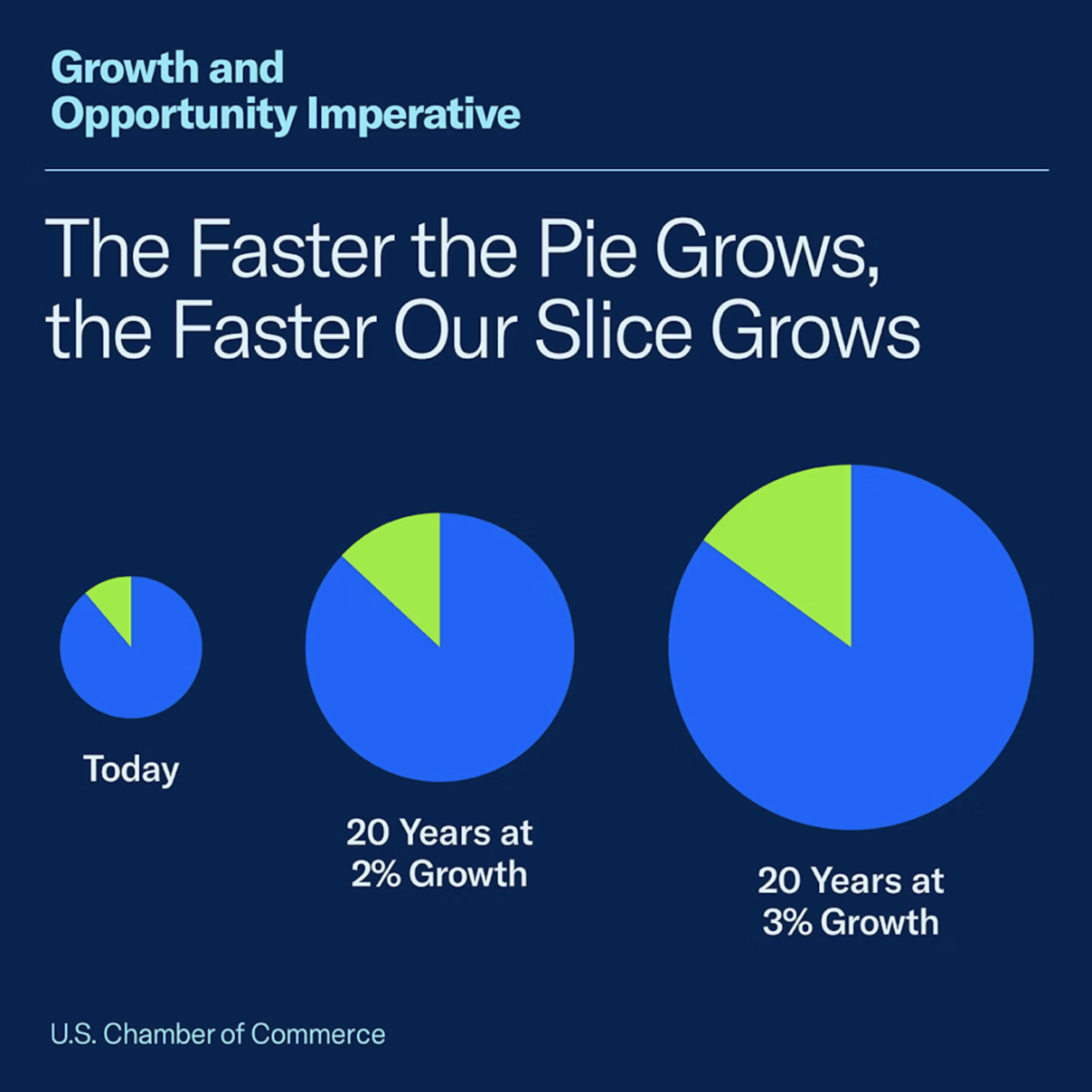
A big part of the American Dream is the idea that our children will be better off than we are, and our grandchildren will be even better off than their parents. Our ability to substantially improve our lives depends, in part, on how quickly the overall economy is growing. It is much easier for our slice of the pie to get bigger when the overall pie is also getting bigger.
Sustained economic growth provides a foundation for broad-based prosperity by expanding opportunities, increasing incomes, fostering innovation, and enhancing the overall quality of life for individuals and families. It is a critical driver in reducing poverty and creating a society where everyone has a chance to thrive.
- When our economy is growing at 3%, someone who is born today will see America’s economy double in size by the time they are in their early 20s.
- At 2% growth, it will take until they are in their mid-30s for the economy to double.
| |
|
Faster Growth Provides Us with More Choices at Lower Prices
Real economic growth not only expands wages and income (enabling us to afford more of the goods and services we need and want) but also boosts production, giving us more choices at lower prices. The result is a higher standard of living. For example:
Shopping for Children’s Shoes
- In 1980, if you wanted to shop from home, say for children’s shoes, that most likely meant the 1,566-page Sears Spring / Summer Catalogue, where you would find about 15 styles of children’s shoes ranging in price from $8.99 to $25.99. At the median weekly earnings of $269 and average hours worked, it would take two hours of work to pay for a $15 pair of shoes.
- On Amazon right now, you can find over 20,000 options with prices as low as $4 and as high as over $200. A $15 pair of shoes today would require less than a half-hour of work at the median wage and average hours worked.
Buying a Cell Phone
- In 1983, the first commercially available handheld cellular phone (the Motorola DynaTAC 8000x) hit the market at $3,995. At a median weekly salary of $316, it would have taken you nearly 13 weeks to buy a cell phone. (Music player, map, address book, calculator, etc., not included.)
- Today, you can buy an iPhone 15 for $799. At today’s median weekly salary, that would require less than a week of work to earn.
Purchasing a New Car
- In 1992, the lowest MSRP for a Toyota Camry was $14,368, and it got 21 miles to the gallon. At the median weekly wage of $443, it would take just over 32 weeks of work to earn enough to pay for the car.
- Today, the lowest MSRP for a 2024 Camry is $26,420, and it gets 32 miles to the gallon. At today’s median wage, it takes just over 23 weeks of work to pay for a new car.
Faster Growth is Essential to Taming Rising Federal Debt
Persistently high deficits and the growing federal debt are rightfully a concern. While fiscal policies are key to stabilizing our growing debt, economic growth will also play a critical role.
Increasing productivity such that we increase economic growth by just a half a percentage point a year, from 2% to 2.5%, would by itself decrease the federal deficit by $1.2 trillion over the next 10 years.
- The opposite is also true: If productivity is less than expected under current economic assumptions and the economy grows at just 1.5% on average, that by itself would increase the deficit by $1.2 trillion.
The Role of Public Policy and a Pro-Growth Goal
When an economy has strong tailwinds, it can grow rapidly despite bad public policy. When those tailwinds disappear, public policy plays a critical role in maximizing opportunities for growth.
To grow America’s economy and create better opportunities for Americans, we need policies that:
- Support a larger and more skilled workforce.
- Support investments in innovation and cutting-edge technology and the private-sector deployment of those innovations to improve productivity.
- Embrace the economy of the future, rather than trying to recreate one of the past, and give the private sector the certainty to plan, invest, and grow.
To properly orient these policies, we need a goal and a test. The U.S. Chamber of Commerce is calling on elected officials and candidates to embrace a goal of at least 3% annual real growth over the next decade—a 50% increase over current projections—and to use that goal as a test against which policies are judged.
A Pro-Growth Agenda
The advantages of achieving growth are evident, yet frequently, the route to revitalizing growth is neglected. Finding a way to increase growth should be the key focus of all policymakers. Through the November elections and beyond, the Chamber will outline policies that will help us reach the goal of 3% annual real economic growth.
| |
// WORK SESSION AGENDA - 5:30 p.m. - BILLINGS CITY HALL | |
|
In this section, we will include the meeting agenda for you to view. Clicking on the items will take you to more information. No need to read it all, but if something catches your eye, be sure to check it out.
MEETING CANCELED DUE TO A LACK OF AGENDA ITEMS
| |
// WATCH THE MEETING ON COMMUNITY 7 TELEVISION | |
// CITY ADMINISTRATOR WEEKLY REPORT | |
|
City Administrator Chris Kukulski began the routine of sending a weekly report every Friday to City Council and department heads with the intent to, "communicate the highlights of the past week and any critical issues coming up." The most recent CA Report includes updates on:
- Code Enforcement successes cleaning up nuisance properties.
- Refunds for incorrectly assessed parking tickets.
- And much more...
| |
// GET MORE INVOLVED IN YOUR COMMUNITY | |
|
Below are some additional public meetings being held this week, along with information about when and where to attend, and what's on the agenda (if one is available).
Tuesday, July 16th
Yellowstone Historic Preservation Board
8:30 - 9:30 am @ Miller Building, 1st Floor Conf Room, 2825 3rd Ave N.
Agenda here.
Westend Neighborhood Task Force
7:00 - 8:00 pm @ Connections Church, 5554 Grand Ave.
Wednesday, July 17th
Rimrock Neighborhoods
7:00 - 8:00 pm @ Mayflower Congregational Church, 2940 Poly Dr.
Thursday, July 18th
Transporation Advisory Committee
10:30 - 11:30 am @ Miller Building, 1st Floor Conf Room, 2825 3rd Ave N.
Agenda here.
Southside Task Force
6:30 - 7:30 pm @ HOPE Center, 425 S. Broadway.
Central Terry Task Force
7:00 - 8:00 pm @ Top Line Hair, 1331 Central Ave.
| | |
|  |
(Your email will be publicly available, similar to those you can read by clicking the button above.) | |
// BOARD & COMMISSION OPENINGS | |
|
"It takes a little time and commitment, but it's incredibly rewarding to give back to our community which has given us so much."
-- Greg McCall, Zoning Commission and Owner, McCall Homes
| |
|
The Mayor's Office is accepting letters of interest to fill the vacancies listed on the city website. For more information on each specific board, visit the city website. City Boards and Commissions are appointed by the Mayor, confirmed by City Council, are advisory only, and members serve without compensation.
Submit applications to: Mayor's Office, PO Box 1178, Billings, MT 59103-1178 NO LATER THAN APRIL 1st .*
| |
|
BOARD OPENING (SEATS)
Human Relations Commission (2)
| |
|
REQUIREMENTS
Must live in Billings
| |
* - this has not been updated on the city website. | |
|
From the City Administrator Report:
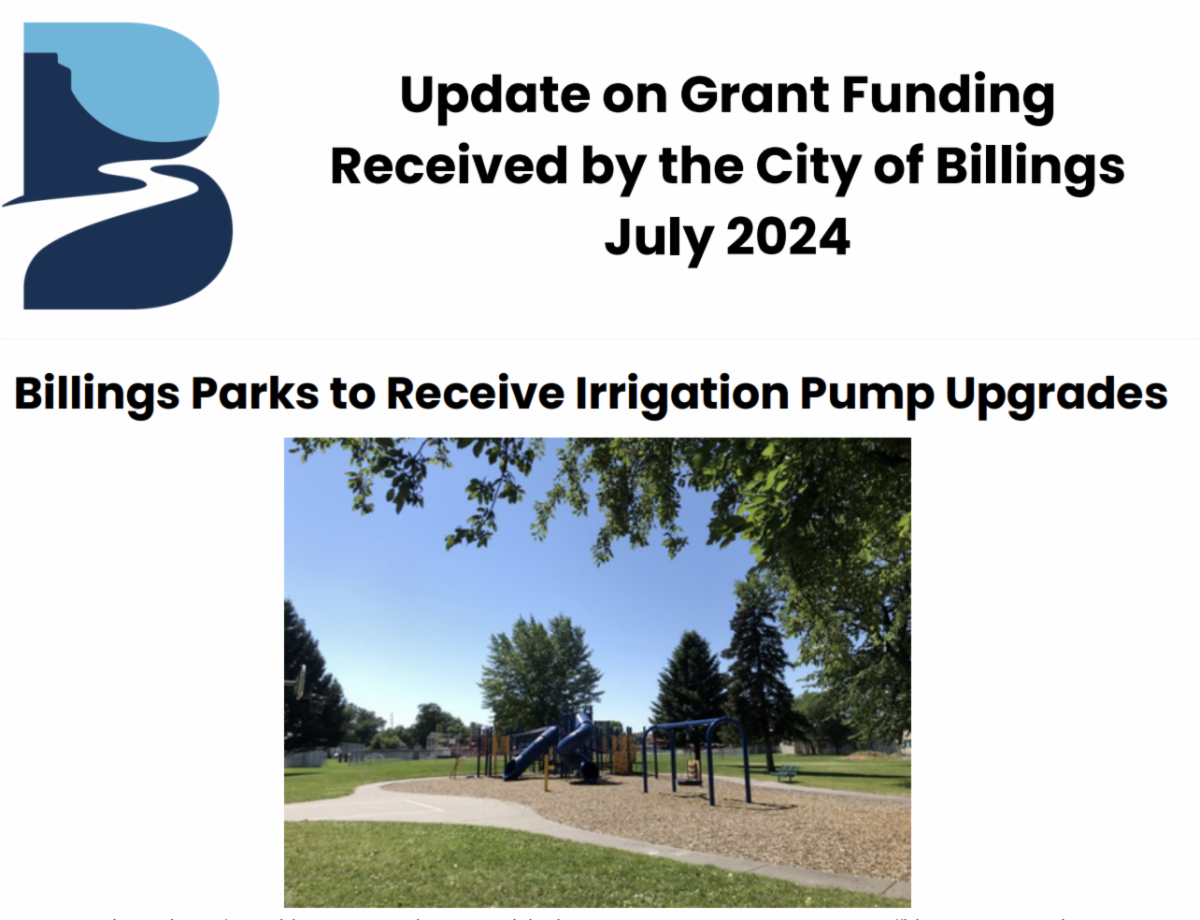
- Three parks will receive replacement irrigation pumps and controllers - Optimist, Central, and South Parks.
- Optimist Park is a 16-acre park located at Morgan Avenue and Hallowell Lane in South Billings. It features ball fields, paved jogging trails, a rec facility, picnic site, playground, basketball court, tree gleaning, restrooms, and more. The project is estimated to cost nearly $47,000.
- Central Park is a 19-acre park located at 8th Street West and Central Avenue just west of downtown. It features ball fields, basketball and tennis courts, horseshoe courts, pickleball court, playground, picnic site, restrooms, and more. The project is estimated to cost over $41,000.
- South Park is a 16-acre park located at 6th Avenue South and South 30th Street in South Billings. It features ball fields, BBQ grills, basketball and horseshoe courts, picnic site and shelter, playground, restroom, a pool, and more. The irrigation project is estimated to cost nearly $50,000.
- The replacement projects will occur later this summer or early fall and should not cause significant disruptions for park users.
- The new pumps and controllers will save an estimated 30% in electricity and 30% in water usage once installed.
| |
// ADDITIONAL BILLINGS CHAMBER RESOURCES | |
// BUSINESS ADVOCACY SPONSORS | |
|
|
|
Please don't hesitate to reach out to the Billings Chamber's Business Advocacy Director, Dan Brooks with questions, comments, or to chat about the City Council.
| | | | |
Billings Chamber of Commerce | Website
| |
| | | |