| | Maryland Stem Cell Research Commission Awards Over $4.8 Million in First FY2027 Funding Cycle | |
COLUMBIA, Md., (September 29, 2026) – The Maryland Stem Cell Research Commission announced over $4.8 million in awards through the Maryland Stem Cell Research Fund (MSCRF) during the first funding cycle of fiscal year 2027, supporting innovative stem cell and regenerative medicine research across Maryland.
This funding supports 15 investigators from Maryland-based research institutions and companies working on diverse medical conditions and diseases ranging from blindness, Huntington disease, Parkinson’s disease, amyotrophic lateral sclerosis, acute myeloid leukemia, cardiomyopathy, cardiac arrhythmias, muscular dystrophy, osteoarthritis, viral infections and other neurological, psychiatric and developmental disorders.
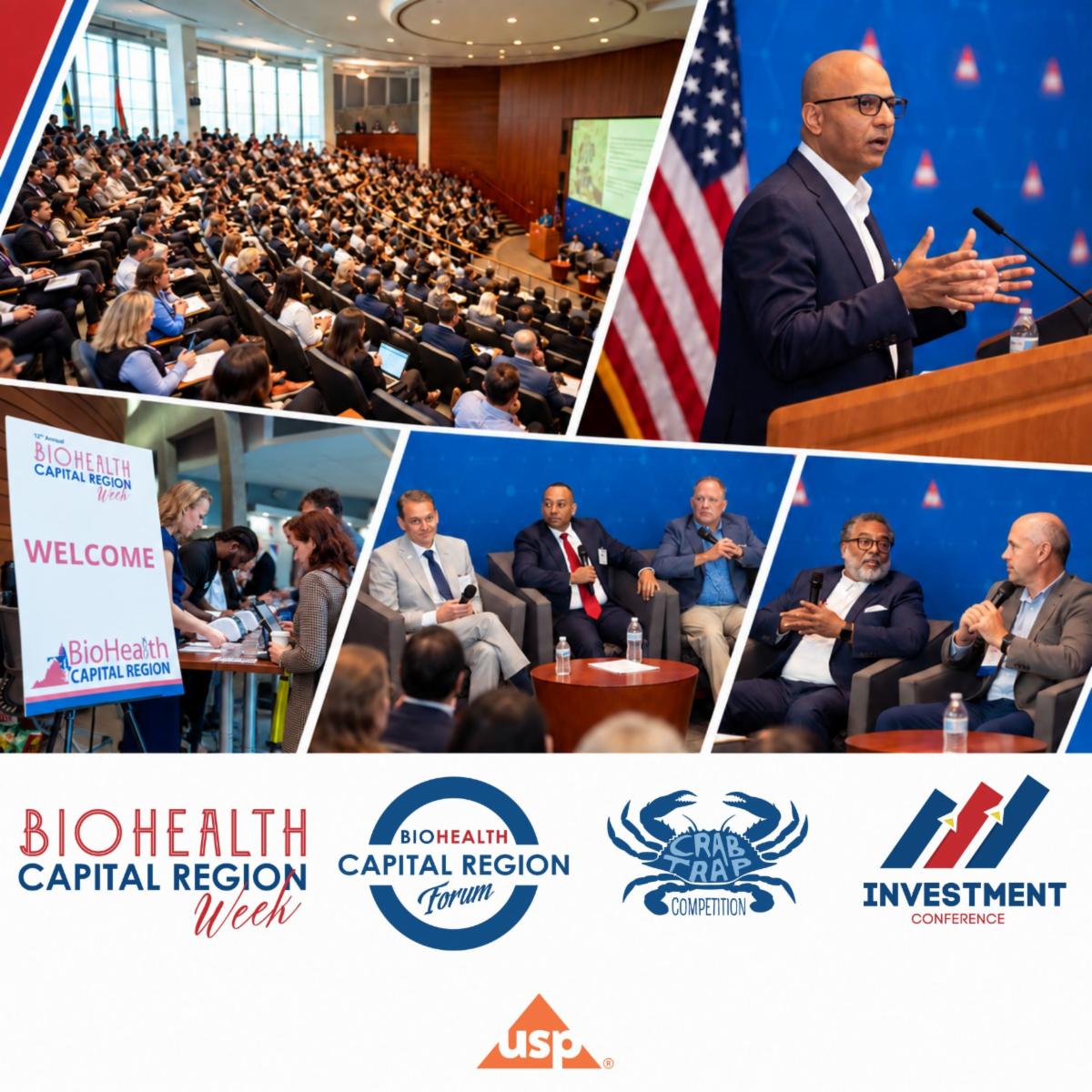
| | 2026 BioHealth Capital Region Week Recap: Growing the BioHealth Capital Region of Tomorrow | |
The 12th Annual BioHealth Capital Region Forum brought leaders from industry, academia, government, investment, research institutions, economic development, and entrepreneurship together on September 15 and 16 at U.S. Pharmacopeia in Rockville, Maryland.
Under the 2026 theme, “Growing the BioHealth Capital Region of Tomorrow,” the two-day Forum focused on the people, technologies, infrastructure, capital and partnerships needed to strengthen the region and support its next stage of growth.
The Forum was part of BioHealth Capital Region Week, which continued September 17 with the BioHealth Capital Region Investment Conference.
2026 BioHealth Capital Region Week by the Numbers
This year’s participation reflected the strength and reach of the regional ecosystem.
Nearly 1,100 people registered for the BioHealth Capital Region Forum, bringing together leaders from across the region and beyond.
The BioHealth Capital Region Investment Conference drew approximately 350 registrants, creating another opportunity for companies, investors and strategic partners to connect.
The Crab Trap Competition received a record 82 applications, highlighting the depth of the emerging company pipeline.
| |  | BHI Seeks a Life Science Business Analyst to Support the NIH SEED Office | |
BioHealth Innovation, Inc. (BHI), Montgomery County's innovation intermediary, is seeking an experienced life science business analyst to support the NIH SEED Office. The analyst will deliver market landscape, technology, and business intelligence research that helps NIH-funded companies advance product development, corporate strategy, and private investment, working alongside SEED's Entrepreneurs-in-Residence on commercialization activities across all therapy areas and modalities.
Day to day, the analyst will run competitive, intellectual property, and product-development landscape analyses of early-stage NIH-funded companies using BHI's commercial data sources, GlobalData and PitchBook, alongside NIH grant data from RePORTER and QVR. Deliverables range from company background packages that support pitch coaching to commercialization-event tracking, emerging-indication trend overviews, clinical-development landscapes, and multi-region market-opportunity analyses, plus ownership of a regularly refreshed portfolio dashboard reporting metrics and outcomes to SEED and BHI leadership. BHI is looking for a bachelor's degree at minimum (master's or PhD preferred) and at least 10 years of experience as a financial, market, or business intelligence analyst in the life science or biomedical industry.
| | | citybiz: Maryland Courts Quantum Investment as Global Congress Spotlights College Park | |
Maryland’s push to turn decades of quantum research into a commercial growth engine drew international attention last week as Quantum World Congress brought researchers, executives, investors and government officials to College Park.
The three-day gathering showcased the state’s expanding roster of quantum companies, its proximity to federal laboratories and opportunities to connect emerging technologies with established cybersecurity and life sciences businesses.
“We’re investing in quantum because we have the assets to win,” Gov. Wes Moore said at the event.
Maryland’s Capital of Quantum initiative includes a $1 billion commitment to strengthen the state’s position in the industry. The broader challenge is translating research expertise into companies, commercial applications and sustained private investment.
College Park offers a model for that transition. IonQ, headquartered there, grew out of research at the University of Maryland and has become a prominent player in quantum computing.
Steve Harris, IonQ’s senior vice president for federal go-to-market and public sector, pointed to the university’s more than 350 researchers working across quantum computing, cryptography, materials, networking, sensing and related fields. That expertise reflects three decades of research, he said.
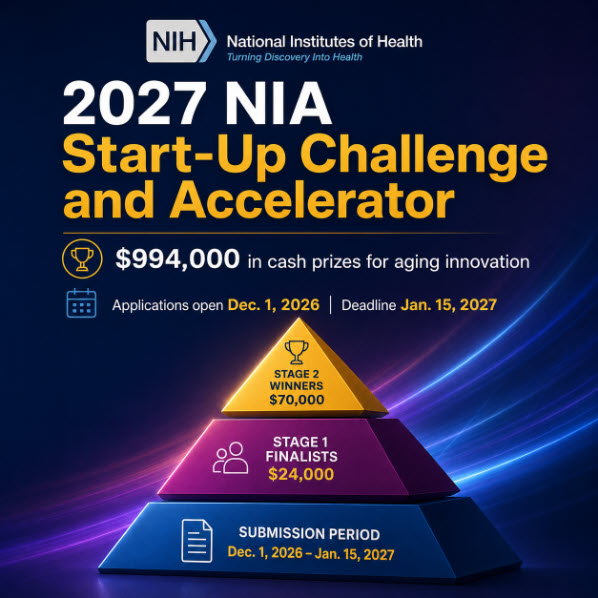
| | | NIA Launches 2027 Start-Up Challenge and Accelerator with $994,000 in Cash Prizes | |
The National Institute on Aging (NIA), part of the National Institutes of Health, has launched the fourth NIA Start-Up Challenge and Accelerator, offering early-stage innovators a combination of funding, entrepreneurial training, mentorship, and networking to help advance new technologies focused on aging and older adults.
The 2027 Challenge will award up to $994,000 in total cash prizes while providing selected entrepreneurs with hands-on support to move research-driven ideas toward commercialization.
The Challenge is seeking innovative tools, technologies, and interventions that address aging-related diseases and conditions, including Alzheimer’s disease and related dementias. NIA is also looking for solutions that promote healthy aging, help older adults age in the place of their choice, improve care delivery, and reduce the burden on caregivers.
The program is designed in particular for individuals and teams that are new to entrepreneurship or are still at an early stage of building a company.
Selected finalists will each receive a $24,000 cash prize and participate in a five-month entrepreneurial accelerator featuring mentorship, education, networking, and business development support.
Participants will also receive guidance on navigating NIH funding opportunities, including NIA’s Small Business Innovation Research and Small Business Technology Transfer programs, commonly known as SBIR and STTR.
| | | TEDCO’s 12th Entrepreneur Expo Returns to Baltimore | October 27, 2026 | |
TEDCO’s 12th Entrepreneur Expo will bring together entrepreneurs, investors, business leaders, universities, and resource partners from across Maryland on October 27, 2026, at the Hilton Baltimore Inner Harbor.
The full-day event will feature workshops, roundtable discussions, keynote conversations, live pitches, networking, and an exhibitor showcase. Sessions will focus on practical topics such as fundraising, investor expectations, startup financials, AI, leadership, and building a business in Maryland.
With more than 1,100 attendees at last year’s Expo, the event has become one of the state’s largest gatherings for the entrepreneurial and innovation community, offering attendees a chance to make new connections, discover resources, and hear directly from founders, investors, and business leaders.
| | | Women Building Bio 2026: A New Evening Format | |
VirginiaBio is reimagining its premier annual conference for 2026. Women Building Bio is moving to an evening format this year, so attendees can keep their daytime schedules intact and still join a few focused hours of insight, networking, and connection. Save the date for Thursday, October 29th at the Sheraton Suites Old Town Alexandria.
Full programming details are still being finalized and will be announced soon. In the meantime, mark your calendar and watch for updates on speakers and session topics. More information is available on the VirginiaBio event page.
| | | HJF Innovation Ecosystem x NIH Panel and Meet-and-Greet — November 3 in Bethesda | |
The Henry M. Jackson Foundation for the Advancement of Military Medicine will host an HJF Innovation Ecosystem x NIH panel and meet-and-greet on November 3 in Bethesda, Maryland. The event will bring together program directors from several National Institutes of Health institutes with individuals, small businesses, and collaborators developing dual-use technologies.
The panel will give attendees an opportunity to hear directly from NIH leaders involved in shaping research and funding priorities relevant to technologies with both health and broader government or national security applications. The program is designed to help innovators better understand NIH interests while creating connections between researchers, companies, collaborators, and federal program leaders.
Attendees may also request 15-minute, one-on-one meetings with participating NIH Program Directors. Meetings will be available during designated periods before and after the panel and will be scheduled on a first-come, first-served basis, subject to availability. Interested participants are asked to submit their organization, technology or area of interest, and the NIH Program Director they would like to meet.
| | | The Montgomery County Economic Development Corporation Celebrates Maryland Economic Development Week | |
9/29/26 - Rockville, Maryland—This week, Montgomery County and the Montgomery County Economic Development Corporation (MCEDC) celebrate Maryland Economic Development Week, an initiative developed by the Maryland Economic Development Association (MEDA) to increase understanding of the contribution economic development has to the state’s business climate, job retention and growth, tax base, and the overall quality of life in Maryland.
Economic development is crucial to the economic vitality of a community, creating quality jobs and strengthening economic mobility for residents. For every $1 invested in Montgomery County through MCEDC, the return is $11.48 in County revenue, which supports funding for schools, public infrastructure, and public services.
“Economic development is one of the few revenue generators for Montgomery County,” said Jared Smith, President & CEO of MCEDC. “We continue to see investment momentum in the County, and we’re dedicated to strengthening Montgomery County’s economic competitiveness. Recent initiatives like the Job Creation Project ZTA, which will streamline permitting for development projects that are in Montgomery County’s key industries, and the authorization of the County’s first TIF for Viva White Oak are strong indicators of Montgomery County’s commitment to accelerating economic development and supporting the growth of our local economy.”
| | | Welldoc Launches AI-Powered Care Loop Connecting Daily Health to Care Teams, Keeping Patients and Clinicians in Control | |
COLUMBIA, Md.--(BUSINESS WIRE)--Welldoc®, a leader in AI-powered health technology for complex conditions, today launched its next-generation platform: a digital-first care loop connecting an individual’s daily health experience directly to their care team. Unlike consumer chatbots, the care loop runs on Welldoc’s clinically validated Small Language Models (SLMs), ensuring guidance is personalized, measurable, and connected to a clinician. At its center is Simon, Welldoc’s AI care agent, orchestrating tailored support between visits.
While digital health tools and sensor technologies proliferate, traditional programs suffer from fragmented care, user drop-off, and unclear ROI. Patients managing complex conditions, such as obesity, diabetes, or early-stage dementia, are often overwhelmed by disjointed apps, unverified chatbots, and disconnected data.1
Backed by 11 FDA clearances, extensive IP, and foundational AI research, Welldoc turns daily patient touchpoints into sustained engagement. It generates actionable insights for care teams, maximizing clinical capacity and delivering personalized care based on risk. Because Welldoc’s SLMs are purpose-built for clinical use, insights are grounded in an individual’s true clinical picture.
"People need simple, connected solutions that bridge daily life with clinical care," said Kevin McRaith, President and CEO of Welldoc. "Our AI-Powered Care Loop translates complex data into trusted, real-time guidance straight to clinicians—helping them identify risks early, use resources wisely, and scale programs efficiently."
| | | ATCC's Advanced Models Platform is Helping to Define the Next Generation of Nonclinical Research | |
Manassas-based ATCC has secured three new federal contracts worth a combined $8.3 million to develop new approach methodologies (NAMs) for infectious disease and oncology research. Two awards come from NIH's National Institute of Allergy and Infectious Diseases: $4.2 million to build a human lung-on-a-chip for testing vaccines and treatments against seasonal and avian influenza, and $2.4 million for a brain and blood-brain barrier chip to screen antivirals against viruses that cause encephalitis. The FDA's Oncology Center of Excellence awarded the third contract, $1.7 million to create standardized organoid models of pediatric brain tumors.
The work reflects a broader shift away from animal testing toward models built from human tissue. With avian influenza still circulating in animal populations and occasionally spilling into humans, researchers need faster ways to see how viruses behave in human tissue and whether countermeasures will work. The FDA contract also signals the agency's growing openness to accepting organoid and microphysiological data in regulatory submissions.
ATCC CEO Ruth Cheng credits the nonprofit's rigor in cell banking and data traceability for the awards. A Nature study of 421 tumor and model pairs from ATCC's Human Cancer Models Initiative found 97.8% concordance in genetic alterations, and the ATCC Genome Portal pairs physical materials with authenticated genomic data traced back to the original source. ATCC runs research centers in Gaithersburg and Germantown, giving the region a central role in this emerging field.
| | |
Gaithersburg's Elutia Receives $8 Million Payment from Boston Scientific; Company Now Fully Funded into 2029
| |
GAITHERSBURG, Md., Oct. 01, 2026 (GLOBE NEWSWIRE) -- Elutia Inc. (Nasdaq: ELUT) (“Elutia” or the “Company”), a pioneer in drug-eluting biomatrix technologies, today announced it has received the full $8 million held in escrow in connection with the sale of its BioEnvelope business to Boston Scientific Corporation (NYSE: BSX). The payment was made following an indemnity holdback period that began with the October 1, 2025 closing of the $88 million transaction. The Company believes it is funded through the first full year of the NXT-41x commercial launch and into 2029, without the need for an equity offering.
This is the third of three funding milestones Elutia outlined in its second quarter earnings release, and all three have now been delivered. The Avenue Capital facility closed on August 11, 2026 and the SimpliDerm divestiture closed on August 17, 2026. The regulatory process remains on track and Elutia continues to expect a favorable FDA clearance decision for NXT-41x in the first half of 2027.
"We said we would fund the Company through the NXT-41x launch, and in one quarter we did," said Dr. Randy Mills, CEO of Elutia. "Every milestone we named has landed. Full payment with no claims speaks to the quality of the products Elutia develops and builds. With the balance sheet settled, we are laser-focused on taking this same technology into plastic and reconstructive surgery with NXT-41x, where surgical infection rates can reach 20%."
| | | Baltimore's SereNeuro Therapeutics Closes Oversubscribed Pre-Seed Financing to Advance Non-Opioid Pain Pipeline | |
BALTIMORE and PHOENIX, Oct. 5, 2026 /PRNewswire/ -- SereNeuro Therapeutics, a preclinical-stage biotechnology company developing non-opioid therapies for pain, today announced the close of its oversubscribed pre-seed financing. The round advances the company's lead program, SN101, toward Investigational New Drug (IND)-enabling activities and supports its second program, SN102.
The syndicate included two Maryland-based venture firms and a physician investor. Qualifying investors structured their investments through Maryland's Biotechnology Investment Incentive Tax Credit at the enhanced refundable rate available to companies located in a federal Opportunity Zone, which includes SereNeuro's East Baltimore site.
"Non-opioid pain therapeutics have become one of the most active corners of biotech this year, with an IPO, nine-figure financings, and pharma licensing deals, nearly all of it chasing one family of sodium channels for symptom relief," said Daniel Saragnese, MBA, CEO and co-founder of SereNeuro Therapeutics. "SereNeuro brings a different biology to the same problem. SN101 is made of living human sensory neurons that carry the full pain-channel identity of a native human dorsal root ganglion, or DRG, neuron: Nav1.7, Nav1.8, and Nav1.9, which most stem-cell-derived neurons lack. SN101 cells are designed to relieve pain and preserve the joint. This capital, with the non-dilutive funding we continue to secure, carries SN101 toward the manufacturing and preclinical studies an IND requires."
| | | | | |