RECENT ACQUISITIONS | GALLERY

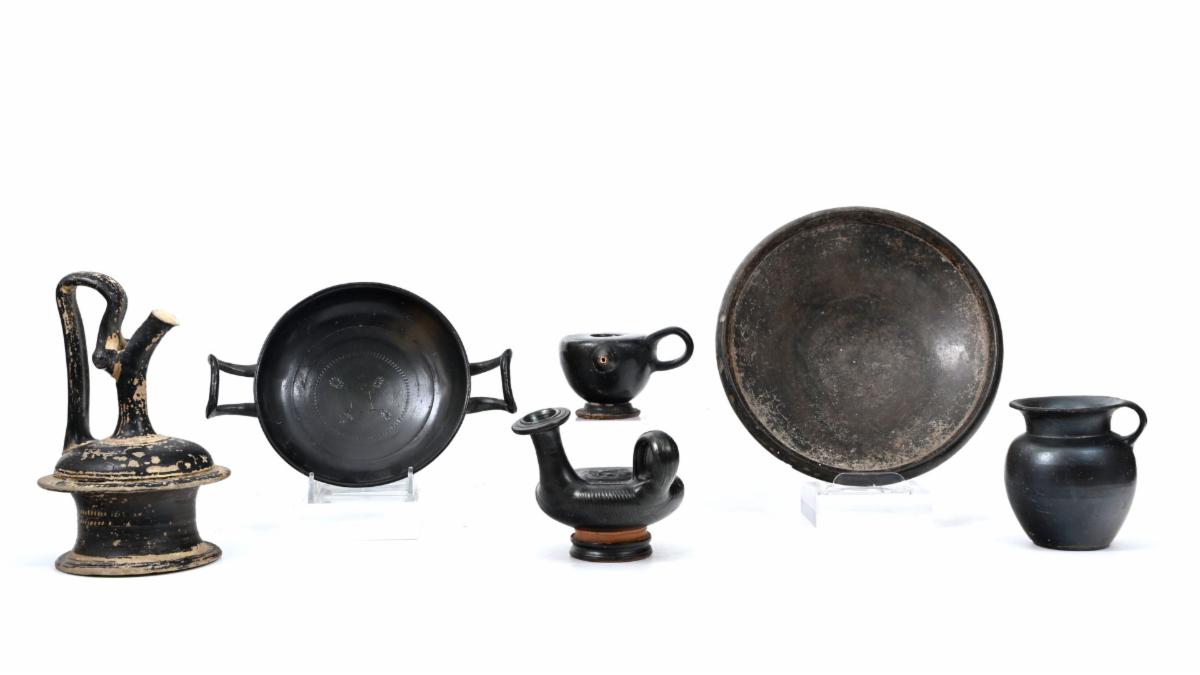
Twenty-four centuries ago, these six vessels were in daily use, pouring oil, holding wine, and feeding a child. Their mirror-black surface still catches the light, and it was never paint. It is a fine clay slip that turned black in the kiln, a method perfected in Athens and taken up by the potters of southern Italy in the 4th century BC. Here are three from the group.


The guttus, a small vessel for dispensing oil drop by drop, has a ribbed body, a ring handle, and a narrow spout. At the center of the top is a molded medallion of a Nubian figure. It comes from the William Frolich collection, New York.


The Campanian kylix, ca. 4th century BC, is a shallow two-handled wine cup with stamped decoration in the tondo. It measures 8¾ inches across the handles and has excellent root marks. It comes from the estate of Rosa and Aaron Esman of New York. Rosa Esman was a gallerist and print publisher, and her husband Aaron was a psychiatrist who wrote on creativity.


The baby feeder, Greek, ca. 350–325 BC, is a squat footed vessel with a short conical spout for controlled pouring. A very similar example is in the Metropolitan Museum of Art (acc. no. 91.1.1627).


Please also check out our recent acquisitions.


Best,


Howie and Dara

South Italian Black Glaze Pottery Guttus

This vessel is a classic example of a guttus, a type of ancient Greek and South Italian pottery used primarily for dispensing small amounts of liquid, such as oil or water, often drop by drop. Characterized by its single handle, ribbed body, and a narrow, funnel-shaped spout, the guttus was both a practical and ceremonial object, commonly found in domestic, ritual, and funerary contexts from the 4th to 3rd centuries BCE. The surface is finished with a lustrous black glaze, typical of South Italian wares, and the vessel stands on a ring-shaped foot with the natural terracotta color visible at the base. Of particular note is the central medallion on the top of the guttus, which features a depiction of a Nubian figure. In ancient Greek art, Nubians were often portrayed with distinctive features and darker skin, serving as motifs that evoked the exotic and distant lands of Africa. Such imagery reflected the Greek fascination with the other and was used to conjure ideas of far-off, mysterious places, sometimes associated with wonder, danger, or ritual significance. The combination of functional design and the exoticizing motif of the Nubian places this guttus at the intersection of daily life and the broader cultural imagination of the ancient Mediterranean world. Size: 3 1/2 in. H. Provenance: William Frolich Collection, New York.

$2,000.00

Campanian Black Glaze Kylix

South Italy, Circa 4th Century BCE Shallow vessel with rich black glaze, stamped tondo and twin horizontal handles. Disc foot, 8 3/4 in. diam handle to handle. 1-1/2 in H. excellent root marks. Provenance: The Estate of Rosa and Aaron Esman, Lexington Ave, NY. Throughout their seventy-year marriage, Rosa and Aaron Esman shared a profound passion for the arts. Rosa Esman was a prominent figure in the art world, owning several renowned galleries such as Tanglewood Gallery and Rosa Esman Gallery, and co-founding Ubu Gallery. She was a pioneer print publisher of limited edition artworks while at Tanglewood Press, Original Editions, and Abrams Original Editions. Dr. Aaron Esman was an avid enthusiast of literature, classical and jazz performances, and theater. As a psychiatrist, he delved deeply into the intricacies of the human mind and its relationship with creativity, often writing on the subject.

$1,100.00

Attic Black Glaze Pottery Baby Feeder Guttos

Greek, circa 350 to 325 B.C. Small footed vessel with squat rounded body, flat shoulder and cylindrical filling hole at the top, a sturdy loop handle rising above the rim and a short conical spout for controlled pouring. Rich black glaze with minor surface wear and encrustation from age; foot with expected edge chipping and burial deposits, handle restored. Size 2 3/8 in. H (at handle) x 3 1/2 in. W. Compare a very similar example in the Metropolitan Museum of Art, New York, acc. no. 91.1.1627. Provenance: Private USA collection.

$695.00
Facebook  Pinterest  Twitter