|
Black History Is Care Work: An Alabama Lineage
Black History Month always invites me to reflect not just on where we have been, but on who carried us here. For me, this reflection is deeply personal. I have shared before that I did not wake up one day and decide to become a child care advocate. I was shaped into one, by people, by place, and by a legacy of Black women in Alabama who understood care as survival, resistance, and nation-building.
When I stepped into leadership of FOCAL (Federation of Child Care Centers of Alabama), today known as the Alabama Institute for Social Justice (AISJ), I did so standing on the shoulders of those who came before me, especially my predecessor, who immediately helped me see child care not as a side issue, but as a central pillar of economic justice. In so doing, I came to understand that systems matter, and that care is one of the most powerful systems we have. I also came to understand something even deeper: we were not starting from scratch. We were inheriting a legacy.
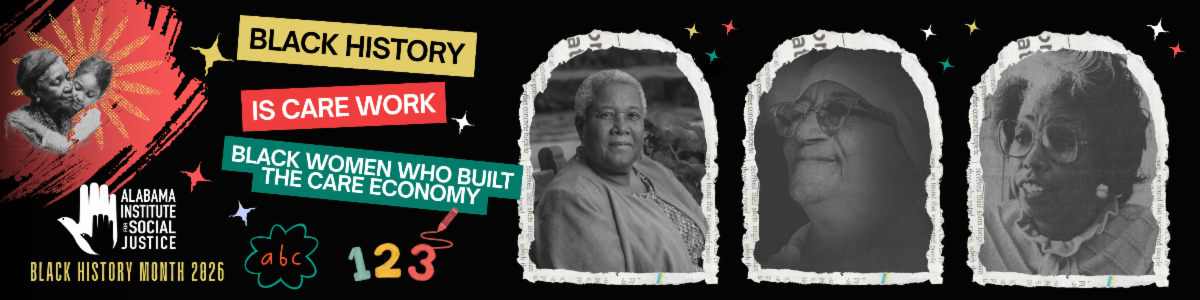
That legacy is inseparable from the work of Sophia Bracy Harris, who co-founded FOCAL in 1972. FOCAL was more than an organization. It was a declaration that Black providers in Alabama deserved safe facilities, professional respect, and a voice in public policy. Long before “child care infrastructure” became common language, FOCAL was organizing, advocating, and insisting that quality care was a right, not a privilege.
As we at AISJ have worked to build on that distinguished legacy, I have come to see our efforts as part of a continuum rather than a new beginning. That continuum includes women like Emma Henderson of Birmingham, who helped train the first generation of Head Start staff in the 1960s and directed the Tuscaloosa Summer Head Start Program. Her work reminds us that workforce development in early childhood is not a modern innovation, it is Black women’s history.
It also includes women whose labor was quieter but no less profound. I am from Prichard, and growing up there gave me an intimate understanding of how care shows up long before policy ever does. People like Onnie Lee Logan, who served as a licensed midwife from 1947 to 1984 in Prichard, Crichton, and surrounding communities, were often the difference between life and loss. She delivered babies, but she also delivered dignity, reassurance, and continuity in a world that routinely denied Black families all three.
I have also shared my own story of child care, of staying with Mrs. Bea Burns, who ran a child care center in my neighborhood with her husband, including when my parents needed care outside of regular business hours. It was there, as a child, that I first absorbed the connection between child care, neighborhoods, and civic life. Mrs. Burns used the trust she built with families to encourage voter participation and help neighbors understand the importance of being counted. Her work was rooted in relationships. In trust. In community.
Over time, this lineage has also given me a clearer understanding of something else: that many of the spaces and institutions we are taught to revere, those built on white supremacist, patriarchal systems, are inherently anti-Black. They were never designed to hold us, protect us, or value our full humanity. And in understanding who we are as Black women; we also inherit the courage to abandon such systems when necessary and to build new ones rooted in our own values and ways of knowing.
And this lineage is not only historical, but it is living. Even today, the hundreds of women who make up The Alabama Movement for Child Care (TAMCC) continue this same tradition of leadership, care, and system-building. They are providers, directors, teachers, organizers, and advocates who hold together the daily realities of families across this state. I am a daily student of their experiences, wisdom, and expertise. They teach me, constantly, what meaningful policy and effective systems should look like when grounded in real life.
Black History Month is not just about honoring the past. It is about telling the truth about how we got here. The truth is this: Black women built what the nation still depends on. They built care systems when the state would not. They trained workforces before credentials were valued. They organized providers before advocacy was funded.
I carry this history with me every day. Our work is not an invention; it is an inheritance. And our responsibility is not just to remember it, but to protect it, steward it, and finally treat it as the essential system it has always been.
Black history lives here.
Black history raised us.
Black history will carry us forward.
In hope and solidarity,
Lenice C. Emanuel, MLA
Executive Director, AISJ
To learn more, click here.
|