Black Maternal Health Week – A greatest impact on maternal and infant health could be made simply by addressing vitamin D deficiency among Blacks! |
|
Black Women Could Lower their Risk of Preterm Birth by 78% |
|
Greetings!
The month of April is recognized as National Minority Health Month in the United States, and today is the first day of Black Maternal Health Week (BMHW), which takes place every year from April 11-17.
Last week, we reviewed data showing how increasing vitamin D levels to the 40-60 ng/ml (100-150 nmol/L) range could virtually eliminate racial health disparities seen among those with darker skin. It is an unfortunate reality that Blacks have the lowest levels of vitamin D, with a 15-20 fold higher prevalence of severe vitamin D deficiency. According to NHANES data, approximately 68% of Black women have vitamin D levels below 20 ng/ml (50 nmol/L) and at these levels, would be expected to have a 20% preterm birth rate; this is a problem that must be addressed for mothers within these groups of darker skin!
Below, we share our own research showing the gap in preterm birth outcomes between white and black mothers – a gap that virtually disappears when vitamin D deficiency is corrected.
|
|
How do race and vitamin D levels affect the risk of having a preterm baby? |
|
We have previously summarized the main results from a published GrassrootsHealth study showing a 62% lower risk of preterm birth for women with vitamin D levels at or above 40 ng/ml (100 nmol/L) compared to women with levels less than 20 ng/ml. Below, we look at another analysis from that paper which assessed the association between vitamin D and preterm birth risk for white and non-white women. This was important to look at due to the racial and ethnic differences in preterm birth rates, with Black women having higher rates compared to other groups.
Among the women in the study (N=1,064), 10% of white women and 15% of non-white women had a preterm birth. Black women accounted for a majority (69%) of the non-white births and had a 19% preterm birth rate. For those with vitamin D levels at or above 40 ng/ml compared to women with levels less than 20 ng/ml, there was a 65% lower risk of preterm birth among white women (p=0.03) and a 68% lower risk among non-white women (p=0.008). The similar decreased risk suggests that improvements in vitamin D status may decrease the disparity in preterm birth rates between racial/ethnic groups.
|
|
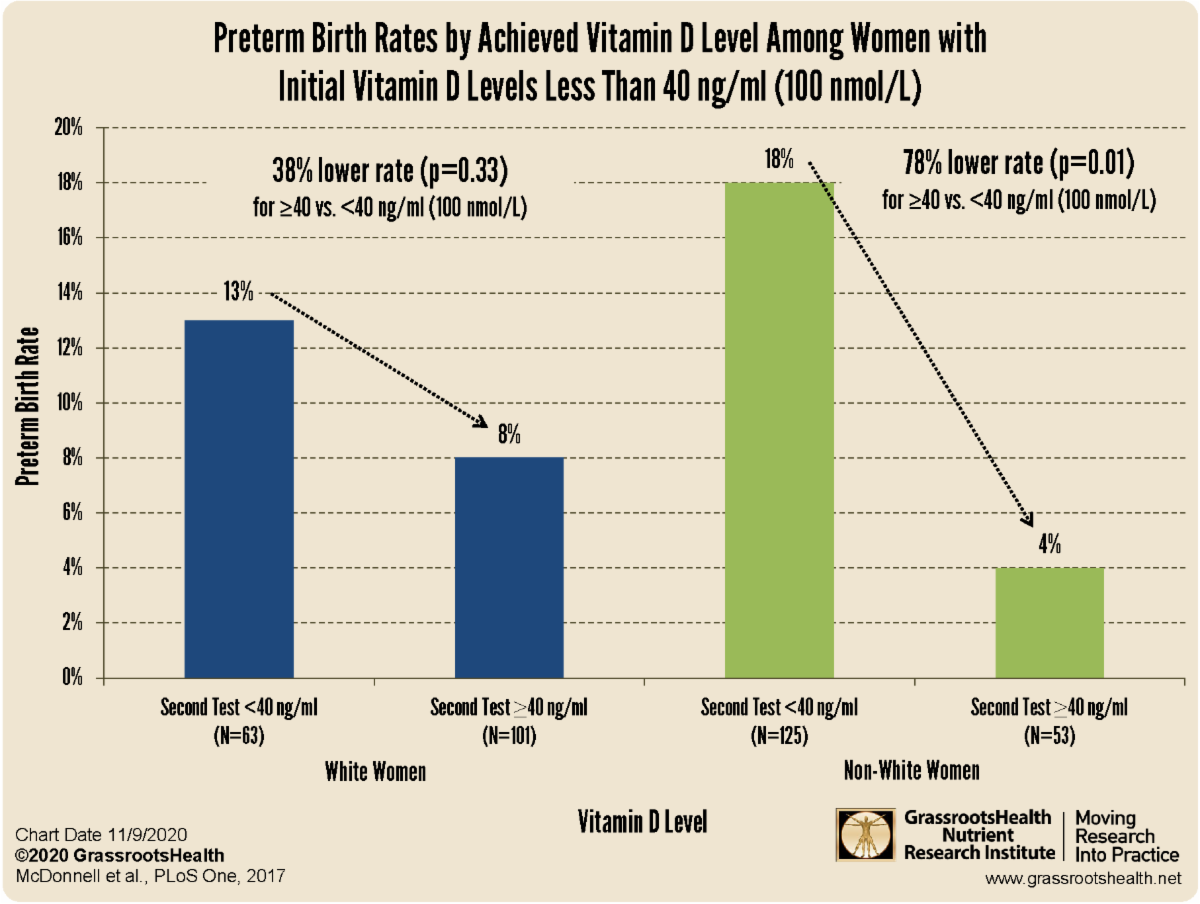
As illustrated in the chart above, among women whose initial vitamin D level was less than 40 ng/ml, the preterm birth rate was 38% lower among white women (p=0.33) and 78% lower among non-white women (p=0.01) for those who raised their level to at least 40 ng/ml prior to giving birth vs. those who did not.
This indicates that improving the vitamin D status of non-white women, who are more likely to have low vitamin D levels, could dramatically decrease racial disparities in preterm birth rates.
|
|
Getting Technical: Identifying that Vitamin D Level Alone Makes a Difference |
|
The most telling part of this analysis comes toward the end of the results section of the paper:
Differences by race/ethnicity were not statistically significant when 25(OH)D concentration was included as a covariate in multivariable regression analysis.
What Does This Mean?
When statisticians crunch data, to sort out findings from a study, there are times when they want to make sure that the finding wasn’t due to a separate variable. For example, many times in vitamin D trials, they account for BMI, which is used as a marker for obesity.
Multivariable regression testing is a way to look at many variables within your trial and see how they affect each other. So, in the BMI example, did vitamin D lower all heart disease? Or only for those that had a BMI < 25? We won’t get into the math to make this computation happen, let’s just say the statisticians know their numbers.
So, the statement above is really the key to disparity and the plausible conclusion that vitamin D levels in recommended ranges (40-60 ng/ml) could level the playing field for all races.
To a statistician this statement means…
there was NO difference in preterm birth rates (what was measured in the study) by ethnicity if vitamin D levels were equal.
Now, we KNOW that there is a huge disparity in preterm birth rates among racial groups. And, as you can now see, we can erase disparity in preterm birth caused by vitamin D deficiency, according to this analysis, by bringing everyone’s vitamin D levels to at least 40 ng/ml (100 nmol/L).
|
|
One Simple Change Makes a BIG Difference |
|
Make Sure You Are Getting Enough Vitamin D! |
|
Having and maintaining healthy vitamin D levels and other nutrient levels can help improve your health now and for your future. Choose which additional nutrients to measure, such as your omega-3s and essential minerals including magnesium and zinc, by creating your custom home test kit today. Take steps to improve the status of each of these measurements to benefit your overall health. With measurement you can then determine how much is needed and steps to achieve your goals. You can also track your own intakes, symptoms and results to see what works best for YOU. |
|
What does the Research Say about Vitamin D & COVID-19? |
|
The eBook, Vitamin D & COVID-19, A Summary of Published Research, is a condensed and concise compilation of much of the published research on vitamin D and COVID-19, easy to read and share as a downloadable, printable PDF. Your purchase helps to further public knowledge and education of this invaluable research! Be sure to educate yourself on the benefits and importance of vitamin D for immune health, and take steps to ensure you and your loved ones are getting enough. |
|
What Does it Take YOU to Get Your D to 40 ng/ml (100 nmol/L)? |
|
Did you know that everyone responds differently to vitamin D supplement amounts - by up to 6 times!? Your health could be greatly affected by making sure you have a vitamin D level of at least 40 ng/ml (100 nmol/L). Help us help you. |
|
Sperti Vitamin D Sunlamps |
The Sperti Vitamin D Sunlamp, model D/UV-F, provides the special UVB rays needed for your body to produce Vitamin D. It is the only FDA recognized ultraviolet product for Vitamin D production in the human body, and independent studies have verified its effectiveness.
See how it works for you.
Look for our special project enrollment opportunity with Sperti!
|
|
Highly Absorbed Magnesium |
Dr. Carolyn Dean is a medical doctor, naturopath, and author of over 35 books including best seller The Magnesium Miracle. With 40 years of experience, she offers proprietary, unique formulations that give every individual at any stage of wellness or illness the necessary building blocks for sustained health, vitality and well-being.
Participate in our special Magnesium*PLUS Focus project offered by RnAReSet.
|
|
The Helen Knoll Foundation |
The Helen Knoll Foundation (HKF) mission is to prevent breast cancer by empowering young women through risk awareness education, advocacy and access to age appropriate screenings. HKF with GrassrootsHealth is launching the Know YOUR Number campaign to help Stop Breast Cancer Before it Starts by working with local groups to provide vitamin D blood spot testing and project enrollment events. |
|
|
|
Have a beautiful and HEALTHY day.
Text-to-give: Text Daction to 44321
Onwards,
Carole Baggerly
Director, GrassrootsHealth
A Public Health Promotion & Research Organization Moving Research Into Practice NOW!
|
|
315 S. Coast Hwy 101, Suite U-87
Encinitas, CA 92024
(760) 579-8141
|
|
|
|
|
|
|
|