|
FROM VOICES TO VISION
A message from Vice Chancellor Joel Peterson
| | |
Making Spaces Ready for Use
Why Enhanced FF&E matters under Measure HH
Dear Colleagues,
In our last Measure HH e-news update, we focused on design development and the continued importance of stakeholder involvement as projects move closer to construction. As that work continues, I want to focus on another part of the process that also plays a significant role in how new and renovated spaces function day-to-day, but often gets less attention: Furniture, Fixtures, and Equipment (FF&E).
In the past, FF&E was often described as anything that would fall out of a building if it were turned upside down - tables, chairs, computers, printers, and other loose equipment.
Under Measure HH, FF&E is defined more broadly and planned more intentionally and comprehensively. Enhanced FF&E (EFF&E) includes all of the above, along with early coordination of instructional and educational technology; audiovisual systems; IT infrastructure, equipment, and software; accessibility features; and other specialized equipment (think height-adjustable workstations with integrated power, technology-integrated conference tables, and modular furniture with data ports).
Enhanced FF&E is also integrated into what we are calling Logistics Management Services (LMS) which includes planning for delivery, installation, storage, and move-out/in of EFF&E, as well as programming, design, project management of interim space configuration construction; the comprehensive coordination of temporary working environments – or “swing space” – to ensure campus spaces are fully available, functional, and uninterrupted during project construction as well as when projects are complete. (I explain more about EFF&E/Logistics Management Services in this video.)
Why do we start EFF&E/LMS conversations so early? Under Measure HH, EFF&E/LMS planning begins alongside design development. Starting earlier allows teams to address layout, equipment requirements, accessibility, durability, and long-term maintenance while keeping schedules and budgets in view. This month, the district is selecting a vendor through a competitive proposal process to manage these processes and help reduce errors in ordering, procurement, documentation, storage, and transport before and after installation.
As with design development, stakeholder input remains important during EFF&E/LMS planning. Faculty, staff, and campus leaders help identify functional and programmatic needs based on how and when spaces will be needed and used.
As Measure HH projects move forward, EFF&E/LMS will remain a key focus - supporting the district’s goal of delivering spaces that are available, functional, and flexible during construction, and ready for use on day one after construction.
Thank you for your continued engagement as this work progresses.
Sincerely,
Joel L. A. Peterson, PhD, MBA, MA
Vice Chancellor & Executive Operations Officer
San Diego Community College District
| | ALBERT GALLARDO: AN ARCHAEOLOGIST'S JOURNEY COMES FULL CIRCLE | |
Albert Gallardo, archaeologist with Helix Environmental and former San Diego City College student, recently returned to campus in a new role - contributing to the district’s first-ever Measure HH-funded affordable student housing project. As part of the San Diego Community College District’s Measure HH bond program supporting improvements across City, Mesa, Miramar, and Continuing Education campuses, the project represents a major investment in student success.
In a recent video interview, Gallardo shared more about his path to this moment. He commuted across the border from Tijuana while pursuing his education, balancing work, long travel times, and the cost of living. He also spoke candidly about dropping out before ultimately returning to City College - a turning point he credits with helping him find direction and confidence. Faculty mentorship and practical guidance during his time at City helped him pursue his passion for archaeology and successfully enter the profession.
Today, he finds himself back on campus in a pivotal role. During early site preparation for the housing project, construction teams uncovered artifacts buried in the soil, including glass bottles, ceramic fragments, and other objects.
Cultural resources review is a standard part of the California Environmental Quality Act (CEQA) process required for projects across all SDCCD campuses. Archaeological studies are conducted in advance to assess potential impacts and ensure historic materials are properly documented and protected. In this case, early site work revealed artifacts dating to the early 1900s, prompting additional testing and documentation before construction could proceed.
Gallardo’s expertise ensured the site was carefully evaluated, tested, and cleared in accordance with environmental standards.
For Gallardo, the affordable student housing project represents more than new buildings. It represents access and opportunity for students navigating challenges he once experienced himself. He also reflects on the broader impact of Measure HH - the bond program making critical campus renovations and modernization possible throughout the district, and helping ensure students continue to learn and grow in spaces designed to support their success.
His return to City College connects his past and present in a meaningful way: from student commuter to professional archaeologist helping advance a project that will support future generations of students.
| FROM IDEAS TO IMPACT: STUDENTS IN THE DESIGN PROCESS | |
San Diego Mesa College recently brought nearly 150 student-athletes together for a hands-on workshop to talk about the future Athletics Complex - and to weigh-in on what matters most to them. Instead of simply presenting plans, the design team asked students to help shape them.
The workshop, led by C.W. Driver and LPA Design Studios (the design/build team leading the project) – focused on programming and early schematic design, the point at which ideas begin to take shape into real, workable spaces. Students walked among concept display boards that showed possible layouts, relationships between spaces, and various amenity options. Then came the interactive part: the “green dot” exercise. With stickers in hand, students marked the features they liked best and posted comments on sticky notes to provide further priorities and ideas. Whether it was gathering spaces, training areas, circulation flow, or spectator seating, the dots quickly revealed clear preferences.
It was a straightforward activity, but the conversations it sparked went well beyond preferences, yielding meaningful insights from the students about how the spaces will function. Students, coaches, and members of the design team discussed training needs, competition and tournament requirements, accessibility, and how the complex will operate day-to-day. For many students, it was their first glimpse into how planning decisions are made - and how their input can genuinely influence outcomes.
That timing matters, and student engagement at this stage is especially valuable. During programming and schematic design, projects are still flexible. Decisions made now shape how spaces function long before construction begins. Hearing directly from students helps ensure the projects are designed to be used as intended - not just on paper.
Measure HH is about building facilities that serve students for decades. Inviting students into the process early helps make sure those spaces reflect real experience, real needs, and real campus life.
Hear from some of the student athletes who participated in the workshop here. We’re also all excited to hear from students at other colleges as they hold similar activities in the future.
| STUDENT VOICES AT THE TABLE: JOIN THE MEASURE HH STUDENT ADVISORY COUNCIL | |
SDCCD is inviting students to take an active role in the future of their campuses through the new Measure HH Student Advisory Council. As projects funded by the $3.5 billion bond move from planning into design, district leaders want direct student input on how new and modernized spaces will function day to day. The council is designed to make sure those perspectives are heard early - and often.
Sixteen current or incoming students will be selected to serve on the council and meet regularly with Vice Chancellor Joel Peterson and the Measure HH team. Members will review concepts, share feedback, and talk candidly about what works - and what doesn’t - in existing campus spaces. The goal isn’t symbolic participation; it’s practical insight that can influence real decisions about classrooms, study areas, student services spaces, and campus life.
Students from all colleges, programs, and backgrounds are encouraged to apply. For those interested in leadership, civic engagement, or simply improving the spaces they use every day, this is an opportunity to be part of the conversation while projects are still taking shape. Application details and eligibility requirements are available here.
| | SPOT IT. SEE IT. SCAN IT. | | |
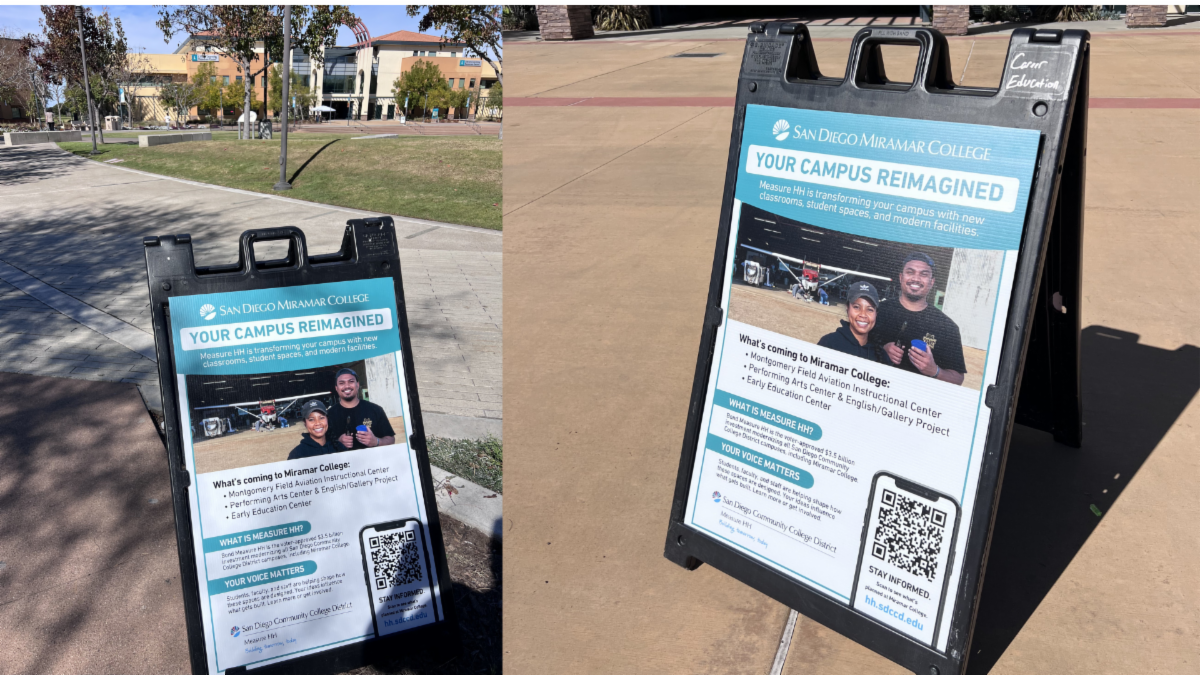
New A-frame information displays have been placed at key locations at San Diego City, Mesa, and Miramar colleges, as well as the College of Continuing Education, to make it easier for campus communities to access Measure HH updates.
Each sign features a QR code that links directly to the Measure HH website. By scanning the code, students, faculty, staff, and visitors can quickly view project updates, timelines, FAQs, and other public resources related to bond-funded improvements across the district.
As Measure HH projects move through planning, design, and construction, visible, on-campus information points help ensure the community knows where to find accurate, up-to-date details. The displays are part of the district’s continued commitment to transparency and accessibility throughout the life of the bond program. Share your photo next to one of the new Measure HH information displays, and maybe you’ll see yourself featured in one of our upcoming e-newsletters. Use hashtag #MeasureHH.
| | CONTRACTORS CONNECT AT MEASURE HH OUTREACH EVENT | | |
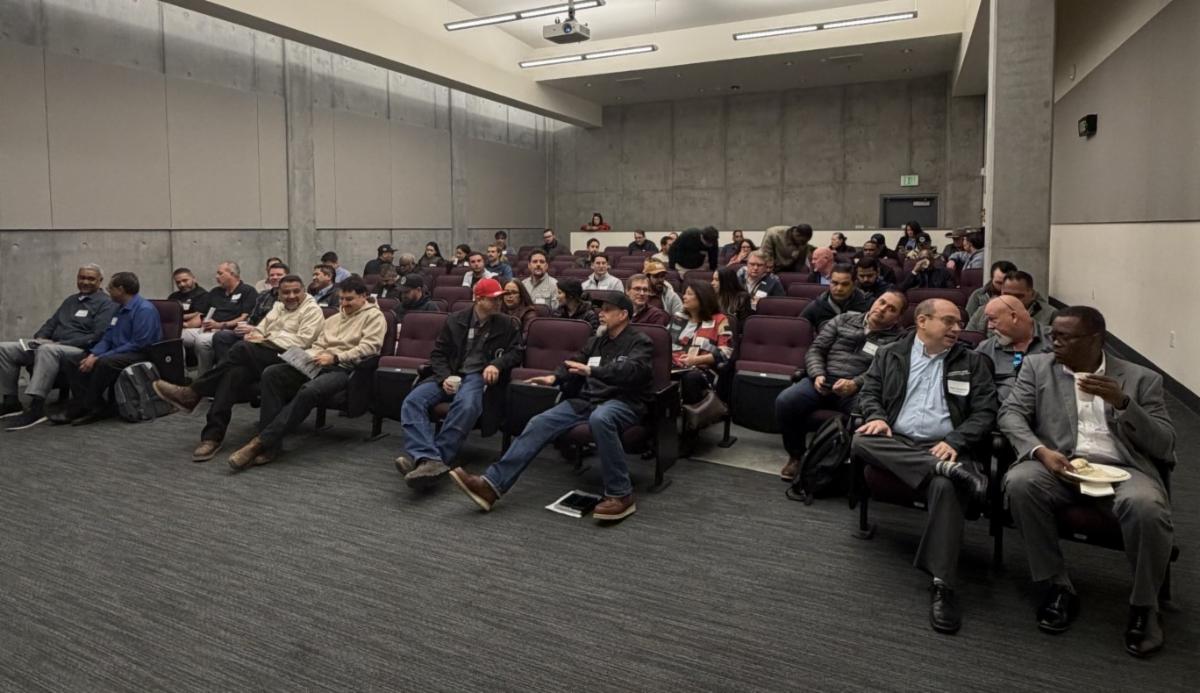
Nearly 80 contractors participated in SDCCD’s recent contractor networking event for capital renovation and repair projects, reflecting strong interest in upcoming Measure HH business opportunities.
The session focused on nearly 50 capital projects anticipated across district campuses through the fall. Designed as both an informational briefing and a networking opportunity, the event provided guidance on doing business with SDCCD, including an overview of upcoming work, how projects will be delivered, and how firms can prepare to compete as solicitations are released.
Attendees also received information about which projects will be subject to the Community Benefits Agreement (CBA), applicable to contracts valued at $1 million and above.
Representatives from the district’s eight active design-build projects were also present to meet contractors and subcontractors, with a particular focus on small, local, and historically underutilized businesses. For many smaller firms, it offered an opportunity to connect face-to-face with prime teams and learn about potential scopes of work in advance of formal bidding.
Held at San Diego City College’s Math & Social Sciences Building, the free event underscored the district’s continued commitment to early outreach, transparent processes, and broad participation as Measure HH projects move into active procurement and construction.
| | |
ALPHABET SOUP
Bond program terms explained
| | |
From planning and design to construction and oversight, Measure HH involves many moving parts - and plenty of shorthand. This glossary provides simple explanations of terms and acronyms that frequently appear in meetings and written materials.
CEQA (California Environmental Quality Act)
Law requiring evaluation of environmental impacts.
Risk-Adjusted Projection (RAP)
A cost estimate that includes potential risks to show a worst-case projection.
Visioning Session
Collaborative discussions used to establish shared goals, values, and priorities for a project.
Punch List Meeting
A meeting held near project completion to review remaining items needing correction or completion.
GMP (Guaranteed Maximum Price)
The maximum amount the owner agrees to pay for construction.
See more terms and definitions in our Measure HH & Capital Projects Glossary!
| | ICYMI (In case you missed it) | | |
Connect with us
With construction underway and major projects in procurement, Measure HH is transforming facilities that serve nearly 90,000 students annually while demonstrating exemplary fiscal stewardship. Future e-news updates will provide additional details on all bond-related activities.
If you are interested in learning more about Measure HH and would like to schedule a presentation for your departmental team or a community organization, or have ideas for future stories, please email us at SDCCDMeasureHH@sdccd.edu.
| | | | |