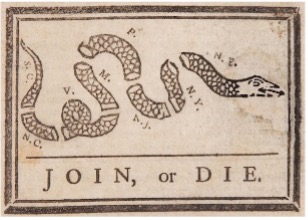
It inspired one of America’s first and most famous political cartoons:
Franklin’s plan was too visionary.
He was too far ahead of his time.
The plan was rejected.
Curiously, however, Joseph Galloway, a loyalist, proposed a very similar plan at the First Continental Congress. It, too, was rejected; this time for being too late. The train of independence gathering momentum passed it by. An unhappy Galloway resigned from the Congress and refused to be elected to the Second Continental Congress. In the 20th century, both Galloway’s and Franklin’s plans inspired the model for the British Commonwealth of Nations.
Franklin, having spent 15 of the previous 17 years in London, was at first suspect by the colonial rebels when he returned to Philadelphia in 1775. Regardless, Pennsylvania’s assembly sent him to the Second Continental Congress. After Richard Henry Lee of Virginia’s proposal on May 15, 1776, that the American colonies “ought to be free and independent states” was tabled for further debate, the Congress decided a formal declaration needed to be drafted before debate could continue. Appointed, along with Thomas Jefferson, John Adams, Robert Livingston, and Roger Sherman, to a committee to write a declaration of independence, Franklin made several small and one very major contribution.
After Jefferson drew up his draft, he asked Franklin, the old newspaper editor, to clean up his copy. Franklin made only a few suggestions, but one of them was profound with implications that echo to today.
Who added “We hold these truths to be self-evident …” to the Declaration of Independence?
It wasn’t Jefferson. He wrote “We hold these truths to be sacred and undeniable. …”
It was Benjamin Franklin – that epitome of the Man (or Person) of the Enlightenment. Franklin understood that something sacred was something given and suffered from at least two defects. First, it could be taken back and, second, depending upon one’s creed, you might or might not accept it as sacred.
As for “undeniable,” that opened the discussion to dispute, for one could ask what makes it undeniable? And from that point forward, it’s a debating contest whose end is not foretold.
Franklin went a step further.
As a man of the Enlightenment, he was a rationalist – he believed in logic and scientific investigation.
So, he asserted these truths were beyond mere creed, they were beyond mere reason – they were self-evident and uncontradictable truths, like, for example, “All bachelors are unmarried” and “the sum of the angles of a triangle is 180 degrees,” which assertions are neither matters of faith nor open to rational argument. They simply are – they’re self-evidently true always and in all places.
Freedom Abroad
When the Revolution seemed to be failing, it was Franklin in Paris who secured vital French aid. Wearing his fur hat, playing the role of backwoods philosopher, he charmed the royalist French into bankrolling a republican revolution as he engineered The Treaty of Amity and Accord between France and the Continental Congress. Louis XVI seemed to intuit that he was planting the seeds of his own demise, but guided by his foreign minister, the Comte Vergennes, he agreed to support the American rebels. Vergennes, no republican, was playing a long game hoping by driving a wedge between Britain and her American colonies it would re-open the door to French dominance in North America.
When the Confederation Congress sent John Adams and John Jay to France to help Franklin secure French aid, they were both dismayed, thinking the glory gone, to discover that Franklin had already succeeded. When, after Yorktown, the British approached Franklin to negotiate a peace treaty between the United States and Britain, Franklin reluctantly agreed to Adams and Jay’s determination to move forward without French involvement, a violation of the agreement Franklin had made with the French.
A master politician, Franklin, who knew the French agreed only to help America to harm Britain, broke his agreement with the French and signed a separate peace accord with the British – The Treaty of Paris of 1783. But it was neither the dyspeptic and dour Adams nor the laconic and remote Jay who then persuaded the French to accept the agreement. It was the gracious and wily Franklin who not only calmed Vergennes anger, but also secured a loan to support the fledgling American republic.
America’s first and most successful ambassador, Franklin invented the American diplomatic corps.
More Freedom at Home
Returning to America and its fumbling Articles of Confederation Congress, Franklin played a key role at the Constitutional Convention in 1787. Using his Philadelphia home’s garden as a convivial setting for private conversations, he got Northern and Southern delegates to agree on many difficult issues.
Using his Poor Richard folksy wisdom persona, Franklin explained how a joiner – a carpenter – cuts a bit from this and a bit more from that to make two sides join smoothly. With the aid of this story, he revealed his genius for compromise – in this case to broker the Connecticut Compromise, which created equal representation in the Senate to convince smaller states to join the union.
While leaving the Constitutional Convention assembly, he famously answered a question from Eleanor Willing Powel, a major figure in Philadelphia’s social and political life, who asked him, “What have you created?” He replied, “A republic, if you can keep it.”
Franklin was the only founder to sign all four seminal documents in the creation of America:
The Declaration of Independence
The Treaty of Amity and Accord with France
The Treaty of 1783 with Britain, and
The U.S. Constitution in 1787.
Freedom’s Fault lines
If Franklin was instrumental in founding American freedom, he also understood its corollary – “Freedom’s Fault lines,” all the moments America failed to live up to its ideals. He understood this because he himself frequently failed to live up to those truths he said were self-evident.
A man of his time, he must be understood in the context of his times.
But he also must be recognized as someone who also learned his whole long life – he never stopped learning.
As a young man, Franklin inveighed against immigrants, Africans, and Native Americans. In his famous 1751 essay “Observations Concerning the Increase of Mankind, Peopling of Countries, etc.” on demography and population, in which he correctly predicted the doubling of American population every 20 years, he also fulminated against German immigrants who refused to learn English, against Africans he thought dishonest and uneducable, and against Native Americans he thought barbaric savages. But he concludes by acknowledging his own prejudice, saying “But perhaps I am partial to the complexion of my own country, for such kind of partiality is natural to mankind.” [4]
With that bow to his own myopia, Franklin learned.
Getting to know his German neighbors, he later published one of the first German language newspapers – Die Philadelphische Zeitung.
Visiting a school for Black children he came away impressed with their wit and vitality saying that perhaps Africans’ negative behavior resulted from their condition as slaves.
When white settlers brutally attacked a peaceful Native American village, he denounced it as “white barbarity.”
He learned.
Yes, he owned slaves. Yes, he advertised for runaway slaves and published ads for slave sales in his newspapers. Yes, he even bought and sold slaves.
Then in the 1750s, he began to change. He also published numerous Quaker anti-slavery pamphlets and petitions. Reading these, he began to agree with them. By the late 1750s, he had no slaves – calling it an abomination.
Living in England and France for much of the 1760s and 1770s he breathed the abolitionist air percolating in the late 18th century. He understood the hypocrisy of fighting for freedom on one hand and owning slaves on the other.
He became a vocal abolitionist. Returning to America in 1787, he joined the Pennsylvania Society for Promoting the Abolition of Slavery, which advocated for the abolition of slavery and the integration of freed slaves into American society.
In 1789, after the ratification of the Constitution, he became an outspoken opponent of slavery by writing and publishing essays calling for slavery’s abolition. In one, he ridiculed those who say Africans are fit only for slavery by delivering a parody in which a North African justifies the enslavement of white Europeans in precisely the same language as southern defenders of American slavery.
Then, this champion of freedom sent to Congress a petition asking for the abolition of slavery and an end to the slave trade. The petition, signed on February 3, 1790, asked the first Congress, then meeting in New York City, to "devise means for removing the Inconsistency from the Character of the American People," and to "promote mercy and justice toward this distressed Race."
It was his last public act.
So, true to his Enlightenment values of reason and learning, this first and arguably greatest of Americans, like the women and minorities who would follow him, beseeched his government, as Martin Luther King, Jr. would say 178 years later, “to just be true to what you said on paper.”
So, what can we learn from Benjamin Franklin – this most human of the founders?
I think this quick glance, and glance is all it is, for Franklin’s long and accomplished life bursts the bounds of thousand-page biographies much less two Book Notes, I think the example of Franklin’s life provides several lessons. First, for students of leadership, Franklin proves the importance of human agency – that one person can make a difference.
Leaders are difference makers and Franklin spent his entire life making a difference. In these post-modern times, one hears a lot of prattling about collaboration and group think, but there are keys to leadership that Franklin exemplifies. First, nothing happens until someone makes it happen. Franklin was a person who made things happen. He took the initiative – he got out in front – and articulated goals that others found compelling. Knowing intuitively that no one does anything alone, Franklin built teams. He didn’t use that word but beginning with The Junto and moving forward he always brought people together for the common good.
To achieve the common good, Franklin’s life attests to the importance of compromise. Just as his homely example at the Constitutional Convention about the “joiner” (a carpenter) taking a bit from one side, then a bit from the other to make a tight and lasting joint, Franklin knew what we seem to have forgotten – that the essence of democratic politics is the art of compromise. If we could only listen to one another carefully, we could find that place where we can peacefully coexist. Just as his earliest political cartoon illustrated, he knew that there is strength in union.
Maybe most importantly, Franklin understood that life is always a work in progress. And, to make progress, one must never stop growing in knowledge and understanding. To do that, one must never stop learning. He would not have known the current educational buzzwords about being a lifelong learner, but Benjamin Franklin was a lifelong learner.
He never stopped learning. Because he never stopped learning, he never stopped growing in understanding and appreciation of his fellow citizens.
Accepting an ever-increasing circle of people into his orbit, he understood implicitly that if America was to mean anything, it was by ever increasing the “We” in “We the People.”
Among his many inventions, Franklin’s two greatest were himself, who continued to learn and grow in wisdom until the very end – and America – the country he played so vital a role in founding. It is a nation still learning how to be true to what it said on paper, but, nonetheless, as the recent confirmation of Ketanji Brown Jackson to the Supreme Court demonstrates, it is still growing in wisdom, still seeking to move forward.
Hiding in plain sight no more, Benjamin Franklin is the original American.