Newsletter Volume 63, Spring 2026 | | The Border Community Alliance is a 501(C)(3) nonprofit organization dedicated to bridging the border and fostering community through education, collaboration and cultural exchange. | | |
A Word from our Executive Director
Dear BCA friends and supporters,
Happy Sonoran Spring!!
As the saguaros start to bloom, the fleeting cool weather is appreciated, and our snowbird friends head back east for a few months, I would like to thank all of you for a successful season of events, tours, forums, language classes and cross-border collaboration, social investment and community-building.
We hosted over 50 events & tours this past season, drawing in hundreds of participants from across the country and beyond. Because of our generous donors, we also distributed $105,000 in social investment funding to our community non-profit partners in Sonora, Mexico in 2025.
Summer at BCA is primarily a time of planning for our next program season, hosting our six Borderlands Ambassadors (see the Borderlands Ambassadors-related articles in this newsletter) and creating new initiatives, such as our upcoming Frontera Voices media program.
As we develop new tours, forums and events for next season, we welcome your suggestions on what you are looking for from BCA, what you would like to learn about, and places you would like to visit. Please contact Anne Gibson, our Tours & Forums Coordinator, at agibson@bordercommunityalliance.org if you have ideas and suggestions.
Summer at BCA is also a time when we recruit new volunteers and Board members. Right now we are particularly seeking a few new folks to join our Special Events Committee and we’re looking for a chair for that committee. Upcoming events that we need help with are the Borderlands Ambassador final presentation events at the end of July. In addition, we’re looking for new board members to join our current 12-member board of directors, as we have several members whose terms will expire at the end of 2026.
If you are interested in any of the above roles, please email me at cbavier@bordercommunityalliance.org. We’d love for you to join our BCA team!
Wishing you a wonderful spring, a restful summer and we look forward to seeing you soon.
Thank you for your support of our work and our mission to bridge the border.
In borderlands community,
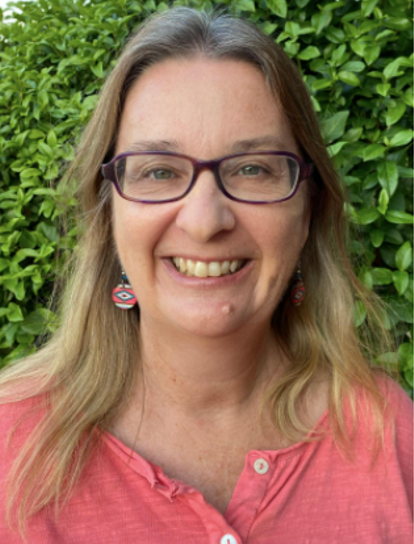
Celia Bavier
| | |
Introducing the
2026 Borderlands Ambassadors
We’re excited to be back for another year of the Borderlands Ambassadors Program at BCA! Each summer, we support a cohort of six students selected for an immersive 45-day (6.5-week) learning experience exploring the economic, political/governmental, social, cultural, historical, and environmental forces shaping life in the Arizona-Sonora borderlands. Through service-learning projects, site visits, conversations with community leaders, and hands-on activities, our Ambassadors engage with the complexities of borderlands history and contemporary realities.
At its core, the program is built on relationships, creating space for deep listening, cross-cultural connection, and a sustained commitment to ethical engagement and learning, grounded in lived experience rather than mainstream narratives.
With that in mind, we’re excited to welcome the 2026 Ambassadors, each bringing their own perspectives and a shared commitment to learning across borders.
| | |
We are deeply grateful to the many individual donors whose support makes this program possible. We also extend our sincere thanks to the Arizona Community Foundation for their generous grant supporting the program again in 2026.
We invite you to join us for our Borderlands Ambassador Final Presentations on July 27 and/or 31 (in person and by Zoom). See our website for details about these events and to register.
| | |
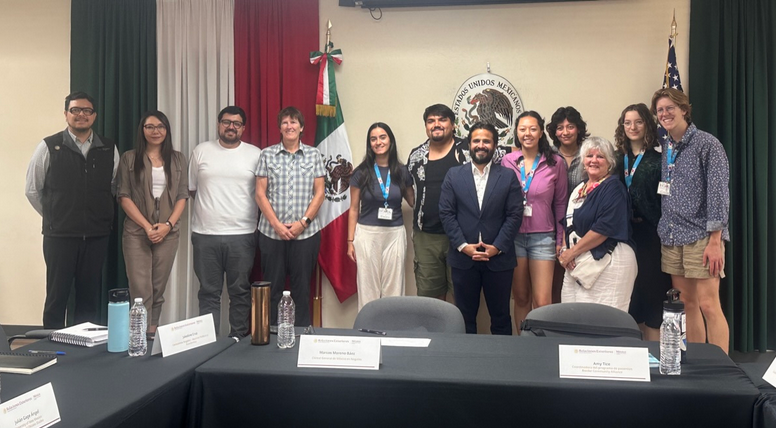
Above: 2025 Borderlands Ambassadors with Mexican Consul General in Nogales, Arizona,
Marcos Moreno Báez and his staff
| | |
Former Ambassadors Return
to the Borderlands
For our Borderlands Ambassador interns, their summer with Border Community Alliance (BCA) doesn’t end when the program concludes. It sets something in motion. Seeds are planted in the desert soil and in the students themselves, grounded in connection, curiosity, and commitment. What they carry back with them - to their homes, schools, and communities - does not lie dormant.
For example, there is Juan, a 2024 Ambassador, who brought his dad to Casa de la Misericordia, in Nogales, Sonora on their way home from the holidays in Hermosillo, Mexico last year.
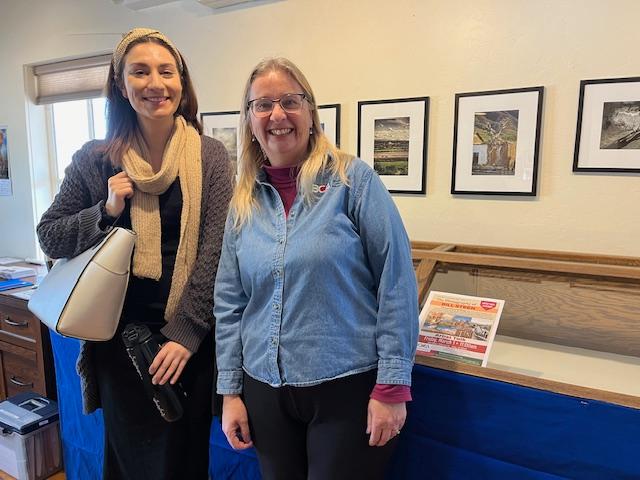
| | There is also Jaime, a 2023 Ambassador, who led a group of high school students from Massachusetts to the Texas/Mexico border last year. And there is Angela, whose journey reflects a deeper kind of return. After first coming to Southern Arizona from Philadelphia as a Borderlands Ambassador in 2017, she has now moved here and built her life and career in the region, working first as a journalist for Nogales International and now as a bilingual reporter and radio producer with Arizona Public Media. | | Former Ambassador Angela Gervasi with BCA Executive Director Celia Bavier | | |
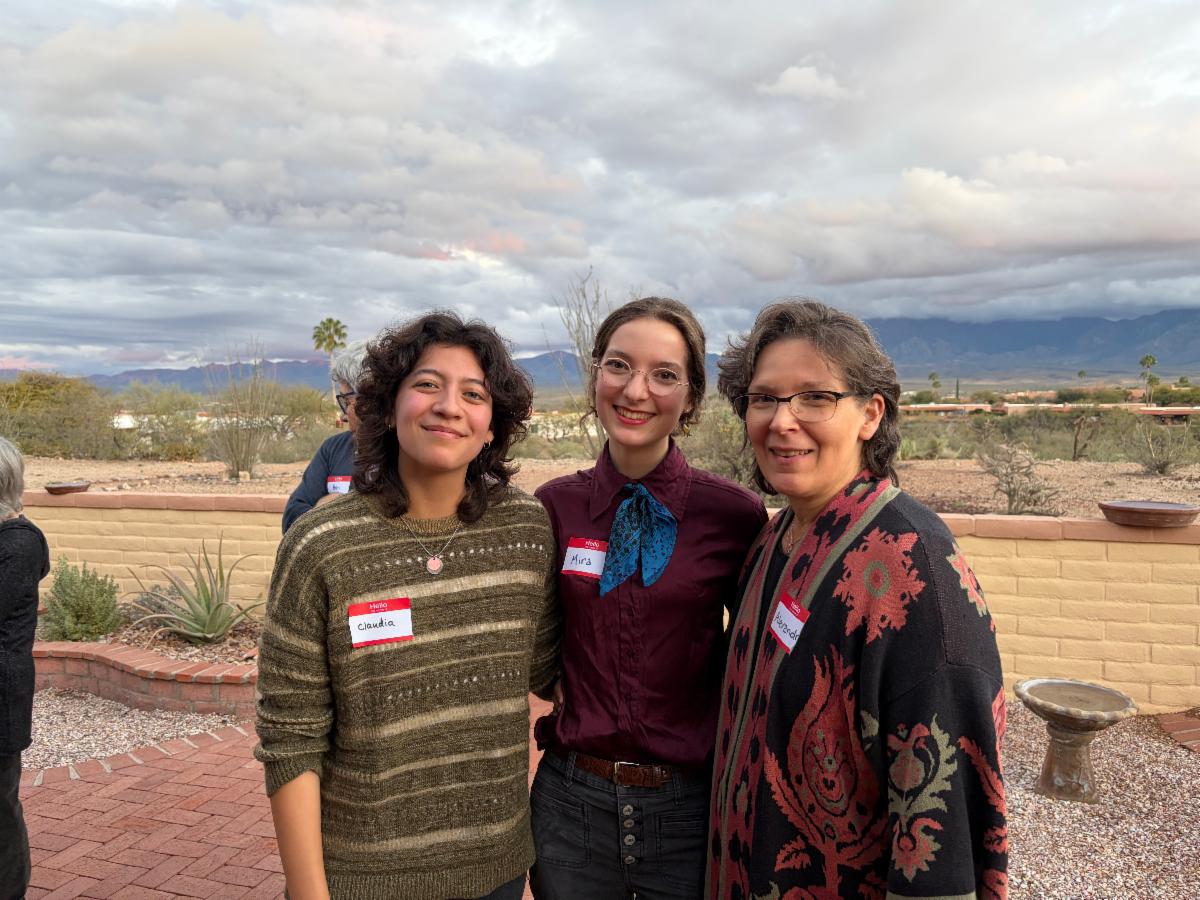
And then we have Claudia and Mira, two members of the 2025 cohort, who offer a different version of what it means to come back. They returned this January together, coming to Arizona and bringing some of their family with them. Not because they had to, but because something called them back.
When Claudia came back to the Borderlands with her mother, Laura, something had shifted from when she was here last summer. “I felt a lot more comfortable in the land,” Claudia reflected. “I knew it really well, and I felt like I was able to guide my mom through the area, which is kind of interesting because usually she's the one who's always organizing things.”
For Laura, the experience was equally transformative. “I let Claudia take the lead,” she said. “She was the expert in this space. I learned so much from Claudia. I saw my daughter in a different light.”
Their conversations stretched across generations. Laura recalled crossing the border herself as a young child, at a time and place when there was no wall. Standing in that same landscape years later, now shaped by new policies and physical barriers, brought both memory and contrast into sharp focus.
Seeing the border wall for the first time impacted Claudia last summer, and then her mom in January. Claudia reflected, “When we saw the wall for the first time, she started crying, and she talked about the border wall as this figure that kind of lives in your head, even though most of us have never actually seen it up close, it lives in our minds. And seeing her see that…it was really emotional for both of us.”
Claudia told me that her mom “has always told us a lot about her childhood and her immigration journey…so I don't know if it necessarily brought up new memories, but, I still feel like being there definitely brought us closer in some sense…just being there and thinking about [her stories] and just knowing we're both thinking about the same stories and the same family members, that's what connected us more, I think.”
What stayed with Laura most were the people in the borderlands. The humanitarians, the deep intergenerational connections, and the way individuals showed up for one another with equal parts humility and commitment. It was a model of community she found both rare and inspiring, and it led her to reflect once again on her own story and pathway to citizenship, “…all these people who didn’t know us worked to pass an immigration bill* that ultimately helped my family. It showed me who these people are—the kind of people who helped my family—and I felt an overwhelming sense of gratitude.”
For Laura, the Borderlands Ambassador program marked what she called “the next level” of Claudia’s education. Claudia’s honors thesis has been directly shaped by her summer experience, and when Laura shared her daughter’s writing in a blog post last summer with her own community, the response was immediate and powerful. Friends reached out, and conversations were sparked; even a Chicago City Council member engaged with Claudia’s reflections. People were interested. They wanted to understand, and during her experience in the Borderlands with Claudia, Laura began to imagine organizing a trip of her own—bringing others into the experience, widening the circle. What began as Claudia’s summer continues to ripple outward.
Below: Claudia and Mira with Mira's mother, Alexandra
| |
Mira’s return in January was with her mom and dad.
Her father, Ben, had first visited the southern Arizona Borderlands in January 2025. When he returned a year later, the landscape had changed. Policies had shifted, and with them, the realities on the ground. But what struck him most was not what had changed, but what had remained.
“I’ve never encountered so many people with such kindness and love in their actions,” he said.
Ben spoke with admiration not only for the work being done, but for the people doing it, especially the retirees among the Green Valley Samaritans who had dedicated their time and energy to supporting migrant communities. Their quiet, sustained commitment left a lasting impression.
At the same time, he saw something new in Mira. He took pride in how she had begun to define her own social justice mission, how her Spanish had strengthened, how her academic path had become more clear as she shifted toward anthropology, shaped directly by what she had experienced during the summer. The program had not just informed her learning; it had helped orient her future.
For Mira’s mother, Alexandra, the return was deeply personal.
“It was an incredible opportunity to be there with Mira—mentally, emotionally, and spiritually.”
What stood out to her was the openness of the community, the generosity, the willingness to share stories, and the sense of heart she hadn’t encountered in quite the same way elsewhere. Attending celebrations like Día de los Reyes with Salvavisión offered more than cultural insight; it offered connection. Through just a handful of stories, Alexandra found herself reflecting on something much larger.
“How many people in the world have these incredible stories of grit and courage?” she wondered, and “What will people endure to take care of their family?”
The trip brought distant realities into sharp, immediate clarity. “It gave me a window into Mira’s experience,” she said. “It brought stories and people from a long distance into near focus for me.”
This is the multiplier effect of the Borderlands Ambassador Program.
The learning does not stay contained within the student. It moves outward into families, into communities, and into conversations that continue long after the summer ends. Parents and friends become witnesses and then participants. They carry stories forward into their own networks, expanding awareness and deepening understanding.
When students return on their own terms, when they choose to go back, to guide others, to re-engage with the landscape and people of the Borderlands, they take on a new level of ownership. The experience becomes not just something they had, but something they are responsible for tending to.
Relationships with the Borderlands do not conclude; they unfold and grow deeper. Coming back becomes a practice. It is the act of remembering, reconnecting, re-seeing, and then bringing others along. Not just physically, but through stories told with permission and integrity, and the quiet insistence that this place, and the people within it, matter.
Claudia and Mira’s recent experiences remind us that the Borderlands are not a single moment in time; they are an ongoing relationship. When young people continue to return, carrying the Borderlands home and bringing others back with them, the impact radiates far beyond where it began.
*The Immigration Reform and Control Act of 1986 (IRCA), signed by President Reagan on November 6, 1986, granted amnesty and a pathway to legal status for nearly 3 million undocumented immigrants.
| | |
An Update from ARSOBO
Many of you have taken BCA/ FESAC’s cross-border social investment tour to Nogales, Sonora tour and visited ARSOBO (Arizona-Sonora Border Projects for Inclusion), a wheelchair and prosthetics factory that provides these items, along with hearing aids, at low or no cost.
ARSOBO hires and trains individuals with disabilities to construct, fabricate, or distribute medical devices they use.
- Wheelchair users construct all-terrain wheelchairs (RoughRider)
- Expert technicians with a prosthetic limb fabricate prosthetics and orthotics
- Hearing-impaired youth participate in a hearing clinic that evaluates others for hearing impairments and distributes hearing aids
Over the past 15 years, ARSOBO has:
- Purchased a clinical van for rural areas serving clients who cannot travel to Nogales.
- Hired and trained 22 individuals with disabilities.
- Constructed 735 all-terrain RoughRider wheelchairs (1/3 customized for children with cerebral palsy).
- Fabricated 890 prosthetics/orthotics (enabling many recipients to return to employment), and distributed 740 hearing aids (1/2 for children).
- Established a Hearing Health program with the University of Arizona’s Speech, Language, and Hearing Department.
- Hired a physical therapist to work with prosthetic recipients.
- ARSOBO all-terrain wheelchairs are in 10 Mexican States, 6 foreign countries, and have been distributed to four Native American nations.
ARSOBO is currently asking your help to raise funds to purchase a vertical infrared oven and other related equipment to produce an inner flexible suction socket for prosthetics. This type of prosthetic will be much more comfortable to wear then the ones they currently produce that are held on by a belt only. Of the $23,000 needed for this project, $7,000 more is still needed to purchase the oven and related equipment and start production.
If you’d like to make a donation to support this project, you can send a check to BCA, PO Box 1863, Tubac, AZ 85646 and write ARSOBO Prosthetic Project in the Memo line. You can also donate online and under “Mexico Program”, choose ARSOBO.
Thank you for continuing to support ARSOBO.
Kiko Trujillo, Industrial Engineer
Co-Founder and Executive Director
Burris ‘Duke’ Duncan, MD
Co-Founder & Chair of the Board of Directors
| | |
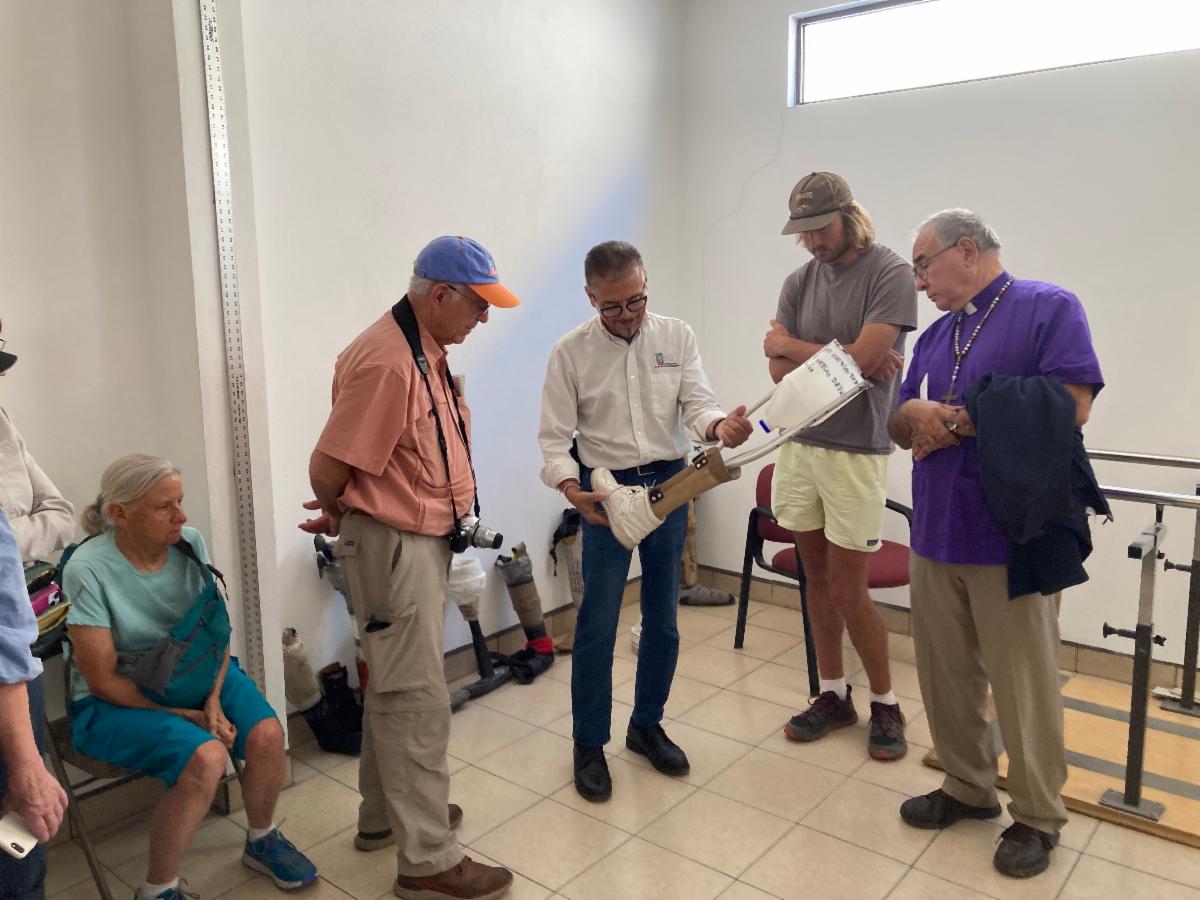
Below: ARSOBO Executive Director, Kiko Trujillo, demonstrating a prosthetic
during a recent BCA tour
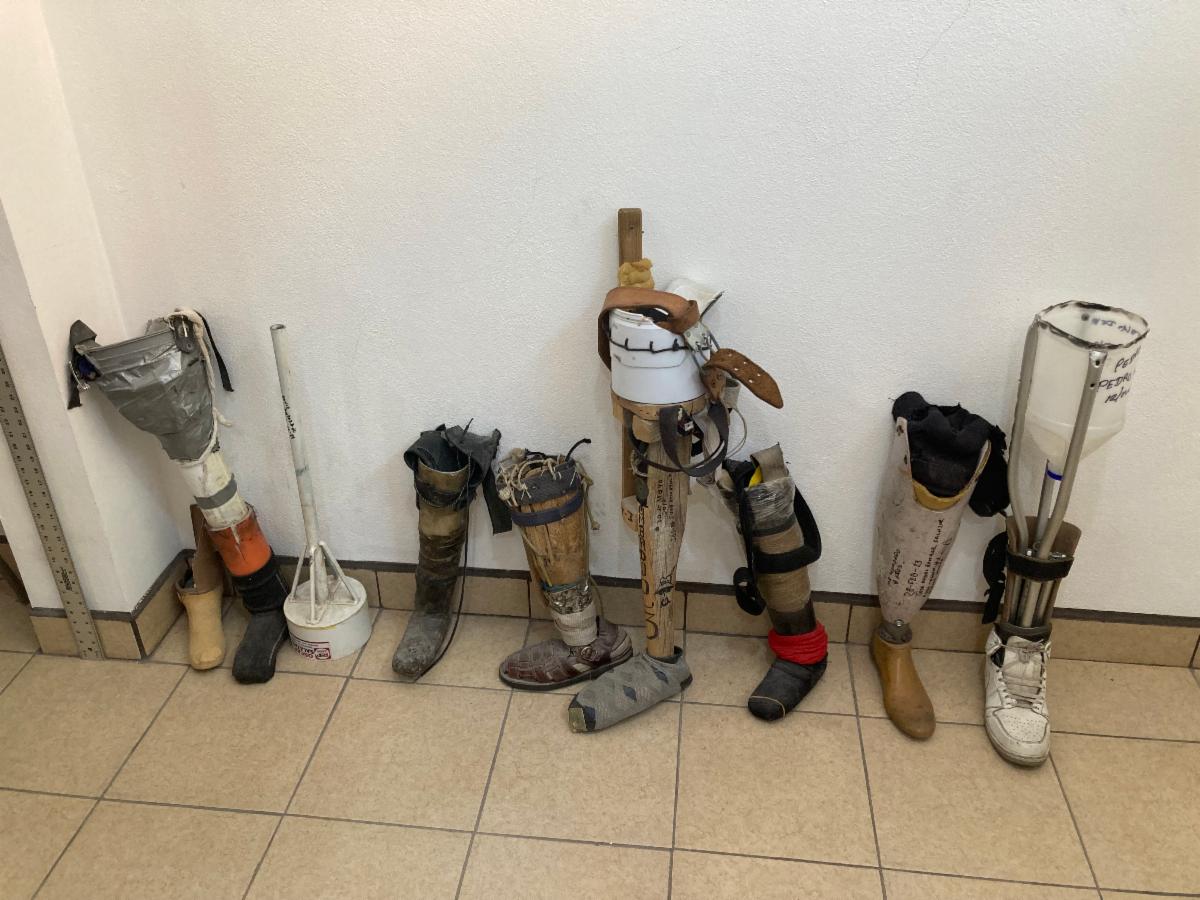
| | Below: "Handmade" prosthetics left by ARSOBO clients at the clinic in Nogales, Sonora | | |
Our office is open Tuesdays & Thursdays, 9:30am-3pm, or by appointment.
Office address: 8 Burruel Street, Tubac, AZ 85646
Mailing address: PO Box 1863, Tubac, AZ 85646
| | | | | |