|
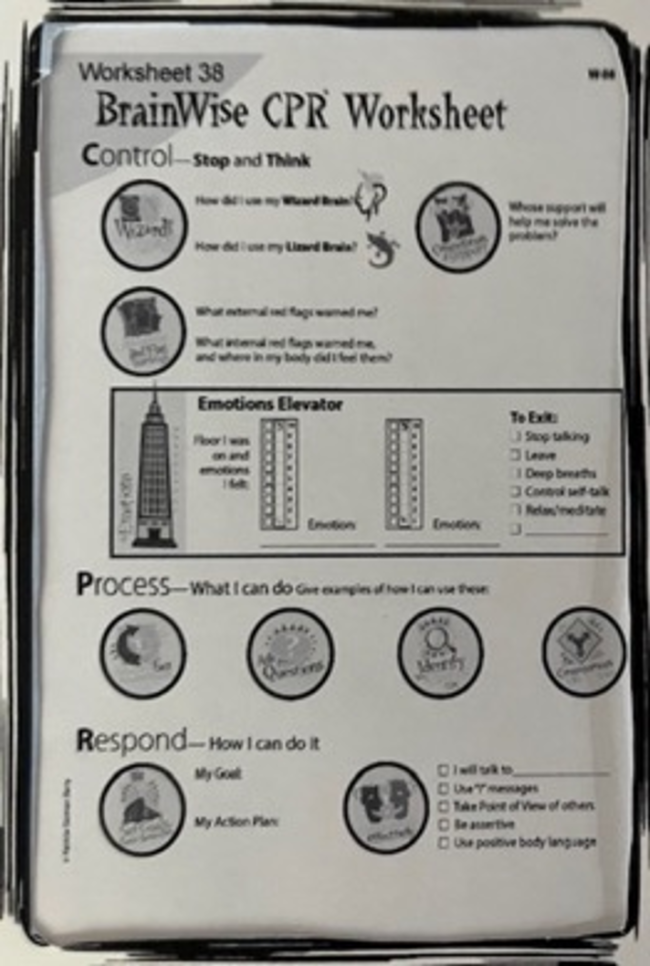
The 10 Wise Ways–The Brain’s CPR Skills. The 10 Wise Ways are first-response skills that help the brain to stop and think and thus prevent and manage problems. Below is a summary of the worksheet instructors and students use when they are learning the steps.
CONTROL (Wise Ways #1-4)
Wizard Brain over Lizard Brain. Students are asked to think about behaviors and identify which brain they fall under. This lays the foundation for the next steps as they go through each Wise Way and think about and analyze the situation.
Constellation of Support: Who are the people and resources that can help me?
Red Flag Warnings: What do I feel inside? (Hot? Tight muscles? Catch in throat? Rapid heart rate?) What messages is my behavior sending? (Ditching class, Ghosting supporters, Badmouthing school.)
Emotions Elevator: Identify different emotions and where they fall on the 10-story elevator. Go through methods that work to help students lower or exit the elevator. They know Lizard Brain reactions underlie the negative self-talk that reinforces their resistance: “I don’t want to do this.” “It’s too hard.” “I can’t do this.” “I don’t need to learn this.”
PROCESS (Wise Ways #5-8)
Fact or Opinion: Separate opinions (“I can’t do this”) from facts (“I know people who can help me.”)
Ask Questions: Use information gathered from the previous Wise Ways to form questions specific to helping solve the problem. A question for the Constellation of Support is “Who are the best people I can go to for help?”
Identify Choices: Students always have more than one choice, and identifying choices is critical for learning the next thinking steps.
Consequences of Choices. Students often cite this Wise Way as the most helpful, but it builds on the preceding concepts. Asking them to go through each choice and identify its Consequences Now and Later, (CNL) as well as its Consequences Affecting Others (CAO) is an exercise Lizard Brain users may have forgotten or never learned.
RESPOND (Wise Ways #9 &10)
Set Goals: Setting goals may be impossible for students who never learned thinking skills. The CPR Worksheet helps students build on, and connect, the concrete examples and activities they learned in their BrainWise class.
Communicate Effectively. Communication requires using all 10 Wise Ways. The worksheet takes the student through different communication methods, helping them understand how learning and using the Wise Ways gives them skills to succeed.
Reinforcement
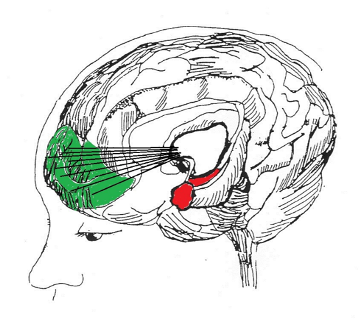
The part of the brain we call the Lizard Brain—the limbic system—is built for survival. These helpful Lizard Brain reactions are instant and automatic, triggered by fear. And hardwired. They fire the same way today as they did thousands of years ago.
Research has found that today’s brain interprets any intense emotion as fear – it reacts without thinking to all strong emotions – anger, revenge, sadness, even happiness – by triggering harmful Lizard Brain behaviors.
The Wizard Brain, by contrast, is not “pre-installed.” It represents the brain’s executive functions—working memory, cognitive flexibility, inhibitory control, planning, self‑monitoring, and emotional regulation. We are not born with these skills, they must be taught, practiced, and strengthened. Without repeated use, they weaken, and the Lizard Brain’s impulses take over.
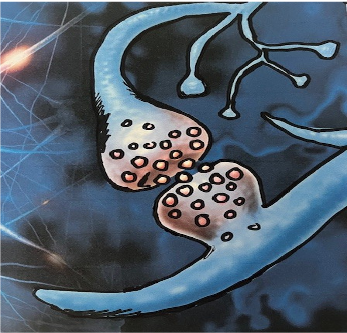
This is why practice is not optional—it is essential. Unlike survival instincts, thinking skills fade without reinforcement. Decades of research demonstrate that meaningful, lasting changes in attitudes, decision‑making, and behavior require 40–50 hours of structured practice (CDC HECAT 2021.) Students need repeated, guided opportunities to learn thinking skills. In other words, the Wizard Brain only becomes strong enough to override the Lizard Brain when students have had enough practice to build and reinforce the neural pathways that support wise choices.
BrainWise addresses this need directly. The Problem‑Solving Worksheet gives students repeated opportunities to use the 10 Wise Ways in real situations. Each time they identify red flags, check their emotions, ask questions, or think through choices and consequences, they strengthen the brain pathways that support executive function. Over time—and with enough practice—these pathways become faster, stronger, and more automatic. This is how students develop the lifelong ability to stop, think, and choose wisely, even when emotions surge.
Without this sustained practice, the Lizard Brain’s emotional and impulsive reactions regain control. With it, students build the cognitive wiring that allows the Wizard Brain to stay in charge.
|