|
Many leaders have some ideas of what good leadership looks like—listening actively, giving space to others, staying calm under pressure. And yet, it’s not uncommon to hear, “I know it in my head, but it is difficult to act on it.”
Even with many hours of training, it is difficult to change one's leadership style, since it is built on layers of experiences.
Recent developments in neuroscience offer understanding into how leaders can grow more effectively, and acquire new behavior. Learning new behavior is not always about information—it’s also about how the brain processes change.
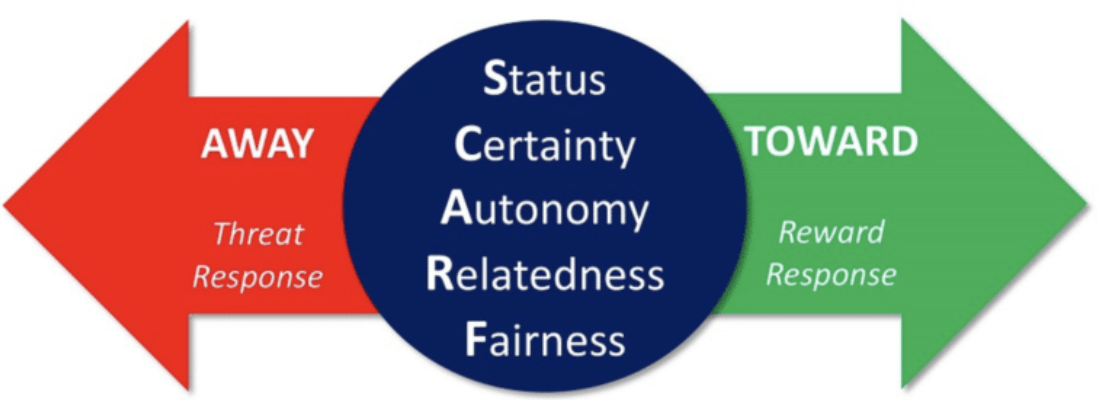
One such concept is the SCARF model, developed by Dr. David Rock.
SCARF stands for:
Status – our relative importance to others
Certainty – our ability to predict what’s next
Autonomy – our sense of control
Relatedness – how connected we feel to others
Fairness – our sense of just treatment
When one of these elements is under threat—even unconsciously—the brain shifts into a defensive mode. This narrows perspective, reduces openness and curiosity, and makes it harder to see options or consider alternative ideas. But when SCARF elements are supported, the brain moves into a reward state—becoming more creative, empathetic, and receptive to change.
|