|
CELEBRATING OUR DIAMOND JUBILEE IN LATIN AMERICA
75 YEARS AGO TODAY
BRANIFF INTERNATIONAL AIRWAYS INAUGURATED ITS FIRST SERVICE
FROM THE US MAINLAND TO CENTRAL AND SOUTH AMERICA
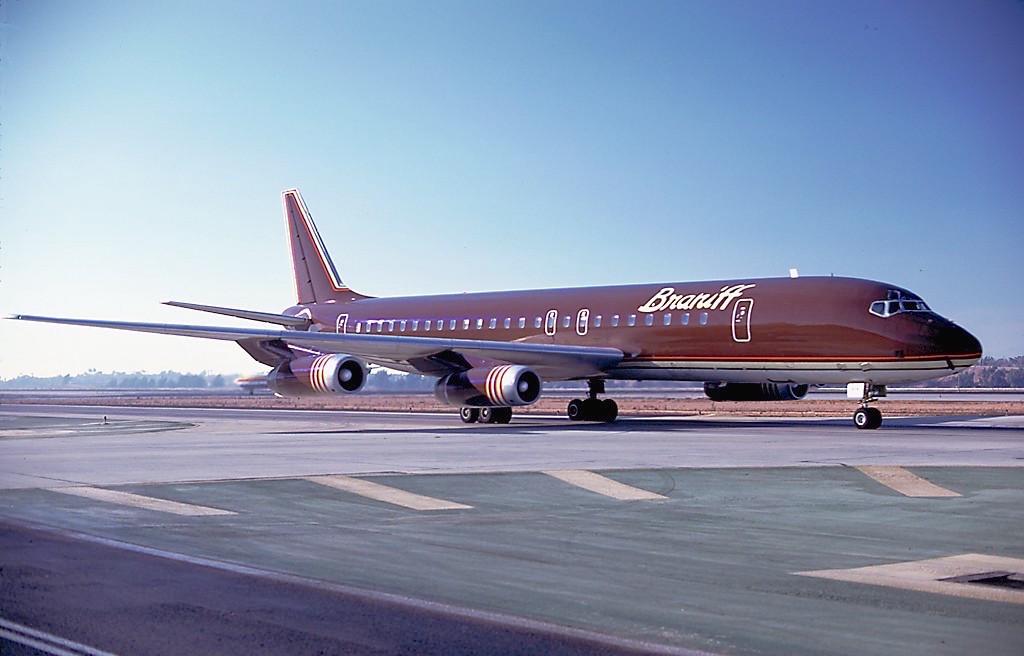
On June 4, 1948, a four-engine Douglas DC-6 airliner departed Dallas Love Field for Houston, Havana, Panama City and Guayaquil, marking the beginning of Braniff service in Latin America. On our 25th Anniversary Modern Master Alexander Calder painted one of our DC-8-62 Intercontinental Jets dubbed South America with Flying Colors to celebrate this milestone. Seventy-Five years later, thanks to our travel partners, you can still step aboard a jet at a Braniff gateway city and fly over a Braniff route to Central and South America.
Con Colores Triumfales de Braniff Internacional!
Sixteen days before the 20th Anniversary of the first flight of Braniff International Airways, the Dallas-based carrier inaugurated service from the U. S. Mainland to Cuba, Central, and South America. On this day, Friday, June 4, 1948, a Braniff International Airways Douglas DC-6 inaugurated the Airline's first service to the Central America and the South American Continent. The initial routing was Dallas, Houston; Havana, Cuba; Balboa City, in the Canal Zone and Guayaquil, Ecuador.
Additional routes of the original 7719-mile route award were added over the next three years that were awarded by the Civil Aeronautics Board in May 1946. Twelve years after the first Latin America flight Braniff inaugurated pure jet service over an even larger Latin America network and in 19 years the carrier merged with Pan American Grace Airways, making Braniff the largest U. S. carrier operating between the US Mainland
and South America.
After the June 4, 1948 inaugural, service was begun at Lima, Peru on June 18, 1948, and beginning on January 30, 1949, all South America flights terminated at Dallas Love Field rather than Houston. Service was extended to La Paz, Bolivia, from Lima on February 8, 1949; Lima to Rio de Janeiro on March 4, 1949; Asuncion, Paraguay was added from La Paz on March 4, 1950; Buenos Aires, Argentina added May 28, 1950; the Miami Gateway was added August 3, 1951; and Sao Paulo, Brazil was added on October 12, 1951.
Braniff's first flight to Latin America departed from Chicago on June 4, and headed for Dallas and then Houston, the new international gateway city on the Braniff route map. The big Douglas DC-6 departed the 1940 Air Terminal at Houston Municipal Airport at 6PM for its first stop at Havana Rancho Boyeros Airport, Cuba. The flight continued to Balboa City Howard Air Force Base and finally Guayaquil Simon Bolivar Airport, Ecuador, and was commanded by veteran Braniff Captain Ted Raines. In the Main Cabin Hostess Melanie Freyssinet and Pursers Eduardo Arrarte and Serbio Valdavia ensured that the passengers taking part in the historic flight were lavished with the best and friendliest Braniff inflight service.
On June 5, the luxurious Douglas DC-6 arrived at Guayaquil at 830AM marking the completion of the first Braniff service to South America. The first return flight arrived at Houston on Monday, June 7, which marked the first complete roundtrip of Braniff International Airways new service to Cuba, Central, and South America. Braniff initially operated three weekly roundtrip flights with three types of service along the routing from Houston to Guayaquil with stops at Havana and Panama. Reduced rate Tourist Class DC-4 service, the lowest price DC-6 Sleeper flights, and reduced tariffs on all South American flights highlighted the new service levels.
From Houston, two Douglas DC-6 Sleeper flights departed Houston each Monday and Friday at 6PM and arrived at Havana at 1045PM and Balboa City, at 340AM. The Monday flight continued on to Guayaquil, Ecuador and landed at 730AM the following morning, perfectly timed for a day's business or leisure. Braniff's economical Douglas DC-4 Tourist Liner flights departed Houston at 300PM on Wednesdays only and continued to Cuba, Panama, and landed at Guayaquil at 755AM the following day, again perfectly timed for the day's planned activities.
Douglas DC-6 service to the north departed Guayaquil at 1210AM on Sundays and Tuesdays with intermediate stops at Balboa and Havana before arriving Houston at 1110AM. The Tourist Liner DC-4 flight departed Guayaquil each Thursday at 1055PM and arrived at Houston on Friday afternoon at 1250PM. Douglas DC-4 Tourist Liner aircraft were easily convertible from passenger to cargo or a combination of the two as needed.
On DC-6 flights Upper Berth Sleeper service was available for $25.00 USD extra per night, which was the lowest price in the industry for the luxury amenity. Sleeper Chair service, available at no additional charge, featured push button reclining and lounging that could be curtained off into a private compartment. Later, Braniff's DC-6's were equipped with 32 Sleeper Seats that were converted into Sleeper Berths with the service beginning on South America routes on March 1, 1950.
Braniff's fares to Latin America were highly discounted offering many leisure travelers the opportunity to fly from the U. S. to the Southern Continent. Chicago to Havana was a reasonable $116.00 USD; Balboa $195.00 USD; and Guayaquil $310.00 USD. All fares listed were one-way with round trip fares featuring a discounted charge.
On Wednesday, May 22, 1946, the Civil Aeronautics Board awarded Braniff Airways, Inc., its first routes from the US Mainland to Cuba, and Central and South America. The coveted route award also included direct service to Monterrey and Mexico City, Mexico. As a result of the award of Braniff's first non-U. S. domestic routes, the carrier officially changed its name to Braniff International Airways, effective on the same date.
From the earliest days of Braniff, the carrier had had an interest in serving the Southern regions. In 1943, a Mexican subsidiary owned by Braniff cofounder Thomas Elmer Braniff, Aerovias Braniff was created with service starting in 1945. During World War II Braniff operated flights from the US Mainland (Texas) to the Panama Canal known as The Banana Run. Braniff's unique WW2 service gained its nickname because Airline's pilots agreed to fly local grower's bananas to the US Mainland so they could be sold since the war had curtailed much of the banana trade in Panama, and a way to get them to the US market.
As a result of Braniff's superb service levels maintained over the Banana Run, for the US Government, the carrier was granted Foreign Air Mail Route 34 that encompassed a 7719-mile route from Texas to South America. Services commenced using Douglas DC-4 and DC-6 aircraft on June 4, 1948. The US Government also looked favorably on another U. S. carrier operating in the region for competitive reasons.
Pan American Grace Airways, Inc., known as Panagra, owned jointly by Pan American World Airways and W. R. Grace and Company, had been in a constant battle over Panagra's desire to extend its routes north from Panama to Miami. This routing was already operated by Pan Am, and they felt it would cause their passenger and cargo loads to drop precipitously. These events persuaded President Harry S. Truman to agree that another airline was needed to compete with Panagra. The hope was that a competitor would diffuse the bickering, that the President felt looked badly on U. S. interests. These developments in turn led to the selection of Braniff Airways for the route authority.
Braniff's new route would operate from Dallas to Houston with continuing service to Havana, Cuba, Balboa, Panama, Guayaquil, Ecuador, Lima Peru, LaPaz, Bolivia, and Asuncion, Paraguay. At Asuncion, the route split to either Sao Paulo and Rio de Janeiro, Brazil, or Buenos Aires, Argentina. Effectively, Houston was made an international gateway as a result of the South America services as well as San Antonio and Laredo which would provide direct service to Monterrey and Mexico City.
However, due to a prolonged battle with the Mexican government, Braniff did not serve Mexico City until 1960 and Acapulco at the end of 1965. Aerovias Braniff had been operating in Mexico just prior to the South America award. However, due to pressure from Pan Am, Aerovias' route authority was revoked by the Mexican Government, which began twelve years of conflagration between the two countries.
Although the CAB had authorized Braniff to operate over the South American routes, the countries where those routes were located had not given their approval. Braniff assisted the U. S. State Department in negotiating bi-lateral air agreements with the affected Latin countries. The airline was required to garner the permission from each nation before services could start which was the dominant reason that it took two years for the first scheduled flight to depart.
Flight times from the new Houston Gateway to destinations along Braniff's 7719-mile Latin America system were as follows:
Havana, Cuba - 4 hours 10 minutes
Balboa, Panama - 9 hours 40 minutes
Quito, Ecuador - 16 hours 30 minutes
Guayaquil, Ecuador - 17 hours 40 minutes
Lima, Peru - 21 hours 10 minutes
La Paz, Bolivia - 37 hours 30 minutes
Asuncion, Paraguay - 42 hours 10 minutes
Sao Paulo, Brazil - 45 hours 45 minutes
Rio de Janeiro, Brazil - 47 hours 20 minutes
Buenos Aires, Argentina - 45 hours 30 minutes
The special convertible DC-4 Tourist Liner operated each Wednesday from Houston to South America beginning in 1948. In a matter of minutes the uniquely designed DC-4 could be converted to all cargo, all passenger, or a combination passenger and cargo configuration. All passenger seats on the Tourist Liner were leather covered and lined each side of the cabin and faced inward. The Tourist Liner allowed Braniff to adjust loads according to traffic demands and allowed the carrier to offer the world's first Coach service. The first DC-4 configured as a Tourist Liner was NC65145 with NC59952 converted later.
Braniff became the first US airline authorized to use JATO or Jet Assisted Takeoff at La Paz, Bolivia, the highest airport in the world. The Jet Assist was fitted to Braniff's Douglas DC-4 airliners in 1949. Chief Pilot and veteran Braniff Captain R. V. Carleton conducted the JATO proving tests at LaPaz in early January 1949. Braniff became the first airline to be certificated by the Civil Aeronautics Commission, as a result of the successful completion of the Carleton led tests, to operate JATO aircraft at LaPaz.
On Wednesday, March 9, 1949, Braniff International Airways inaugurated nonstop Douglas DC-6 aircraft equipped with Sleeper Berths from Lima, Peru to Rio de Janeiro, Brazil. The new route was the longest scheduled nonstop flight at the time and was the first to link the West and East Coasts across the heartland of South America.
Braniff service to Rio featured two weekly flights southbound from Houston on Sunday and Tuesday. Connecting service would depart from Dallas, Chicago, and Kansas City that met with the Sunday and Tuesday Houston to Rio departure. Rio passengers arrived the following day on Monday and Wednesday. Return flights departed Rio for the U.S. Mainland on Wednesday and Friday and arrive the following day.
Houston southbound flights departed at noon with intermediate stops in Havana, Cuba, Balboa, Panama, and Guayaquil, Ecuador, arriving at Lima at 5AM the following morning. The DC-6 continued nonstop to Rio arriving in the Brazilian capitol on Monday and Wednesday afternoons. Braniff's convenient Douglas DC-4 Tourist Liner service operated each Thursday between Houston and Lima allowing for connections on the Rio bound DC-6 flights.
Braniff offered a reasonable fare of $495.00 USD from the U.S. Mainland to Rio. A 10-percent discount was given to any passenger who purchased a roundtrip ticket between the two destinations. Between Houston and Lima a special 25-percent discount was given to passengers who chose Braniff's thrifty and convenient Douglas DC-4 Tourist Liner. Passengers who chose the combination Tourist Liner, with stops in any of the cities enroute, then DC-6 nonstop from Lima to Rio, were able to fly for only $375.00 USD one way or $715.95 USD roundtrip.
A large-scale construction of needed navigation infrastructure was completed by Braniff for the introduction of the new Transcontinental nonstop service across the South American Continent's heartland. New navigation aids and powerful radio outlets were installed at La Paz and Santa Cruz, Bolivia, and Campo Grande, Brazil. There was concern that the high terrain that the DC-6 would be operating over would cause erratic radio and navigation signals and that the jungle would act like a "signal sponge" and absorb the signals from Santa Cruz and Campo Grande. However, the equipment turned out to operate with near perfect precision leaving many industry experts and critics baffled.
The Douglas DC-6 airliners also required extensive modification in order to operate over the 2,548 mile distance. Braniff's DC-6's wing tanks were more than doubled in size to accommodate additional fuel required for the route that was flown in only 9.5 hours. The fuel capacity on the DC-6 grew to 4201 gallons or 25,206 pounds of aviation fuel, which allowed the big Douglas four-engine airliner to fly for 19 hours or 4400 miles at 5000 feet or 17 hours or 4200 miles at 10,000 feet.
The 9.5 hour Douglas DC-6 flight from Lima to Rio de Janeiro, Brazil, was the fastest on record. Service from Houston, Texas to Rio was also accomplished in record time of only 26 hours and 25 minutes including four intermediate stops enroute.
On Thursday, May 16, 1957, Braniff International Airways inaugurated its first Douglas DC-7C El Dorado service to South America. The big new long-range airliner began domestic service with Braniff in October 1956. South America El Dorado service operated between Newark and Rio de Janeiro via the Braniff/Eastern Airlines interchange service, which began in 1955.
On March 17, 1955, Braniff International Airways placed an order for seven long-range Douglas DC-7C Seven Seas four-engine airliners. The $20 million USD purchase, the largest in Braniff history, was announced by Braniff President Charles Edmund Beard.
The deal was signed by President Beard and Douglas Aircraft Corporation President Donald W. Douglas. The price included the seven aircraft, spare parts, spare engines, and special shop equipment that would be required to maintain the new airliner that was an enlarged version of the the Douglas DC-7.
President Beard noted that the new airliners would be used on Braniff's international route system for which it was perfectly designed. Specifically, the new DC-7C would operate Braniff routes between the U.S. Mainland and South America as well as between Chicago and Texas domestically. Scheduled delivery for the first three aircraft was fall of 1956 with the remaining four arriving during the first half of 1957.
The big Douglas airliner could seat up to 81 passengers but was configured in a 62 seat all First Class configuration or with a mixed First Class and Coach Class of 75 passengers. In the mixed configuration 59 passengers rode in Coach Class and 16 in the forward First Class compartment. A luxurious Lounge was also installed along with elegant buffet accommodations that would feature the finest in inflight cuisine and beverage service on the long-haul international flight segments.
On August 18, 1955, Braniff Airways began a unique interchange service Eastern Airlines to provide service between the East Coast of the United States and Latin America. The interchange was awarded to enable Braniff and Eastern passengers to have full access to Braniff's extensive Latin America system that had not been profitable since service began in 1948, even with extensive subsidy. The new service departed from New York Idlewild Airport, with an Eastern Airlines crew in command of a Braniff DC-6 that continued to Washington DC National Airport and Miami. At Miami a Braniff crew assumed control of the flight before it continued to Panama and South America. Six months later Braniff began service between Dallas and Newark, which marked the carrier's first service from Texas to the East Coast.
On May 8, 1957, Braniff International Airways made history by flying the very first nonstop flight by a commercial airliner from Rio De Janeiro to Miami International Airport a distance of 2800 statute miles. The aircraft that made this record breaking flight was Braniff's new and luxurious Douglas DC-7C El Dorado aircraft. Registered as N5902, the high flying luxury liner made the Rio to Miami record trip in 14 hours and 30 minutes. Passengers reported that they felt fresh and relaxed even after the long trip on the DC-7C. The aircraft began its journey from Rio with 7824 gallons of gasoline and 240 gallons of oil. El Dorado arrived in Miami with 1000 gallons of fuel and 180 gallons of oil which would have been enough to continue on as far as Washington, DC. Gross weight on takeoff was 135,000 pounds or 8000 pounds less than Maximum Certificated Takeoff Weight. On board were 35 passengers and 6 crewmembers as well as passenger luggage.
The Rio to Miami record breaking leg was one of the ending flights of the gala DC-7C El Dorado South America Pre-Inaugural Flight that departed from Dallas Love Field on May 7, 1957, and then proceeded to New York then Washington, DC, Panama City, Guayaquil, Lima, Bogota, Sao Paulo, Rio, Miami and back to Dallas Love Field. It was a remarkable trip that marked another Braniff Airways first. Service commenced using the DC-7C in Latin America on May 16, 1957, via the Braniff/Eastern Interchange from New York to Rio following the same routing as the pre-inaugural flight of May 7 and 8.
On Wednesday, May 15, 1957, Braniff International Airways inaugurated Douglas DC-6 El Bogotano Service from New York/Newark to Bogota, Colombia. The service was as a result of signing a new bi-lateral air agreement between the two countries. Braniff became the first U.S. airline to offer service between the capitals of Colombia and Washington, DC, an intermediate stop on the new route.
Three flights weekly were flown over the new route that departed from Newark Airport with intermediate stops in Washington, DC (National), Miami, and Panama before continuing on to Bogota. Flights between New York and Miami were operated by Eastern Airlines crews via the Braniff/Eastern Interchange Service that provided single-plane service to Latin America from New York.
Braniff began the first jet service from the US to Panama and Peru on April 1, 1960. The 106-passenger (50 First Class; 56 Coach) Boeing 707-227 El Dorado Super Jet was the first scheduled jet to operate over these routes and it cut flying time to South America in half. Eastern Airlines crews operated Braniff's Super Jet from New York Idlewild to Miami, which departed each Saturday at 1250AM and arrived at 320AM.
The Interchange agreement between Braniff and Eastern had been in successful operation since August 1955. Braniff crews took command at Miami for the nonstop flight to Panama which arrived at 551AM. The flight continued on to Lima for a 942AM arrival and finally Buenos Aires at 517PM or 417PM Eastern Time.
The fast El Dorado Super Jet was only ordered by Braniff and featured the short Boeing 707-120 fuselage with the engines of the Boeing 707-320 Intercontinental Jet. Braniff's Big Boeing could fly from Lima, Peru, to Rio de Janeiro, Brazil, a distance of 2552 miles, in a quick 4 hours and 38 minutes. At a cost of $5 million USD each, the El Dorado Super Jets were classified as Mach .9 aircraft or just under the speed of sound or Mach 1 and cruised at 656 miles per hour.
In addition to the new El Dorado Jet service, five Douglas DC-7C flights provided service from Washington DC, New York and Miami to Panama, Colombia, Ecuador, Peru, Bolivia, Paraguay, Argentina, and Brazil. Both First Class and Tourist service was available on the DC-7C flights which offered the finest inflight service between the two continents. All Braniff flights between the US Mainland and South America featured elegant inflight Gold Service that included such delicacies as Fresh Smoked Salmon and Alaskan Crab Canapes.
Over the next three years Braniff continued to inaugurate El Dorado Super Jet service throughout South America. All jet service was commenced between the two continents, on October 27, 1963, as Braniff tripled its South America service and retired the last of the Douglas DC-7s from Southern Hemisphere service. Braniff's soon to be merger partner, Panagra, was still operating piston-powered aircraft over much of its Latin American system but had also begun DC-8-31 jet service in the region in May 1960. a month after Braniff offered the first jet service in South America.
South America services as a result of the all jet equipment placement on October 27, were:
1. New York Idlewild to Miami, Panama and Bogota, on Monday, Tuesday, Friday and Saturday Flight 977
2. New York Idlewild to Miami, Panama, Lima, and Buenos Aires, on Tuesday Flight 979
3. Chicago O'Hare to Houston and Panama, on Wednesday Fligth 45
4. New York Idlewild to Miami, Panama, Guayaquil, Lima, Sao Paulo and Rio de Janeiro, on Wednesday Flight 973
5. New York Idlewild to Miami, Panama, Lima, Asuncion, and Buenos Aires, on Friday, Flight 979
6. New York Idlewild to Miami, Panama, Lima, Sao Paulo and Rio de Janeiro, on Sunday Flight 975
Jet service was delayed between Lima and LaPaz so that runway lengths could be increased to accommodate the big Boeing 707-227 airliners. Douglas DC-7C aircraft operated this route while the modifications were completed.
Since the Airline had began serving South America in June 1948, it had operated the southern continent system at a loss each year. Accounting methods and procedures combined with political considerations within the region prevented the Latin American Division from demonstrating profitability. In 1965, however, Braniff showed a true full year's profit for the first time of $313,000 USD, compared to a loss of $27,000 USD in 1964. Traffic was increasing across the Braniff Latin America Division and the prospective merger talks with W. R. Grace and Company and Pan American World Airways created the necessity of showing the true strength of Braniff's southernmost operations.
A financially sound airline operating in the South American region would be more palatable to the CAB and even the President when the merger was presented for approval in 1966. The merger was approved and Panagra was amalgamated into Braniff's system on February 1, 1967.
Interestingly, Panagra was slightly larger than Braniff's LAD operation. In 1964, Panagra flew 278,350,000 Revenue Passenger Miles compared to Braniff's 224,000,000 flown in the region. However, Braniff's total system wide Revenue Passenger Miles flown for the year were 1,804,362,000. Panagra brought 1370 employees to the new merger and not one employee was terminated as a result of the joining of forces. Instead, Braniff began hiring additional employees to handle the increased traffic across the region.
Braniff gained critical access to many major cities in South America that it had never been authorized to fly to prior to the merger. Additional long haul routes were requested and granted by February 1969, further strengthening Braniff as the leading carrier from the U.S. Mainland to South America. On February 1, 1967, Braniff International merged with Pan American Grace Airways which used the trade name Panagra. Braniff purchased the 39 year old South American West Coast airline for $30 million USD from two owners, W. R. Grace and Company and Pan American World Airways, Inc.
Braniff Executive Vice President Charles Edward Acker presented a check for $15 million USD to W.R. Grace and Company Assistant General Council Walter Morris, in January 1967 signaling the historic finalization of the merger between the two carriers. Braniff had also presented a check for $15 million USD to Pan American World Airways for their one-half share in Panagra. With the payments in place, the merger was allowed to commence. Panagra had been Braniff's chief competitor along the South American West Coast since Braniff began serving the region in 1948. Panagra's history dated back to 1928, the same year that Braniff was first founded.
Braniff President Charles Edmund Beard negotiated an earlier agreement for Braniff to buy Panagra for $22 million USD in 1964. Arrangements were made for Braniff to buy W. R. Grace's half of Panagra for $11 million USD with negotiations to continue into early 1965 for the purchase or Pan Am's half of Panagra. A projected merger date was to have been late summer 1965. However, the proposal was not approved by Pan American Chairman Juan Terry Trippe. With the overhaul of Braniff's management team in April 1965, a new merger proposal was delayed until further evaluation could be completed by the new group.
Pan Am had been under pressure from the Civil Aeronautics Board, which had requested that the Justice Department file charges against Pan American, to remedy antitrust problems that the carrier had become involved in by limiting the northward expansion of Panagra. Panagra only operated as far North as Panama and then extended south along the West Coast of South America to cities such as Cali, Colombia, Quito and Guayaquil, Ecuador, Lima, Peru, La Paz, Bolivia, Antofagasta and Santiago, Chile, and Buenos Aires, Argentina. Pan Am operated flights north from Panama to Miami.
A New York Federal Court ruled that Pan Am was in violation of the Sherman Anti Trust Act by its actions in regards to limiting Panagra's Northern expansion. The New York Court found that Panagra was not in violation of the antitrust act but that Pan Am was in violation and should divest itself of Panagra stock and its ownership. In 1963, the case was sent to the Supreme Court which which ruled that the case fell under the jurisdiction of the CAB.
In December 1965, Braniff International successfully negotiated the purchase W. R. Grace and Company's 50-percent share in Panagra for $15 million USD. Three months later on March 17, 1966, Braniff further completed an agreement to purchase Pan American World Airways's 50 percent share in Panagra for the same amount. The plan was forwarded to the Civil Aeronautics Board who approved the merger agreement in July 1966. Although, Braniff ultimately paid more for Panagra in its second negotiation, it actually received a better deal because Panagra had ordered and paid significant deposits down valued at $27 million USD on five new long-range McDonnell Douglas DC-8-62 Intercontinental Jets, which Braniff received when the two carriers merged.
President Lyndon Baines Johnson approved the merger in October 1966 and on January 19, 1967, Braniff International completed the purchase agreement. The two carriers merged on February 1, 1967, and the combined airline operated 30 flights a week to South America. Braniff also acquired Panagra's interest in the Peruvian airline Faucett.
On Saturday, February 1, 1969, Braniff International inaugurated nonstop Boeing 727-100 trijet service from New Orleans, Louisiana, to Panama City, Panama. The new service from New Orleans was part of a route award that gave Braniff jet service authority from five other U.S. Gateway cities to South America.
The day before Thanksgiving 1968, President Lyndon Baines Johnson approved the recommendation from the Civil Aeronautics Board to award Braniff nonstop jet service authority from six U.S. Gateway cities including New Orleans, Miami, San Francisco, Los Angeles, Washington, DC, and New York City. From San Francisco and Los Angeles the award allowed Braniff to operate to Rio de Janeiro and Buenos Aires with intermediate stops in Bogota and other current Braniff points in South America.
From Miami and Panama, the authority removed the restrictions that had required flights through Miami be operated via an interchange agreement. New York/Newark, Miami, Washington DC, New Orleans and Houston would become coterminals on Braniff routes to Panama City. Braniff was further granted nonstop authority from all six Gateways or coterminals to all current Braniff destinations in South America other than Brazil. A restriction continued that required Braniff flights that serve Brazil must also serve Lima, Peru.
On Monday, February 3, 1969, Braniff International inaugurated East and West Coast nonstop service to South America. Braniff had inaugurated nonstop service from New Orleans to Panama City on February 1, 1969. Both new services were the result of a route authority granted by the CAB and approved by the President in November 1968, that cleared Braniff to serve South America from six US Mainland cities without the use of interchange agreements.
Braniff 727 Trijet aircraft were used to inaugurate the New Orleans to Panama nonstop service on February 1. Inaugural flights from the East and West Coast co-terminals on February 3, were operated using McDonnell Douglas DC-8-62 Intercontinental Jets. Nonstop service was commenced from San Francisco to Los Angeles and then continued nonstop to Lima, Peru. The California to Lima service marked the first time that single-carrier service was offered by a U.S. airline between Northern California and the West Coast of South America. Initial service called for two weekly roundtrip flights using DC-8-62 aircraft.
Across the U.S. on the East Coast, a Braniff DC-8-62 departed simultaneously from Washington DC to South America beginning the first jet service from the nation's capital to the Southern Continent. Washington Dulles would now have service to five new Latin American destinations including Panama City, Quito, Lima, Santiago, and Buenos Aires, Argentina. Twice weekly roundtrips were operated with the DC-8-62 Intercontinental Jets featuring a range of 6000 miles and carrying 164 passengers.
Since beginning service in June 1948, Braniff International expanded its South American services throughout the 1970s. Boeing 747s were added to many of the Latin routes beginning in August 1979 in connection with the carrier's expansion to the Pacific and Far East. This further enhanced Braniff's superb service levels throughout the region by providing single-plane service from Asia/Pacific and The Far East to Latin America. Braniff served Latin America until May 12, 1982, when the carrier ceased operations due to excessive competition from the Airline Deregulation Act of 1978, a global recession, and unprecedented fuel cost increases.
A plan to sell the Latin America Division to Pan American World Airways, whose Chairman was Braniff's former President Charles Edward Acker, was not approved by the CAB in early 1982. Eastern Airlines, a former possible Braniff merger partner, ultimately leased the routes from Braniff on April 28, 1982, and began service after Braniff ceased operations. By the end of the 1980s, Eastern Airlines ceased operations and sold Braniff's former Latin American routes to American Airlines, which still operates the service today.
Braniff International
www.braniffinternational.com
www.braniffboutique.com
|