"Bread for Our Journey" is an online approach to faith development you can do as an individual, in informal small groups, or as a family.
This weekly collection is curated and written by Saint John's staff.
These reflections are intended to deepen our understanding
of scripture, to open our awareness of different voices and wisdom,
and to broaden our spiritual practices that bring creativity and justice to our world.
|
|
Wherever you see this "For All Ages" icon, consider inviting your children to connect and reflect in these ways with you.
|
|
December 19th, 2021
"Incomprehensible Love"
This is the Fourth Sunday of Advent. We light the Candles of Hope, Peace, Joy, and Love.
Today we hear from the prophet Mary, whose song echoes the call for us to care for our neighbors and “make room in the inn". As we prepare for the birth of Christ, how can our church become a house where the Holy will be born anew–offering respite, sustenance and care, opening the doors ever wider to those seeking shelter from the onslaught of life? No one church can do it all, but each can do something, and as we do, the lonely and frightened spaces within us are filled with the light of Hope, Peace, Joy, and Love.
Today we offer the Light of Love to illumine the Door of Welcome. May this light shine in our hearts, in our lives, and in our church. May Love awaken us to possibilities and lead us to greater hospitality. There IS room in this Inn, a House for the Holy.
~ Dr. Marcia McFee, Worship Design Studio
|
|
READ
Our scripture for today is taken from the worship readings for this Sunday.
Luke 1: 46-55
Mary said, “With all my heart I glorify the Lord!
In the depths of who I am I rejoice in God my savior.
He has looked with favor on the low status of his servant.
Look! From now on, everyone will consider me highly favored
because the mighty one has done great things for me.
Holy is his name. He shows mercy to everyone,
from one generation to the next,
who honors him as God. He has shown strength with his arm.
He has scattered those with arrogant thoughts and proud inclinations.
He has pulled the powerful down from their thrones and lifted up the lowly.
He has filled the hungry with good things and sent the rich away empty-handed.
He has come to the aid of his servant Israel,
remembering his mercy, just as he promised to our ancestors,
to Abraham and to Abraham’s descendants forever.”
Common English Bible
|
|
REFLECT ON THE TEXT
Use these questions as prompts to journal on your own or to reflect in discussion with family or friends.
Today the prophet Mary, who foretold of a love beyond what the world had seen, gives us a view of God's love that has resounded for generations.
Theologian Elizabeth Johnson writes, “The Magnificat is a revolutionary song of salvation whose political, economic, and social dimensions cannot be blunted. People in need in every society hear a blessing in this canticle. The battered woman, the single parent without resources, those without food on the table or without even a table, the homeless family, the young abandoned to their own devices, the old who are discarded: all are encompassed in the hope Mary proclaims.”
Mary manifests the truth of God's love by answering "yes" to God's call on her life.
In what ways are you responding "yes" to live out God's love?
In what ways is your church responding yes?
How have you seen Mary's words happen in life?
|
|
A great way to engage with all ages today is to talk about love. Wherever you have conversation with your family today - around the dinner table or in the car - ask these questions.
When do you feel loved?
Who do you know you can ask for help on when things are hard?
How can you show love to other people, especially people who feel alone and scared?
|
|
REFLECT ON OUR WORLD
As theologian Karl Barth asked preachers to preach with "a Bible in one hand and a newspaper in the other" so, too, are we called to reflect on what is going on in the world and how it intersects with our faith.
What does loving our neighbor look like in a mental health crisis?
How can our churches and communities reduce the stigma around mental health conditions?
|
|
Click on the image to print page to help you create a mandala.
As you go through each circle below, color, write or draw in each one.
Starting in the center circle of the mandala, send yourself a loving blessing. In the next bigger circle, think about your love getting bigger to people you love, like your family and friends. In the next circle out send love to your community and neighbors. In the circle around that one send loving-kindness to difficult people in your life. In the circle that holds them all send kindness out to the entire world and even the universe.
|
|
|
Think about what best represents your kind wishes to each group of people you thought about. For example, a loving-kindness wish to a friend might be hug; for the world, it might be peace.
Practicing this kind of meditation helps us feel more connected to ourselves and others, and it gives us a way to visualize the love we send to ourselves and the world.
|
|
LIVE IN WONDER
Through this series we will explore stories of hope, peace, joy, and love that evoke our sense of wonder and awe.
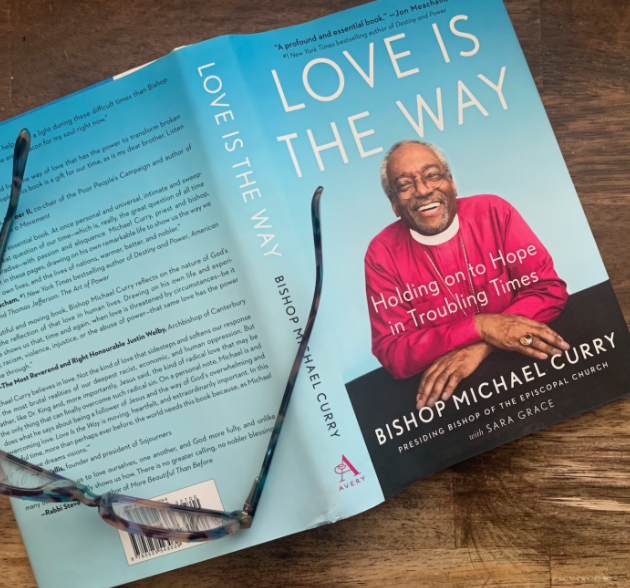
A Passage from Episcopal Bishop Michael Curry's book, Love is the Way: Holding on to Hope in Troubling Times
There is a Jewish proverb, "Before every person there marches an angel proclaiming, 'Behold, the image of God.'" Unselfish, sacrificial living isn't about ignoring or denying or destroying yourself. It's about discovering your true self - the self that looks like God - and living life from that grounding. Many people are familiar with a part of Jesus' summary of the law of Moses: You shall love your neighbor as you love yourself. Yourself. Loving the self is a required balance. If we fail in that, we fail our neighbor, too. To love your neighbor is to relate to them as someone made in the image of God. And it is to relate to yourself as someone made in the image of the God. It's God, up, down, and all around, and God is love.
The ability to love yourself is intimately related to your capacity to love others. The challenge is created a life that allows you to fulfill both needs. I often speak of the loving, liberating, life-giving God. Sharing godly love liberates the true self, so that we can more fully live and discover that place where "your deep gladness and the world's great hunger meet," as Frederick Buechner put it Wishful Thinking: A Theological ABC.
I don't know exactly why it works that way, other than to channel my grandma: "We've got a good God and a good Gospel." But I've seen it happen enough times to be confident in saying it. Perhaps loving others saves us from the confusion, the frustration, and ultimately the neurosis that comes when we try to center the world around ourselves. Or perhaps it allows us to step outside the self enough to see ourselves with some distance, for a better perspective on what's missing. Or maybe when loving ourselves is hard, practicing loving others strengthens the muscle enough to turn the force inward.
All I know is that I have seen the wonderful personal transformations that happen when people start navigating with God's GPS. I've experienced it myself. It was during my college years that I started to be able to answer the question "What do I truly need to be happy?" Or as old Black preachers used to say, "What are you gonna do with your dash?" - that space between the birthdate and end date on your tombstone.
|
|
LOVE IN BELOVED COMMUNITY
Each week let us explore different ways to love our neighbors and help build God's kin-dom on earth together.
“Power without love is reckless and abusive, and love without power is sentimental and anemic. Power at its best is love implementing the demands of justice, and justice at its best is power correcting everything that stands against love.” ~ Rev. Dr. Martin Luther King, Jr.
Dr. King’s beloved community exhibits agape love, which, as the love of God operating in the human heart, seeks to “preserve and create community.” Christ’s mature followers love each other as well as those who persecute or do evil against them. Christians confront hate with love because agape love derives its essence from the cross of Christ, which brings redemptive power. This love does not accept injustice or evil as acceptable. Rather, it loves by way of justice, which ensures equity in access, participation, and flourishing for everyone.
Some Christians might view the beloved community as a euphemism for the Kin-dom of God. In this way, people interpret the beloved community as something that is achieved in the future, but Dr. King’s words were for the present age, both national and global. For him, the human community meeting the basic needs of every person becomes beloved.
When an opportunity presents itself to confront hate and interrupt injustice or to faithfully respond to an interruption in your own patterns, ask yourself, If not me, who? If not now, when?
|
|
One of the best ways that we can show love to one another is to listen with genuine care and interest.
When you talk with someone, how can you help them know that you are listening?
Make a phone call to someone today with the purpose of simply listening deeply with love.
|
|
REST IN GOD
In this section we invite you to explore practices that center and ground us in Divine presence.
Click on the video image link to listen to "Room For Us All" by The Many.
As you listen, meditate on the questions and ideas below.
|
|
|
- Have you ever felt like you were not welcomed?
- Who have you made room for or who has made room for you?
- What keeps us from welcoming certain people?
- Repeat to yourself "love is not a limited resource."
- When we shift from a scarcity mindset and realize there is plenty of love to go around (and enough room for all), how might that shift our actions, our policies, our relationships?
|
|
PRAY
This week's prayer is a reflection from Arrows of Light, a collection by Steven Charleston, a bishop in the Episcopal Church and a citizen of the Choctaw Nation.
We are on the threshold now, standing just a step away from the light, with all the things we dreamed so near at hand, it seems like a different world from the one we thought we knew. Love is like that. It transforms. It enlightens. It makes whole. Love is there, right there, waiting for us to discover it and release its power into the lives of countless people, people who will be restored before they even know it, lifted up before they can even believe it, swept into tomorrow with the joy of a holy promise fulfilled.
We are on the threshold now, ready to step over, cross over into a time of peace, a hope so strong it casts out every shadow, now and forever.
Amen.
|
|
To receive these Bread for Our Journey emails each week,
If you have questions or suggestions for this curriculum,
|
|
|
|
|
|
|