|
Breaking News: CMS Releases CY 2027 Final Physician Fee Schedule and ASC/Hospital Outpatient Rules
| |
What it means for interventional pain physicians, and what ASIPP is doing next
On November 4, 2026, the Centers for Medicare & Medicaid Services (CMS) released the CY 2027 final rules for the Medicare Physician Fee Schedule (CMS-1848-F) and the Hospital Outpatient Prospective Payment System and Ambulatory Surgical Center payment system (CMS-1850-F). Both take effect January 1, 2027.
The results are mixed. Physician payments fall again. ASC rates for most common pain procedures decline, while hospital outpatient rates rise sharply. There is good news on one front: CMS dropped the proposed multiple procedure discount for neurostimulation codes, a change ASIPP strongly opposed. Meanwhile, Medicare Advantage plans will receive over $13 billion more in 2027.
ASIPP’s efforts on your behalf come first below, followed by the details of each rule.
| |
ASIPP’s Efforts: Working to Eliminate the ASM
The mandatory Ambulatory Specialty Model (ASM) begins January 1, 2027, with payment adjustments of up to ±9% applied in 2029 based on 2027 performance. CMS declined to delay it (CMS-1848-F), but the fight is far from over.
ASIPP’s work to eliminate the ASM continues:
- ASIPP is scheduled to meet with CMS.
- ASIPP has been working closely with members of Congress. The chairs of the Oversight and Energy and Commerce Committees have personally contacted CMS Administrator Dr. Mehmet Oz about the ASM.
- ASIPP is pursuing options to include relief in the legislative packages expected in December, before the new Congress convenes.
- This effort has significant bipartisan support from Republicans and Democrats, and ASIPP is hopeful the ASM may be eliminated.
ASIPP proposed an Independent Physician Payment Modifier to separate independent physicians from hospital-employed physicians. The modifier would address the cuts independent physicians absorb in ASCs and hospitals from the facility practice expense reduction and the efficiency adjustment (ASIPP).
CMS did not adopt a modifier in the final rule. However, CMS noted that commenters agreed using facility place of service as a stand-in for physician employment “is imprecise,” and that most recommended a more direct way to identify hospital-employed physicians. CMS stated that it “may consider comments about the site-of-service differential in future rulemaking” (CMS-1848-F).
The issue remains open, and ASIPP is actively working to advance the modifier with CMS and Congress.
ASIPP Is Still Working for You
ASIPP will continue to press CMS and Congress on the ASM, the Independent Physician Payment Modifier, the same-day E/M reduction, and the ongoing erosion of physician payment. We will keep members informed as these efforts progress. Your voice matters; please share how these changes affect your practice and patients with ASIPP.
| |
Good News: Neurostimulation Multiple Procedure Discount Removed
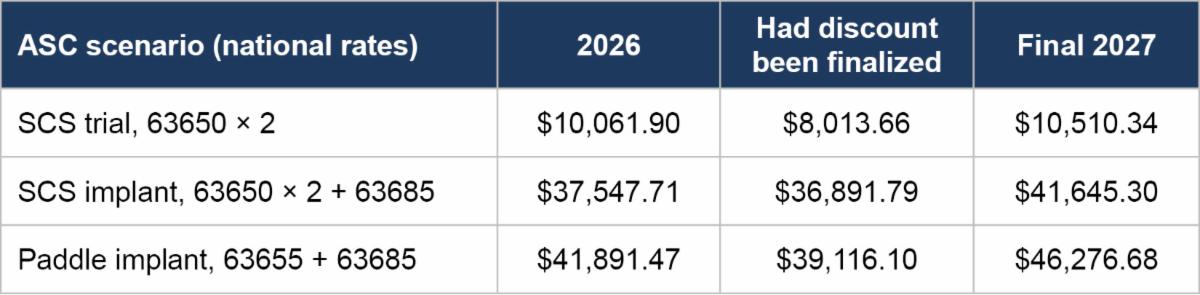
In the proposed rule, CMS would have applied the 50% ASC multiple procedure discount to 14 device-intensive codes, including spinal cord and peripheral nerve stimulation codes 63650, 63655, 63663, 63664, 63685, 64553, 64555, 64561, 64575 and 64590. In the final rule, CMS stated that the change “was inadvertent and not an intentional proposed policy change” and that these procedures “will continue to be identified with an ‘N’,” meaning they are exempt from the discount (CMS-1850-F).
This preserves meaningful ASC payment for neuromodulation:
|
Physician Fee Schedule
Conversion factor: The conversion factor falls from $33.4009 to $32.6286 (−2.31%), mainly because the one-year 2.5% statutory increase for 2026 expired. Qualifying APM participants receive $32.9548 (−1.83%) (CMS fact sheet). The final conversion factor is lower than the proposed $32.84.
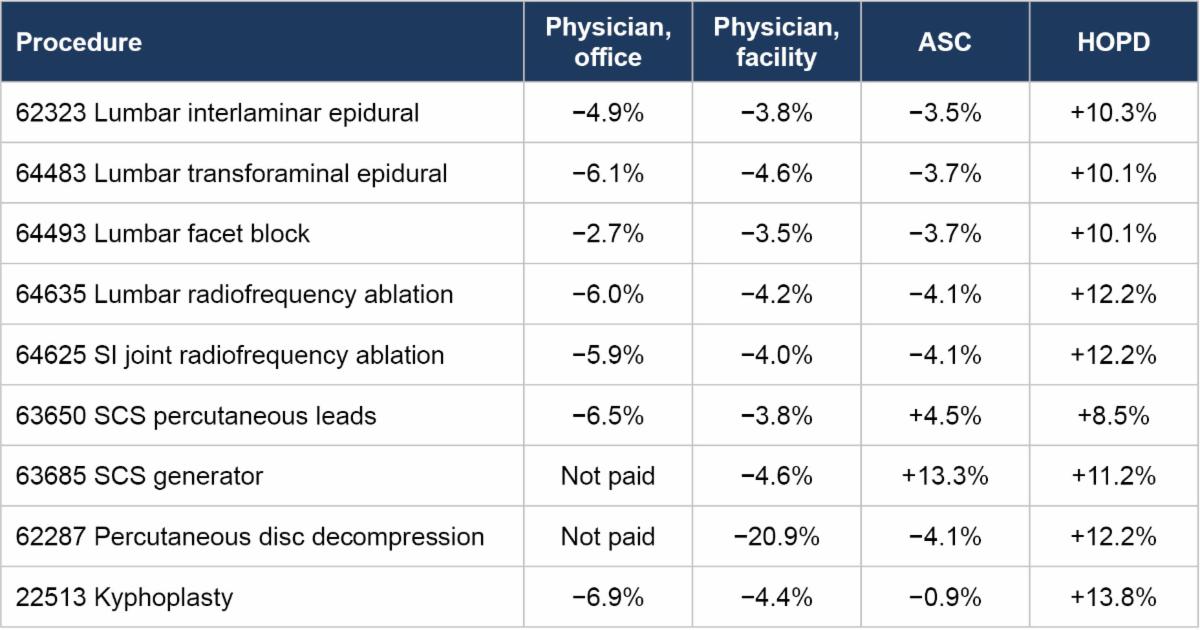
Overall impact: CMS estimates a −2% impact for interventional pain management as a specialty, before the conversion factor reduction is applied. Most injection and radiofrequency ablation professional fees fall 3% to 7% in the office and 2% to 5% in facilities.
Same-day E/M with modifier 25: CMS scaled back its proposal. The reduction now applies only to office E/M visits billed with modifier 25 on the same day as a 0-day global procedure, and the lower-paid service is paid at 80% instead of the proposed 50% (CMS fact sheet). 10- and 90-day global procedures, including radiofrequency ablation, are excluded. The cut is still significant. A 99214 with a lumbar transforaminal epidural (64483) in the office falls from $400.48 to $353.56 (−11.7%).
Code-specific cuts:
- Percutaneous disc decompression (62287): work RVU cut from 9.03 to 6.23 (−31%), over the RUC’s recommendation of 7.06.
- Occipital (64405) and trigeminal (64400) nerve blocks: cuts of 12% to 21%.
- SI joint fusion (27279): paid in the office setting for the first time.
Efficiency adjustment: No new efficiency cut was applied for 2027. Under CMS’s three-year cycle, the next one is expected in CY 2029 rulemaking.
| |
Medicare Advantage Plans Get Over $13 Billion More; Physicians Get Cut
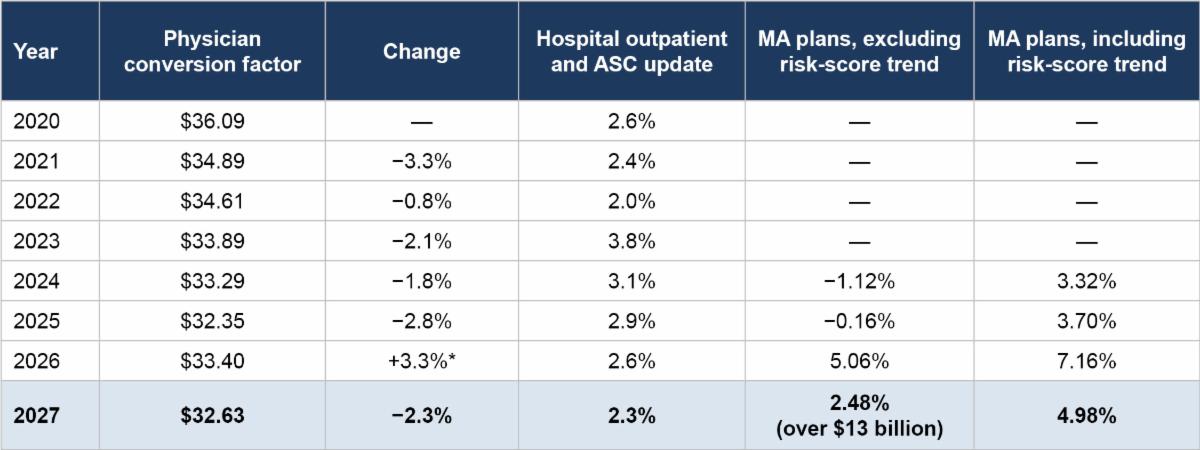
While physicians face another conversion factor cut, CMS’s final 2027 rate announcement raises payments to Medicare Advantage (MA) plans by an average of 2.48%, or over $13 billion, far above the 0.09% CMS first proposed. When risk-score trend from coding and population changes is included, the increase is 4.98% (CMS fact sheet). None of this reaches physicians automatically: MA plans generally pay physicians at or below Medicare fee schedule rates, so the 2.31% cut typically flows through to MA contracts.
Medicare payment updates by system, 2020 to 2027
| | |
*Includes the one-time 2.5% statutory increase that expired after 2026. The 2024 conversion factor shown is the value in effect from March 9, 2024. Hospital outpatient and ASC figures are the annual market basket updates; the 2027 hospital outpatient conversion factor rose more because of the 340B redistribution described below. MA values are CMS’s expected average changes in plan payments (CMS 2024, 2025, 2026 and 2027 rate announcements).
The bottom line: From 2020 to 2027, the physician conversion factor fell about 9.6% ($36.09 to $32.63), while hospital outpatient and ASC updates compounded to an increase of about 21%. Over the last four years alone, MA plans received cumulative increases of roughly 20% including risk-score trend.
| |
ASC Payment System
The ASC conversion factor rises 2.3%, from $56.322 to $57.721 for ASCs meeting quality reporting (CMS-1850-F). However, relative weights for common pain procedures declined, so most injection and ablation rates fall about 3.5% to 4.1%:
- Interlaminar epidural (62323): $387.46 to $373.96
- Transforaminal epidural and facet block (64483, 64493): $485.51 to $467.67
- Radiofrequency ablation (64635, 64625): $948.66 to $909.47
Device-intensive procedures increase: 63685 +13.3%, 62362 +10.9%, 64590 +8.1%, 64555 +7.9%, 27279 +6.9% and 64628 +5.7%. Nerve blocks paid at office rates in ASCs fall sharply (64400 −26.8%, 64405 −23.4%).
| |
Hospital Outpatient (HOPD) Payment System
The hospital outpatient conversion factor rises from $91.415 to $99.970. Most of this comes from CMS’s cut to 340B drug payments (now average sales price minus 28%), which by law must be redistributed to non-drug services (CMS fact sheet). As a result, most pain procedure rates rise 8% to 12% (64483: $903.63 to $995.07; 64635: $1,995.02 to $2,239.03). Most hospitals will keep somewhat less, because the 340B remedy offset on non-drug services increases from 0.5% to 2% (CMS fact sheet).
The site-of-service gap widens. ASC payment for a transforaminal epidural drops from about 54% of the hospital rate in 2026 to 47% in 2027. This further disadvantages the lower-cost, physician-owned ASC setting.
| | Summary of Payment Changes, 2026 to 2027 (National) | | Facility amounts are paid separately from the physician professional fee. Code-level tables for all settings are available to members. | |
ASM: What the Final Rule Changed
CMS did not allow a reporting-only first year, but it did finalize several changes to the model (CMS-1848-F):
- A new lumbar spine MRI overuse measure, attributed to a single physician.
- Replacement of the functional status measure with the Functional Outcome Assessment measure (Q182).
- A transition year for interoperability requirements.
- A new 5-point scoring adjustment for rural participants.
| | |
All amounts are national unadjusted Medicare rates; local payment varies by geographic adjustment.
| | |
Please contact us with any questions.
Thank you,
| | | Laxmaiah Manchikanti, MD
ASIPP Chairman of the Board & CEO
drm@asipp.org | Mahendra Sanapati, MD
ASIPP Chief Operating Officer
drs@apccweb.com | Annu Navani, MD
ASIPP President
annu@navani.net | | | | | |