|
On October 31, 2025, the CMS issued a Final Rule that announces final policy changes for Medicare payments under the Physician Fee Schedule and other Medicare Part B issues effective on or after January 1, 2026.
Even though we have submitted numerous comments (ASIPP’s detailed comment letter), letters, and congressional requests, CMS has not made any changes in the Final Rule compared to the proposed rule. There are numerous misinterpretations, consequently resulting in errors to the payments.
PHYSICIAN PAYMENTS
Conversion Factor
- Beginning in January 2026, there will be two separate conversion factors (CF): one for qualifying alternative payment model (APM) participants (QPs) and one for physicians and practitioners who are not QPs.
- In 2026, the CF will be $33.57 for QPs and $33.40 for non-QPs. These amounts represent increases of 3.8% and 3.3%, respectively, compared to the 2025 CF of $32.35.
- The CF update is primarily based on three factors:
- A statutory update in the Medicare Access and CHIP Reauthorization Act that provides a 0.25% CF increase for non-QPs and 0.75% increase for QPs
- A 0.49% budget neutrality adjustment increase
- A one-time 2.5% increase due to the budget reconciliation legislation
Efficiency Adjustment
CMS finalized its proposal to apply an efficiency adjustment to non-time-based codes and services. As such, the agency will apply a negative 2.5% reduction to the work relative value unit (RVU) and the corresponding intraservice portion of physician time for non-time-based services. The efficiency adjustment will not apply to evaluation and management, care management, behavioral health, new codes, and any services on the Medicare Telehealth Services List.
Modifications to Indirect Practice Expense Methodology
CMS finalized its proposal to revise the methodology for allocating indirect practice expense (PE) costs for facility-based services by reducing the portion of facility PE RVUs by half the amount allocated to non-facility-based services. Previously, allocation was equal in both settings.
Indirect practice costs include expenses such as rent, administrative staff, scheduling, and billing and coding. CMS cites stakeholder concerns that paying both the physician and the facility for the same indirect costs may result in duplicative payment.
This shift in resources from facility to non-facility practices shifts reimbursement from one to the other. Non-facility practices will experience an increase in reimbursement while hospital-based practices will see a decrease in reimbursement.
Specialty Impact
As a result of these sweeping methodology reforms, on average, the interventional pain management specialty will experience a payment differential based on the physician’s practice setting.
- Physicians that practice in a facility setting (hospitals and ASCs) will see a reimbursement decrease of approximately 11%.
- Physicians in independent practices and office settings will see a reimbursement increase of approximately 7% to 10% for services provided in office settings, including procedures and E/M services.
- Unfortunately, for independent physicians providing services in ASCs, which is mistakenly considered as a facility as ASCs do not provide any benefits for practice expenses, there will be reimbursement decreases of 8% to 11% for any services provided in ASCs.
Telehealth
CMS finalized most telehealth policies as proposed:
- Streamlined Telehealth Services List: CMS will simplify the process for adding services to the list by removing the “provisional” and “permanent” distinction and focusing the review solely on whether the service can be effectively delivered via two-way audio-video.
- Removal of Frequency Limitations: Frequency limits for subsequent inpatient, subsequent nursing facility, and critical care consultation telehealth services will no longer be in place.
- Permanent Virtual Direct Supervision: For services requiring direct supervision, CMS will permanently allow this supervision to occur through real-time audio and visual interactive telecommunications (not audio-only).
The agency did revise the provision on the teaching physician policy and will allow teaching physicians to have a virtual presence in all teaching settings, in clinical instances when the service was furnished virtually, on a permanent basis.
Quality Payment Program (QPP)
CMS’ proposed rule limited changes to QPP in an attempt to provide stability to the program. As such, CMS finalized its proposal to keep the Merit-Based Incentive Payment System (MIPS) performance threshold at 75 points through the 2028 performance period/2030 MIPS payment year.
Ambulatory Specialty Model (ASM)
CMS has proposed the Ambulatory Specialty Model (ASM) to hold specialists financially accountable for managing chronic conditions in Original Medicare, focusing on low back pain and congestive heart failure. The model begins January 1, 2027, and runs through 2031, with payment adjustments starting in 2029.
Specialists—including anesthesiology, pain management, neurosurgery, orthopedics, and PM&R—would face payment adjustments from –9% to +9%, based on performance in disease management, adherence to clinical guidelines, and care coordination. However, CMS plans to use a “redistribution percentage” of 85%, ensuring Medicare savings by reducing total physician payments, unlike MIPS or the Hospital VBP program.
CMS refused to make any changes to Ambulatory Service Model for low back pain management as we have requested.
Summary of CMS Payment Rules
This summary highlights the good, bad and the ugly.
Good:
- Conversion factor increase of 3.6% to 3.8%.
- Payment increases of approximately 10% for office procedures and 7%–10% for evaluation and management (E/M) services.
- 2.6% payment increase for Ambulatory Surgery Center (ASC) services.
Bad:
- No permanent extension of telehealth services, despite multiple established rules. However, our sources indicate telehealth is included.
- A 2.5% efficiency adjustment applied to work RVUs for non-time-based services.
Ugly:
- 8%–10% reductions in physician payments for services provided in hospitals or ASCs. Our sources indicate telehealth is included.
In addition, physicians continue to face increasing administrative burdens, including preauthorizations, expanding Medicare regulations through LCDs (which are adopted by Medicare Advantage Plans, Medicaid, and incorporated into private medical policies), and frequent audits. At any given time, approximately 30% of interventional pain physicians are under audit. This has resulted in significant time spent on documentation, preauthorizations, and adherence to the appropriateness criteria set by LCDs and medical policies.
This is not a realistic assessment, given that physician payments have already decreased by 33% since 2001. The situation is further compounded by an ever-growing number of rules, regulations, and administrative burdens associated with EMRs—and now AI. Physician workload continues to rise, not fall. Remember the concept of “pajama time,” as many physicians work late into the evening to complete their documentation.
- The proposed conversion factor increase is only a temporary measure and may be clawed back, similar to the post-COVID cuts that followed payment increases under the Trump Administration.
- ASCs are being grouped with hospitals, despite being overwhelmingly owned and operated by independent physicians.
- ASCs essentially function as extensions of office practices.
- Independent physicians providing services at hospitals and ASCs are inaccurately classified as hospital-based physicians.
ASIPP will be providing you with additional analysis and is considering providing a webinar to highlight the key changes in 2026 Physician Fee Schedule for interventional pain management community.
2026 Fee Schedules
| |
Prolonged use of melatonin for the treatment of insomnia was associated with an increased risk for heart failure, hospitalization, and/or all-cause mortality, an observational study showed.
Individuals with insomnia taking melatonin for a year or more had an 89% higher chance of incident heart failure over 5 years than those who didn’t take it. They were also 3.5 times more likely to be hospitalized for the condition, the preliminary findings, which are not yet peer reviewed, suggested.
“Long-term nightly use may not be as risk-free as we assumed,” lead author Ekenedilichukwu Nnadi, MD, chief resident in internal medicine at SUNY Downstate/Kings County Primary Care, Brooklyn, New York, told Medscape Medical News.
Click here to read the full article.
| | |
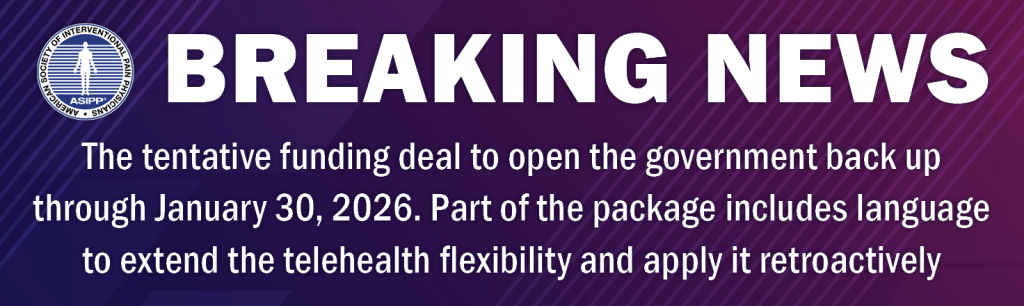
The tentative funding deal to open the government back up through January 30, 2026 includes language to extend the telehealth flexibility and apply it retroactively.
Lawmakers in the Senate cut a deal Sunday, November 9, to end a federal government shutdown, but the path ahead remained unclear given the lack of involvement of either the White House or Republican leadership in the House of Representatives.
Sunday evening’s 60-40 vote cleared the chamber’s filibuster threshold and puts the resolution on schedule for a vote Monday or early in the week. Democrats could still gum up the process, but many took Sunday’s development as a sign that the caucus’s moderates had firmly decided on a course.
Eight moderate Democrats got on board with an agreement backed by their GOP colleagues that would extend government funding through the end of January while further negotiations take place on a range of issues, including subsidies for Affordable Care Act health plans, multiple news outlets reported Sunday evening.
The tentative funding deal to open the government back up through January 30, 2026. Part of the package includes language to not only extend the telehealth flexibility but also apply it retroactively.
The bipartisan agreement struck by moderate lawmakers on Nov. 9 is now on track for full approval this week in Congress. That vote will likely take place in the second week of December.
Click here to view a summary of the bill.
Click here for the full story
| |
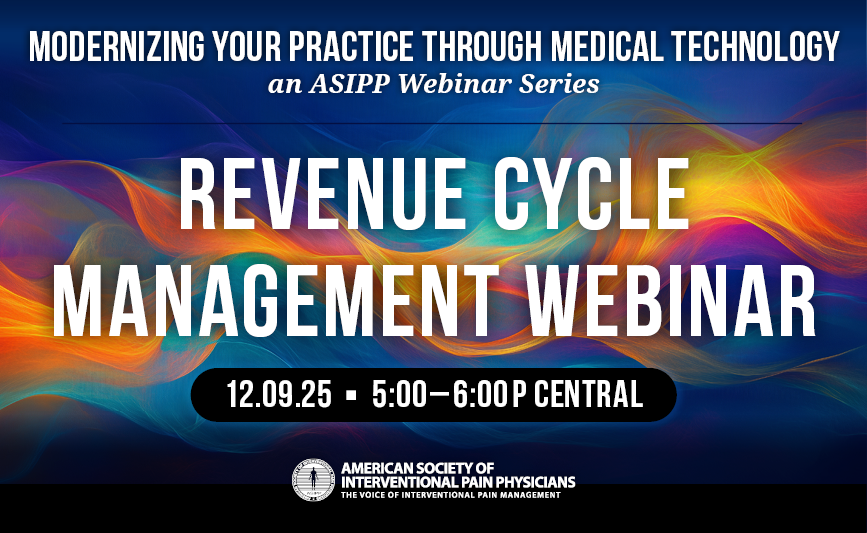
Upcoming ASIPP Webinars
Register today!
| | |
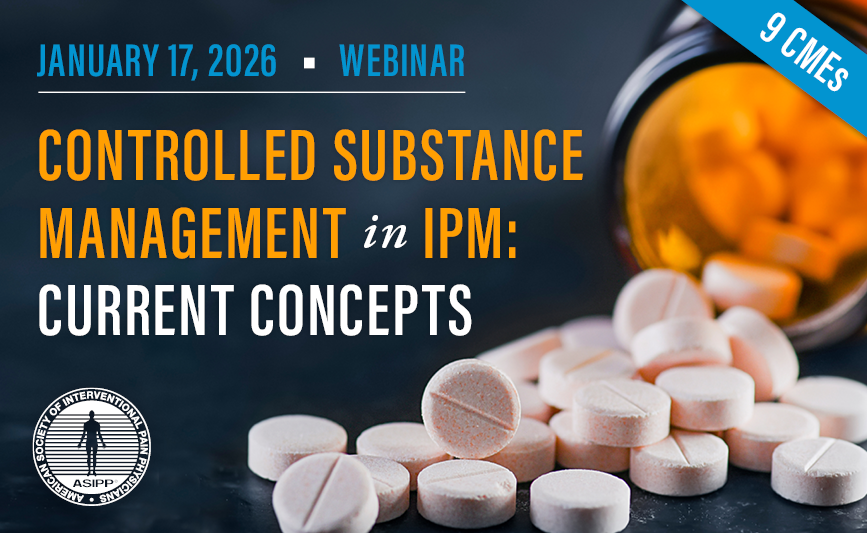
Join ASIPP on January 17, 2026, for an important webinar: Unveiling the Complexities of Controlled Substance Management in Interventional Pain Management (IPM).
Controlled substance management continues to present challenges for pain physicians, from evolving regulations and compliance requirements to balancing patient care with risk mitigation. This webinar will provide expert guidance to help you navigate these complexities and strengthen your practice.
| | |
Join ASIPP on January 31, 2026, for our webinar Strategies for Successful Practice Management. This program will focus on practical approaches to strengthen your practice through improved documentation, compliance strategies, and effective practice-building techniques.
Whether you are looking to optimize workflows, ensure regulatory readiness, or position your practice for long-term growth, this webinar will provide valuable insights to support your success.
| | |
Oura's initiative illustrates the promise and peril of wearables
Ōura Health, maker of the sleek ring that tracks sleep, stress, and fitness, has formally petitioned the FDA for clearance to continuously monitor blood pressure through its optical sensors. If approved, the Ōura Ring would become one of the most well-known consumer wearables not worn on the wrist to provide continuous, clinically validated blood pressure readings.
The petition is an impressive leap forward for the company and for wearable technology. For decades, blood pressure has been a static snapshot taken in a clinic, once or twice a year, often under fluorescent lights and leading to patient anxiety. (I have yet to meet someone who is not at least somewhat bothered by the cuff that normally reads blood pressure.) Continuous, real-world monitoring will reveal the rhythms of blood pressure as people go about their lives: at work, under stress, asleep, or recovering from exercise.
As exciting as this step is, the rise of continuous biometric surveillance also surfaces profound questions about accuracy, accessibility, and who really owns the torrent of data these devices generate.
Click here to read the full article.
| | |
ASIPP is proud to launch our Resident and Fellow Mentorship program. This initiative is designed to connect trainees with experienced pain physicians to foster professional growth, provide guidance, and strengthen the future of our specialty.
Each mentor would be paired with one to two trainees, but can take more if interested. Trainees will be responsible for initiating introductions and arranging at least one to two video calls per year. These sessions will provide opportunities for mentees to seek advice on clinical decision-making, career planning, research opportunities, and professional development.
We believe that your experience, expertise, and insight can have a lasting impact on the next generation of pain physicians. By volunteering as a mentor, you will play a critical role in shaping the future of our field and ensuring that ASIPP continues to cultivate excellence in interventional pain medicine.
If you are interested in serving as a mentor, please confirm your participation by filling out the appropriate form below.
| | |
The distress that Will Bynum later recognized as shame settled over him nearly immediately.
Bynum, then in his second year of residency training as a family medicine physician, was wrapping up a long shift when he was called into an emergency delivery. To save the baby’s life, he used a vacuum device, which applies suction to assist with rapid delivery.
The baby emerged unharmed. But the mother suffered a severe vaginal tear that required surgical repair by an obstetrician. Soon afterward, Bynum retreated to an empty hospital room, trying to process his feelings about the unexpected complication.
“I didn’t want to see anybody. I didn’t want anybody to find me,” said Bynum, now an associate professor of family medicine at Duke University School of Medicine in North Carolina. “It was a really primitive response.”
Shame is a common and highly uncomfortable human emotion. In the years since that pivotal incident, Bynum has become a leading voice among clinicians and researchers who argue that the intense crucible of medical training can amplify shame in future doctors.
Click here to read the full article.
| |
Join Us in New Orleans for ASIPP 2026
Earn CMEs, Expand Networks, and Explore the Future of Pain Management
| | |
It is our pleasure to invite you to the American Society of Interventional Pain Physicians’ 2026 Annual Meeting, where we will continue to shape the future of Interventional Pain Management.
This 28th Annual Meeting will take place Thursday, March 19 through Saturday, March 21, 2026, at the Hilton New Orleans Riverside in New Orleans, Louisiana.
The 2026 Annual Meeting will provide the tools, knowledge, and connections you need to thrive in the evolving field of interventional pain management.
| | JOIN or RENEW your ASIPP Membership for the best registration rates. | | |
Christie Stabile, 56, was first diagnosed with COVID in May 2020. While she initially recovered, within a few weeks she started experiencing extreme fatigue, dizziness, and a rapid, irregular heartbeat. Eight months later, she was diagnosed with long COVID, as well as mast cell activation syndrome and postural orthostatic tachycardia syndrome, two conditions often tied to long COVID.
“I came down with COVID four more times, which didn’t help the situation,” said Stabile, who lives in Clifton, New Jersey. “Each time, I’d develop an inflammatory response that led to rashes; swollen, blue feet; and a heartrate that went through the roof for no reason at all.”
While her long COVID is managed by a team of specialists that include a cardiologist, hematologist, and gastroenterologist, she’s also turned to complementary therapies. These include everything from red light therapy, over-the-counter supplements such as BPC-157, vitamin B infusions and apheresis, or “blood washing.” Much of the time, these therapies haven’t been covered by insurance, so she has spent thousands of dollars out of pocket.
Click here to read the full article.
| |
Several factors may be at play
| | |
Apply now!
December 13, 2025
January 24 & February 7, 2026
Four (4) hour virtual exam
- ABIPP Path – Combined CCPM/ CSM Exam
For those with subspecialty in Pain Medicine
Two (2) hour virtual exam
- ABIPP Competency Exam in IPM
For those without primary board certification
Two (2) hour virtual exam
- ABIPP Competency Exam in Regenerative Medicine
Two (2) hour virtual exam
- Controlled Substance Management Competency Exam
Two (2) hour virtual exam
- Documentation, Coding, Compliance, Practice Management Competency Exam
Two (2) hour virtual exam
| | |
If you want exhibit A that artificial intelligence (AI) is taking over medicine, look no further than OpenEvidence.
An AI medical search and question-answering tool sometimes referred to as ChatGPT for doctors, OpenEvidence draws on peer-reviewed sources like The New England Journal of Medicine and JAMA to ground answers in published evidence. Launched by the Mayo Clinic Platform_Accelerate program in 2023, it’s now the most widely used and fastest-growing AI application.
“It’s achieved mass adoption,” said Isaac Kohane, MD, PhD, professor of genomics and bioinformatics at Harvard Medical School, Boston. “And right now, it’s free. You can see it open on all the computers in nursing stations of most hospitals in the United States.”
Click here to read the full article.
| | | |
We're excited to let you know that the new ASIPP Community, hosted by DocMatter, is now live!
The ASIPP Community on DocMatter will serve as a place for members to collaborate around clinical and research topics to advance the care of their interventional pain patients.
Click here to be a part of the conversation!
| | |
Pain Medicine Case Reports (PMCR) and Editor-in-Chief Alaa Abd-Elsayed, MD, PhD would like to invite you to submit case reports and case series to the PMCR journal. Your article will be published free of charge.
Open access journals are freely available online for immediate worldwide open access to the full text of published articles. There is no subscription fee for open access journals. Open access journals are no different from traditional subscription-based journals: they undergo the same peer review and quality control as any other scholarly journal.
Interested in becoming a member of the PMCR Editorial Board?
Editorial board members are asked to review 2-6 manuscripts per year. Please submit your most up-to-date CV to sgold@asipp.org for consideration.
For more information or to submit your articles, click here.
| | |
We are excited to announce that Pain Medicine Case Reports (PMCR) journal (eISSN 2768-5152) has been accepted for inclusion in MEDLINE and PubMed, the prestigious bibliographic database of the U.S. National Library of Medicine. PMCR, a companion publication to the prestigious Pain Physician journal by ASIPP, joins its counterpart in achieving indexing in both MEDLINE and PubMed, marking ASIPP’s dual presence in these renowned databases.
The inclusion of PMCR journal in MEDLINE signifies a higher level of selectivity, as MEDLINE consists of the top 5,200 biomedical journals. This indexing also means that articles from PMCR will be searchable using NLM Medical Subject Headings (MeSH terms) and other metadata.
The selection for MEDLINE follows a rigorous evaluation process by reviewers from the Literature Selection Technical Review Committee (LSTRC). According to their criteria, the scientific quality of a journal’s content is the primary factor considered for indexing.
We extend our congratulations to the Pain Medicine Case Reports Editor-in-Chief, Deputy Editor-in-Chief, Journal Team, and Editorial Board for this achievement, which underscores the significance and excellence of this esteemed journal.
| | | | |