MedPAC members express concern about broker payments and underfunded public counselors
The system of paying Medicare agents and brokers more money if they enroll someone in a Medicare Advantage plan rather than traditional Medicare with a supplement plan needs to be changed, according to several members of the Medicare Payment Advisory Commission (MedPAC).
"The broker compensation piece really frustrates me," MedPAC member Stacie Dusetzina, PhD, of Vanderbilt University School of Medicine in Nashville, Tennessee, said at a commission meeting on Friday. "I don't think that people should have to work for free, and they are clearly a great source of information. A lot of beneficiaries rely on them, but the differences in how you get compensated across different plans, I think, is not a good thing. We should level the playing field so that your incentive is to get people into the right plan for them, and you don't get paid differently based on which plan they go into."
Gokhan Metan, PhD, of WiseCare AI in St. Louis, agreed. "When I look at the total agent/broker compensation payouts of $6.9 billion reported [by MedPAC staff] -- which, by the way, I believe is an underestimate of what is actually being paid -- if you compare that figure with the $55.2 million [for] SHIP, the ratio is 125 to 1 ... of commercial marketing compensation to objective public counseling. That, to me, is very problematic." Metan was referring to the State Health Insurance Assistance Program (SHIP), a federally funded program with offices nationwide designed to give beneficiaries unbiased information on choosing a plan.
Click here to read the full article.
| |
Advocacy group sees "rollback of consumer protections" that hurts docs terminated from networks
In an effort to remove what it considers burdensome and unnecessary rules, the Centers for Medicare & Medicaid Services (CMS) finalized a package of polices for Medicare Advantage (MA) plans for 2027 that it hopes will improve care and reduce red tape and confusion for beneficiaries and insurance companies.
"We are moving away from a system that incentivizes administrative box-checking and are instead laser-focused on what truly matters: the clinical outcomes and health of our beneficiaries," Chris Klomp, director of Medicare and deputy administrator at CMS, said in a press release.
But David Lipschutz, co-director of law and policy at the Center for Medicare Advocacy, called several of the 219-page rule's provisions "a rollback of consumer protections, which gives in to pressures from the insurance industry and those who sell their products."
Click here to read the full article.
| | |
The Opportunity:
- Well-established group seeking an interventional pain physician with pain fellowship training
- Comprehensive interventional pain management program with physicians, nurse practitioners, and two Ambulatory Surgery Centers
- Established interventional pain management practice with strong clinical and research focus
- High-volume practice that is ethical and fully legally compliant
- Research and publication opportunities available
- Early and generous partnership opportunities in both the practice and ASC
| |  | |
The Community:
- Excellent quality of life in a county of more than 60,000 residents, with a regional drawing area exceeding 200,000
- High standard of living with abundant recreational and social opportunities
- Strong public school system and a private parochial elementary school
- Convenient location: approximately 2.5 hours to Nashville and St. Louis; 3 hours to Memphis, Louisville, and Lexington
- Daily one-hour flights to major international hubs, including Chicago O’Hare and Houston, TX
| | Please email Cindy Jackson at cindy@thepainmd.com with your current CV to schedule an interview or to learn more about this practice. | |
Millions of U.S. patients are still prescribed long-term opioids
| |
While artificial intelligence solutions can reduce administrative burden in prior authorizations and billing, organizations are reporting increased transaction volumes and higher costs, according to a new report.
The Peterson Health Technology Institute took insights from a January 2026 workshop featuring senior leaders from a spectrum of organizations, ranging from health systems to federal agencies. Leaders discussed ways in which technology and policy can enable AI to reduce administrative costs, accelerate payment cycles and promote high-value care.
AI has the potential for organizations to execute expedited prior authorizations at reduced costs, though the report notes there is no existing evidence that it “translates to lower average cost per claim factoring in the cost of the AI solution.”
Click here to read the full press release.
| |
High-dose vaccine tied to roughly 20% lower risk of Alzheimer's dementia
| |
ASIPP is pleased to announce the launch of the Regenerative and Longevity Medicine Section!
This section reflects the growing importance of regenerative and longevity medicine—fields dedicated to restoring health, enhancing vitality, and extending the healthy years of life. From stem cell therapies and tissue engineering to gene therapy and orthobiologics, these disciplines are transforming the way we approach pain management and age-related decline.
Section membership offers:
- Access to ASIPP’s physician database and future data registry
- Opportunities for certification and continuing education
- Section-exclusive resources and updates
No additional cost for ASIPP members!
| | |
ASIPP is proud to launch our Resident and Fellow Mentorship Program. This initiative is designed to connect trainees with experienced pain physicians to foster professional growth, provide guidance, and strengthen the future of our specialty.
Each mentor would be paired with one to two trainees, but can take more if interested. Trainees will be responsible for initiating introductions and arranging at least one to two video calls per year. These sessions will provide opportunities for mentees to seek advice on clinical decision-making, career planning, research opportunities, and professional development.
We believe that your experience, expertise, and insight can have a lasting impact on the next generation of pain physicians. By volunteering as a mentor, you will play a critical role in shaping the future of our field and ensuring that ASIPP continues to cultivate excellence in interventional pain medicine.
If you are interested in serving as a mentor, please confirm your participation by filling out the appropriate form below.
| | |
California group wants more influence over decisions affecting kids, families
More than 100 pediatricians who work for Packard Children's Health Alliance, part of Stanford Medicine Children's Health, have filed to unionize with the Union of American Physicians and Dentists (UAPD).
The physicians, who practice at 27 clinic locations throughout the Greater San Francisco Bay Area and Monterey Bay region, according to UAPD, filed their petition with the National Labor Relations Board (NLRB) on Monday.
Their move to unionize follows years of concern among the group that "corporate pressures on healthcare are steering administrative decisions further away from the patients and families they serve," UAPD said in a statement.
Click here to read the full article.
| |
Simply eating more vegetarian foods may not be enough, study suggests
| | |
Apply now for one of the following dates:
April 18, May 23, & June 27, 2026
Four (4) hour virtual exam
- ABIPP Path – Combined CCPM/ CSM Exam
For those with subspecialty in Pain Medicine
Two (2) hour virtual exam
- ABIPP Competency Exam in IPM
For those without primary board certification
Two (2) hour virtual exam
- ABIPP Competency Exam in Regenerative Medicine
Two (2) hour virtual exam
- Controlled Substance Management Competency Exam
Two (2) hour virtual exam
- Documentation, Coding, Compliance, Practice Management Competency Exam
Two (2) hour virtual exam
| | | |
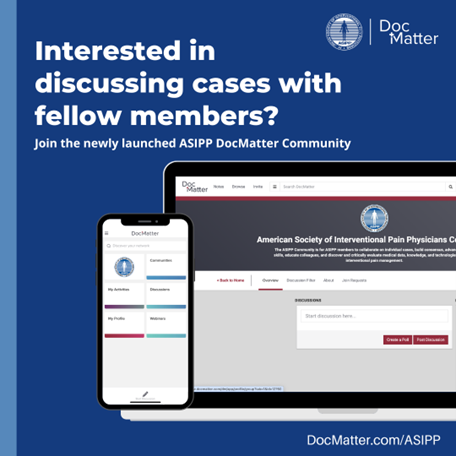
We're excited to let you know that the new ASIPP Community, hosted by DocMatter, is now live!
The ASIPP Community on DocMatter will serve as a place for members to collaborate around clinical and research topics to advance the care of their interventional pain patients.
Click here to be a part of the conversation!
| | |
Pain Medicine Case Reports (PMCR) and Editor-in-Chief Alaa Abd-Elsayed, MD, PhD would like to invite you to submit case reports and case series to the PMCR journal. Your article will be published free of charge.
Open access journals are freely available online for immediate worldwide open access to the full text of published articles. There is no subscription fee for open access journals. Open access journals are no different from traditional subscription-based journals: they undergo the same peer review and quality control as any other scholarly journal.
Interested in becoming a member of the PMCR Editorial Board?
Editorial board members are asked to review 2-6 manuscripts per year. Please submit your most up-to-date CV to sgold@asipp.org for consideration.
For more information or to submit your articles, click here.
| | |
We are excited to announce that Pain Medicine Case Reports (PMCR) journal (eISSN 2768-5152) has been accepted for inclusion in MEDLINE and PubMed, the prestigious bibliographic database of the U.S. National Library of Medicine. PMCR, a companion publication to the prestigious Pain Physician journal by ASIPP, joins its counterpart in achieving indexing in both MEDLINE and PubMed, marking ASIPP’s dual presence in these renowned databases.
The inclusion of PMCR journal in MEDLINE signifies a higher level of selectivity, as MEDLINE consists of the top 5,200 biomedical journals. This indexing also means that articles from PMCR will be searchable using NLM Medical Subject Headings (MeSH terms) and other metadata.
The selection for MEDLINE follows a rigorous evaluation process by reviewers from the Literature Selection Technical Review Committee (LSTRC). According to their criteria, the scientific quality of a journal’s content is the primary factor considered for indexing.
We extend our congratulations to the Pain Medicine Case Reports Editor-in-Chief, Deputy Editor-in-Chief, Journal Team, and Editorial Board for this achievement, which underscores the significance and excellence of this esteemed journal.
| | | | |
Analgesic Effect of Cannabinoids for Fibromyalgia: A Systematic Review and Meta-Analysis
Pui Ming Lam, MBBS, Fengfeng Wang, Ph D, Chung Hin Shing, MBBS, Hung Chak Ho, PHD, Marc Russo, MD, and Stanley Sau Ching Wong, MBBS
| |
Experiment-Induced Nociception in Humans with Substance Use Disorders: A Review of Psychophysical Studies
Hada Fong-ha Ieong, Ph D, and Fu Gao, MD, PhD
| |
Technical Strategies in Spinal Cord Stimulation for Refractory Angina: A Narrative Review
Kira Wang, and David Hao
| |
Vitamin D Supplementation in the Management of Painful Diabetic Peripheral Neuropathy: A Narrative Review
Seoyon Yang, Dong Soon Jang, and Min Cheol Chang
| | | | |
|
ASIPP is in collaboration with Curi Medical Liability Program
Since this malpractice insurance program officially launched in November 2018, ASIPP has signed up hundreds of providers with an average savings of 30%. This is professional liability insurance tailored to our specialty and will stand up for us and defend our practices.
Curi is a full-service advisory firm that serves physicians and their practices. Their valued advice is grounded in your priorities and elevated in your outcomes. They are driven by a deep understanding of your specific circumstances in medicine, business, and life. To read a few important points to keep in mind about the program, including discounts, administrative defense, cyber coverage, aggressive claims handling, and complimentary risk management CME activities, visit our website.
| | |
IMPORTANT UPDATE
SPR is happy to announce an important update regarding Humana Medicare Advantage. As of May 1, Humana is now recognizing SPRINT as a PNS therapy. Previously, SPRINT was categorized as PNT (Percutaneous Nerve Stimulation), which allowed denials on the grounds that the therapy fell outside the NCD.
Additional details are as follows:
Payer: Humana Medicare Advantage (click here to view policy)
Policy Title: Peripheral Nerve Stimulators
Policy changes: SPRINT no longer misclassified as PNT and is now appropriately classified as PNS. Humana is applying the Noridian Medicare LCD criteria to ALL PNS devices – Including SPRINT PNS!
Effective Date: 5/1/2025
Click here to view a PDF of the official policy update.
| | |
|
Group Purchasing Organization Offer Better Pricing and Creates Added Value
ASIPP has formed a partnership with Henry Schein and PedsPal, a national GPO that has a successful history of negotiating better prices on medical supplies and creating value-added services for independent physicians. Working with MedAssets, PedsPal provides excellent pricing on products like contrast media that alleviate some of the financial pressures you experience today.
Learn More
For updated information concerning tariffs on products, click here.
| | |
|
ASIPP, Fedora Healthcare Solutions Partnership
ASIPP offers our members the benefit of a unique revenue cycle management/ billing service.
We have received a tremendous amount of interest in the ASIPP billing and coding program.
Click here to learn more about the negotiated rate for practices and more!
| | |
Like and Follow ASIPP® on Facebook, X, LinkedIn,
and YouTube for the most up-to-date news
related to you, your practice, and your patients!
| | | | |