Volume 24 Number 19, October 29, 2026

A few years back, I wrote a brief ebook that exposed 13 Reasons Managers Are “Unlucky” When Making Hiring Decisions. You can still download it from my website for free. I later supplemented the book with an article that described a 14th reason—the biggest hiring mistake of them all—failing to act when a hiring decision results in an unexpected—and unsatisfactory—outcome.


The book and subsequent article reflected what I had learned from decades conducting and observing hiring interviews. Since the ebook was published, I have continued to identify why the wrong people are hired and the right people are allowed to escape.


Here are five more mistakes managers make when hiring. They can be summed up in just one word, which we will get to later.


Continue reading to discover the 5 mistakes and the one-word solution >>>

Service banquets. Awards ceremonies. Taking your staff to lunch. Designating special weeks to honour specific employee groups. Birthday parties. Company picnics.


These are all great things and are worth doing. Staff members appreciate and look forward to them. But they must not be seen as effective staff recognition practices, either individually or collectively. These are events, while recognition reflects an attitude.


While some recognition may occur during annual or monthly events, meaningful recognition is what occurs daily, through simple, thoughtful acts and words that convey to staff that what they do is noticed and appreciated.


Recognition comes from the heart, not the calendar.


Continue reading >>>

Describe a time when you felt there was a need for a new policy or procedure.


Why ask this question? Those closest to the action are often best able to identify more efficient ways to complete tasks or improve customer service. What they do with these ideas distinguishes top performers from other staff.


Suggested Followup Questions:

  • What was the need you identified?
  • How did you feel it would improve how things were done?
  • Who did you discuss this idea with?
  • How did you present your idea?
  • What happened because you identified this need? 
  • Did any change occur because of your suggestion?
  • Why was the outcome of your suggestion?


How candidates may respond and how to score those responses:


Unsatisfactory response (worth a score of 1) – Possible answer: “It was obvious to me and my co-workers that there was a better way. We talked about it all the time. I can’t believe that management could not see what we needed to do.”


Acceptable response (score as 3) – Possible answer: “Once I saw that the way we were doing things wasn’t working, I told my manager. I figured he would come up with a way we could do better.”


Outstanding "top-performer" response (worth a 5) – Possible answer: “I felt we were taking too long to respond to customers’ requests. There had to be a better way. I went to my manager with a proposal on how we could improve our response time. She liked what I had come up with. She made a couple of suggestions which improved my idea. Then we implemented the process in our department. We reduced the time that customers had to wait for a response by nearly half.”


Reference Check Question: Describe a time when [candidate’s name] suggested a need for new policy or procedure.


Caution: Each workplace and every manager is unique. Workplace cultures and values are different. There is no such thing as a perfect interview question. Questions that work for one manager may not work for another. Before choosing to use this, or any question, consider whether it fits your unique set of circumstances. Is the question right for you and your work environment? The same is true for the suggested rating scale, which may or may not reflect the culture of your organization or your observations of how your top performers respond to circumstances similar to those described. You should adapt both the question and rating guide to fit your circumstances and leadership style.


During my Interview Right to Hire Right workshops, participants learn to write behaviour description interview (BDI) questions based on their understanding of what makes top performers successful.

Convert waiting time into recognition time. Carry a supply of thank-you notes in your briefcase. Whenever you have a few minutes, such as when waiting for an appointment, when you’re on an airplane, or when you are waiting for a meeting to begin, use the time to write notes to staff members who deserve to be recognized.


*****


Certificates can be an effective staff recognition tool when they capture the uniqueness of what each person contributes.


A certificate that congratulates Jordan for “his significant contributions to the ABC project” that is just like the one all his colleagues received has less meaning than a document that refers to two or three specific ways that Jordan contributed to the project’s success. Prepare unique lists for each team member’s certificate.


*****


Some tokens used to express appreciation become tired over time, but here is a way you can breathe new life into one approach that might be worn out. Go beyond simply engraving the company logo on the side of a travel mug. Add specific words of appreciation or a carefully selected quotation that would be meaningful to the recipient. Avoid the trite teamwork-related cliches found so often in workplaces: e.g. Together Everyone Achieves More, or There’s no I in TEAM. Quote a business guru or world leader that the recipient admires, or one of their favourite authors. Select a quotation that reflects their interests or hobbies. Or engrave a message from you to acknowledge the important achievement for which you are recognizing the individual. The more personalized the inscription, the greater the impact the message of appreciation delivers on your behalf, both when you make the presentation and with every sip.


*****


Remote workers can miss out on the perks that staff working on-site routinely receive—company lunches, treats in the coffee room, the opportunity to leave early. Demonstrate that they are valued members of the team and not overlooked by arranging delivery of their favourite treats or sending a gift card so they can take a break at a coffee shop close to where they work. If practical, invite them to staff lunches and other events. 


*****


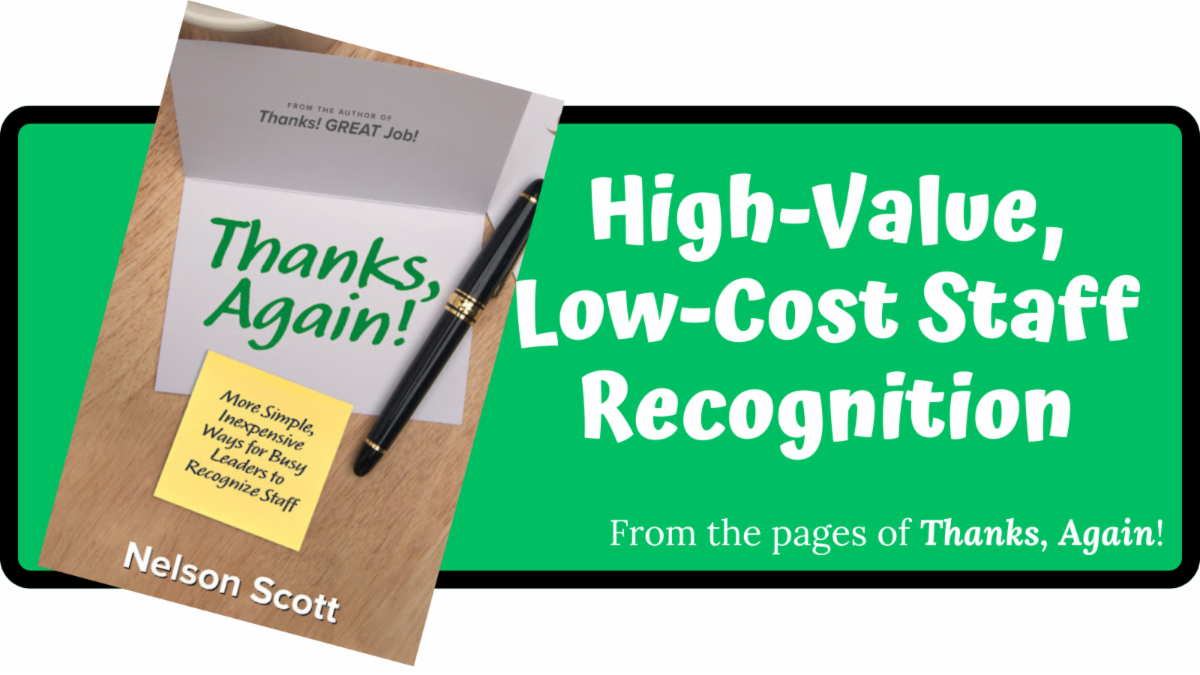
Thanks, Again! More Simple, Inexpensive Ways for Busy Leaders to Recognize Staff is available at Audreys Books, 10702 Jasper Ave., Edmonton (and on its website) and online from Amazon, Indigo, FriesenPress Bookstore, Barnes & Noble and on the Apple Books app.

CONTACT NELSON SCOTT:
Telephone: 780-232-3828 • Email: nelson@GREATstaffrecognition.com