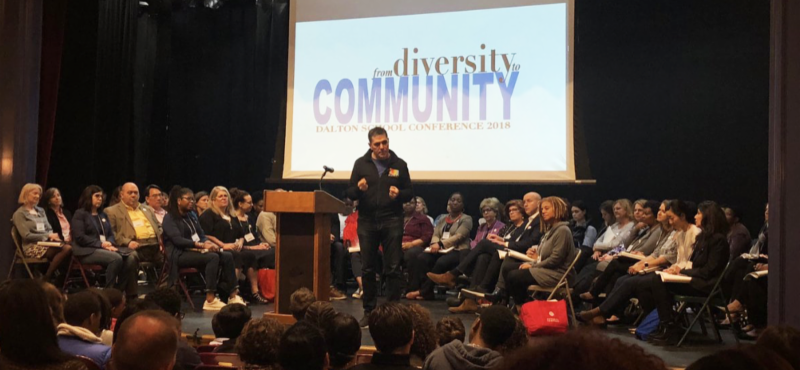
How does the Pollyanna Conference support the diversity, equity, and inclusion work you spearhead at Allen-Stevenson?
The nice thing about the Pollyanna Conference at The Dalton School is that all the groups have come together over one conversation and want to be there to bounce ideas off each other.
This is a journey and the conference experience illustrates where you are on this journey. Because all of the schools are at different stages, hearing what they are doing is invaluable. You come away from the conference seeing where you need to go as a school, with new ideas and new ways to share to help you on your way.
Also important for the school is that members of the POD have all heard similar information throughout the conference so back at school our work is more effective. Together we can breathe some life into our diversity, equity, and inclusion efforts and help to push our school forward.
Are there concrete actionable steps your POD has brought back to school and implemented?
The curriculum piece has been one area of focus for Allen-Stevenson following the Pollyanna conference. We’ve been working with different constituents – parents, faculty and leadership – on how to make sure we have an equitable curriculum.
We have a team of teachers who are taking initiatives and meeting to make sure we have a curriculum that is reflective of the whole community and one in which all boys can see themselves. We started with the history curriculum this year.
Coming out of our POD discussions, we’ve begun talking about how parents can become more involved in conversations around diversity, equity, and inclusion. Our Parent Chats now cover different topics and perspectives and we are more intentional about the types of topics we choose so we can further grow our whole community.
Giving more of a voice to our students is another initiative that arose from the POD. We’ve made sure that when we talk with boys in our GSA and BOCAS (Boys of Color at Allen-Stevenson) affinity groups, as well as during advisory, we are very intentional and make sure to get their input. We present them with questions and are trying to give them a platform where they can express their opinions. We want to make the community a safer and more learned place.
What are the benefits of attending the Conference year after year?
By returning year after year, you get to see and hear from other schools how they are progressing and what they are doing in relation to their diversity, equity, and inclusion work. It holds me, and our school, accountable.
When I meet with colleagues at the Conference, I can describe what we have implemented. I enjoy talking with this wonderful group of people who have fresh ideas and from whom I can learn. I like to hear what they’ve done in their schools and value their friendships. Because it is a familiar community working toward the same goals, we give each other strength.
The Conference also creates opportunities to make connections within a specific group that might not always have the chance to meet, such as all boys’ schools in our case. The hope is that working together for our communities is better for our students.
What is the most important element of the Conference day and why?
While it is all great, for me it is hearing the voice of the students and what they are asking for that is so important. They are our future and our leaders. They are so smart too. Schools are changing and the problems that are presenting are better solved together. As adults, we talk and intellectualize, but students want action. They look at this all differently and are so resilient. I’m excited to see where they will take us on this journey.
Describe last weekend's Conference at Dalton in one word.
Activism.