|
Daily Transportation News
April 29, 2026
| | | British Taxi Drivers Hailed As Lifeline for Millions – But Nearly Half Say They Don’t Get the Credit They Deserve | |
|
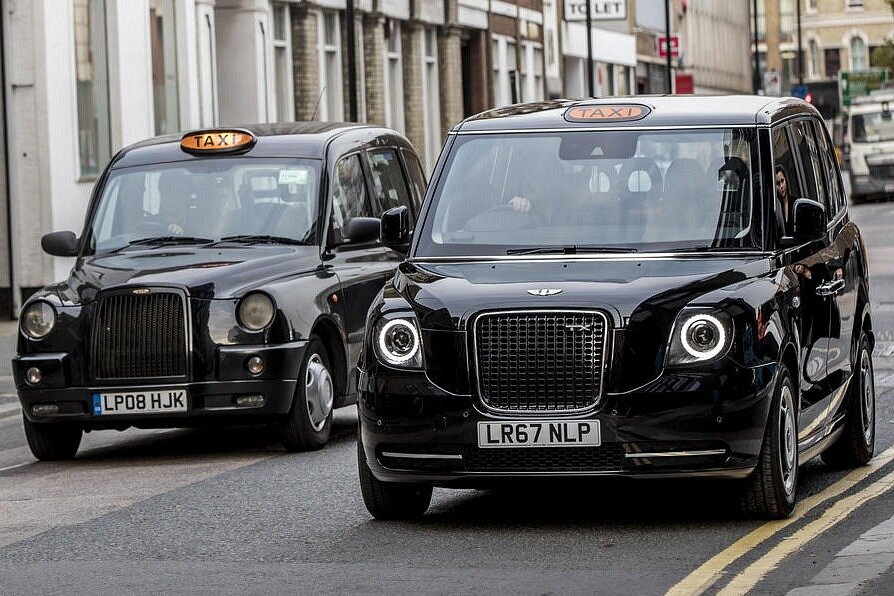
Taxi drivers are viewed by most UK adults as an essential part of local transport networks, with new polling suggesting strong public recognition of their role in daily life, emergency travel and support for vulnerable passengers.
An Opinion Matters survey of 2,000 UK adults, commissioned by Acorn Insurance, found 82% believe taxi drivers play an essential role in their local community. A similar proportion said taxis are essential to daily life.
The findings show taxis remain a key fallback when other transport options are unavailable. Nearly two-fifths of respondents, 39%, said they rely on taxis when public transport is not running, while 38% said they had used one in an emergency.
Almost a third, 29%, said they would struggle to manage without taxis. More than 28% said they rely on taxis more now than they did five years ago, pointing to continued demand despite wider changes in travel habits.
The survey also found 58% of respondents had relied on a taxi driver during a difficult or important moment. That figure rose to 72% among Gen Z respondents and 71% among Millennials.
Source: TaxiPoint
Click Here to Read More
| | Legislative Fly In: The Transportation Alliance Heads to Capitol Hill on May 5th and 6th with a Clear Mission for 2026 | |
The Transportation Alliance 2025 PAC Dinner | |
As The Transportation Alliance (TTA) prepares for its 2026 legislative fly-in, one message is clear: transportation policy must prioritize safety, accountability, and smart partnerships that deliver results for riders, businesses, and taxpayers alike. This year’s agenda is not theoretical—it’s grounded in real-world challenges facing the for-hire transportation industry and the communities it serves every day. From passenger safety to healthcare access to protecting small businesses, the Alliance is advancing a focused, solutions-driven policy platform.
Safety Cannot Be Optional
At the top of the list is the C.A.R.E. Act of 2026, a nationwide push to require in-vehicle cameras across all for-hire transportation services. The data is undeniable—drivers face significantly higher risks of violence, and cities that have implemented camera requirements have seen dramatic reductions in assaults and fatalities.
This is about more than technology. It’s about creating a consistent national safety standard that protects both drivers and passengers while strengthening trust in the system.
One Standard for Safety—No Exceptions
TTA is also drawing a firm line on federal safety standards, urging Congress to protect the integrity of the FTA’s drug and alcohol testing framework under 49 CFR Part 655. Expanding exemptions—particularly to rideshare platforms—would create a dangerous two-tier system where safety depends on business model rather than the trip itself. For seniors, individuals with disabilities, and those relying on federally funded transportation, “same trip, same rules” must remain the standard.
Fixing NEMT: Cutting Waste, Protecting Access
Non-Emergency Medical Transportation (NEMT) is a lifeline for millions, providing over 100 million rides annually. But inefficiencies and outdated systems are costing taxpayers billions. TTA is calling for modernization through technology, accountability, and national standards—measures that can reduce fraud, improve service, and deliver massive savings. Even modest improvements can yield outsized returns, with studies showing double- and even triple-digit ROI when NEMT prevents costly emergency care.
Let the Private Sector Deliver
Finally, TTA is tackling the growing issue of government-operated microtransit systems competing with private providers. The message to policymakers is straightforward: government should be a partner—not a competitor. Contracting with qualified private operators delivers better service, faster innovation, and lower costs. When government focuses on oversight instead of operations, communities win.
A Defining Moment for Transportation Policy
As industry leaders meet with lawmakers, the stakes are high. These priorities are about more than regulation—they are about building a transportation system that is safer, more efficient, and more accountable to the people it serves. The Transportation Alliance is coming to Capitol Hill with real solutions. Now the question is whether policymakers are ready to act.
Find out more about the Legislative Fly-In here
| | |
Uber Is in the Hotel Business Now, Thanks in Part to AI
Uber customers in the United States can now book hotels directly through the app, one of several new features announced Wednesday that pushes far beyond the company’s original ride-hailing purpose and even deeper into its users’ lives. Uber announced the new hotel booking feature on Wednesday during its product-heavy annual Go-Get event in New York City.
Click Here to Read More
Minnesota Bill Would Establish Intelligent Speed Assistance Program
Minnesota is considering a bill that would establish an intelligent speed assistance (ISA) program for drivers who excessively speed in the state. The bill, HB3429, would make it a gross misdemeanor for anyone who holds a restricted license to drive, operate, or be in physical control of any motor vehicle not equipped with an ISA device certified by the state’s commission of public safety. HB3429 was introduced in February and referred to the Transportation Finance and Policy Committee. The committee recommended adopting the bill as amended and sent it to the Judiciary, Finance, and Civil Law Committee. A companion bill, SB3691, sits in the Senate’s Transportation Committee.
Click Here to Read More
California’s Driverless Taxis Can Now Be Ticketed under New Rules
California’s long‑running struggle to regulate and ticket so-called autonomous vehicles may soon be over, with the state passing new laws that will see traffic cops finally able to cite the vehicles for moving violations. But not until much later in 2026. The actions of autonomous vehicles have come into focus across several states, as records show that Waymo’s driverless taxis have accumulated hundreds of traffic and parking violations, largely because state law limits how driverless cars can be ticketed.
Click Here to Read More
| |
Proposed High‑Speed Rail Will Not Make a Big Dent in Canada’s Greenhouse Gas Emissions
In February 2025, the Canadian government announced Alto, a high-speed rail line that will eventually connect Toronto to Québec City. In November, the government said it would introduce new legislation to speed up the project. One of its proposed benefits is that electrified, high-speed rail will help Canada reduce emissions and meet its climate targets. Alto says the project will help prevent many short-haul flights and remove the carbon emissions equivalent to 100,000 cars from the road each year.
Click Here to Read More
Opinion: Electric Buses Not Right Fit for Canadian Winters
Winter driving in Canada isn’t fun. It doesn’t matter how good your tires are or how charged your battery is, sometimes you are going to get stuck in a snowbank. That is increasingly the story of Canada’s electric bus rollout. To be clear, everyone supports cleaner air and better transit. No one disputes reducing emissions is a worthwhile goal. But policy has to be grounded in reality — not wishful thinking. And in Canada, reality includes minus 30, biting wind, and long hours on the road.
Click Here to Read More
Why Strong Tailpipe Emission Standards Are Necessary for Canada’s EV Acceleration
Electric vehicles are having a comeback year in Canada. While EV sales and interest are already soaring in European markets and other countries, here at home, February EV sales were up 47 per cent year over year, and online searches for EVs grew 94 per cent from January to late March with online car retailer Clutch.ca. Or you could just ask Canadians. In Clean Energy Canada’s new April survey with Abacus Data, 52 per cent of people expressed openness to getting an EV, with 21 per cent of Canadians saying the new $5,000 federal incentive and recent gas prices have made them even more inclined to go electric than they were before.
Click Here to Read More
| |
Solar-Powered Vehicles Could Boost Europe’s Energy Transition
Research by the European research Project SolarMoves has revealed the benefits that vehicles using their own solar panels could have on the energy transition in Europe. As electric vehicles grow, so does congestion on the power grid. Across Europe, countries that have shown quick EV progression are now reaching their power grid limits, calling for a solution. That’s where solar panels come in. Solar panels integrated into a vehicle can generate power that directly supports its operation, reducing the need for grid reinforcement.
Click Here to Read More
Dominican Republic and Hungary Advance Air Transport Cooperation Agreements
The governments of the Dominican Republic and Hungary are advancing efforts to strengthen bilateral air transport relations through new aviation agreements aimed at improving connectivity between both countries. The negotiation process moved forward during a meeting held April 27 at the headquarters of the Civil Aviation Board, where officials worked on a memorandum of understanding as a preliminary step toward signing a formal Air Services Agreement. The proposed framework would allow airlines greater flexibility to determine routes, flight frequencies, and fares based on market demand.
Click Here to Read More
UK Transport Company Plunges into Administration - Lorries Delivering Goods Since 1974
A UK transport company that has been operating since 1974 has entered administration. A notice was shared in the London Gazette today, revealing that John K Philips Group Limited entered administration on April 20, 2026. The company was founded when John Philips bought his first truck and set up a small business delivering paint more than 50 years ago. It has since become one of the biggest distribution companies in the North West of England.
Click Here to Read More
| |
The Reorganization of Motorcycle Taxis in Kantunilkín Begins with the Distribution of Permits
With the firm purpose of transforming the local transportation system into a safer, more efficient, and more organized model, the Directorate of Citizen Security has intensified its regularization efforts for motorcycle taxi drivers in the municipal seat of Lázaro Cárdenas. Through the distribution of official identification cards, authorities seek to provide legal certainty to the operators and, primarily, safeguard the well-being of the thousands of citizens who use this service daily.
Click Here to Read More
Soweto Commuters Pay More As Taxi Fares Ignore Fuel Cut
South Africans are still paying high taxi fares even after the government extended a cut to the fuel levy. The government introduced a temporary R3 per litre reduction on the general fuel levy in April. Officials brought in the cut after fighting in the Middle East pushed global oil prices up. The government planned to end the relief on 5 May. Officials have now extended the cut until 2 June to help households struggling with high transport costs. The government expects the cut to cost R17.2 billion between April and June. The state will phase out the relief by the end of June.
Click Here to Read More
Taxi Bosses Down Tools after Eastern Cape Fails to Pay for Scholar Transport
A group of Eastern Cape scholar transport operators marched peacefully on Wednesday morning in Bhisho after failing to reach an agreement with the department of transport over payments. Members of the South African National Taxi Council marched to the office of Premier Oscar Mabuyane in Bhisho on Wednesday. They handed over a petition demanding immediate payment. Some of the demands were that all outstanding payments be settled, that a transparent and accelerated payment schedule be provided to address the backlog, that operators be treated with dignity and respect, and that they be paid in full for fuel escalation.
Click Here to Read More
| | |
Albany Must Finally Slow the Super Speeders
By NYC DOT Commissioner Mike Flynn and Dr. Mitchell Katz
| |
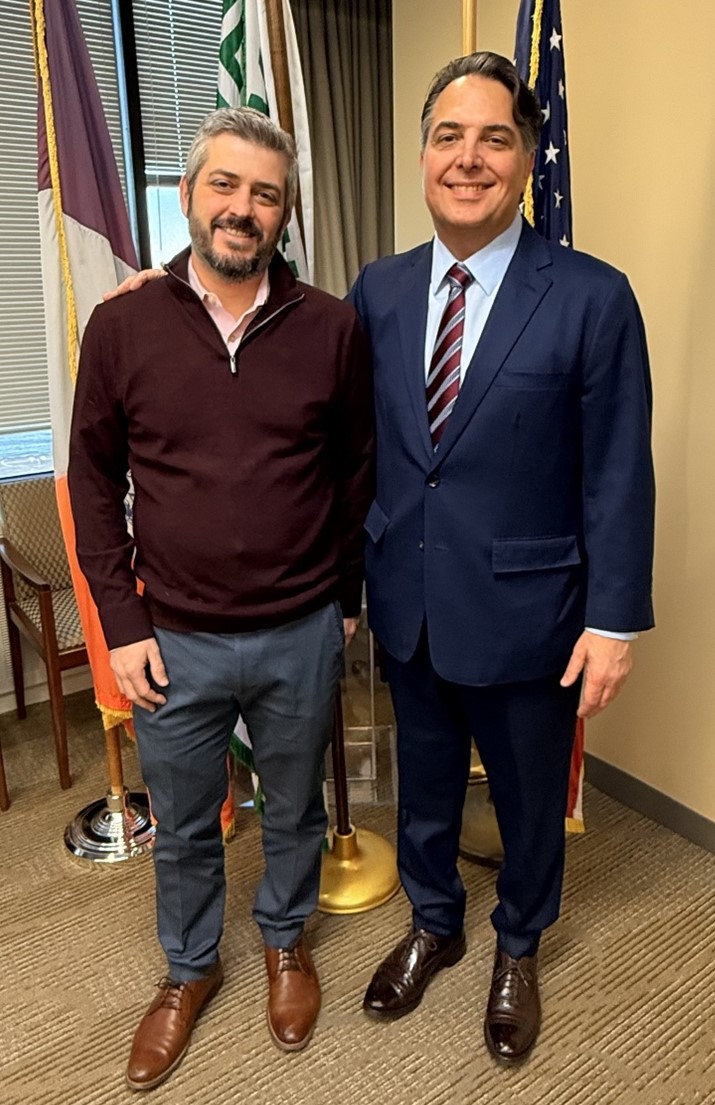
NYC DOT Commissioner Mike Flynn and IATR President Matt Daus | |
New York City streets have never been safer — but one persistent danger demands our full attention. A small but reckless group of recidivist speeders poses a grave threat to the health and safety of everyone. That is why we, and Mayor Mamdani, support Intelligent Speed Assistance (ISA) to rein in super speeders and save lives.
Since Vision Zero launched in 2014, New York City has led the nation in combating traffic violence by deploying world-class street design, greater public education, and expanded enforcement efforts. We also recognized that traffic safety is not just a transportation issue, but a health crisis for injured patients and the providers that treat them.
The results of the program are undeniable. One effective intervention, automated traffic enforcement cameras, has reduced speeding by 96% where cameras are installed. The vast majority of drivers stop speeding after one or two camera violations, but a small and extremely reckless group of super speeders flagrantly endanger themselves and everyone around them.
The choice to speed, putting personal convenience ahead of the lives of others, is made from the driver’s seat. That is where we must act next if we are serious about treating traffic violence with the same urgency as other preventable causes of death.
New York City streets have never been safer — but one persistent danger demands our full attention. A small but reckless group of recidivist speeders poses a grave threat to the health and safety of everyone. That is why we, and Mayor Mamdani, support Intelligent Speed Assistance (ISA) to rein in super speeders and save lives.
Since Vision Zero launched in 2014, New York City has led the nation in combating traffic violence by deploying world-class street design, greater public education, and expanded enforcement efforts. We also recognized that traffic safety is not just a transportation issue, but a health crisis for injured patients and the providers that treat them.
The results of the program are undeniable. One effective intervention, automated traffic enforcement cameras, has reduced speeding by 96% where cameras are installed. The vast majority of drivers stop speeding after one or two camera violations, but a small and extremely reckless group of super speeders flagrantly endanger themselves and everyone around them.
Source: New York Daily News
Click Here to Read More
| |
|
Message from IATR President Matthew W. Daus
At the International Association of Transportation Regulators (IATR), our regulators are at the forefront of addressing both the challenges and opportunities facing the mobility paradigm. Our IATR members, partner organizations, and regulated industries will continue on our shared quest to fulfill the mission of our non-profit educational organization - to bring about Multi-Modal Mobility Innovation for All! This mission can best be accomplished through information sharing, collaboration, identifying and promoting best practices, and educating our membership. These educational updates and electronic media clips are affectionately known as “IATR snips” and endeavor to cover all aspects of mobility around the globe - especially news and developments involving safety, technology innovation, multi-modal integration, automation, sustainability, electrification, accessibility, regulatory modernization, and equity.
If you would like more information about the IATR, you can visit our website at www.iatr.global. Current members can renew their memberships when you log in to your IATR portal on the top right-hand side of our website, or click here. If you forgot your membership password, please email our Membership Director, Eric Richardson, at erichardson@iatr.global.
| | | | | |
|
RENEW YOUR MEMBERSHIP FOR 2026:
Weekly news snippets
Access to the membership database
Videos and files from recent conferences
Discounted rates for future conferences, and more!
Renew your membership at http://www.iatr.global or email info@iatr.global for any questions!
| | | | |