|
‘A network of 150… [will] …provide a new kind of community-based care at a level that falls between the current general practice and the traditional district general hospital…
… a massive shift of work from hospitals into [centres] that would cater for most people's medical needs closer to home.’
No, nothing to do with our great leader’s 9.5 year plan.
These are quotes are from 2007/8 when (the now) Lord Darzi persuaded Gordon Brown, polyclinics and neighbourhood care was a good thing.
By 2011 they’d all disappeared. Wes Streeting is having a go at resurrecting them.
Why do leaders ignore memory when it is such a valuable asset? History is free, accessible and rich with advice and guidance. We only have to look.
What does history tell us about shifting care out of hospitals?
- It involves running the old system and the new system at the same time, which is expensive and politically risky.
- Hospitals will always have to do what hospitals do, even as activity shifts out.
- Fixed costs remain.
- Bring money.
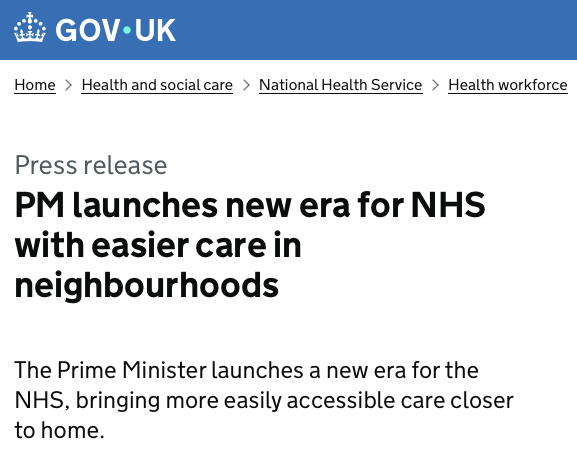
Streetings' new plan for neighbourhood services require new investment in buildings, staff, and tech.
There are no immediate savings unless hospital capacity is actually cut… which, because demand grows, is impossible
In short, you pay twice before you save once. And, by the way, there is no capital to repair hospitals, never mind build new mini-ones.
Interestingly, Darzi centres were never really popular. Travelling further to a Centre wasn’t as appealing as popping in to see the local family doctor.
However, community teams focussed on admission avoidance makes a lot more sense… which is where I suspect a lot of this will end up.
The most frequent users of the NHS are the elderly and they are probably the easiest group of people to keep out of hospital but that involves social care and social care is largely missing from the new master-plan.
Missing is, planning for;
- A social care, decade-long funding and delivery roadmap
- Social care measurable milestones post-2026
- A standalone, fully-resourced social care strategy
There’ve been three major long-term national plans for the NHS in England since 2000:
- The NHS Plan (2000),
- the Five Year Forward View (2014),
- and the NHS Long Term Plan (2019).
All of the aspirational, optimism needed for a future that was never fulfilled.
Is there any difference this time?
-
Who could not support an NHS digital front door. Expansion of the NHS App? Why not?
- Who would not acknowledge the future of services supported by machine learning.
- Who will not join a cheer for the operational independence of Trusts.
- Who would say stopping people getting sick in the first place isn’t a good idea.
-
Why not national virtual ward, integrated software.
-
Who wouldn't want to try vertically integrating practices into hospitals.
-
Why not halve the healthy life expectancy disparity between richest and poorest regions.
But…
… as the HSJ quietly point out, the delivery chapter is missing from the 150-odd pages.
-
What are the year-by-year objectives?
-
Where are the named organisations responsible?
-
Where is the IT roll-out, roadmap.
-
What is the contingency for changing needs? (Ten years is a long time)
-
Where are the funding allocations by year and service.
Who builds the neighbourhood hubs? What’s the time-line. What happens to hospitals in the meantime. When do we start training the workforce to staff 200 hubs.
Who has the answer to the only question that matters… HOW?
A delivery framework, timeline, or accountable ownership for implementation? This is a recurring weakness of NHS reforms. Why so many fail.
Standing at a podium speaking about vision without a plan is an hallucination. Describing a future with no way of building it, is a mirage.
Without a road map, any plan is a dead end.
And there is another thing…
... earlier plans that were less ambitious and incremental, failed to get traction, even though the delivery environment was stable.
This plan is ambitious, transformative but in a chaotic delivery environment; abolishing quangos and merging NHSE and DH+, sharp systemic changes?
Mmmm…
Hubs, App, AI, prevention initiatives, hospital capacity shifts, workforce growth, capital projects… over ten years… beyond the life of a parliament?
Mmmm…
Punishing people and organisations makes for better performance?
Err... no.
No implementation targets, no-one accountable. Ministers will dodge the bullets.
Up-sum; nice plan but go away and come back with;
- A 2-year and 5-year Delivery Plan
- Concrete, funded milestones.
- Name accountable leads for each priority area.
- Align capital, workforce and digital investment plans.
- Annual progress reports to Parliament.
- Independent delivery oversight by the NAO or an NHS Transformation Board… if they still exist.
And remember; Health spending will grow by 2.8% a year in real-terms between 2025 and 2029 and capital investment will grow by just 1% a year.
A Plan without any money is not a ticket into the future.
A plan without a plan… is just a brochure.
|