|
Enterprise Fund Update
At the April 15, 2025 City Council Meeting, Graham Clark, the Finance Director, and Ken Rutt, the Public Works Director, provided the First Quarterly Enterprise Update; the presentation can be found here. The presentation was broken into three time periods.
Past State of Enterprise Funds
There have been a number of rate studies during this council's tenure. The first was completed in 2020/2021 by RBS Bank and looked back to 2012 and using sales and use tax to support the infrastructure. The Willdan Study was completed in 2021/2022, and the AECOM study was completed in 2023. Water rates have increased in the last 3 years as we discussed in our November 4, 2024 newsletter, and we are not done.
Current State of Enterprise Funds
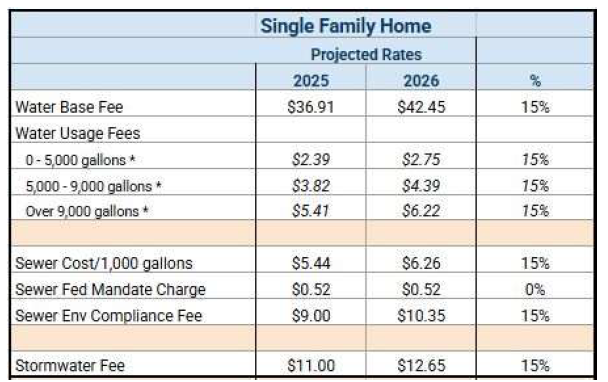
The Enterprise Fund was "stabilized" in 2024 by adding a 50% increased in water rates and a stormwater base fee to your water bill. The idea is that this approach would not depend on usage fluctuations due to annual rainfall, or slower development (remember when they implemented the increased tap fees, which slowed growth?)
The unaudited 2024 financials show that the water fund revenues will decrease by $500,000 and expenses will increase by $1,100,000. The sewer fund revenues will decrease by $200,000, and the expenses will increase by $1,300,000. Definitely, not sustainable.
Mr. Rutt said that a single-family home uses 110 gallons/person and a multi-family uses 51 gallons/person. Broomfield's population is expected to increase to 119,000 by 2050, and the water demand per year is expected to be 17,263 acre-feet/year. The peak water demand in the winter is 5.5 million gallons per day (MGD) and the peak water demand in the summer is about 5 times that or 24.5 MGD. Public Works needs to focus on four categories of Potable Water: the supply, the conveyance or how the water gets here, the treatment, and the distribution.
Broomfield also currently subsidizes about 2,340 homeowners using the Utility Rate Assistance Fund (URAF). This fund is a newly created government program with a cost of $580,000 ($520K in assistance and $60K for increase personnel) in 2024, and is expected to increase to between $900,000 to $1,000,000 as people find water and sewer unattainable. With the steady expansion of local government, reliance on public aid naturally increases.
Water Storage Costs
Chimney Hollow ($131.5M) will provide 26,464 acre-feet of storage and will take 3 years to fill. Sienna Reservoir ($24.46M) will provide peak summer demand. Broomfield Reservoir ($137M) will provide additional storage needed by 2037.
To keep up with technology, the City and County of Broomfield has a water replacement program at a cost of $832,249 in 2025, and a total cost of $13.5M over a 12-year period. The waterline replacement cost for 2025 is $4.1M and approximately $291M over the 36-year program.
The now infamous North Area Water Tanks will require a $60-$70M bond (debt) and will provide a 10% buffer by 2032. The city said they found a "viable alternative" related to the project, though it was not clear what that alternative is for the reuse tank at a cost savings of $17.3M. The tank will still be needed by 2030.
The Great Western Reservoir is in need of rehabilitation and three potential alternatives are: 1) Selective Replacement of the Toe Drain and Outlet, 2) Full Dam Replacement (even more money!!!), or 3) Breach and Decommission the Dam. There is also a potential radiological contamination due to Rocky Flats - currently they are sampling the sediment.
Enterprise Fund Balances
- Water Fund in 2029 projects a negative $13.7M balance
- Sewer Fund in 2029 projects a negative $33.2M balance
- Reclaimed Fund projects negative balances starting in 2027.
Other Associated Water Costs
- 2025 Sewer Collection Line Rehabilitation: $1.01M
- 2025 Sewer Lift Station Program: $8.27M
- 2026 Wastewater Treatment Facility Expansion: $114M bond/$548.3M cost through 2035, however on a different slide they say they are going to pursue a $130M bond.
- The wastewater treatment facility has cut back on their use of water, so biosolids have increased treatment costs. Regulation costs are 39% of the total cost.
|