|
This newsletter contains the following stories and information:
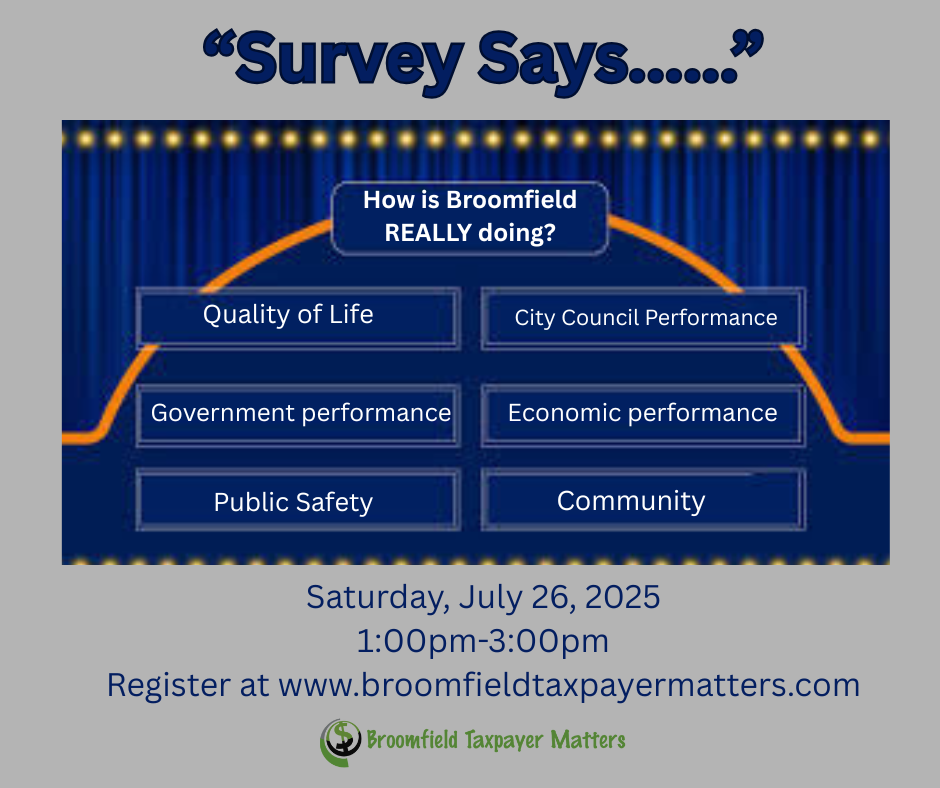
- Attend the Next Make Your Voice Heard Event on July 26 - "Survey Says"
-
What's in the Broomfield 2024 Annual Financial Comprehensive Report (ACFR)?
- Three Councilmembers are running for the State Legisature seat - What gives?
- Affordability Housing Update - The Grove at Cottonwood
- An Update on Broomfield's Enterprise Fund Update - and that means more debt
- Broomfield's in the middle of another policy issue. And citizens are none to happy.
- Are we governed with our consent?
- Upcoming Agendas
- July 15, 2025, Study Meeting
- July 17, 2025, Special Session
- July 21, 2025, Study Session
- July 22, 2025, Regular Meeting
- City Council member contact information
| | |
Pay Attention to these upcoming items in the Broomfield Council Agendas:
July 15 - Study Session
- Second Quarterly Enterprise Update
July 17 - Special Meeting
- 3A. Executive Session Request Related to Eagle Trace Golf Course
July 21, 2025- Study session - Location: Broomfield Community Center, 280 Spader Way, Broomfield,CO 80020, Time: 6:00 p.m.
- Organizational Strategic Plan Workshop #2 with City Council facilitated by Raftelis: Vision and Strategic Outcome Areas
July 22 - Regular Meeting
- Expense report for Elected Officials - 2nd Quarter
- 6B. Ordinance Approving Civil Enforcement in Municipal Court - 1st Reading
-
6C. Authorized spending for On Demand Services under Master Services Agreements - Water and Utility Supplies and Battery Powered Landscape Equipment
- 7B. Broomfield Water Recovery Facility - Early Work Maximum Price
- 7E. Medium Density Residential Zone District Update Ordinance - 1st Reading
Please let us know if you plan to attend by registering here.
| | |
Join us for our next "Make your Voice Heard" event
July 25, 2025
from 1-3 p.m.
With the recent surveys from the City and County of Broomfield, what is really behind the numbers?
What is our community’s feedback on the policies and direction of Broomfield? What are they not willing to talk about?
| | |
2024 Annual Financial Comprehensive Report
The City and County of Broomfield’s 2024 Annual Comprehensive Financial Report (ACFR), audited by Eide Bailly, LLP, provides a detailed snapshot of the city’s financial health.
While the report suggests stability, a deeper dive reveals key insights and areas for residents to question. Below, we summarize the critical findings from the ACFR, the Report of Governance, and the related discussion, alongside relevant graphs to illustrate trends.
The trends we highlight below speak to the concerns we have been raising for sometime with respect to property taxes, the city's enterprise funds, and the looming increases in City and County of Broomfield debt.
Audit Overview
The auditors’ responsibilities, outlined in the Letter of Governance, include:
- Expressing an opinion on the accuracy of financial statements.
- Evaluating internal controls to ensure reliability without directly assessing their effectiveness.
- Reviewing major federal program compliance and related internal controls.
| |
|
A notable audit finding involved the Water Reclamation Fund, where a $1.2 million transmission and distribution system was not removed from the books post-disposal. This led to an overstatement of assets and depreciation, corrected by:
- Debiting Fund Balance: $870,661
- Debiting Accumulated Depreciation: $338,590
- Crediting Capital Assets: $1,209,251
| | | | |
Financial Highlights
- Expenditures: Budgeted at $152.87 million, actual spending was $138.24 million (under by $14.63 million).
- Revenues: Budgeted at $160.32 million, actual revenues were $148.88 million (under by $11.44 million).
-
Net Position Growth: The city’s net position increased by $70 million to $1.381 billion, driven by higher property tax revenue and capital assets.
-
Governmental Funds: The combined ending fund balance rose by $38.5 million to $293.7 million.
-
Tax Revenues:
-
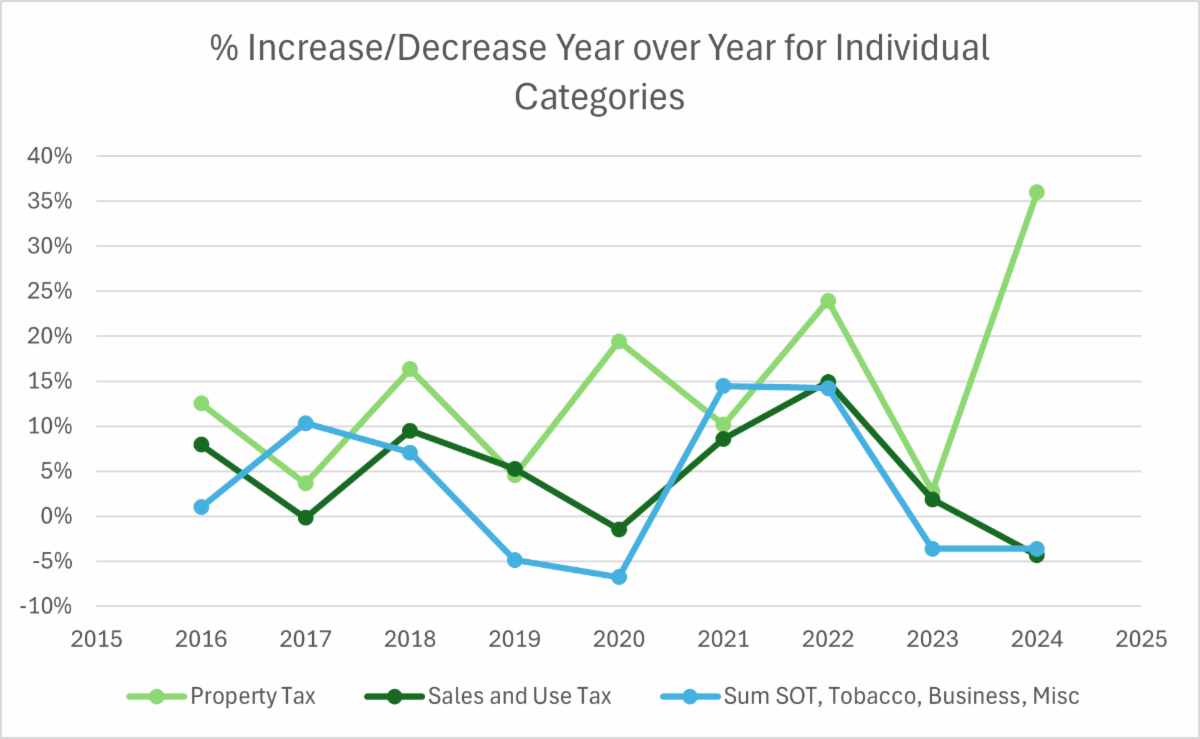
Property Taxes: Surged 35.99% to $124.14 million from $91.29 million, due to higher valuations, growth, and policy changes. Remember, the Broomfield Council and Broomfield Staff intentionally decided to take the increased property tax revenue to pay for a new Police Department building, partial property tax rebates for certain groups, and to fund the first time homebuyer's down-payment loan program.
- Sales and Use Taxes: Fell 4.3% to $95.45 million, primarily due to lower use tax collections. This at a time where Broomfield's retail areas such as Flatirons Mall are being torn down and replaced by mixed-use. Redevelopment takes time and is costly, in the meantime Broomfield sales taxes are suffering.
-
Debt: Total outstanding debt as of December 31, 2024, was $328 million. Debt service coverage ratios for water and sewer bonds remain strong, exceeding policy targets. But wait, there's more. The Broomfield Council is expected to add $181 million more in debt (see page 6) for water infrastructure before the end of the year.,
-
Population: Reported as 78,323 (1.7% growth in 2024), though page 165 of the ACFR cites 77,500, raising questions about accuracy.
-
Workforce and Economy: Broomfield employs nearly 968 full-time equivalent staff with an average salary of $109,500, well above state and national averages. Median household income is $117,451, and the unemployment rate rose to 4.3%.
-
Capital Assets: Additions included 64,000 feet of street infrastructure, 48,000 feet of water lines, and 30,000 feet of sewer lines.
-
2025 Budget Goals: Financial sustainability, environmental stewardship, mobility, diversity and inclusion, and organizational health.
Tax Revenue Trends, Especially Property Taxes
As mentioned above. property taxes and sales/use taxes are the largest revenue sources for the City and County of Broomfield. Since 2020, property taxes have grown significantly, outpacing sales and use taxes, partly due to state-level legislation. The net effect? The cost of living in Broomfield continues to go up.
| | |
This graph illustrates the percentage change in tax revenues over time, highlighting the significant, consistent rise in property tax revenue from you to the city.
Specific Ownership Tax (SOT), Tobacco, Business, and Miscellaneous Taxes (light blue circles) increase and decrease from 2015 to 2024. Sales and Use Tax (dark blue circles) increase and decrease with no upward trend
Only Property Taxes (green circles) show a clear increasing trend over time with the largest increase in the past year.
| | | |
How is Council Spinning the Audit Results and continue growth in property taxes?
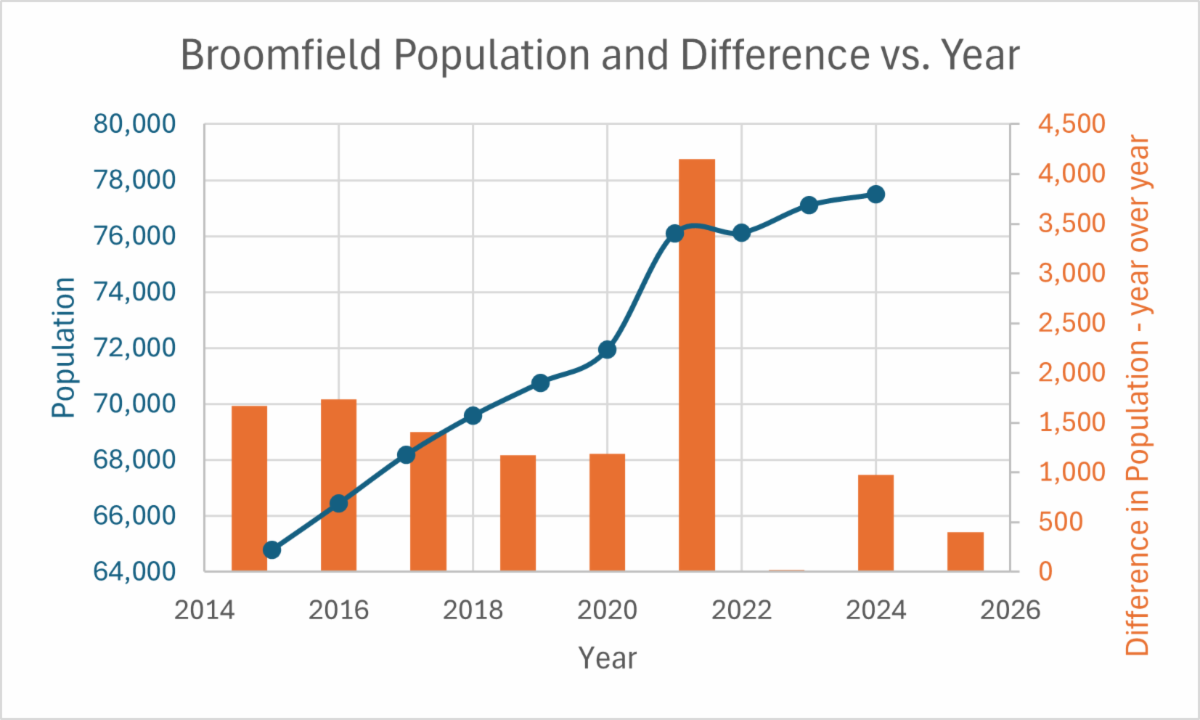
Councilmember Cohen noted significant population growth (5% since 2020, 35% since 2010) alongside rising expenses. However, the ACFR (page 165) shows the largest population spike occurred from 2020 to 2021 (~4,200 new residents). While population growth spiked between 2020 and 2022, (orange bars), population increases have slowed dramatically in recent years. The graph below depicts this trend.
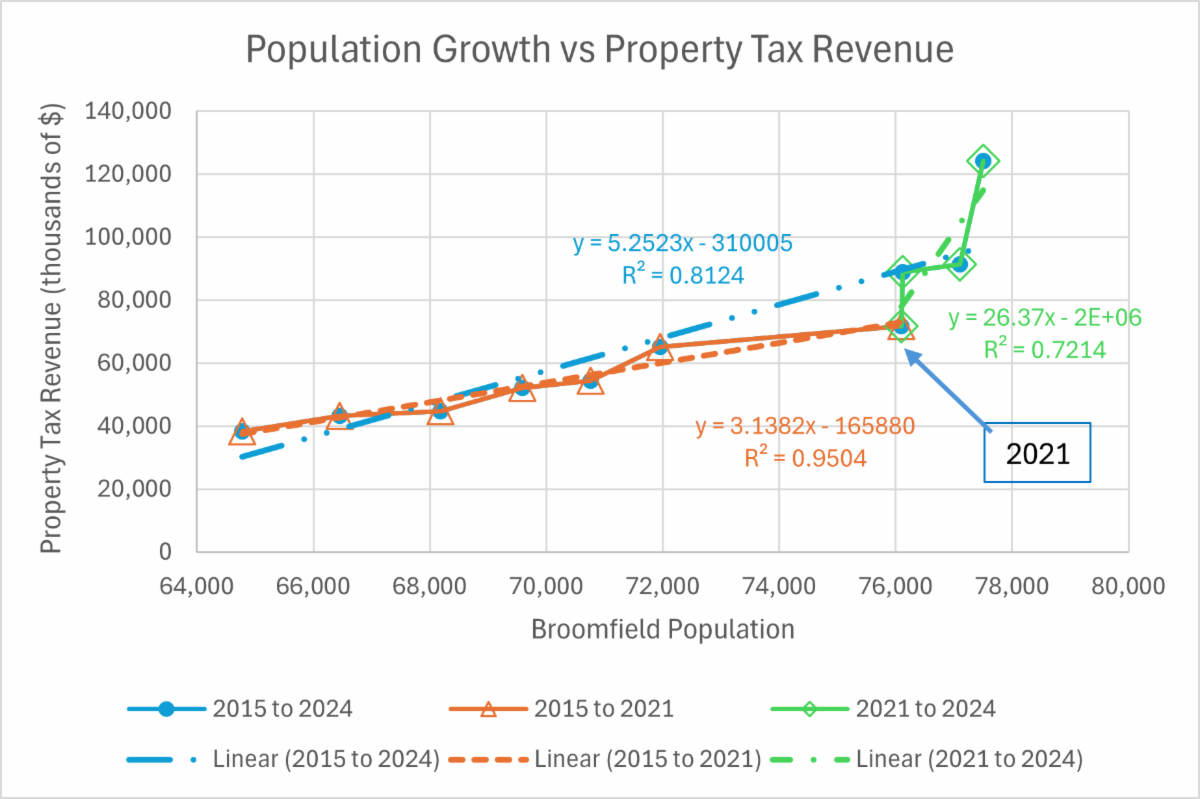
| | Correlating the population grown to property taxes through linear regression analysis reveals a shifting relationship between population and property tax revenue: | | |
2015–2024: Moderate correlation (blue dot-dot-dash line).
2015–2021: Steady growth between population and property tax revenue (orange, dashed line)
2021–2024: Property taxes rising much faster than population growth (green dot-dash line).
Note - Property tax revenues increased dramatically in 2024 due to the repeal of Gallagher and minimal adjustments to property policies in the State Legislature.
| | | |
Even more debt is coming to Broomfield
The city plans to incur significant debt in 2026, increasing the debt balance to $723.47 million:
- Windy Gap Final Group Financing: $18.92 million (Water Fund)
- Treatment Facility Expansion: $114 million (Sewer Fund)
- Water Tanks: $68 million (Water Fund)
- New Police Department Building: $65 million (Capital Improvement Plan)
- Broomfield Town Square Obligation: $104 million (Obligation Fund)
Debt Service Coverage
When it comes to debt service (debt payments), pages 178–183 of the ACFR detail the coverage ratio for water and sewer bonds, which measures the ability of enterprise fund revenues to cover debt payments. The table on page 180 shows ratios above 1, indicating sufficient coverage, but this depends on stable license fees, resident numbers, and water usage. Without continued development, debt obligations could be at risk.
What's The Key Takeaway?
While Broomfield’s financial position appears strong, the rapid rise in property taxes, planned debt increases, and discrepancies (e.g., population figures) warrant scrutiny. Spending is outpacing revenue growth, and residents should ask how the city plans to balance growth, debt, and financial sustainability.
Remember, they are now taking more money from you in the form of property taxes, the largest in history. Stay informed and ask questions to ensure Broomfield’s financial future aligns with community needs.
| |
Three Councilmembers Running for the same State Legislature seat. What gives?
Three of your current councilmembers are running for higher office with the open HD 33 legislative seat in 2026. Why? Is it because they see the mess that they have created in their time on the council? Do they see trouble coming for the City and County of Broomfield?
Or, is it because they weren't on council to serve the community; they see the council as training ground and a stepping stone to higher office?
Who on Broomfield Council is running for House District 33?
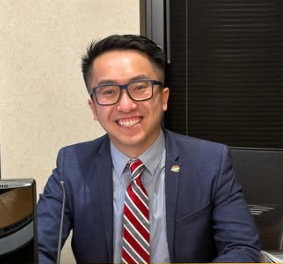
Well, a shorter answer is, who isn't running for the seat? Sure, running for public office can be a calling and should be one focused on civil service. But, three members of an ultra majority council all running for the same seat? It seems like the Broomfield Council is becoming a political seeding ground for higher public office. Below are the three Broomfield Councilmembers who have thrown their hats in the ring:
| | So why now? If their focus is on Broomfield, shouldn't they be fully committed to that rather than running for another office, especially with the issues they have called out but have not been solved? Think about it. They ran (or are running on) housing affordability. Under their leadership: |
- Broomfield’s cost of living index ranges from 108.8% to 137% of the national average
- The median home price in Broomfield is approximately $660,000
- Median rent is around $1,940–$2,073 per month, which is 80.3% higher than the national average
- All this at a time where Broomfield’s median household income is $101,206–$117,541, which is 82.9% higher than the national average. Yet, it is is becoming more and more expensive to live in Broomfield.
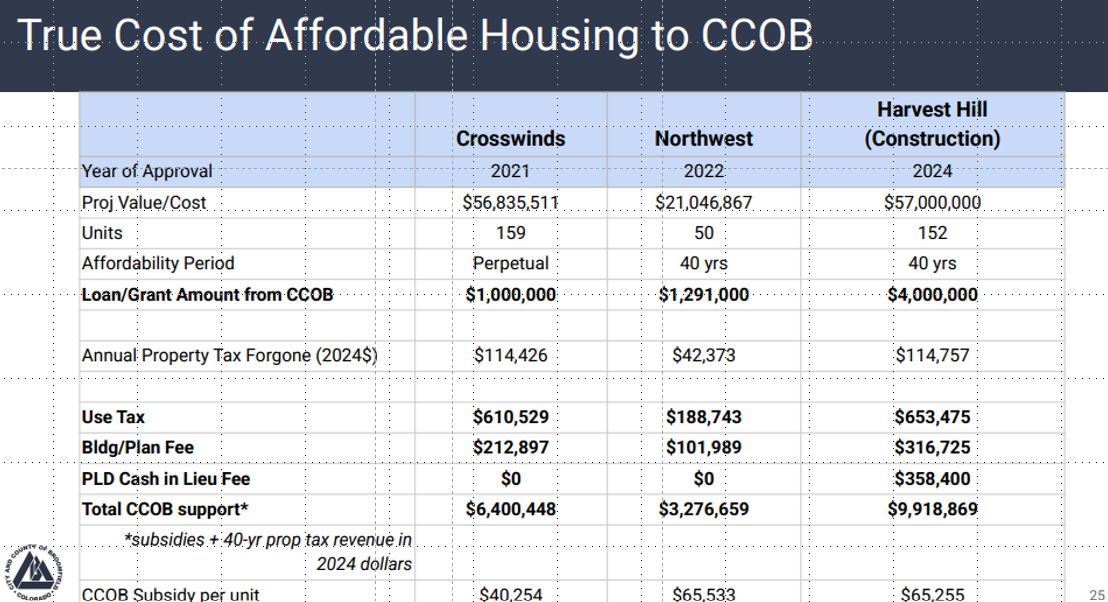
Is housing more affordable? Or are you feeling the pinch of their policies - including higher property taxes and skyrocketing water bills? From Broomfield's 2025 Focus Session presentation, they tell you the true cost of taxpayer subsidies, money you could have used for your households:
| |
The Broomfield Council votes in lockstep on these issues and say this is not due to their policies. After all they have several Housing Funds to help homeowners.
So how is Broomfield compared to other Colorado cities?
- Pueblo: Median home price of $265,000–$324,975, median rent of $995. Known for cultural attractions and a cost of living 6% below the national average.
- Grand Junction: Median home price of $400,000–$465,000. A hub for outdoor activities with a cost of living below the state average.
| | |
These councilmembers are looking to jump ship at a time when the City and County of Broomfield is headed toward incurring more debt over the next few years, water rates are increasing every year since 2022, and the infrastructure is in desperate need of repair, but they focus on social programs, not infrastructure?
Do you really need any of those policies at the state level, where they have a current budget shortfall, and they have passed tax, after, fee, after tax to make things less affordable in Broomfield and Colorado?
| | |
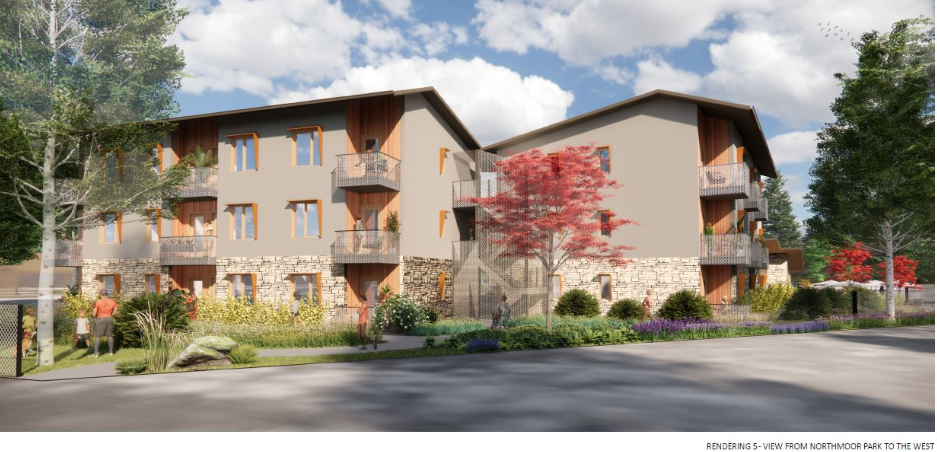
Groundbreaking for this Broomfield Housing Alliance Development was discussed during the July 8, 2025 regular meeting with emphasis placed on housing issues.
“The Grove at Cottonwood,” is a multi-home development focusing on affordable housing for families, including residents with intellectual and developmental disabilities. Here are some of the general details:
-
40 affordable rental units across five buildings with a mix of one-bedroom and two-bedroom units
-
All 40 units are 100% affordable (depending on who can afford them), targeting households with incomes between 30% and 60% which translates to income ranges roughly between $37,230 and $74,460 for a household of four
- the Fair Market Rent (FMR) for a two-bedroom apartment in Broomfield County in 2025 ranges between $1,981 and $2,421, so people living in these "affordable" or "income-aligned" units would pay less
So, is this really a good or fair solution to the problem? What are possible arguments against capping rents or for subsidies?
- Distorts the housing market and reducing supply
- Inefficiently allocates benefits to a narrow income band
- Potentially lowers property maintenance quality
- Creates disincentives for tenants to earn more
- Incurs high administrative costs (as we saw in the previous article)
- Limits scale of housing units compared to housing needs
- Risks gentrification in desirable areas
We need our councilmembers to look at the consequences of their policies, not just pay lip service to underserved communities while excluding those who pay full price without their consent. Broomfield's 77,000 residents all deserve more affordability, not just the groups that the Broomfield Council deems worthy.
| | |
The 2nd Quarterly Update on the Enterprise Funds will be discussed during the Study Session on Tuesday, July 15, 2025. The presentation and memo are linked for convenience.
| | |
This second Quarterly Enterprise Update includes:
1. Updates on enterprise-related capital projects;
2. Updates for ongoing maintenance operations programs;
3. Enterprise revenues, expenses, and fund balances;
4. Steps for ensuring the long-term financial sustainability of the enterprise funds
5. Overview of development projections
6. Status on launching the Enterprise Fund Advisory Committee
7. Future Rate Recommendations
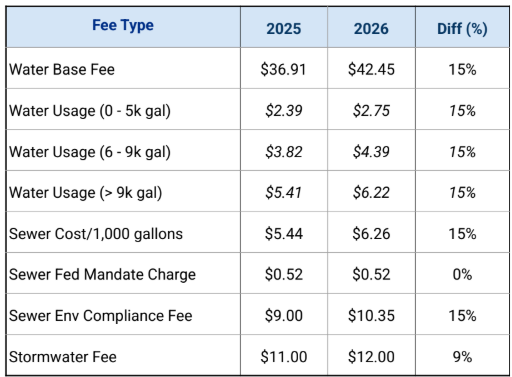
| | Water Rate Recommendations 2026 | | |
Here are the highlights (lowlights) of the presentation:
- Broomfield has received ample rainfall, which has a direct impact on usage revenues, meaning revenues are down. But thanks to Broomfield Council's quick thinking, your increased base water rates saved their budget.
- In 2024, a total of 376 residential permits were issued, less than the 841 originally projected, meaning license fees revenues are down.
- Current 2025 projections anticipate 684 residential permits being issued and paid for in 2025 and as of June 30, 2025, only 289 residential permits have been paid for, meaning permit fees are down
- 1,321 applications for the utility rate assistance fund have been approved, with an estimated budget impact of ~$360k ($300K in assistance and $60K in personnel costs). The total 2025 cost is projected to be $400k-$600k. Higher rates mean less people can afford the rates
- 2026 Bonds issued will see debt increase by about $180M, doesn't include the interest payments
- Mineralized uranium was detected in water samples taken from behind the cofferdam at the Chimney Hollow Reservoir - Broomfield's future water supply
- Good news - infrastructure projects are moving ahead.
There is a lot of information in this presentation and memo, please check them out. Above you saw the new water rate recommendations for the councilmembers. Will they nod their head in approval?
| |
Broomfield's in the middle of another policy issue. And citizens are none to happy.
This time, it's around wildfire policy being handed down from the state level. It’s not wildfire itself, but a wildfire prevention policy that many say has gone too far.
In recent years, Colorado legislators passed a suite of wildfire resilience laws, beginning with Senate Bill 23-166, which created the Wildfire Resiliency Code Board and directed it to develop minimum fire-resistant building standards for homes in Wildland Urban Interface (WUI) zones. That directive culminated in the 2025 Colorado Wildfire Resiliency Code, which took effect statewide on July 1, 2025. The new standards require strict defensible space regulations, use of ignition-resistant materials, and mandatory vegetation removal in high-risk areas (SB 23-166).
Like all Colorado jurisdictions, the City and County of Broomfield must comply. But it’s how Broomfield is implementing the policy that has drawn criticism from homeowners, real estate professionals, and even some city councilmembers.
Earlier this year, Broomfield unveiled a draft wildfire risk map that designated hundreds of homes as being within the WUI. These designations triggered costly requirements: retrofitting exteriors with fire-resistant siding and roofing, creating wide “defensible zones” free of vegetation, and in some cases, replacing wood fences or decks. Insurance premiums have increased, and real estate transactions have been disrupted as buyers become wary of the burdens that come with these designations. What is as concerning many is the lack of transparency and accountability in the process. It appears that residents weren’t notified directly and discovered the changes only after seeing higher insurance bills or being told by contractors and inspectors about new code implications. City officials acknowledged at a May 20, 2025 study session that public outreach had been limited and that the wildfire mapping criteria were not clearly explained.
Further complicating the rollout is the timeline. Although the state’s wildfire code is now in effect, Broomfield has delayed full adoption until early 2026, citing the need for additional hearings and policy development. In the meantime, residents live in limbo—subject to changing rules, without a clear path for appeals or adjustments to the wildfire risk maps. Broomfield is choosing bureaucratic compliance and is just now pushing back and advocating for citizens.
Broomfield will be holding a Community Meeting on July 21st from 2-3PM at the Broomfield City and County Building (that's middle of the day) regarding the issue. Is this too little too late?
| | |
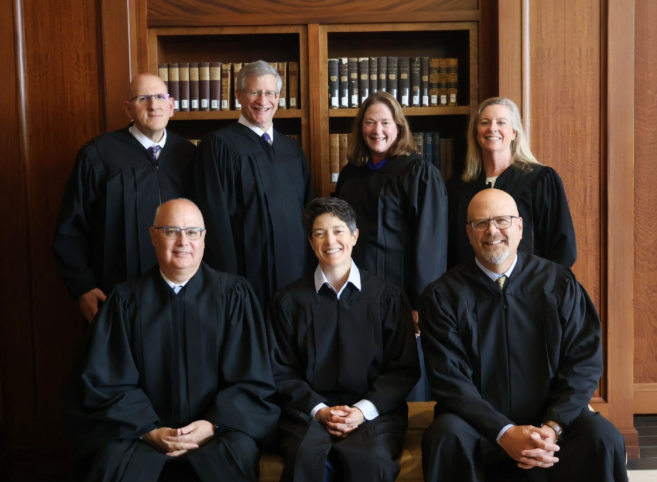
In this recent article for the Denver University Law Review, David Kopel argues that the Colorado Supreme Court has systematically nullified key taxpayer protections embedded in the state’s 1876 Constitution and the 1992 Taxpayer’s Bill of Rights (TABOR).
The provisions were designed to limit corporate welfare, special privileges for big business, and government debt without voter approval. However, Kopel contends that the court, often in collaboration with other branches of government, has overridden these safeguards.
The Colorado Constitution explicitly prohibits corporate welfare and special privileges through language banning government aid “directly or indirectly” to corporations. Yet, the court has replaced this clear text with a lenient “rational basis test,” allowing such practices as long as the legislature deems them beneficial.
Similarly, TABOR’s mandate for voter approval on taxes and debt has been weakened. The court has ruled that taxes labeled as “fees” or debt termed “Certificates of Participation” bypass the need for public votes, with nearly three-fourths of state spending now classified as “fees.”
Additionally, TABOR’s strict standard to “reasonably restrain” government growth has been replaced with a nearly unattainable “beyond a reasonable doubt” threshold, favoring government interests.
Kopel’s critique highlights a broader erosion of democratic consent, as the court’s rulings effectively amend the constitution without voter input, undermining the principle of governance by the people.
This is the real Constitutional crisis.
| | |
Upcoming City Council Meetings
Please let us know if you plan to attend by registering here.
July 15, 2025
Study Session - 6:00 p.m.
Agenda
Concept Review (1)
Study Session (2)
2A. Second Quarterly Enterprise Update
2B. 2026 Boards and Commissions Recruitment Process
2C. Comprehensive Plan Community Advisory Committee (CPCAC) Recruitment Process
++++++++++++++++++++++++++++++++++++
July 17, 2025
Special Session - 6:00 p.m.
Agenda
Meeting Commencement (1)
1A. Pledge of Allegiance
1B. Review and Approval of Agenda
Public Comment (2)
Councilmember Reports (3)
3A. Executive Session Request Related to Eagle Trace Golf Course
Adjournment (4)
++++++++++++++++++++++++++++++++++++
July 21, 2025
Location: Broomfield Community Center
280 Spader Way, Broomfield,CO 80020
Time: 6:00 p.m.
Agenda
Organizational Strategic Plan Workshop #2 with City Council facilitated by Raftelis: Vision and Strategic Outcome Areas
Note* The workshop is open to the public. Due to the format (e.g., hands-on, moving around the room, etc.), it will not be live-streamed or recorded. While verbal public comments will not be part of the workshop, attendees may submit comments via comment cards. Additionally, staff will provide a summary at a subsequent Council meeting, and residents may comment at that time or during any general public comment section of a Council meeting.
++++++++++++++++++++++++++++++++++++
July 22, 2025
Regular Meeting - 6:00 p.m.
Draft Agenda
Meeting Commencement (1)
1A. Pledge of Allegiance
1B. Review and Approval of Agenda
Petitions and Communications (2)
2A. Update from Executive Director of E-470 Public Highway Authority
2B. Child Support Proclamation
2C. Broomfield Open Space Foundation - Nature Fest
2D. National Night Out
Councilmember Reports (3)
Public Comment (4)
**Note** Public is allowed to comment on items other than those listed in the current agenda
Reports (5)
5A. Expense report for Elected Officials - 2nd Quarter
5B. Development Update - Flatiron Crossings and HiFi Village Redevelopment
5C. Master Services Agreement Quarterly Report - June 2025
Consent Items (6) (No Minutes Approval)
6A. Minutes for Approval
6B. Ordinance Approving Civil Enforcement in Municipal Court - 1st Reading
-- Ordinance 2271
6C. Authorized spending for On Demand Services under Master Services Agreements - Water and Utility Supplies and Battery Powered Landscape Equipment
-- Resolution 2025-118
6D. Amendment Three to the IGA with RTD - Bicycle Shelters
-- Resolution 2025-113
6E. Board of Equalization - Mutual Agreements for Abatements over $10,000
-- Resolution 2025-115-BOE
Action Items (7)
7A. Natural Medicine Ordinance - 2nd Reading
-- Ordinance 2270
7B. Broomfield Water Recovery Facility - Early Work Maximum Price
-- Resolution 2025-12
-- Resolution 2025-13
-- Resolution 2025-109
7C. 2025 Anticipated Aggregate Spend Agreements for Vehicle and Equipment Purchases
-- Resolution 2025-08
7D. 2025 Large Equipment Purchases
-- Resolution 2025-07
7E. Medium Density Residential Zone District Update Ordinance - 1st Reading
-- Ordinance 2275
Mayor and Councilmember Requests for Future Action (8)
Adjournment (9)
| |
|
Contact the City and County of Broomfield
Contact your City Council or City Staff about one of these stories:
| | | | | |
Broomfield Taxpayer Matters is Accepting Donations!
Your generous donation helps us help to hold our local city officials, elected representatives, and politicians accountable!
| | | | |