|
This newsletter contains the following stories and information:
- Thank you for attending the "Survey Says" - Make Your Voice Heard Event
- Broomfield Considers a Human Rights Ordinance and Commission
- Broomfield's Boards and Commissions
- Master Service Agreements - Even less Transparency from Local Government
- Does Broomfield have more Affordable Housing or just less housing?
- Upcoming Agendas
- July 29, Study Session
- August 4, Virtual Meeting
- August 12, Regular Meeting
- August 19, Regular Meeting
- City Council member contact information
| | |
Pay Attention to these upcoming items in the Broomfield Council Agendas:
July 29 - Study Session
2A. Development Update - Flatiron Crossing and HiFi Village Redevelopment
2B. Discussion of Human Rights Ordinance
August 4 - Special Meeting
- 3A. BOE Approval of Administrative Denials, Stipulations, and Hearing Officer Recommendations for Protest Requests
August 12 - Regular Meeting
- 6D. Midway Blvd IGA with Colorado Department of Transportation
- 7A. Six Proposed Ordinance Changes with Potential Charter Changes - 2nd Reading
- 7D. IGA with City of Louisville for Leases of Fully Consumable Water
August 19 - Study Session
- 1A. Great Western Park Residential Concept Review
- 2A. Economic and Fiscal Update and Draft Operating and Capital Budgets
Please let us know if you plan to attend by registering here.
| | |
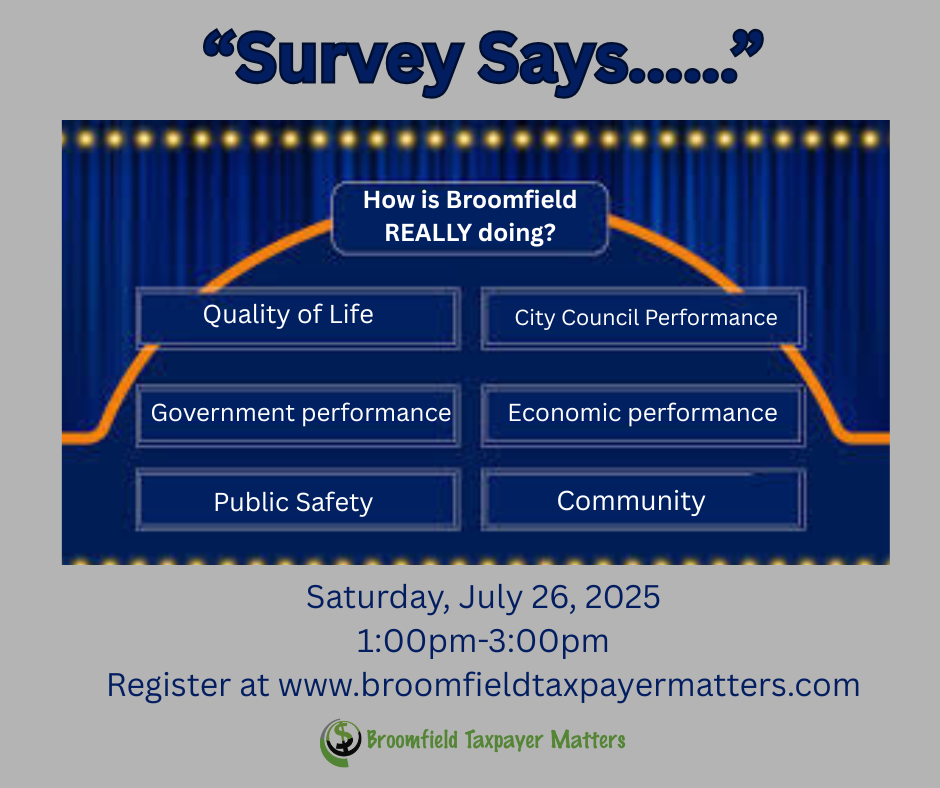
Thank you for attending the "Make your Voice Heard" event July 26, 2025
With the recent surveys from the City and County of Broomfield, what is really behind the numbers? What is our community’s feedback on the policies and direction of Broomfield? What are they not willing to talk about?
For those attended, we hoped you learned a few things to help you understand how the city manipulates the language in the survey to make you respond a certain way, and what is really underlying the sentements reflected in the survey.
| | |
Broomfield Considers Human Rights Ordinance and Commission
On July 29, the Broomfield Council will hold a study session on a possible Human Rights Ordinance. This is a follow up to the December 10, 2024 proposal by Broomfield Mayor Guyleen Castriotta proposed to prohibit discrimination in housing, employment, and public accommodations, covering protected classes such as ancestry, race, religion, sexual orientation, gender variance, and source of income. This ordinance aims to address gaps in state and federal protections and expedite complaint resolution, as state and federal agencies often face high complaint volumes.
Shouldn't this actually be called the "Specific Groups" Rights Ordinance and Commission? All humans do not fall into these categories.
Municipalities like Boulder, Denver, Fort Collins, Aurora, Aspen, and Telluride have active human rights ordinances, but no specific discrimination cases from 2023–2025 were publicly reported in these jurisdictions. Statewide, the CCRD received 492 complaints in 2023 (mostly employment-related), and the EEOC handled 304 complaints in Colorado in 2024, but these reflect state and federal filings, not municipal ordinances.
Proposed Enforcement Models for Broomfield
Broomfield is considering enforcement mechanisms inspired by other Colorado municipalities:
-
City Manager Model: Complaints handled by the city manager or a designated office, with mediation or municipal court prosecution (e.g., Boulder Office of Human Rights, Denver Office of Human Rights and Community Partnerships).
- Third-Party Hearing Officer: Staff’s recommended model, budgeted at $50,000 for the first year, where an external officer conducts hearings, with appeals to a commission or district court.
-
Human Rights Commission: A commission oversees hearings, requiring more staff support (e.g., Aurora Human Relations Commission).
- Municipal Court/Business Licensing: Violations treated as code infractions, potentially impacting licenses (e.g., Fort Collins, Aspen).
Recent Colorado Anti-Discrimination Law Updates (2022–2025)
The Colorado Anti-Discrimination Act (CADA) prohibits discrimination in employment, housing, and public accommodations. Recent legislative changes have strengthened protections and enforcement:
-
HB 22-1367 (2022): Extended the filing deadline for discrimination complaints with the Colorado Civil Rights Division (CCRD) from 180 to 300 days, expanded protections for domestic workers, and aligned age discrimination remedies (40+) with other classes, allowing punitive damages.
-
SB 23-172: POWR Act (2023): Broadened workplace harassment definitions to include “unwelcome” conduct, restricted nondisclosure agreements limiting discussion of discriminatory practices, and mandated five-year recordkeeping for complaints.
-
HB 24-1124 (2024): Consolidated damages under CADA, offering court orders, attorney fees, up to $50,000 in noneconomic damages, or a $5,000 statutory fine per violation, with reductions for small businesses correcting violations.
-
HB 24-1451: CROWN Act Expansion (2024): Added hair length to race-based discrimination protections, covering hairstyles like braids, locs, and Afros.
-
HB 24-1312: Kelly Loving Act (2025): Prohibits “deadnaming” or misgendering transgender individuals in workplaces and schools, expanding gender identity protections.
-
SB 24-205: Algorithmic Discrimination (2026): Will prohibit AI-driven discrimination in hiring and other areas, requiring transparency and risk mitigation, effective February 2026.
These state laws, enforced by the CCRD and courts, complement federal laws like Title VII, the ADA, and the ADEA. However, local ordinances like Broomfield’s proposed one cover additional classes (e.g., source of income, custody of a minor), addressing gaps in state and federal protections.
Broomfield's proposed approach will require more government personnel
Broomfield’s staff seeks Council direction on adopting the proposed ordinance, selecting an enforcement model, and potentially establishing a Human Rights Commission. Budget impacts vary, with internal staffing estimated at $75,000–$125,000 annually for 50 complaints, compared to Boulder’s 2025 Human Rights Office budget of $114,134.
This Council has been really good and dividing our community into oppressor vs. oppressed classes, but what if we all just treat each other as human beings worthy of dignity and respect. If you walk up and ask someone for help, do they need to know anything about your private life? Or, if you want to rent an apartment from someone, do they to know anything else other than do you have the funds to rent an apartment and do you have a history of renting? How about we just get back to common sense and treating each other with respect.
Why does our city council want to assume the worst in us by creating all of these ordinances? After all, there is no evidence that landlords have abused the relationship.
| | |
Speaking of Boards and Commissions...Here is a list of Broomfield's current Boards and Commissions, an unelected body, not accountable to the taxpayer, but whose recommendations, council almost always follows:
- Advisory Committee on Environmental Sustainability (ACES)
- Arts, History and Cultural Council (AHCC)
- Board of Health (BH)
- Board of Equalization (BOE)
- Broomfield Housing Alliance (BHA)
- Charter Review Committee (CRC)
- Fiscal Leadership on Water Advisory Committee
- Historic Landmark Board
- Land Use Review Commission
- Library Advisory Board
- Local Licensing Authority
- Neighborhood Board of Adjustments
- Open Space and Trails Advisory Committee
- Parks, Recreation and Senior Services Advisory Committee
- Personnel Merit Commission
- Scientific & Cultural Facilities District
They just added the a FLOW advisory committee to look at water infrastructure, maybe a human rights committee. With each committee the council is relying on unelected citizens who may or may not represent you.
| |
Master Service Agreements - Even less Transparency from Local Government
At the July 22, 2025 City Council Meeting, Council approved several updates on Master Service Agreements and Spending Approvals (7-22-25 Agenda). The City and County of Broomfield (CCOB) is expanding the use of MSAs, building on Resolution 2025-59 (March 2025). MSAs allow the City Manager to authorize on-call, on-demand, and emergency expenditures over $200,000 without repeated Council approvals, streamlining procurement for high-need vendors.
MSAs provide pre-established pricing for multiple vendors, enabling consistent budget management and faster response for on-call or emergency needs (e.g., water treatment chemicals, vehicle repairs).
The Council approved resolutions included approving Resolution 2025-118 (Item 6C, 7-22-25 Agenda) which extends MSA authority to vendors like Core and Main LP, Rexel USA, Inc., TNT Fleet Services, Inc., and Mac Equipment, Inc. for on-call, on-demand, and emergency purchases within approved budgets. Specific funding sources, account numbers, and project numbers are not detailed in the memo, raising transparency concerns. This is in addition to previous approved MSAs (Resolution 2025-59), \which covers vendors for Landscape & Irrigation (e.g., Colorado Design Scapes), Bridge and Guardrail Repair (e.g., ABCO), and Vehicle Body Work (e.g., Diversified Body Shop), and Municipal Code Reference: BMC 3-20-040 which governs purchasing, with exceptions for emergencies (3-20-180) and other cases (3-20-190).
Changing how Council enables Broomfield Staff through MSAs:
Old Aggregate Spend Method: Approved via public resolution (e.g., $500k for Core and Main LP with three 1-year renewals). Purchase orders (POs) encumber the full amount upfront, with spending limited to the budgeted amount and POs expiring annually.
New MSA Method: MSAs are initially non-encumbering, zero-sum contracts. Funds are encumbered only when specific services are identified, and POs are issued. This reduces the need for repeated Council approvals for expenditures over $200k, offering flexibility but less upfront transparency.
While MSAs streamline procurement, they also reduce transparency on how the money you give them to spend wisely, compared to the traditional aggregate spend method. Residents can review BMC 3-20-040 for details or contact staff for funding specifics. The lack of detailed funding sources (account/project numbers) in the agenda memo hinders tracking of expenditures, unlike the clearer aggregate spend method. In streamlining their processes, they forget about you, the taxpayer, and your right to know what is happening to the money.
| |
Does Broomfield have more Affordable Housing or just less housing?
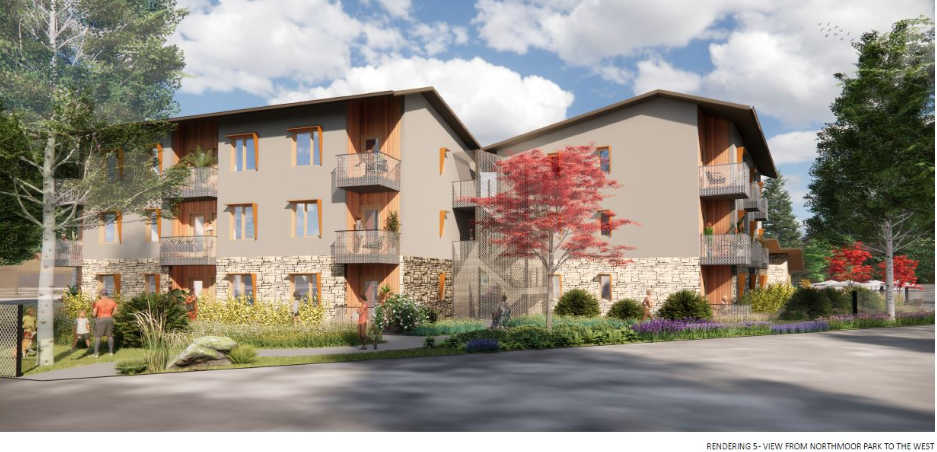
From 2020 to 2024, Broomfield, Colorado, the council tried to increase the supply of housing in Broomfield by implementing an "inclusionary", affordable housing ordinance on March 10, 2020. During this last four years, the city has added a mix of single-family homes, townhomes, condos, and multifamily units, with a focus on affordability and sustainability.
So how have they done? Do taxpayer-funded subsidies and deed restrictions increase efficiency, make homes affordable, and what have been the long-term impacts?
Below is a summary of key developments and considerations:
- Diverse Housing Growth:
- Single-Family Homes: Baseline community added 19 homes in 2024 ($630,490–$685,490), featuring modern designs and amenities like parks.
- Townhomes & Condos: Dillon Pointe and Grand Vue at Interlocken offered townhomes ($317,820–$1,699,000) and condos ($305,000–$6,149,000) with trails and pools.
- Mixed-Use Projects: Wadsworth Junction, Vista Highlands, and HiFi Village at Flatiron Crossing (345 apartments, 20% income-restricted) blended housing with commercial spaces.
- Affordable Housing: Ulysses’ Harvest Hill delivered 157 income-aligned units, including 15 for-sale homes with deed restrictions; Village Cooperative of Broomfield targeted seniors.
| | |
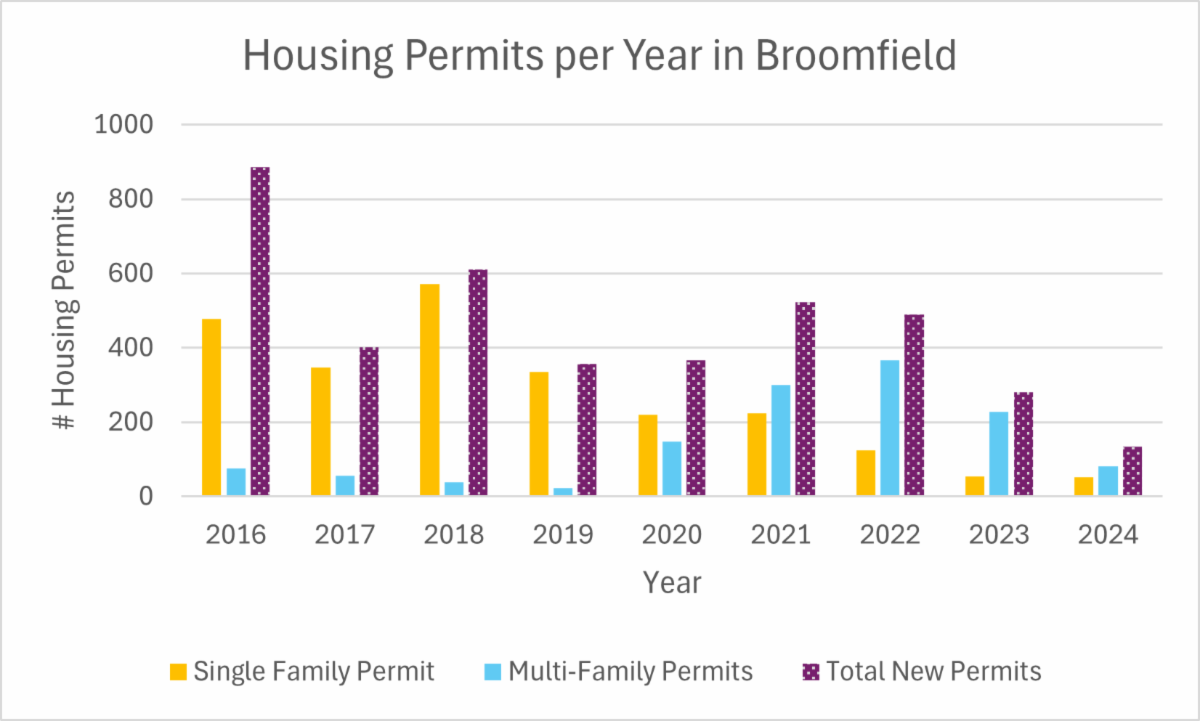
It looks like total new permits (printed page 4 in the 2020 and 2024 ACFR) , were at their highest point in 2016, long before this council was in office. They have also decreased substantially, since this council decided to increase the tap fees in 2022. Remember that? We discussed that in February 2024 newsletter.
So if they are trying to create more affordable housing, why do the numbers keep going down? Could it be their policies?
| | |
They say that hindsight is 20/20, and we've had four years to see how your current councilmembers have made housing more affordable, which they haven't. So why is that? Let's take a look at some known consequences of government central planning:
-
Taxpayer-Funded Subsidies:
- Sources: Federal programs (HUD’s HOME, Low-Income Housing Tax Credits), state funds (Colorado’s Department of Local Affairs), and local taxes (property, sales) supported projects like Ulysses’ Harvest Hill ($4 million).
- Tax Increment Financing (TIF): Used in Baseline and Flatiron Crossing, TIF diverts property tax increments to fund project-specific infrastructure, reducing short-term funds for city-wide needs like roads and schools.
- Deed Restrictions:
- Purpose: Caps resale prices on units like the 15 for-sale homes in Ulysses’ Harvest Hill to maintain affordability for low- to moderate-income households.
- Impact: Limits future property value growth for restricted units compared to market-rate homes, reducing owners’ equity-building potential but ensuring long-term affordability.
- Challenges & Criticisms:
- Inefficiencies: Redistributing taxpayer money incurs administrative costs, creating a potential “loop.”
- Opportunity Costs: Diverted funds limit spending on other services like infrastructure or schools.
- Dependency Risks: Long-term reliance on subsidies may strain budgets if demand grows.
- Tax Burden: Higher-income residents bear significant costs, potentially causing resentment.
- Sustainability Concerns:
- Risks: Reliance on taxpayer funds and rising costs (construction, insurance) could strain budgets.
- Mitigation: Inclusionary zoning, public-private partnerships, and deed restrictions reduce future subsidy needs; TIF projects aim to boost long-term tax revenue.
So you be the judge, are the city's policies making Broomfield more affordable or increasing it's supply of housing?
| | |
Upcoming City Council Meetings
Please let us know if you plan to attend by registering here.
July 29, 2025
Study Session - 6:00 p.m.
Agenda
Concept Review (1)
Study Session (2)
2A. Development Update - Flatiron Crossing and HiFi Village Redevelopment
2B. Discussion of Human Rights Ordinance
2C. City Council Direct Reports - Evaluation Process Discussion
++++++++++++++++++++++++++++++++++++
August 4, 2025
Virtual Meeting - 6:00 p.m.
Draft Agenda
1. Meeting Commencement
1A. Review and Approval of Agenda
2. Public Comment
3. Action Items
3A. BOE Approval of Administrative Denials, Stipulations, and Hearing Officer Recommendations for Protest Requests
4. Adjournment
++++++++++++++++++++++++++++++++++++
August 12, 2025
Regular Meeting - 6:00 p.m.
Draft Agenda
Meeting Commencement (1)
1A. Pledge of Allegiance
1B. Review and Approval of Agenda
Petitions and Communications (2)
2A. Employee Appreciation Proclamation
2B. National Non-Profit Proclamation
Councilmember Reports (3)
Public Comment (4)
**Note** Public is allowed to comment on items other than those listed in the current agenda
Reports (5)
Consent Items (6)
6A. Minutes for Approval
6B. Industrial Lane Phase II Construction Administrative Design/Amendment and Construction Agreement
-- Resolution 2025-121
-- Resolution 2025-122
6C. Parking Lot Repair and Replacement
-- Resolution 2025-119
-- Resolution 2025-124
6D. Midway Blvd IGA with Colorado Department of Transportation
-- Resolution 2025-120
6E. LightGig Master License Agreement (Fiber to Home)
-- Resolution 2025-108
Action Items (7)
7A. Six Proposed Ordinance Changes with Potential Charter Changes - 2nd Reading
-- Ordinance 2276 - General Language Update
-- Ordinance 2277 - Council Qualifications - No Dual Offices
-- Ordinance 2278 - Mayor and Council Vacancies
-- Ordinance 2279 - Code of Ethics
-- Ordinance 2280 - Emergency Ordinance
-- Ordinance 2281 - IGAs
7B. Medium Density Residential Zone District Update Ordinance - 2nd Reading
-- Ordinance 2275
7C. Public Land Dedication Ordinance - 1st Reading
-- Ordinance 2273
7D. IGA with City of Louisville for Leases of Fully Consumable Water
-- Resolution 2025 - 14
Mayor and Councilmember Requests for Future Action (8)
Adjournment (9)
++++++++++++++++++++++++++++++++++++
August 19, 2025
Study Session - 6:00 p.m.
Agenda
Concept Review (1)
1A. Great Western Park Residential Concept Review
Study Session (2)
2A. Economic and Fiscal Update and Draft Operating and Capital Budgets
| |
|
Contact the City and County of Broomfield
Contact your City Council or City Staff about one of these stories:
| | | | | |
Broomfield Taxpayer Matters is Accepting Donations!
Your generous donation helps us help to hold our local city officials, elected representatives, and politicians accountable!
| | | | |