Weekly update from the National Housing Conference | | News from Washington | By Brittany Webb | | |
Bank regulators split over future of CRA rules
The Federal Deposit Insurance Corporation (FDIC) and Office of the Comptroller of the Currency (OCC) are reportedly preparing to develop a new Community Reinvestment Act (CRA) rule, splitting from the Federal Reserve’s plan to cleanly repeal the Biden administration’s 2023 rule and return to the longstanding 1995 framework. The agencies disclosed in a recent court filing that the FDIC and OCC intend to “pursue a different path,” though details of their planned approach have not been made public. The potential split has raised concern among both banking and community organizations. Banking groups have warned that different regulatory frameworks could subject institutions to inconsistent standards, while community advocates are concerned that a new rewrite could weaken banks’ obligations in underserved communities.
The CRA requires banks to help meet the credit needs of the communities where they operate, particularly in low- and moderate-income neighborhoods. According to the latest research from the Center for Affordable Housing Lending, a research partner to the National Association of Affordable Housing Lenders, CRA incentivized more than $430 billion in loans and investments in 2024 alone. CRA examinations influence the approval of bank mergers and new branches, and the law helps support mortgage lending, small-business credit, affordable housing, and community development investment. Importantly, CRA is a driving motivation for the Low-Income Housing Tax Credit and the New Markets Tax Credit. The 2023 final rule sought to modernize regulatory examinations by evaluating certain lending activity beyond areas where banks maintain physical branches. Banking groups challenged the rule in court, and it has remained blocked while regulators reconsider it.
NHC has maintained that any CRA framework should increase investment in underserved communities, benefit more low- and moderate-income people, prevent displacement, and make bank performance and government enforcement more transparent and predictable. NHC also supports updated treatment of online banking and cautioned that a durable CRA regulation must remain nonpartisan and retain enough support to withstand changes in presidential administrations. There has not been a confirmed release of any rule proposal.
| | | |
HUD suspends Virgin Islands housing authority
The U.S. Department of Housing and Urban Development (HUD) suspended the Virgin Islands Housing Finance Authority (VIHFA) from participating in federal assistance programs while HUD’s Office of Inspector General investigates whether the authority misused disaster recovery funding. HUD said that VIHFA has spent less than one-third of nearly $2 billion provided after Hurricanes Irma and Maria struck the territory in 2017, and further cited longstanding concerns with management and oversight of federal funding.
Previous inspector general reports found that the authority ineffectively monitored disaster relief funds and lacked sufficient risk management procedures to prevent fraud. HUD also reported that VIHFA has completed only 2% of its planned single-family rental rehabilitation projects and none of its planned single- and multifamily housing projects. One housing official from VIHFA is currently serving a prison sentence after being convicted of self-enrichment in his position by manipulating contract bids.
VIHFA Interim Executive Director and Chief Financial Officer Valdez Shelford said the authority has implemented corrective measures, strengthened its compliance framework, and welcomes the opportunity to provide HUD with additional documentation. Del. Stacey Plaskett (D-V.I.) said her office would continue working toward a resolution that advances the interests of Virgin Islands residents.
| | | |
SAVE THE DATE
December 8, 2026
| |
Join the National Housing Conference on December 8 at the National Press Club in Washington, D.C., for our annual Solutions for Affordable Housing convening. This premier event brings together leaders from across the affordable housing ecosystem, including government, philanthropy, nonprofit organizations, real estate development, lending, and other sectors, to build connections and advance housing priorities that are tangible, impactful, and achievable.
Through engaging discussions with national experts and policymakers, attendees will gain a deeper understanding of the most pressing housing challenges facing communities today and the federal, state, and local policies shaping solutions. Whether you're looking to strengthen partnerships, stay ahead of emerging trends, or better align your organization's work with the nation's housing priorities, Solutions for Affordable Housing offers valuable insights and actionable ideas to help drive meaningful progress.
Registration will open in September. Stay tuned for additional details, including the agenda and featured speakers.
| | |
Bipartisan bill incentivizes property sales for affordable housing
Reps. Scott Peters (D-Calif.) and Brian Fitzpatrick (R-Pa.) introduced the bipartisan Affordable Housing Incentives Act, legislation intended to help affordable housing organizations and homelessness service providers compete for properties in high-cost real estate markets. The bill would extend an existing capital gains tax deferral mechanism to property owners who sell to eligible nonprofit organizations or government agencies for use as affordable housing or homeless shelters.
Properties benefiting from the incentive would be required to remain affordable for at least 30 years. The sale price could not exceed an independent qualified appraisal, a safeguard intended to prevent inflated prices and protect affordable housing organizations. Supporters said the proposal could help preserve existing lower-cost apartments while allowing mission-driven organizations to acquire properties more quickly.
The legislation is also supported by NHC, the National Low Income Housing Coalition, U.S. Conference of Mayors, National Association of Home Builders and Inclusive Abundance Action.
| |  | |
HUD partners with NFL, federal agencies on youth development
HUD joined three federal agencies and the National Football League (NFL) in a new partnership intended to connect young people in underserved communities with sports, education, health, and workforce development opportunities. HUD, the Department of Health and Human Services, the Department of Education, and the Department of Labor signed a memorandum of understanding to identify sites where structured youth sports programming can be paired with academic participation, healthy living initiatives, mentorship, and career pathways.
“A key part of HUD’s mission is to foster strong families and communities,” said HUD Secretary Scott Turner. “Through public-private partnerships with federal agencies, the NFL, and local organizations, we will equip youth with the tools they need to lead successful lives.”
Following the announcement, HUD launched a new TikTok account.
| | | |
NLIHC shows widespread two-bedroom affordability gap
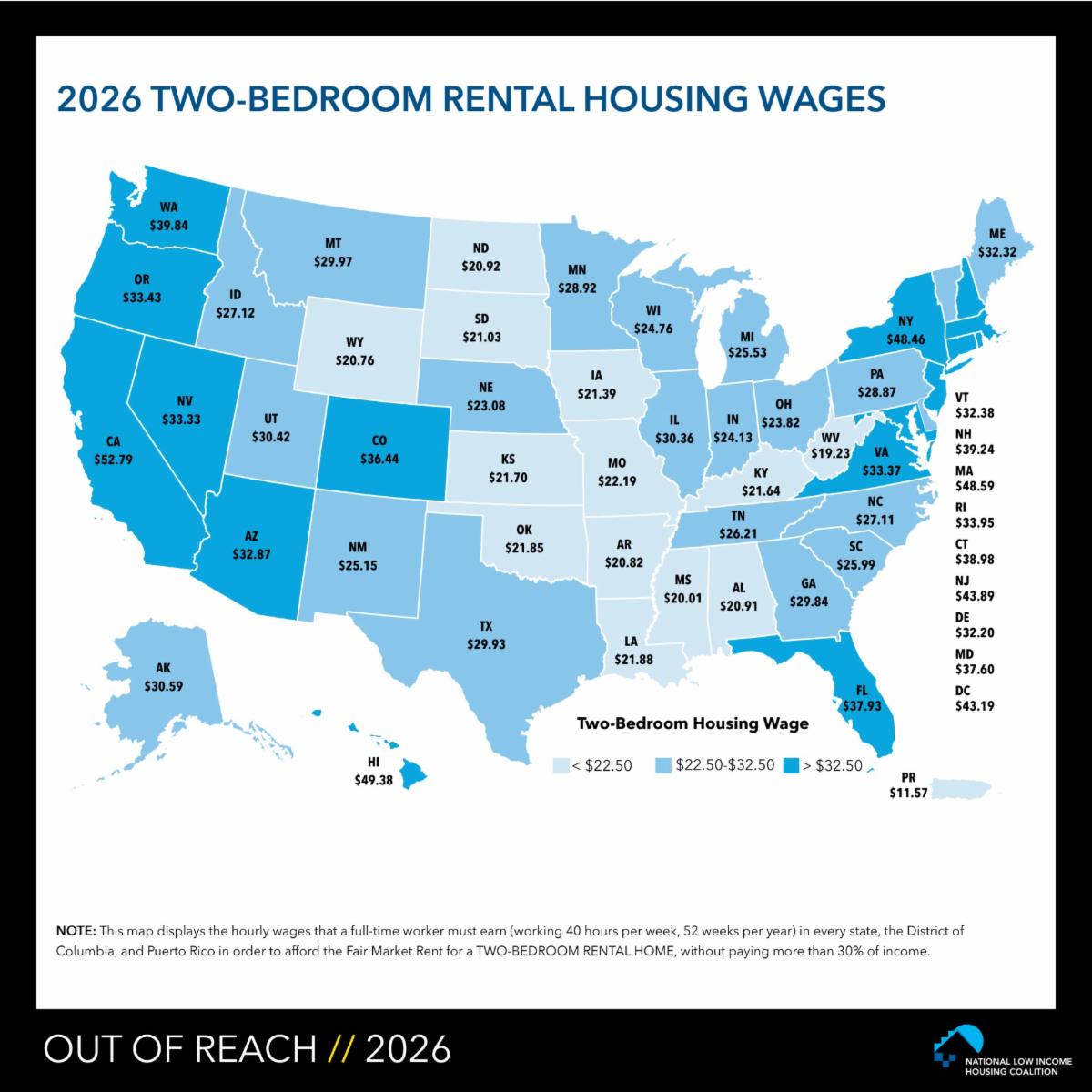
The National Low Income Housing Coalition’s (NLIHC) 2026 Out of Reach report puts the national two-bedroom housing wage at $34.73/hour, against an average renter wage of $24.84, leaving a $9.89 gap. The lowest required wages are concentrated in parts of the interior South and Midwest, while the highest wages necessary cluster in major coastal markets, Alaska, and parts of Hawaii, where even a modest one-bedroom unit exceeds $24.84 per hour at the 30% income threshold in most cases. The pattern is consistent with prior years, as regional affordability differences emphasize a need for more federal rental assistance and sustained investment to close the gap.
| | |
The Daily podcast by The New York Times reports that the Trump administration’s push to accelerate housing construction is running into the construction sector’s reliance on foreign-born labor. The piece frames housing and immigration as competing goals, as building more homes requires a labor force that includes immigrants. It suggests that efforts to reduce immigration could complicate the administration’s housing agenda.
A paper published in the Vanderbilt Policy Accelerator argues that a presidential administration can expand affordable housing supply without new legislation by scaling community-owned housing solutions. It proposes a specific set of executive actions like directing Treasury/IRS to prioritize community ownership in LIHTC allocation, exempting these projects from Fannie Mae and Freddie Mac (the Enterprises) multifamily lending caps, having the Enterprises standardize underwriting and pricing for community ownership loans, and more. The central point is that existing federal authority over the Enterprises, Federal Home Loan Banks, and LIHTC allocation is already sufficient to scale a proven but small sector.
The GAO report, titled Assessing and Improving Effectiveness, argues that federal agencies broadly lack the goals and data needed to know whether their programs work, focusing on outputs rather than outcomes. Among the programs it cites as incomplete is the Supportive Housing Program, run jointly by HUD and the VA to support veterans experiencing homelessness, which was found to have only partially defined goals and was missing both data collection and data use. The report underscores that policy success leans on the importance of administrative capacity, oversight, and execution to effectively carry them out.
| | |
The July FHA+ issue from Gate House Strategies marks America's 250th birthday, tracing housing finance from frontier homesteads to today's $50 trillion real estate market. Brian Montgomery covers two-and-a-half centuries of policy evolution, while Mike Frueh unpacks the VA's new Partial Claim program and funding fee changes. Inside Voices covers Capitol Hill's ROAD to Housing Act drama, FHA's modernization, and Bill Pulte's dual mandate. Gate House Strategies advises lenders and policymakers on mortgage and housing strategy nationwide.
| | The National Housing Conference is a diverse continuum of affordable housing stakeholders that convene and collaborate through dialogue, advocacy, research, and education, to develop equitable solutions that serve our common interest. | | Defending Our American Home since 1931 | | Copyright © 2024. All Rights Reserved. | | | | |